9p Rearrangements in ALL
1999-08-01 Nyla A Heerema Affiliation1.The Ohio State University, Division of Clinical Pathology, Department of Pathology, 167 Hamilton Hall, 1645 Neil Ave, Columbus, OH 43210, USA
Clinics and Pathology
Disease
acute lymphocycic leukemia (ALL)
Phenotype stem cell origin
lack of specificity for a particular immunophenotype
Epidemiology
approximately 10% of childhood ALL, similar in adult ALL
Prognosis
recent data indicate that an abnormal 9p is an adverse risk factor for B-lineage, but not T-lineage pediatric patients; this is more pronounced in standard-risk patients (age 1 - 9 years with WBC count
Cytogenetics
Cytogenetics morphological
various aberrations result in an abnormal 9p; these include monosomy 9, del(9p), add(9p), der(9)t(V;9)(V;p), dic(V;9)(V;p), i(9q) and balanced translocations with 9p breakpoints; dicentric chromosomes in ALL nearly always involve a chromosome 9; an abnormal 9p usually occurs as part of a more complex karyotype; it occurs as a sole aberration in less than 10% of cases with an abnormal 9p
Additional anomalies
additional anomalies are frequent; an abnormal 12p is particularly frequent (16% of cases), and a deletion of 6q is also frequent (11% of cases)
Genes Involved and Proteins
Note
the different types of 9p aberrations may have different molecular consequences; when a deletion of 9p occurs, the genes involved colud be MTS1/CDK4I/p16INK4A(CDKN2) and MTS2/p15INK4B(CDKN2B); these are believed to be tumor suppressor genes, and loss of heterozygosity occurs more frequently than cytogenetic deletions of 9p; however, mutation of the remaining allele is infrequent, and methylation changes may cause inactivation of the remaining allele
Article Bibliography
| Pubmed ID | Last Year | Title | Authors |
|---|---|---|---|
| 7845002 | 1995 | Dicentric (9;12) in acute lymphocytic leukemia and other hematological malignancies: report from a dic(9;12) study group. | Behrendt H et al |
| 3493041 | 1987 | Lack of association between abnormalities of the chromosome 9 short arm and either "lymphomatous" features or T cell phenotype in childhood acute lymphocytic leukemia. | Carroll AJ et al |
| 3925340 | 1985 | Lymphoblastic leukemia with lymphomatous features associated with abnormalities of the short arm of chromosome 9. | Chilcote RR et al |
| 9639410 | 1998 | Review of alterations of the cyclin-dependent kinase inhibitor INK4 family genes p15, p16, p18 and p19 in human leukemia-lymphoma cells. | Drexler HG et al |
| 10477677 | 1999 | Association of chromosome arm 9p abnormalities with adverse risk in childhood acute lymphoblastic leukemia: A report from the Children's Cancer Group. | Heerema NA et al |
Summary
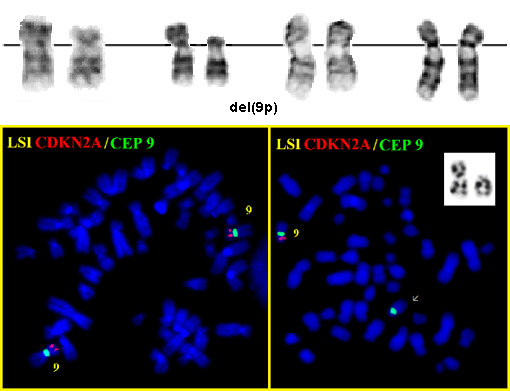
del(9p) G- banding - Courtesy Jean-Luc Lai and Alain Vanderhaegen (left), and, from middle left to right: del(9)(p13), del(9)(p21), and del(9)(p22) - Courtesy Diane H. Norback, Eric B. Johnson, and Sara Morrison-Delap, UW Cytogenetic Services; Hybridization with Vysis CDKN2A/CEP9 probe showing 2 green and 2 red signals on normal and one red signal on metaphase with 9p deletion. u2013 Courtesy Adriana Zamecnikova.
Citation
Nyla A Heerema
9p Rearrangements in ALL
Atlas Genet Cytogenet Oncol Haematol. 1999-08-01
Online version: http://atlasgeneticsoncology.org/haematological/1156/9p-rearrangements-in-all
