Clinics and Pathology
Disease
specifically observed in acute promyelocytic leukemia (APL), or M3 AML; in the vast majority of cases, M3 AML is characterized by a t(15;17)(q25;q21); the t(11;17) represents a rare variant translocationwith characteristic clinicopathologic features concerning presentation, response to treatment with all-trans retinoic acid (ATRA) and prognosis.
Phenotype stem cell origin
promyelocytic (M3) acute leukaemia; a number of patients express an unusual morphologic spectrum intermediate between M2 and M3 AML.
Epidemiology
less than 1% of morphologic M3 AML.
Clinics
high incidence at diagnosis of disseminated intravascular coagulation; poor response to ATRA at induction therapy, in contrast with the classical M3 AML with t(15;17).
Cytology
high rate of normal or dystrophic promyelocytes in peripheralblood and in bone marrow; no intracytoplasmic Auer rods; myeloperoxydasereaction positive; immunocytochemical detection with an anti-PLZF shows adistinct punctate nuclear distribution of the protein, suggesting itscompartmentalization in the nucleus.
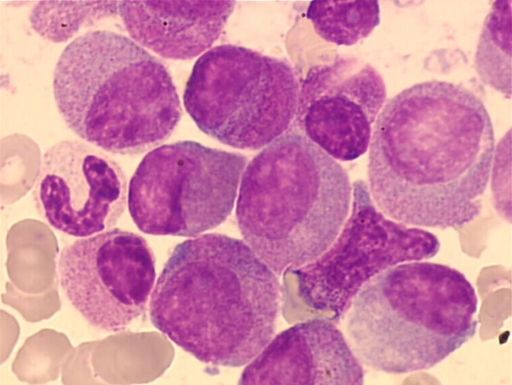
In patients with t(11;17)(q23;q21), t(5;17)(q35;q21), and t(11;17)(q13;q21) where RARa is fused to the PLZF (promyelocytic leukemia zinc finger), NPM (nucleophosmin) and NuMA (nuclear mitotic apparatus) genes respectively, chromosome 17 and RARa but not PML are involved. Patients were initially reported as having M3 morphology. Interestingly, the t(11;17)(q23;q21) PLZF/RARa subgroup showed a clearly morphological differences with predominance of cells with regular nuclei, many granules, usually no Auer rods, increased number of pseudo Pelger-Huet cells and a strong MPO activity. These particular characteristics could allow the definition of a separate morphological entity among APL. Patients with t(5;17)(q35;q21) are too rares to draw any morphological correlation - Text and iconography Courtesy Georges Flandrin 2001.
Prognosis
distinctly worse prognosis than M3 AML with t(15;17), mainlybecause the patients fail to respond to the maturation effect of ATRA.
Cytogenetics
Cytogenetics molecular
fusion of distal PLZF probe with RARa on 17q21.
Additional anomalies
no recurrent additional anomaly are known.
Variants
3 related translocations observed in M3 AML; the first is the common translocation (15;17) and the two others are extremelly rare; all these translocations involve a breakpoint at 17q21, in RARa, which fuses with different partners:1- t(15;17)(q22;q21), fusion with PML in 15q22;2- t(5;17)(q32;q12), fusion with NPM1 in 5q32, encoding for a RNA processing protein;3- t(11;17)(q13;q21), fusion with NUMA in 11q13, involved in the control of mitosis.
Genes Involved and Proteins
Gene name
ZBTB16 (zinc finger and BTB domain containing 16)
Location
11q23.2
Dna rna description
Krüppel-like zinc finger gene.
Protein description
transcription factor associated with myeloid maturation.
Gene name
RARA (Retinoic acid receptor, alpha)
Location
17q21.2
Protein description
nuclear receptor with DNA binding and transcriptional properties.
Result of the Chromosomal Anomaly
Description
the translocation involves a breakpoint in the zinc fingerregion of PLZF, with fusion of two zinc fingers to the RARa B region toform a 5 PLZF - 3 RARa fusion gene; the reciprocal 5 RARa - 3 PLZF genefuses seven zinc fingers to the RARa region; RARas breakpoint occurs in1- as a result of thealternative splicing of PLZF gene, two forms of PLZF-RARa protein can be detected:
Transcript
both 5 PLZF -3 RARa and 5 RARa - 3 PLZF transcripts aredetected by RT-PCR, and both fusion partners would be implicated inleukemogenesis; four chimeric transcripts are produced, due to alternativesplicing of PLZF gene and to transcription of either A1 or A2 domain ofRARa gene
Description
a) PLZF(A)-RARa (735 amino acids; 81 kDa) composed of the N-term part of PLZF including POZ domain and two of the nine zinc fingers, fused to the DNA and ligand binding domains of RARa
Description
b) PLZF(B)-RARa (858 amino acids; 93 kDa) differing from form A by the inclusion of a 123 amino acid prolin rich segment of PLZF; PLZF-RARa protein is an abnormal retinoic acid receptor with reduced and modified DNA-binding and transcriptional activities.
Description
2- Two forms of RARa-PLZF protein are also detected, due to involvement of alternative promoters of the RARa gene: RARa(A1)-PLZF (277 amino acids; 31 kDa) and RARa(A2)-PLZF (274 amino acids; 31 kDa), composed of A1 or A2 transcriptional activation domain of RARa linked to the seven C-terminal zinc fingers of PLZF.
Highly cited references
| Pubmed ID | Year | Title | Citations |
|---|---|---|---|
| 34042280 | 2021 | Mutational profile of ZBTB16-RARA-positive acute myeloid leukemia. | 39 |
| 23091311 | 2012 | Rapid detection of prognostically significant fusion transcripts in acute leukemia using simplified multiplex reverse transcription polymerase chain reaction. | 28 |
| 28529810 | 2017 | Molecular Profiling: A Case of ZBTB16-RARA Acute Promyelocytic Leukemia. | 23 |
| 29326799 | 2018 | Molecular Heterogeneity in Acute Promyelocytic Leukemia - a Single Center Experience from India. | 23 |
| 38028572 | 2023 | An Acute Promyelocytic Leukemia Resistant to All-Trans Retinoic Acid: A Case Report of the ZBTB16::RARa Variant and Review of the Literature. | 16 |
| 21120193 | 2010 | A variant acute promyelocytic leukemia with t(11;17) (q23;q12); ZBTB16-RARA showing typical morphology of classical acute promyelocytic leukemia. | 15 |
| 35454359 | 2022 | ZBTB16-RARα-Positive Atypical Promyelocytic Leukemia: A Case Report. | 12 |
| 36169236 | 2022 | Differentiation therapy using low-dose venetoclax in a variant acute promyelocytic leukaemia carrying ZBTB16-RARA. | 10 |
| 23071480 | 2012 | ZBTB16-RARα variant of acute promyelocytic leukemia with tuberculosis: a case report and review of literature. | 10 |
| 37314303 | 2023 | Round Promyelocyte Cells with Round Nuclei: Clues to the Diagnosis of ZBTB16-RARA Acute Promyelocytic Leukemia. | 3 |
| 37495505 | 2023 | ZBTB16::RARA variant acute promyelocytic leukemia (vAPL) treated with gemtuzumab ozogamicin (GO) with unique pathology and genetic findings. | 0 |
| 36168835 | 2022 | Morphological characterization of acute myeloid leukaemia with t(11;17)(q23;q21)/ZBTB16::RARA fusion. | 0 |
| 33206504 | 2020 | Cereblon Modulators Target ZBTB16 and Its Oncogenic Fusion Partners for Degradation via Distinct Structural Degrons. | 0 |
| 26414475 | 2015 | Acute Promyelocytic Leukemia: A Review and Discussion of Variant Translocations. | 0 |
| 35347397 | 2022 | Successful allogeneic bone marrow transplantation in a case of variant acute promyelocytic leukemia with ZBTB16-RARA. | 0 |
| 28385775 | 2017 | Variant ZBTB16-RARA translocation: morphological changes predict cytogenetic variants of APL. | 0 |
| 27302179 | 2016 | A case of acute promyelocytic leukaemia with unusual cytological features and a ZBTB16-RARA fusion gene. | 0 |
Article Bibliography
| Pubmed ID | Last Year | Title | Authors |
|---|---|---|---|
| 8819070 | 1996 | Variant and masked translocations in acute promyelocytic leukemia. | Brunel V et al |
| 8387545 | 1993 | Rearrangements of the retinoic acid receptor alpha and promyelocytic leukemia zinc finger genes resulting from t(11;17)(q23;q21) in a patient with acute promyelocytic leukemia. | Chen SJ et al |
| 8384553 | 1993 | Fusion between a novel Krüppel-like zinc finger gene and the retinoic acid receptor-alpha locus due to a variant t(11;17) translocation associated with acute promyelocytic leukaemia. | Chen Z et al |
| 9389704 | 1997 | Characterization of cryptic rearrangements and variant translocations in acute promyelocytic leukemia. | Grimwade D et al |
| 7849296 | 1995 | Clinical and molecular characterization of a rare syndrome of acute promyelocytic leukemia associated with translocation (11;17). | Licht JD et al |
| 2790765 | 1989 | A new variant translocation 11;17 in a patient with acute promyelocytic leukemia together with t(7;12). | Najfeld V et al |
| 8952164 | 1996 | PML, PLZF and NPM genes in the molecular pathogenesis of acute promyelocytic leukemia. | Pandolfi PP et al |
Summary
Fusion gene
ZBTB16/RARA ZBTB16 (11q23.2) RARA (17q21.2) M ins(11;17)(q23;q21q21) t(11;17)(q23;q21) t(15;17)(q22;q21) t(5;17)(q35;q21)|ZBTB16/RARA ZBTB16 (11q23.2) RARA (17q21.2) TIC
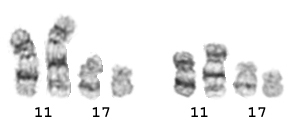
t(11;17)(q23;q21) G- banding - Courtesy Diane H. Norback, Eric B. Johnson, Sara Morrison-Delap UW Cytogenetic Services .
Citation
Franck Viguié
t(11;17)(q23;q21) ZBTB16/RARA
Atlas Genet Cytogenet Oncol Haematol. 1998-04-01
Online version: http://atlasgeneticsoncology.org/haematological/1028/t(11;17)(q23;q21)-zbtb16-rara
