ESR2 (Estrogen Receptor 2 (ER beta))
2008-04-01 Chunyan Zhao , Karin Dahlman-Wright , Jan-Ake Gustafsson AffiliationDepartment of Biosciences, Nutrition, Novum, Karolinska Institutet, S-141 57 Huddinge, Sweden
DNA/RNA
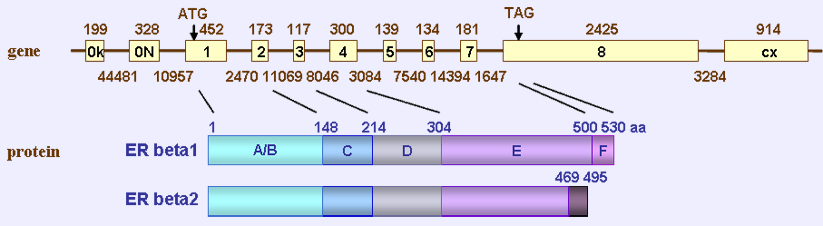
Genomic organization of human ER beta gene, protein and functional domains.
Gene: exons are indicated with boxes and introns with lines. The numbers above each box indicate the size of the exons (bp); the numbers below each line designate the size of the respective introns (bp). Dotted lines between gene and protein point to protein domain junctions.
Protein: numbers indicate the total size of the protein in amino acids. The shaded bar shows the divergent C-terminal regions between the isoforms.
Description
ER beta gene consists of 8 encoding exons. The open reading frame of the coding region is 1,593 bp.
Proteins
Expression
ER beta is mainly expressed in tissues such as the ovary (granulosa cells), prostate (epithelium), testis, epididymis, colon, lung, bladder, bone marrow, salivary gland, vascular endothelium and regions of the brain, including hypothalamus and cortex.
Localisation
Nucleus
Function
Cellular signaling of estrogen is mediated through two estrogen receptors (ERs), ER alpha and ER beta. The first ER, now known as ER alpha, was cloned in 1986. This receptor was regarded as the only ER that mediates estrogenic effects, until a second ER, now known as ER beta, was cloned from rat prostate. ER alpha and ER beta belong to the superfamily of nuclear receptors and specifically to the family of steroid receptors that act as ligand-regulated transcription factors. ER alpha and ER beta have a high sequence homology and share affinity for the same ligands and DNA response elements.
Binding of ligand activates ERs, by a mechanism that involves dissociation of heat shock proteins and dimerization of receptor proteins. Estrogen-modulated gene transcription is exerted via different mechanisms: the genomic and the nongenomic pathways. The canonical model for ER-mediated regulation of gene expression involves the direct binding of dimeric ER to DNA sequences known as estrogen response elements (EREs), followed by recruitment of a variety of coregulators to alter chromatin structure and facilitate recruitment of the RNA polymerase II (Pol II) transcriptional machinery.
The transcriptional activity of ERs can be modulated by different types of post-translational modifications such as phosphorylation, acetylation, sumoylation, ubiquitination and methylation.
ER alpha and ER beta exhibit different affinities for some natural compounds, and distinct expression patterns in a variety of tissues. Transcriptional activation by ER alpha is mediated by two distinct activation functions: the constitutively active AF-1 and the ligand-dependent AF-2. ER beta seems to have a weaker corresponding AF-1 function and thus depends more on the AF-2 for its transcriptional activation function. ER alpha and ER beta have different activities in certain ligand, cell-type, and promoter contexts.
Binding of ligand activates ERs, by a mechanism that involves dissociation of heat shock proteins and dimerization of receptor proteins. Estrogen-modulated gene transcription is exerted via different mechanisms: the genomic and the nongenomic pathways. The canonical model for ER-mediated regulation of gene expression involves the direct binding of dimeric ER to DNA sequences known as estrogen response elements (EREs), followed by recruitment of a variety of coregulators to alter chromatin structure and facilitate recruitment of the RNA polymerase II (Pol II) transcriptional machinery.
The transcriptional activity of ERs can be modulated by different types of post-translational modifications such as phosphorylation, acetylation, sumoylation, ubiquitination and methylation.
ER alpha and ER beta exhibit different affinities for some natural compounds, and distinct expression patterns in a variety of tissues. Transcriptional activation by ER alpha is mediated by two distinct activation functions: the constitutively active AF-1 and the ligand-dependent AF-2. ER beta seems to have a weaker corresponding AF-1 function and thus depends more on the AF-2 for its transcriptional activation function. ER alpha and ER beta have different activities in certain ligand, cell-type, and promoter contexts.
Homology
Chimpanzee (Pan troglodytes), dog (Canis lupus familiaris), cow (Bos taurus), mouse (Mus musculus), rat (Rattus norvegicus) chicken (Gallus gallus), zebrafish (Danio rerio).
Implicated in
Entity name
Various cancers
Note
Targeted disruption of ER beta in mice has suggested roles for ER beta in many tissues and organs, including the ovary, uterus, mammary gland, brain, immune system and ventral prostate.
Entity name
Prostate cancer
Disease
Estrogens can have profound effects on prostate growth and differentiation as well as in the pathogenesis of prostate cancer. In the adult rodent ventral prostate, ER beta is expressed in the epithelial cells, whereas ER alpha is expressed in the stroma. The estrogenic effects in the prostate may therefore be exerted by both ERs but in different cells. ER beta knockout mice display signs of prostatic hyperplasia with aging.
Entity name
Breast cancer
Disease
Estrogen is essential for growth and development of the mammary glands, and has been associated with promotion and growth of breast cancer. ER beta is found in both ductal and lobular epithelial and stromal cells of the rodent, whereas ER alpha is only found in the ductal and lobular epithelial cells and not in stroma. Recent studies have indicated a protective role of ER beta against breast cancer development. In vitro studies indicated that ER beta is an important modulator of proliferation and invasion of breast cancer cells.
Entity name
Colon cancer
Disease
ER beta is the predominant ER in the colonic epithelium, suggesting that effects of estrogen in the colon are mediated by ER beta. In colons from ER beta knockout mice, the number of proliferating cells was higher, and the migration of labelled cells from base to lumen of the crypts was faster when compared to wild-type mice. Additionally, immunohistochemical staining revealed fewer apoptotic cells (cleaved caspase 3-positive), a significant decrease in expression of the epithelial differentiation marker, cytokeratin CK20, the adherens junction protein, alpha -catenin, and the hemidesmosomal protein, plectin, in ER beta knockout mice. These findings suggest a role for ER beta in the organization and architectural maintenance of the colon.
Entity name
Ovarian cancer
Disease
A loss of ER beta expression or a decrease in ER beta/ER alpha ratio in epithelial ovarian cancer cells as compared with normal tissues has been reported by several groups. ER beta overexpression in ovarian cancer cells has been reported to exert antitumoral effects.
Article Bibliography
| Pubmed ID | Last Year | Title | Authors |
|---|---|---|---|
| 17132854 | 2006 | International Union of Pharmacology. LXIV. Estrogen receptors. | Dahlman-Wright K et al |
| 16556737 | 2007 | Estrogen receptor-beta: recent lessons from in vivo studies. | Harris HA et al |
| 8650195 | 1996 | Cloning of a novel receptor expressed in rat prostate and ovary. | Kuiper GG et al |
| 11581496 | 2001 | Mechanisms of estrogen action. | Nilsson S et al |
| 9671811 | 1998 | Molecular cloning and characterization of human estrogen receptor betacx: a potential inhibitor ofestrogen action in human. | Ogawa S et al |
| 18301783 | 2008 | Estrogen receptor beta: an overview and update. | Zhao C et al |
Other Information
Locus ID:
NCBI: 2100
MIM: 601663
HGNC: 3468
Ensembl: ENSG00000140009
Variants:
dbSNP: 2100
ClinVar: 2100
TCGA: ENSG00000140009
COSMIC: ESR2
RNA/Proteins
Expression (GTEx)
Pathways
Protein levels (Protein atlas)
PharmGKB
| Entity ID | Name | Type | Evidence | Association | PK | PD | PMIDs |
|---|---|---|---|---|---|---|---|
| PA152241907 | lapatinib | Chemical | LabelAnnotation | associated | |||
| PA164746311 | everolimus | Chemical | LabelAnnotation | associated | |||
| PA164747170 | fulvestrant | Chemical | LabelAnnotation | associated | |||
| PA164747674 | goserelin | Chemical | LabelAnnotation | associated | |||
| PA164920420 | olaparib | Chemical | LabelAnnotation | associated | |||
| PA165110439 | ixabepilone | Chemical | LabelAnnotation | associated | |||
| PA165290933 | pertuzumab | Chemical | LabelAnnotation | associated | |||
| PA165291472 | neratinib | Chemical | LabelAnnotation | associated | |||
| PA166153469 | palbociclib | Chemical | LabelAnnotation | associated | |||
| PA166153470 | ribociclib | Chemical | LabelAnnotation | associated | |||
| PA166153471 | abemaciclib | Chemical | LabelAnnotation | associated | |||
| PA166182723 | eribulin | Chemical | LabelAnnotation | associated | |||
| PA166184523 | alpelisib | Chemical | LabelAnnotation | associated | |||
| PA443560 | Breast Neoplasms | Disease | ClinicalAnnotation | associated | PD | 26536870 | |
| PA445218 | Pancreatic Neoplasms | Disease | ClinicalAnnotation | associated | PD | 22838950 | |
| PA448432 | anastrozole | Chemical | LabelAnnotation | associated | |||
| PA449383 | docetaxel | Chemical | LabelAnnotation | associated | |||
| PA449563 | exemestane | Chemical | LabelAnnotation | associated | |||
| PA449748 | gemcitabine | Chemical | ClinicalAnnotation | associated | PD | 22838950 | |
| PA450196 | letrozole | Chemical | ClinicalAnnotation, LabelAnnotation | associated | PD | 26536870 | |
| PA451221 | raloxifene | Chemical | LabelAnnotation | associated | |||
| PA451581 | tamoxifen | Chemical | ClinicalAnnotation, LabelAnnotation | associated | PD | 17713466 | |
| PA451731 | toremifene | Chemical | LabelAnnotation | associated | |||
| PA451743 | trastuzumab | Chemical | LabelAnnotation | associated |
References
| Pubmed ID | Year | Title | Citations |
|---|---|---|---|
| 37748565 | 2024 | Estrogen receptor β affects hypoxia response in colorectal cancer cells. | 2 |
| 37862941 | 2024 | The ERβ-cAMP signaling pathway regulates estradiol-induced ovine oocyte meiotic arrest. | 2 |
| 38097136 | 2024 | USP7-mediated ERβ stabilization mitigates ROS accumulation and promotes osimertinib resistance by suppressing PRDX3 SUMOylation in non-small cell lung carcinoma. | 0 |
| 38281964 | 2024 | Exploring the association of ESR1 and ESR2 gene SNPs with polycystic ovary syndrome in human females: a comprehensive association study. | 0 |
| 38318796 | 2024 | Allelic variants of the estrogen receptor genes and frailty phenotype in postmenopausal women. | 0 |
| 38340326 | 2024 | AURKA Enhances the Glycolysis and Development of Ovarian Endometriosis Through ERβ. | 0 |
| 38649856 | 2024 | 25-hydroxycholesterol promotes proliferation and metastasis of lung adenocarcinoma cells by regulating ERβ/TNFRSF17 axis. | 1 |
| 37748565 | 2024 | Estrogen receptor β affects hypoxia response in colorectal cancer cells. | 2 |
| 37862941 | 2024 | The ERβ-cAMP signaling pathway regulates estradiol-induced ovine oocyte meiotic arrest. | 2 |
| 38097136 | 2024 | USP7-mediated ERβ stabilization mitigates ROS accumulation and promotes osimertinib resistance by suppressing PRDX3 SUMOylation in non-small cell lung carcinoma. | 0 |
| 38281964 | 2024 | Exploring the association of ESR1 and ESR2 gene SNPs with polycystic ovary syndrome in human females: a comprehensive association study. | 0 |
| 38318796 | 2024 | Allelic variants of the estrogen receptor genes and frailty phenotype in postmenopausal women. | 0 |
| 38340326 | 2024 | AURKA Enhances the Glycolysis and Development of Ovarian Endometriosis Through ERβ. | 0 |
| 38649856 | 2024 | 25-hydroxycholesterol promotes proliferation and metastasis of lung adenocarcinoma cells by regulating ERβ/TNFRSF17 axis. | 1 |
| 36261089 | 2023 | Unique ESR1 and ESR2 estrogen receptor gene variants associated with altered risk of triple-negative breast cancer: A case-control study. | 0 |
Citation
Chunyan Zhao ; Karin Dahlman-Wright ; Jan-Ake Gustafsson
ESR2 (Estrogen Receptor 2 (ER beta))
Atlas Genet Cytogenet Oncol Haematol. 2008-04-01
Online version: http://atlasgeneticsoncology.org/gene/40500/esr2
