Denys-Drash syndrome (DDS)
2015-12-01 Maria Piccione , Emanuela Salzano AffiliationDepartment of Sciences for Health Promotion and Mother and Child Care G. DAlessandro, University of Palermo, Palermo, Italy. [email protected]; [email protected]
Abstract
Denys-Drash is a rare genetic disorder related to mutations in WT1 gene and characterized by the triad of 46,XY disorder of sex developmental, renal dysfunction and Wilms Tumor. To date about 150 patients with Denys-Drash Syndrome have been reported
Identity
Name
Denys-Drash syndrome (DDS)
Alias
Drash syndrome , Wilms tumor and pseudo- or true hermaphroditism , Nephropathy, Wilms tumor, and genital anomalies
Note
Meacham Syndrome(OMIM # 608978) is an allelic disorder with some clinical features overlapping plus cardiac and pulmonary malformations.
Inheritance
To date about 150 patients with DDS have been described and its prevalence is largerly unknown (Mueller 1994). The inheritance pattern is autosomal dominant, but most reported cases resulted from a de novo mutation in germline cells or in earlier phases of embryonic development as postzygotic somatic event (Coppes et al.1992).
Orphanet
220 Denys-Drash syndrome
Omim
194080
Omim
136680
Mesh
D030321
Clinics
Phenotype and clinics
Denys-Drash is a rare condition characterized by the triad of 46,XY disorder of sex developmental, renal dysfunction and Wilms Tumor. Litterature also described patients with complete and incomplete forms of Drash syndrome depending on the expression of a full or patial phenotype in which nephrophay is associated with either one of the other features (Jadresic et al.1990).
Genitalia
Male: 46, XY disorder of sex developmental with gonadal dysgenesis (sometimes both testicular and ovarian tissue present)inappropriate to drive a normal external genitalia development; higher risk to develop gonadoblastoma.
Female: gonadal dysgenesis with ambiguous genitalia; sometimes can present normal external genitalia; higher risk to develop gonadoblastoma (Koziell et al. 1999; Öçal G 2011).
Kidney
Progressive diffuse mesangial sclerosis,focal glomerular sclerosis, nephrotic syndrome, highly progressive renal failure; nephroblastoma (Niaudet et al.2006).
Cardiovascular System
Secondary hypertension
Genitalia
Male: 46, XY disorder of sex developmental with gonadal dysgenesis (sometimes both testicular and ovarian tissue present)inappropriate to drive a normal external genitalia development; higher risk to develop gonadoblastoma.
Female: gonadal dysgenesis with ambiguous genitalia; sometimes can present normal external genitalia; higher risk to develop gonadoblastoma (Koziell et al. 1999; Öçal G 2011).
Kidney
Progressive diffuse mesangial sclerosis,focal glomerular sclerosis, nephrotic syndrome, highly progressive renal failure; nephroblastoma (Niaudet et al.2006).
Cardiovascular System
Secondary hypertension
Differential diagnosis
Frasier Syndrome
Denys-Drash Syndrome shares several clinical features with Frasier Syndrome so that has been proposed as another end of the WT1 mutations spectrum. Patients affected by Frasier Syndrome present a 46,XY partial gonadal dysgenesis with streak gonads and normal external genitalia (with uterus) associated more frequently with development of gonadoblastoma.
Glomerular damage consists usually in a non specific and focal sclerosis resulting in proteinuria and nephrotic syndrome that usually progresses to end -stage renal failure during adolescence or adulthood. Wilms tumor is not as common as in Denys-Drash Syndrome (Barbaux et al. 1997; Koziell et al. 1999)
Denys-Drash Syndrome shares several clinical features with Frasier Syndrome so that has been proposed as another end of the WT1 mutations spectrum. Patients affected by Frasier Syndrome present a 46,XY partial gonadal dysgenesis with streak gonads and normal external genitalia (with uterus) associated more frequently with development of gonadoblastoma.
Glomerular damage consists usually in a non specific and focal sclerosis resulting in proteinuria and nephrotic syndrome that usually progresses to end -stage renal failure during adolescence or adulthood. Wilms tumor is not as common as in Denys-Drash Syndrome (Barbaux et al. 1997; Koziell et al. 1999)
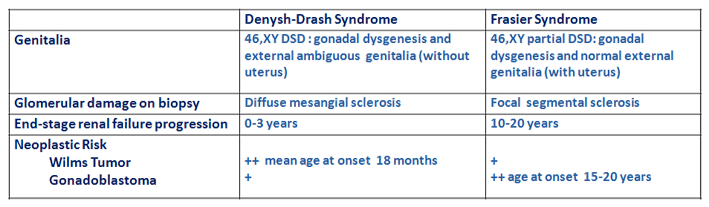
Comparison between Denys-Drash and Frasier Phenotypes.
Neoplastic risk
Most patients with DDS delevop Wilms tumor at the mean age of 18 months (vs a mean age of 44 months in sporadic Wilms tumor) with a bilateral onset in 20% of cases. Gonadoblastomas arise in dysgenetic gonads more frequently in Frasier Syndrome patients than DDS patients and usually present as benign tumors (Barbaux et al. 1997; Koziell et al. 2000).
Treatment
Nephrophaty is usually poorly responsive to common treatments. Some patients with Frasier Syndrome have underwent bilateral surgical gonadectomy (Niaudet et al.2006).
Prognosis
Death is usually secondary to renal failure. In Denys-Drash Syndrome nephrophaty has an early onset and renal failure comes within 3 years, while a slower end-stage progression is typical of Frasier nephrophaty.
Rare reported patients with congenital diaphragmatic hernia died by average age of 24 hours (Antonius et al.2008).
Rare reported patients with congenital diaphragmatic hernia died by average age of 24 hours (Antonius et al.2008).
Cytogenetics
Note
Deletion or chromosomal rearrangements of 11p13 critical region are rarely reported: only 1 DDS case was found carrier of 11p13-p12 deletion and none with Frasier Syndrome (Jadresic et al.1991). However cytogenetic deletion involving 11p11 and 11p13 are described in sporadic Wilms Tumor and in Wilms tumor in association to WAGR (Wilms tumor, aniridia, genitourinary anomalies and mental retardation) Syndrome (OMIM #194072).
Genes involved and Proteins
Note
Alias
Wilms Tumor 1NPHS4Last Three Zinc Fingers Of The DNA-Binding Domain Of WT1Amino-Terminal Domain Of EWSWilms Tumor ProteinEWS-WT1WIT-2AWT1WAGRGUD
Note
WT1 gene encodes for a DNA-binding protein including four zinc-finger motifs at the C-terminus and a proline\/glutamine-rich DNA-binding domain at the N-terminus. It acts as trascriptional modulator that has an essential role in the normal development of the urogenital system. This gene has a biallelic, and monoallelic expression from the maternal and paternal alleles in different tissues.
Dna description
10 exons, extending for 48 kb of genomic DNA.
Transcription
Alternative splicing at two sites results in four major different zinc finger protein isoforms (molecular weights of between 52 and 54 kDa).
Description
Alternative splicing at the two sites generates 4 major different isoforms, respectively either including or excluding exon 5 and including or excluding three amino-acids - lysine, threonine and serine (KTS positive or negative isoforms). The KTS isoforms are highly conserved throughout evolution, indicating a very biological important function.
Expression
Kidney, ovary, testis, liver, heart and hematopoietic cells.
Localisation
Mainly nuclear, depending on the different isoforms.
Function
WT1 mediates trascriptional activation and\/or repression of several gene targets. It particular seems to directly synergize with SF1 participating to steroidogenesis and in sexual differentiation by regulating expression of the polypeptide hormone mullerian inhibiting substance. In addition WT1 plays a key role in podocyte gene-expression and subsequently in podocyte differentiation (Nachtigat et al 1998; Lefebvre et al. 2015).
Note
Denys-Drash WT1 mutations are clustered particularly in the exons encoding Zf2 and Zf3in and behave as dominant negatives. Most WT1 mutations in rasier patients affect the exon 9 donor splice site resulting in a functional imbalance of WT1 +KTS isoforms, as detected on dysgenetic gonads by RTPCR (Klam et al.1998; Haber et al.1991). In addition transcriptional profiling of mice lacking the WT1 alternative splice isoform (+KTS) seems to have a more restrictive podocyte set of genes whose expression depends on these alternatively spliced isoforms (Klamt et al 1998; Lefebvre et al. 2015).
To be noted
Registry
http:\/\/www.uke.de\/kliniken-institute\/kliniken\/kinder-und-jugendmedizin\/ Registry for Patients with WT1 Mutation Associated Diseases - UKE - Universitätsklinikum Hamburg-Eppendorf; Klinik und Poliklinik für Kinder- und Jugendmedizinhttps:\/\/www.amc.nl\/web\/Het-AMC\/Afdelingen\/Overzicht\/Klinische-Informatiekunde-KIK\/Klinische-Informatiekunde-KIK\/Department.htm ESPN\/ERA-EDTA Registry: European Registry for Children on Renal Replacement Therapy AMC - Academisch Medisch Centrum- Afdeling Klinische Informatiekunde
Databases
http:\/\/www.genecards.org\/cgi-bin\/carddisp.pl?gene=WT1 Gene WT1 (GeneCards)http:\/\/ghr.nlm.nih.gov\/condition\/denys-drash-syndrome Denys-Drash syndrome (Genetic Home Reference)
Article Bibliography
| Pubmed ID | Last Year | Title | Authors |
|---|---|---|---|
| 21911322 | 2011 | Current concepts in disorders of sexual development. | Öçal G et al |
| 18203154 | 2008 | Denys-Drash syndrome and congenital diaphragmatic hernia: another case with the 1097G > A(Arg366His) mutation. | Antonius T et al |
| 9398852 | 1997 | Donor splice-site mutations in WT1 are responsible for Frasier syndrome. | Barbaux S et al |
| 2172500 | 1990 | Clinicopathologic review of twelve children with nephropathy, Wilms tumor, and genital abnormalities (Drash syndrome). | Jadresic L et al |
| 9499425 | 1998 | Frasier syndrome is caused by defective alternative splicing of WT1 leading to an altered ratio of WT1 +/-KTS splice isoforms. | Klamt B et al |
| 25993318 | 2015 | Alternatively spliced isoforms of WT1 control podocyte-specific gene expression. | Lefebvre J et al |
| 9590178 | 1998 | Wilms' tumor 1 and Dax-1 modulate the orphan nuclear receptor SF-1 in sex-specific gene expression. | Nachtigal MW et al |
| 16927106 | 2006 | WT1 and glomerular diseases. | Niaudet P et al |
| 1327525 | 1992 | Inherited WT1 mutation in Denys-Drash syndrome. | Coppes MJ et al |
| 1658787 | 1991 | Alternative splicing and genomic structure of the Wilms tumor gene WT1. | Haber DA et al |
| 10762296 | 2000 | Frasier syndrome, part of the Denys Drash continuum or simply a WT1 gene associated disorder of intersex and nephropathy? | Koziell A et al |
| 8071974 | 1994 | The Denys-Drash syndrome. | Mueller RF et al |
External Links
Citation
Maria Piccione ; Emanuela Salzano
Denys-Drash syndrome (DDS)
Atlas Genet Cytogenet Oncol Haematol. 2015-12-01
Online version: http://atlasgeneticsoncology.org/cancer-prone-disease/10036/denys-drash-syndrome-(dds)
