TRAF3 (TNF Receptor Associated Factor 3)
2002-08-01 Valérie Kedinger AffiliationIGBMC - BP 10142, 67404 ILLKIRCH cedex, France
Identity
HGNC
LOCATION
14q32.32
LOCUSID
ALIAS
CAP-1,CAP1,CD40bp,CRAF1,IIAE5,LAP1,RNF118
FUSION GENES
DNA/RNA
Description
13 exons spanning approximately 130 kb
Transcription
Three alternatively spliced transcript variants encoding two distinct isoforms have been reported.
Proteins
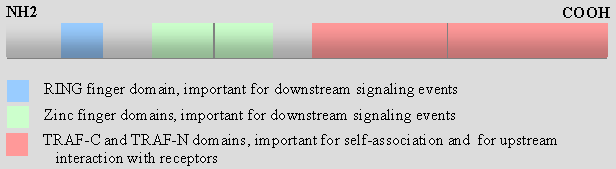
Description
Isoform 1: 568 amino acids
Isoform 2: 543 amino acids
Expression
TRAF3 protein is detected in the skin, with a stronger intensity in more differentiated cells in the upper layers of the complex epithelium. TRAF3 is also expressed in the cartilage, in the cardiovascular system, in the trachea, in the salivary gland, in the liver, in the pancreas, in the prostate gland, in the pituitary gland. A gradient of TRAF3 expression appears to exist along the nephron, with progressively higher expression from proximal tubule to collecting duct. In the central nervous system, many but not most neurons in the cerebral cortex, basal ganglia, and brain stem contain at least low levels of TRAF3 protein. In contrast, almost no expression of TRAF3 is detected in the immune system.
Localisation
mainly cytoplasmic
Function
The TRAF family proteins act at least in part as adapter proteins that recruit other signaling molecules to ligand-bound TNF family receptors.
TRAF3 was first described as a molecule that binds the cytoplasmic tail of CD40. Signaling through CD40 in B cells induces rescue from apoptosis, proliferation, differentiation, Ig production, class switching and expression of co-stimulatory molecules.
Insights into the in vivo functions of TRAF3 have come from generation of mice deficient for TRAF3. These mice are depleted in all lineages of peripheral leucocytes, and die shortly after birth. However, B cells from TRAF3-/- upregulate CD23 and proliferate normally in response to CD40 ligand stimulation. Moreover, fetal liver cells from TRAF3 deficient mice can reconstitute the immune system of irradiated wild type mice, although isotype switching in response to T-dependent antigens is defective. Thus, TRAF3 is not required for CD40 signaling, but appears important in T cell-dependent immune responses.
These effects of TRAF3 may be mediated through other TNF receptor family members : TRAF3 can bind directly to the cytosolic domains of CD27, CD30, LTbR, LMP-1, and also binds indirectly TNF-R2.
Homology
TRAF3 belongs to a family of six proteins (TRAF1 to 6), sharing a common structural organization. TRAF3 counterparts are found in mouse, fly and worm.
Implicated in
Disease
Hodgkin disease, Lymphomas.
Article Bibliography
| Pubmed ID | Last Year | Title | Authors |
|---|---|---|---|
| 11023520 | 2000 | Hodgkin disease: pharmacologic intervention of the CD40-NF kappa B pathway by a protease inhibitor. | Annunziata CM et al |
| 11607847 | 2001 | Tumor necrosis factor receptor-associated factors (TRAFs). | Bradley JR et al |
| 7533327 | 1995 | Involvement of CRAF1, a relative of TRAF, in CD40 signaling. | Cheng G et al |
| 10644711 | 2000 | Membrane localization of TRAF 3 enables JNK activation. | Dadgostar H et al |
| 9550380 | 1997 | Immunohistochemical analysis of in vivo patterns of TRAF-3 expression, a member of the TNF receptor-associated factor family. | Krajewski S et al |
| 9580648 | 1998 | Epstein-Barr virus and a cellular signaling pathway in lymphomas from immunosuppressed patients. | Liebowitz D et al |
| 8934568 | 1996 | Targeted disruption of TRAF3 leads to postnatal lethality and defective T-dependent immune responses. | Xu Y et al |
| 10199393 | 1998 | A single gene for human TRAF-3 at chromosome 14q32.3 encodes a variety of mRNA species by alternative polyadenylation, mRNA splicing and transcription initiation. | van Eyndhoven WG et al |
Other Information
Locus ID:
NCBI: 7187
MIM: 601896
HGNC: 12033
Ensembl: ENSG00000131323
Variants:
dbSNP: 7187
ClinVar: 7187
TCGA: ENSG00000131323
COSMIC: TRAF3
RNA/Proteins
Expression (GTEx)
Pathways
Protein levels (Protein atlas)
References
| Pubmed ID | Year | Title | Citations |
|---|---|---|---|
| 38367916 | 2024 | FOSL1 regulates hyperproliferation and NLRP3-mediated inflammation of psoriatic keratinocytes through the NF-kB signaling via transcriptionally activating TRAF3. | 0 |
| 38662551 | 2024 | TRAF3 loss-of-function reveals the noncanonical NF-κB pathway as a therapeutic target in diffuse large B cell lymphoma. | 0 |
| 38367916 | 2024 | FOSL1 regulates hyperproliferation and NLRP3-mediated inflammation of psoriatic keratinocytes through the NF-kB signaling via transcriptionally activating TRAF3. | 0 |
| 38662551 | 2024 | TRAF3 loss-of-function reveals the noncanonical NF-κB pathway as a therapeutic target in diffuse large B cell lymphoma. | 0 |
| 36727735 | 2023 | Circular RNA SMARCA5 inhibits cholangiocarcinoma via microRNA-95-3p/tumor necrosis factor receptor associated factor 3 axis. | 3 |
| 36823147 | 2023 | TRAF3 activates STING-mediated suppression of EV-A71 and target of viral evasion. | 3 |
| 36976509 | 2023 | The Interaction of OTUB1 and TRAF3 Mediates NLRP3 Inflammasome Activity to Regulate TGF-β1-induced BEAS-2B Cell Injury. | 1 |
| 37097293 | 2023 | TRAF3-EWSR1 signaling axis acts as a checkpoint on germinal center responses. | 0 |
| 37422573 | 2023 | LncRNA XIST Exacerbates Oxygen-Glucose Deprivation/Reoxygenation-Induced Cerebral Injury Through the miR-25-3p/TRAF3 Axis. | 3 |
| 37798663 | 2023 | Effects of TRAF3 on the proliferation and migration of lung adenocarcinoma depend partly on pyroptosis. | 1 |
| 36727735 | 2023 | Circular RNA SMARCA5 inhibits cholangiocarcinoma via microRNA-95-3p/tumor necrosis factor receptor associated factor 3 axis. | 3 |
| 36823147 | 2023 | TRAF3 activates STING-mediated suppression of EV-A71 and target of viral evasion. | 3 |
| 36976509 | 2023 | The Interaction of OTUB1 and TRAF3 Mediates NLRP3 Inflammasome Activity to Regulate TGF-β1-induced BEAS-2B Cell Injury. | 1 |
| 37097293 | 2023 | TRAF3-EWSR1 signaling axis acts as a checkpoint on germinal center responses. | 0 |
| 37422573 | 2023 | LncRNA XIST Exacerbates Oxygen-Glucose Deprivation/Reoxygenation-Induced Cerebral Injury Through the miR-25-3p/TRAF3 Axis. | 3 |
Citation
Valérie Kedinger
TRAF3 (TNF Receptor Associated Factor 3)
Atlas Genet Cytogenet Oncol Haematol. 2002-08-01
Online version: http://atlasgeneticsoncology.org/gene/271/
