STK11 (serine/threonine kinase 11)
2007-01-01 Bharati Bapat , Sheron Perera AffiliationSamuel Lunenfeld Research Institute, Mount Sinai Hospital, Department of Lab Medicine, Pathobiology, University of Toronto, Canada
Identity
HGNC
LOCATION
19p13.3
LOCUSID
ALIAS
LKB1,PJS,hLKB1
FUSION GENES
DNA/RNA
Description
10 Exons spanning 23 kb, the 10th exon occurs within the 3 untranslated region of the gene. The gene is transcribed in telomere to centromere direction.
Transcription
The length of this transcript has not been reconciled. The curated human Vega transcript is the longest transcript reported to date (3,627 bp, Vega external transcript). The GeneBank sequence is the same but is shorter (3,286 bp) at the 3 end (NM_000455.4). The exon/intron structures in GeneBank are given for 2 alternative assemblies (aligned with NT_011255.14 and NW_927173.1), of which the NT_0112255.14 is consistent with the Vega annotation. Alternative transcripts although shown to occur, have not be been well characterized.
Proteins
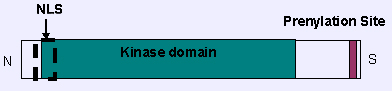
Diagram of STK11 protein (not drawn to scale). The kinase domain is depicted by the green box. The second box outlined by the dashed lines illustrates the location of the nuclear localization signal (NLS) and the purple box indicates the prenylation motif. This protein is believed to contain a putative cytoplasmic retention signal (not shown).
Description
433 amino acids, 48.6 kDa; N-term with a nuclear localization domain and a putative cytoplasmic retention signal, a kinase domain, and a C-terminal CAAX box prenylation motif.
Expression
Ubiquitous, especially high expression in the testis and fetal liver.
Localisation
Found in both the nucleus and the cytoplasm. Localization is thought to be dependent on interaction with proteins such as BRG1, LIP1, STRAD, MO25.
Function
A serine/threonine protein kinase, recently classified as a part of the Ca2+/ calmodulin kinase group of kinases. STK11 was shown to associate and activate the pseudokinase, STRAD, resulting in the reorganization of non-polarized cells so they form asymmetrical apical and basal structures. Another mechanism by which this may occur is by the interaction of STK11 with the PAR1 family of serine/threonine kinases. AMPK is a protein kinase cascade that plays an important role in regulating energy homeostasis. The first report of an upstream regulator came when it was discovered that STK11, in complex with STRAD and the scaffolding protein MO25, can phosphorylate and activate AMPK. Subsequently, it was demonstrated that STK11 can phosphorylate the T-loop of 12 other AMPK related human kinases. In addition it has been implicated in a range of processes including, chromatin remodeling, cell cycle arrest, ras-induced cell transformation, p53-mediated apoptosis and Wnt signaling.
Homology
Orthologs found in several species and include:
Xenopus laevis egg and embryonic kinase 1(XEEK1),
Caenorhabditis elegans partitioning defective gene 4 (PAR4),
mouse LKB1
and drosophila LKB1.
Xenopus laevis egg and embryonic kinase 1(XEEK1),
Caenorhabditis elegans partitioning defective gene 4 (PAR4),
mouse LKB1
and drosophila LKB1.
Mutations
Germinal
Most mutations identified to date are in the catalytic domain of STK11, indicating that kinase activity is likely essential for its function as a tumor suppressor. Several types of mutations including insertions, deletions, nonsense, missense and splice site alterations have been identified to date. One family has been identified with complete germline deletion of this gene.
Somatic
Many of the polyps that develop in Peutz-Jeghers syndrome (see below) show loss of heterozygosity and sometimes somatic mutations. Somatic mutations rarely occur in sporadic tumours, with the exception of adenocarcinoma of the lung. The inactivation of the LKB1 can also occur through promoter hypermethylation.
Implicated in
Entity name
Peutz-Jeghers syndrome (PJS)
Disease
Autosomal dominant syndrome associated with mucocutaneous hyperpigmentation and benign intestinal polyps known as hamartomas. The relative incidence is estimated to vary from 1/29 000 to 1/120 000 births. Patients are at an increased risk of developing malignancies in epithelial tissues, for example it has been estimated that there is a about 84, about 213 and about 520 fold increased risk of developing colon, gastric and small intestinal cancers respectively. PJS patients are also at an increased risk of developing cancers in the breast, lung, ovaries, uterus, cervix and testes.
Hybrid gene
A majority (60-70%) of Peutz-Jeghers patients show germline mutations in STK11. Genetic locus heterogeneity may exist for this disease. A small percentage of families with no mutations in STK11/LKB1 have been identified, however no other candidate genes that predispose to Peutz-Jeghers syndrome have been identified to date.
Oncogenesis
Patients inherit mutations in one allele, and the remaining allele is later inactivated generally by LOH or sometimes somatic mutation. This biallelic inactivation of STK11 leads to a loss of tumour suppressor activity, thereby promoting tumourigenesis.
Entity name
Lung adenocarcinoma
Disease
Adenocarcinoma is the most common non-small-cell lung cancer accounting for about 30-40% of all cases diagnosed to date. These tumors are thought to derive from epithelial cells that line the peripheral small airways and the heterogeneity of lung tumours is well documented. The outcome of non-small cell lung cancer is more difficult to predict, and about 50% of patients die from metastatic disease even after surgery of the primary tumour.
Hybrid gene
As many as 33% of sporadic lesions analyzed display somatic mutations in STK11.
Oncogenesis
Loss of protein function is seen in sporadic lung adenocarcinoma tumours.
Article Bibliography
| Pubmed ID | Last Year | Title | Authors |
|---|---|---|---|
| 15121768 | 2004 | Genotype-phenotype correlations in Peutz-Jeghers syndrome. | Amos CI et al |
| 12805220 | 2003 | Activation of the tumour suppressor kinase LKB1 by the STE20-like pseudokinase STRAD. | Baas AF et al |
| 15016379 | 2004 | Complete polarization of single intestinal epithelial cells upon activation of LKB1 by STRAD. | Baas AF et al |
| 12226664 | 2002 | Loss of the Lkb1 tumour suppressor provokes intestinal polyposis but resistance to transformation. | Bardeesy N et al |
| 10644993 | 2000 | Epigenetic inactivation of LKB1 in primary tumors associated with the Peutz-Jeghers syndrome. | Esteller M et al |
| 9428765 | 1998 | A serine/threonine kinase gene defective in Peutz-Jeghers syndrome. | Hemminki A et al |
| 9425897 | 1998 | Peutz-Jeghers syndrome is caused by mutations in a novel serine threonine kinase. | Jenne DE et al |
| 11430832 | 2001 | The Peutz-Jegher gene product LKB1 is a mediator of p53-dependent cell death. | Karuman P et al |
| 14976552 | 2004 | LKB1 is a master kinase that activates 13 kinases of the AMPK subfamily, including MARK/PAR-1. | Lizcano JM et al |
| 15623475 | 2005 | LKB1, the multitasking tumour suppressor kinase. | Marignani PA et al |
| 11297520 | 2001 | Phosphorylation of the protein kinase mutated in Peutz-Jeghers cancer syndrome, LKB1/STK11, at Ser431 by p90(RSK) and cAMP-dependent protein kinase, but not its farnesylation at Cys(433), is essential for LKB1 to suppress cell vrowth. | Sapkota GP et al |
| 16580634 | 2006 | The tumor suppressor LKB1 induces p21 expression in collaboration with LMO4, GATA-6, and Ldb1. | Setogawa T et al |
| 11741830 | 2001 | LIP1, a cytoplasmic protein functionally linked to the Peutz-Jeghers syndrome kinase LKB1. | Smith DP et al |
| 15186763 | 2004 | LKB1 kinase: master and commander of metabolism and polarity. | Spicer J et al |
| 12879020 | 2003 | Regulation of the Wnt signalling component PAR1A by the Peutz-Jeghers syndrome kinase LKB1. | Spicer J et al |
| 10430928 | 1999 | Growth suppression by Lkb1 is mediated by a G(1) cell cycle arrest. | Tiainen M et al |
| 11509733 | 2001 | Vascular abnormalities and deregulation of VEGF in Lkb1-deficient mice. | Ylikorkala A et al |
Other Information
Locus ID:
NCBI: 6794
MIM: 602216
HGNC: 11389
Ensembl: ENSG00000118046
Variants:
dbSNP: 6794
ClinVar: 6794
TCGA: ENSG00000118046
COSMIC: STK11
RNA/Proteins
Expression (GTEx)
Pathways
Protein levels (Protein atlas)
PharmGKB
| Entity ID | Name | Type | Evidence | Association | PK | PD | PMIDs |
|---|---|---|---|---|---|---|---|
| PA33744 | PRKAA1 | Gene | Pathway | associated | 22722338 | ||
| PA33745 | PRKAA2 | Gene | Pathway | associated | 22722338 | ||
| PA33746 | PRKAB1 | Gene | Pathway | associated | 22722338 | ||
| PA33747 | PRKAB2 | Gene | Pathway | associated | 22722338 | ||
| PA33751 | PRKAG1 | Gene | Pathway | associated | 22722338 | ||
| PA33752 | PRKAG2 | Gene | Pathway | associated | 22722338 | ||
| PA33753 | PRKAG3 | Gene | Pathway | associated | 22722338 | ||
| PA445307 | Peutz-Jeghers Syndrome | Disease | Literature, MultilinkAnnotation | associated | 23788249 |
References
| Pubmed ID | Year | Title | Citations |
|---|---|---|---|
| 37816458 | 2024 | Modulating the phenotypic transition of vascular smooth muscle cells via LKB1, a new pharmacologic target to strike atherosclerosis? | 0 |
| 37817679 | 2024 | Impact of the STK11/KRAS co-mutation on the response to immunotherapy in a real-world pan-cancer cohort. | 1 |
| 37968341 | 2024 | STK11 loss leads to YAP1-mediated transcriptional activation in human KRAS-driven lung adenocarcinoma cell lines. | 1 |
| 38330261 | 2024 | Influence of TP53 Comutation on the Tumor Immune Microenvironment and Clinical Outcomes With Immune Checkpoint Inhibitors in STK11-Mutant Non-Small-Cell Lung Cancer. | 0 |
| 38480816 | 2024 | Impact of LKB1 status on radiation outcome in patients with stage III non-small-cell lung cancer. | 0 |
| 38632512 | 2024 | Effect of the STK11 mutation on therapeutic efficacy and prognosis in patients with non-small cell lung cancer: a comprehensive study based on meta-analyses and bioinformatics analyses. | 0 |
| 38743625 | 2024 | Genome-wide CRISPR screens in spheroid culture reveal that the tumor suppressor LKB1 inhibits growth via the PIKFYVE lipid kinase. | 0 |
| 38830518 | 2024 | miR-744-5p promotes T-cell differentiation via inhibiting STK11. | 0 |
| 38844063 | 2024 | LKB1 inhibits telomerase activity resulting in cellular senescence through histone lactylation in lung adenocarcinoma. | 1 |
| 37816458 | 2024 | Modulating the phenotypic transition of vascular smooth muscle cells via LKB1, a new pharmacologic target to strike atherosclerosis? | 0 |
| 37817679 | 2024 | Impact of the STK11/KRAS co-mutation on the response to immunotherapy in a real-world pan-cancer cohort. | 1 |
| 37968341 | 2024 | STK11 loss leads to YAP1-mediated transcriptional activation in human KRAS-driven lung adenocarcinoma cell lines. | 1 |
| 38330261 | 2024 | Influence of TP53 Comutation on the Tumor Immune Microenvironment and Clinical Outcomes With Immune Checkpoint Inhibitors in STK11-Mutant Non-Small-Cell Lung Cancer. | 0 |
| 38480816 | 2024 | Impact of LKB1 status on radiation outcome in patients with stage III non-small-cell lung cancer. | 0 |
| 38632512 | 2024 | Effect of the STK11 mutation on therapeutic efficacy and prognosis in patients with non-small cell lung cancer: a comprehensive study based on meta-analyses and bioinformatics analyses. | 0 |
Citation
Bharati Bapat ; Sheron Perera
STK11 (serine/threonine kinase 11)
Atlas Genet Cytogenet Oncol Haematol. 2007-01-01
Online version: http://atlasgeneticsoncology.org/gene/292/stk11
Historical Card
2002-02-01 STK11 (serine/threonine kinase 11) by Jean-Loup Huret Affiliation
Genetics, Dept Medical Information, University of Poitiers, CHU Poitiers Hospital, F-86021 Poitiers, France
