ADGRL2 (adhesion G protein-coupled receptor L2 )
2003-11-01 Jim Heighway AffiliationRoy Castle International Centre for Lung Cancer Research, Liverpool, UK
Identity
HGNC
LOCATION
1p31.1
IMAGE

LEGEND
Probe(s) - Courtesy Mariano Rocchi, Resources for Molecular Cytogenetics
LOCUSID
ALIAS
CIRL2,CL2,LEC1,LPHH1,LPHN2
FUSION GENES
DNA/RNA
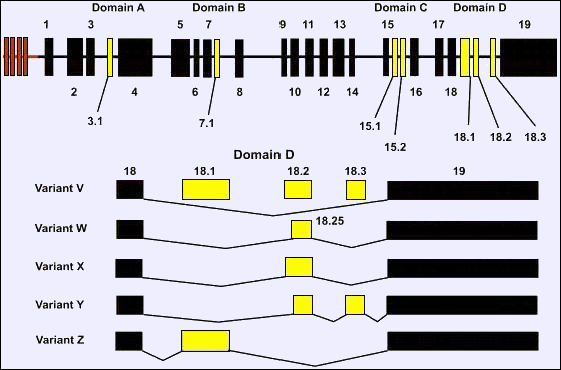
Representation of the genomic structure of LPHH1. Black blocks represent core exons which are present in the majority of gene transcripts. The yellow blocks represent alternatively spliced coding exons which may be incorporated variably in transcripts derived from different cell types/tissues or as a consequence of differing cellular states. The red boxes represent the presence of multiple, in some cases tissue-specific, leader exons that have been identified for this gene, an observation consistent with the existence of multiple dispersed promoter elements. The most variably spliced region of the coding sequence was the carboxy-terminal domain D.
Description
LPHH1 consists of 19 commonly used coding exons. A further seven exons have been identified which may be alternatively spliced into the core backbone with variable frequencies and tissue specificities. At least a number of these additional exons are highly conserved in mammalian species. The core exons (ATG, exon 1 to stop, exon 19) span a region of about 154kb. However, the 5end of the gene is not precisely defined with transcripts in different tissues apparently initiating from specific locations over an extensive region. The most distant leader exon identified (foetal lung) lies approximately 390kb from exon 1 which makes the total size of the gene at least 550kb.
Transcription
Expression has been observed by RT-PCR in all normal tissues and lines tested with the clear exception of lymphocytes and lymphoblastoid cells. Strongest expression was observed in foetal lung, normal adult lung and thyroid. Alternative splicing to some degree in at least one domain (minimally the carboxy-terminal domain D) was seen in each tissue and line examined with human brain showing a characteristic pattern and additional variability in the other three coding sequence domains.
Pseudogene
No known pseudogene.
Proteins
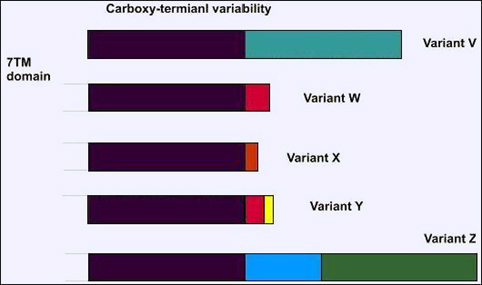
Alternative splicing in domain D dramatically alters the structure of the carboxy-terminus of the encoded protein, latrophilin 2. Variable splicing in this region occurs in all tissues and cell lines tested.
Description
LPHH1 encodes a putative seven-span transmembrane receptor with atypically large extra membrane N (predicted to be extra-cellular) and C termini. In addition to the seven hydrophobic membrane spanning domains, a putative lectin-like region is present near the N-terminus.
Expression
Protein likely to be ubiquitously expressed in adherent cells but that has not so far been confirmed. Human brain-specific alternative splices alter the structure of the extra-membrane, intra-cellular loop between TM domains 5 and 6, a region thought to be critical for G-protein/receptor interactions.
Localisation
Likely to be plasma membrane.
Function
Likely role in coupling cell adhesion to cell signalling.
Homology
Latrophilin 2 is part of a small sub-family of 7TMs which includes latrophilins 1 and 3. Latrophilin 1 is the receptor for Black Widow spider toxin: -latrotoxin.
Mutations
Note
None reported.
Implicated in
Entity name
Breast carcinoma
Note
Analysis of breast cancer cell lines has demonstrated dramatic differences in transcript levels between certain lines. In one case, strong expression was allelically imbalanced.
Entity name
Lung carcinoma
Note
strong expression in normal lung was reduced in 55% (35/64) of matched primary non-small cell lung carcinomas (NSCLC). Over-representation was not scored in any tumour, nor in any lung cancer cell line tested and transcript was undetectable by RT-PCR in one line (1/15) and very low in a further two. Loss of heterozygosity was scored in 8/16 informative NSCLC lesions. Primary and SCLC lines showed a characteristic pattern of alternative splicing.
Article Bibliography
| Pubmed ID | Last Year | Title | Authors |
|---|---|---|---|
| 10994649 | 2000 | A family of heptahelical receptors with adhesion-like domains: a marriage between two super families. | Hayflick JS et al |
| 10760572 | 2000 | Genomic structure and expression profile of LPHH1, a 7TM gene variably expressed in breast cancer cell lines. | White GR et al |
Other Information
Locus ID:
NCBI: 23266
MIM: 607018
HGNC: 18582
Ensembl: ENSG00000117114
Variants:
dbSNP: 23266
ClinVar: 23266
TCGA: ENSG00000117114
COSMIC: ADGRL2
RNA/Proteins
Expression (GTEx)
References
| Pubmed ID | Year | Title | Citations |
|---|---|---|---|
| 33798451 | 2021 | Adhesion GPCR Latrophilin-2 Specifies Cardiac Lineage Commitment through CDK5, Src, and P38MAPK. | 6 |
| 34581723 | 2021 | LPHN2 inhibits vascular permeability by differential control of endothelial cell adhesion. | 10 |
| 33798451 | 2021 | Adhesion GPCR Latrophilin-2 Specifies Cardiac Lineage Commitment through CDK5, Src, and P38MAPK. | 6 |
| 34581723 | 2021 | LPHN2 inhibits vascular permeability by differential control of endothelial cell adhesion. | 10 |
| 30340542 | 2018 | A de novo variant in ADGRL2 suggests a novel mechanism underlying the previously undescribed association of extreme microcephaly with severely reduced sulcation and rhombencephalosynapsis. | 15 |
| 30340542 | 2018 | A de novo variant in ADGRL2 suggests a novel mechanism underlying the previously undescribed association of extreme microcephaly with severely reduced sulcation and rhombencephalosynapsis. | 15 |
Citation
Jim Heighway
ADGRL2 (adhesion G protein-coupled receptor L2 )
Atlas Genet Cytogenet Oncol Haematol. 2003-11-01
Online version: http://atlasgeneticsoncology.org/gene/313/adgrl2
