ERVE-1 (endogenous retrovirus group E member 1)
2020-06-01 Luigi Cristiano, MSc AffiliationR&D Dep. (Aesthetic and medical biotechnologies research unit), Prestige, Terranuova Bracciolini, Italy; [email protected] - [email protected]
Abstract
Endogenous retrovirus group E member 1, alias ERVE-1, is an integrated retroviral element of the human genome. Still poorly characterized, it maps on Chromosome 17 and it is reported for multiple sclerosis and systemic lupus erythematosus.
DNA/RNA
Note
Endogenous retrovirus group E member 1 (ERVE-1) is an integrated retroviral element of the human genome. It is known that human endogenous retroviruses (ERVs) and ERV-like sequences are part of the repetitive portions of the human genome and are remnants of infections of former exogenous retroviruses. They comprise about 8% of the human genome (Landers et al, 2001) and include solitary long terminal repeats (LTRs), non-retroviral sequences flanked by LTRs, and LTRs-like sequences (Mayer et al, 2011). ERVs are divided into various groups. ERVE-1 is member 1 of the group E of endogenous retroviruses and it maps on Chromosome 17, specifically on 17q11.2 (Campos-Sánchez and Sandoval-Carvajal, 2018; Taruscio et al, 2002). In addition, it starts at 28,232,590 and ends at 28,235,281 bp from qter (reverse strand). It is present in the Ensembl database with a sequence named ENSG00000267259. ERVE-1 DNA sequence shows a strong promoter sequence site located at +0.8 kb from the gene transcription start site.
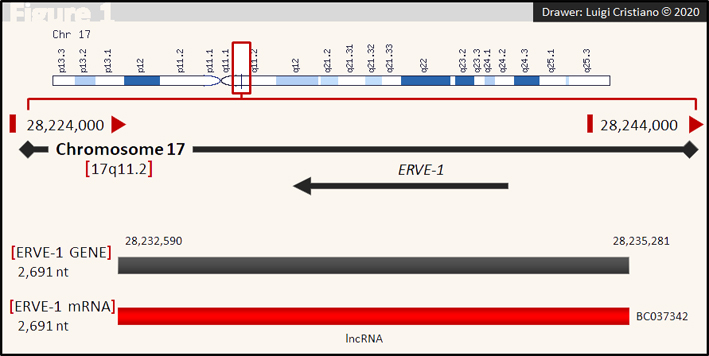
Figure. 1. ERVE-1 gene. The figure shows the locus on chromosome 17 of the ERVE-1 gene, its DNA and mRNA (reworked from https://www.ncbi.nlm.nih.gov/gene; http://grch37.ensembl.org; www.genecards.org)
Transcription
Usually, human ERVs are silenced epigenetically and are not transcribed (Kewitz and Staege, 2013), however, they are found to be transcribed in particular situations, such as under pathological conditions, and usually their transcription is initiated by promoter sequences within the proviral LTRs (Mayer et al, 2011).
ERVE-1 mRNA is 2,691 bp long with a reference sequence reported in GeneBank as BC037342. It is also present in the Ensembl database with a sequence named ERVE-1-201 (ENST00000592016.1) and it is considered to be a long non-coding RNA (lncRNA). Abundant ERVE-1 transcript was found in normal pancreas and thyroid tissues (Shiroma et al, 2001) and this suggests that it may play a role in their physiologic functions. In addition, the long terminal repeat (LTR)-derived promoter of ERVE-1 was found hypomethylated in placental cells whereas it was detected hypermethylated in blood cells (Ruebner et al, 2013; Reiss et al, 2007). This suggests that ERVE-1 could be transcribed in this tissue compared to others in which it is epigenetically silenced.
ERVE-1 mRNA is 2,691 bp long with a reference sequence reported in GeneBank as BC037342. It is also present in the Ensembl database with a sequence named ERVE-1-201 (ENST00000592016.1) and it is considered to be a long non-coding RNA (lncRNA). Abundant ERVE-1 transcript was found in normal pancreas and thyroid tissues (Shiroma et al, 2001) and this suggests that it may play a role in their physiologic functions. In addition, the long terminal repeat (LTR)-derived promoter of ERVE-1 was found hypomethylated in placental cells whereas it was detected hypermethylated in blood cells (Ruebner et al, 2013; Reiss et al, 2007). This suggests that ERVE-1 could be transcribed in this tissue compared to others in which it is epigenetically silenced.
Pseudogene
No observed pseudogenes for the ERVE-1 sequence.
Proteins
Note
It is well-known that human ERVs and ERV-like sequences no longer encode proteins because of the accumulation of nonsense mutations as a consequence of their ancient incorporation into the genome of the host (Mayer et al, 2011). For ERVE-1 sequence there is no protein reported.
Implicated in
Top note
Expression of ERVs is usually switched off (Kewitz and Staege, 2013) but the expression of ERVs and ERV-like sequences have been reported for a large number of human diseases, including cancer, however, their exact involvement and mechanism of action remain to be clarified (Mayer et al, 2011). ERVE-1 is poorly studied, however, it was reported for multiple sclerosis (MS) and Systemic lupus erythematosus (SLE).
Entity name
Multiple sclerosis (MS)
Note
ERVE-1 could have biological functions in the pathogenesis of multiple sclerosis (MS) (Kim et al, 2008; Antony et al, 2007), however, as the disease is very complex, further studies are needed to understand its contribution.
Entity name
Systemic lupus erythematosus (SLE)
Note
The expression level of ERVE-1 mRNA is found higher in lupus CD4+ T cells respect to healthy controls while the methylation of the LTR-derived promoter of ERVE-1 is found low in these patients (Suntsova et al, 2015; Wu et al, 2015). These data suggest that ERVE-1 is positively correlated with systemic lupus erythematosus (SLE) disease and that it is involved in its development (Wu et al, 2015).
Article Bibliography
| Pubmed ID | Last Year | Title | Authors |
|---|---|---|---|
| 23847767 | 2013 | Expression and Regulation of the Endogenous Retrovirus 3 in Hodgkin's Lymphoma Cells. | Kewitz S et al |
| 18604468 | 2008 | Quantitative expression of the HERV-W env gene in human tissues. | Kim HS et al |
| 11237011 | 2001 | Initial sequencing and analysis of the human genome. | Lander ES et al |
| 21542922 | 2011 | A revised nomenclature for transcribed human endogenous retroviral loci. | Mayer J et al |
| 17617638 | 2007 | Widely variable endogenous retroviral methylation levels in human placenta. | Reiss D et al |
| 23457515 | 2013 | Reduced syncytin-1 expression levels in placental syndromes correlates with epigenetic hypermethylation of the ERVW-1 promoter region. | Ruebner M et al |
| 11721880 | 2001 | Search for active endogenous retroviruses: identification and characterization of a HERV-E gene that is expressed in the pancreas and thyroid. | Shiroma T et al |
| 26082181 | 2015 | Molecular functions of human endogenous retroviruses in health and disease. | Suntsova M et al |
| 11956766 | 2002 | Organization and integration sites in the human genome of endogenous retroviral sequences belonging to HERV-E family. | Taruscio D et al |
| 25595738 | 2015 | DNA methylation modulates HERV-E expression in CD4+ T cells from systemic lupus erythematosus patients. | Wu Z et al |
Other Information
Locus ID:
NCBI: 85314
MIM: 606601
HGNC: 14602
Variants:
dbSNP: 85314
ClinVar: 85314
COSMIC: ERVE-1
References
| Pubmed ID | Year | Title | Citations |
|---|---|---|---|
| 25595738 | 2015 | DNA methylation modulates HERV-E expression in CD4+ T cells from systemic lupus erythematosus patients. | 30 |
| 25595738 | 2015 | DNA methylation modulates HERV-E expression in CD4+ T cells from systemic lupus erythematosus patients. | 30 |
Citation
Luigi Cristiano, MSc
ERVE-1 (endogenous retrovirus group E member 1)
Atlas Genet Cytogenet Oncol Haematol. 2020-06-01
Online version: http://atlasgeneticsoncology.org/gene/40490/
