ETS2 (v-ets erythroblastosis virus E26 oncogene homolog 2 (avian))
2008-07-01 Yvonne Buggy , Michael J Duffy AffiliationDrug Safety Research Unit, SO14 0 Southampton, UK (YB); UCD School of Medicine, Medical Science, University College Dublin, Ireland (MJD)
DNA/RNA
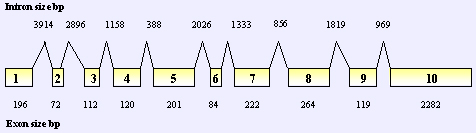
Exon-Intron structure of human ETS2.
Description
Ets-2 is a functioning gene comprising 10 exons and spanning 19.6 kb of genomic DNA. It encodes three mRNA transcripts: 4.7 kb, 3.6 kb and 2.7 kb, respectively (Watson et al., 1988). This suggests the existence of three functionally distinct proteins, potentially translated from these transcripts.
Transcription
Structural analysis of the Ets2 promoter has revealed the absence of TATA and CAAT boxes, thus allowing transcription initiation from multiple start sites (Papas et al., 1990a). The first Intron of Ets2 also contains transcriptional initiation sequences, facilitating transcription. These sequences may compensate for the absence of TATA and CAAT sites within the promoter (Begue et al., 1997). The three RNA transcripts are thought to arise from alternative splicing by a number of different promoter polyadenylation signals (Watson et al., 1990). All Ets genes, including Ets2, are characterised by a region of conserved sequence known as the Ets domain (GGAA/T). This comprises an 85 amino acid region which forms the winged helix-turn-helix DNA binding domain (Watson et al., 1990).
Proteins

Schematic representation of the Ets2 protein. The pointed domain, the transactivation domain and the Ets DNA binding domain are all shown.
Description
1-469 amino acids
Pointed domain: 87-170 amino acids
DNA binding domain: 363-443 amino acids.
The Ets2 protein consists of 469 amino acids, a pointed domain, a transactivation domain and the Ets DNA binding domain (Watson et al., 1988). The protein is thought to exist in two forms: a 52 kDa, thought to be the full length protein (Watson et al., 1988) and a 54 kDa protein, believed to be a phosphorylated protein (Ma et al.,1996). The Ets2 protein is phosphorylated by Ca2+- dependent mitogenic signaling (Fisher et al., 1989; Fujiwara et al., 1990).
Pointed domain: 87-170 amino acids
DNA binding domain: 363-443 amino acids.
The Ets2 protein consists of 469 amino acids, a pointed domain, a transactivation domain and the Ets DNA binding domain (Watson et al., 1988). The protein is thought to exist in two forms: a 52 kDa, thought to be the full length protein (Watson et al., 1988) and a 54 kDa protein, believed to be a phosphorylated protein (Ma et al.,1996). The Ets2 protein is phosphorylated by Ca2+- dependent mitogenic signaling (Fisher et al., 1989; Fujiwara et al., 1990).
Expression
Ets2 has previously been shown to play a role in cell proliferation and differentiation (Kilpatrick et al., 1999). Early studies demonstrated that overexpression of Ets2 results in cellular transformation and proliferation in vitro (Seth et al.,1989). Furthermore, transfection of non-tumourigenic cell lines with Ets2 results in increased cell adhesion and enhanced invasiveness. Increased Ets2 expression has been observed in breast (Buggy et al., 2006; Galang et al., 2004), prostate (Foos et al., 2000; Turner et al., 2007b), esophageal (Li et al., 2003) and hepatocellular (Liao et al., 1996) carcinomas.
Localisation
The Ets2 protein is located in the nucleus.
Function
Ets-2 has a number of important functions defined in mammalian systems. Ets genes are thought to act as positive or negative regulators of gene expression involved in various biological processes (Papas et al., 1989; Sapi et al., 1998). Ets-2 is thought to be involved in the regulation of cell proliferation and differentiation in certain cell types (Kilpatrick et al., 1999). In T-cells, Ets-2 expression is induced upon mitogenic stimulation (Bhat et al., 1987). It has been demonstrated that Ets-2 overexpression in myeloid progenitor cells stimulates the development of mature macrophages (Aperlo et al., 1996). Yamamoto et al., showed that deleting the Ets-2 gene in mice resulted in growth retardation and often embryonic death (Yamamoto et al.,1998). This may be due to a disruption in the transcriptional regulation of the epidermal growth factor and transforming growth factor-BETA.
Ets-2 expression has long been associated with Downs Syndrome. In 1990, Papas et al., identified and mapped two members of the Ets family of transcription factors - Ets-2 and Erg to the portion of chromosome 21 believed to be involved in Downs Syndrome (Papas et al., 1990 b). The Ets-2 gene is found in three copies in partial trisomies associated with the syndrome phenotype (Sacchi et al., 1988).
In the liver, Ets-2 expression has been associated with hepatic cell regeneration and also with the development of hepatocellular carcinoma (Bhat et al., 1996; Liao et al., 1996). Ets-2 expression has also been found in 30 % of rheumatoid arthritis patients (Sun et al., 2001). Ets-2 expression was reported in the synovial cells, suggesting an intrinsic activation mechanism of this immediate early gene in the disease process (Dooley et al., 1996).
A distinct role for Ets-2 in malignant transformation has been established. Seth et al., demonstrated that Ets-2 expression in NIH3T3 cells stimulates growth in the absence of serum growth factors (Seth et al., 1989). This group also showed that cell lines producing high levels of Ets-2 were capable of proliferating in the absence of serum. The Ets-2 transformed cells also exhibited anchorage-independent cell growth in agar suspension and tumourigenesis in nude mice. This study provides the first evidence of the transforming ability and mitogenic activity of Ets-2. Similar findings have been obtained by Sapi et al., using BT20 breast carcinoma cells (Sapi et al., 1998). Using these cells, colony formation was abolished following transfection with a dominant negative construct of Ets-2. Induction of Ets-2 has also been shown to be necessary for thyroid cell transformation (Sapi et al., 1998).
Ets-2 expression has long been associated with Downs Syndrome. In 1990, Papas et al., identified and mapped two members of the Ets family of transcription factors - Ets-2 and Erg to the portion of chromosome 21 believed to be involved in Downs Syndrome (Papas et al., 1990 b). The Ets-2 gene is found in three copies in partial trisomies associated with the syndrome phenotype (Sacchi et al., 1988).
In the liver, Ets-2 expression has been associated with hepatic cell regeneration and also with the development of hepatocellular carcinoma (Bhat et al., 1996; Liao et al., 1996). Ets-2 expression has also been found in 30 % of rheumatoid arthritis patients (Sun et al., 2001). Ets-2 expression was reported in the synovial cells, suggesting an intrinsic activation mechanism of this immediate early gene in the disease process (Dooley et al., 1996).
A distinct role for Ets-2 in malignant transformation has been established. Seth et al., demonstrated that Ets-2 expression in NIH3T3 cells stimulates growth in the absence of serum growth factors (Seth et al., 1989). This group also showed that cell lines producing high levels of Ets-2 were capable of proliferating in the absence of serum. The Ets-2 transformed cells also exhibited anchorage-independent cell growth in agar suspension and tumourigenesis in nude mice. This study provides the first evidence of the transforming ability and mitogenic activity of Ets-2. Similar findings have been obtained by Sapi et al., using BT20 breast carcinoma cells (Sapi et al., 1998). Using these cells, colony formation was abolished following transfection with a dominant negative construct of Ets-2. Induction of Ets-2 has also been shown to be necessary for thyroid cell transformation (Sapi et al., 1998).
Implicated in
Entity name
Human malignancies
Note
A growing number of human malignancies have been associated with Ets2 overexpression. Early studies have demonstrated overexpression of Ets2 results in cellular transformation (Seth et al., 1989). Ets2 has been shown to act as both a negative and positive regulator of gene expression in biological processes, including metastasis, angiogenesis, tissue remodeling and apoptosis (Papas et al., 1990a).
Entity name
Breast Cancer
Disease
Deregulation of Ets2 has been shown in human breast cancer (Turner et al., 2007a). Buggy et al., showed that both Ets2 mRNA and protein are overexpressed in human breast cancer compared with normal breast tissue (Buggy et al., 2006). Multiple studies in animal models and cell lines suggest that Ets2 is causally involved in breast cancer formation and progression (Buggy et al., 2006; Watabe et al., 1998). Transfection of the non-tumourigenic immortalized MCF-12A breast cancer cells with Ets2 resulted in serum growth factor independent proliferation, growth in soft agar and enhanced invasiveness (Sapi et al., 1998). In addition, Ets2 plays an important regulatory role in controlling expression of the breast tumour promoting protein, parathyroid hormone-related protein (Lindemann et al., 2003).
Entity name
Esophageal Carcinoma
Disease
Overexpression of Ets2 has been observed in human esophageal carcinoma (Li et al., 2003). Compared with normal tissue expression of both Ets2 mRNA and protein are upregulated in tumour tissue, suggesting a role in the pathology of esophageal carcinoma.
Entity name
Prostate Cancer
Disease
Increased expression of Ets2 has been shown in human prostate cancer (Foos et al., 2000; Turner et al., 2007b). Inhibition of Ets2 by antisense oligonucleotides or dominant negative constructs reduces anchorage-independent growth of prostate cancer cells, significantly reduces the ability of cells to form colonies in soft agar and reduces tumour formation in nude mice. Furthermore, Ets2 has been associated with the transcriptional upregulation of uPA and matrix metalloproteinases (Man et al., 2003; Trojanowska, 2000), which are associated with prognosis in prostate cancer.
Article Bibliography
| Pubmed ID | Last Year | Title | Authors |
|---|---|---|---|
| 8943340 | 1996 | Constitutive c-ets2 expression in M1D+ myeloblast leukemic cells induces their differentiation to macrophages. | Aperlo C et al |
| 9495315 | 1997 | Identification of a second promoter in the human c-ets-2 proto-oncogene. | Bègue A et al |
| 3472202 | 1987 | Temporal and tissue-specific expression of mouse ets genes. | Bhat NK et al |
| 16380248 | 2006 | Ets2 transcription factor in normal and neoplastic human breast tissue. | Buggy Y et al |
| 8660103 | 1996 | Constitutive expression of c-fos and c-jun, overexpression of ets-2, and reduced expression of metastasis suppressor gene nm23-H1 in rheumatoid arthritis. | Dooley S et al |
| 2516500 | 1989 | c-ets-2 and the mitogenic signal pathway. | Fisher RJ et al |
| 11114728 | 2000 | Altered Ets transcription factor activity in prostate tumor cells inhibits anchorage-independent growth, survival, and invasiveness. | Foos G et al |
| 2137553 | 1990 | Phosphorylation of the ETS-2 protein: regulation by the T-cell antigen receptor-CD3 complex. | Fujiwara S et al |
| 14662758 | 2004 | Changes in the expression of many Ets family transcription factors and of potential target genes in normal mammary tissue and tumors. | Galang CK et al |
| 10377039 | 1999 | Transcription factors Ets1, Ets2, and Elf1 exhibit differential localization in human endometrium across the menstrual cycle and alternate isoforms in cultured endometrial cells. | Kilpatrick LM et al |
| 12532432 | 2003 | Overexpression of ETS2 in human esophageal squamous cell carcinoma. | Li X et al |
| 8620444 | 1996 | Expression of the c-jun, jun-B, ets-2 and liver regeneration factor-1 (LRF-1) genes during promotion and progression of rat liver carcinogenesis in the resistant hepatocyte model. | Liao DZ et al |
| 12628005 | 2003 | Ets2 and protein kinase C epsilon are important regulators of parathyroid hormone-related protein expression in MCF-7 breast cancer cells. | Lindemann RK et al |
| 8958954 | 1996 | A novel ets-2-related nuclear factor is involved in transcriptional activation of the human interleukin-12 p40 gene promoter in response to interferon-gamma and LPS stimulation of monocytic cells. | Ma X et al |
| 14612405 | 2003 | Ets2-dependent stromal regulation of mouse mammary tumors. | Man AK et al |
| 2247505 | 1990 | The ETS family of genes: structural analysis, gene products, and involvement in neoplasia and other pathologies. | Papas TS et al |
| 2659278 | 1989 | The ets family of genes: molecular biology and functional implications. | Papas TS et al |
| 2149958 | 1990 | ETS family of genes in leukemia and Down syndrome. | Papas TS et al |
| 3267212 | 1988 | The ETS genes on chromosome 21 are distal to the breakpoint of the acute myelogenous leukemia translocation (8;21). | Sacchi N et al |
| 9500466 | 1998 | Ets-2 transdominant mutant abolishes anchorage-independent growth and macrophage colony-stimulating factor-stimulated invasion by BT20 breast carcinoma cells. | Sapi E et al |
| 9879994 | 1998 | ETS2 function is required to maintain the transformed state of human prostate cancer cells. | Sementchenko VI et al |
| 2813360 | 1989 | c-ets-2 protooncogene has mitogenic and oncogenic activity. | Seth A et al |
| 12182227 | 2002 | ETS proteins and MMPs: partners in invasion and metastasis. | Singh S et al |
| 11248661 | 2001 | Messenger-RNA expression of matrix metalloproteinases, tissue inhibitors of metalloproteinases, and transcription factors in rheumatic synovial cells under mechanical stimuli. | Sun HB et al |
| 11175362 | 2000 | Ets factors and regulation of the extracellular matrix. | Trojanowska M et al |
| 17661355 | 2007 | Defining ETS transcription regulatory networks and their contribution to breast cancer progression. | Turner DP et al |
| 17308102 | 2007 | Prostate-derived ETS factor is a mediator of metastatic potential through the inhibition of migration and invasion in breast cancer. | Turner DP et al |
| 9639404 | 1998 | The Ets-1 and Ets-2 transcription factors activate the promoters for invasion-associated urokinase and collagenase genes in response to epidermal growth factor. | Watabe T et al |
| 1964597 | 1990 | Molecular analysis of the ets genes and their products. | Watson DK et al |
| 2847145 | 1988 | Mammalian ets-1 and ets-2 genes encode highly conserved proteins. | Watson DK et al |
| 9573048 | 1998 | Defective trophoblast function in mice with a targeted mutation of Ets2. | Yamamoto H et al |
Other Information
Locus ID:
NCBI: 2114
MIM: 164740
HGNC: 3489
Ensembl: ENSG00000157557
Variants:
dbSNP: 2114
ClinVar: 2114
TCGA: ENSG00000157557
COSMIC: ETS2
RNA/Proteins
Expression (GTEx)
Pathways
PharmGKB
| Entity ID | Name | Type | Evidence | Association | PK | PD | PMIDs |
|---|---|---|---|---|---|---|---|
| PA443622 | Carcinoma, Non-Small-Cell Lung | Disease | ClinicalAnnotation | associated | PD | 31616045 | |
| PA445846 | Thrombocytopenia | Disease | ClinicalAnnotation | associated | PD | 31616045 | |
| PA448803 | carboplatin | Chemical | ClinicalAnnotation | associated | PD | 31616045 | |
| PA449748 | gemcitabine | Chemical | ClinicalAnnotation | associated | PD | 31616045 |
References
| Pubmed ID | Year | Title | Citations |
|---|---|---|---|
| 38839969 | 2024 | A disease-associated gene desert directs macrophage inflammation through ETS2. | 1 |
| 38839969 | 2024 | A disease-associated gene desert directs macrophage inflammation through ETS2. | 1 |
| 36975761 | 2023 | ETS2 alleviates acute-on-chronic liver failure by suppressing excessive inflammation. | 2 |
| 37062218 | 2023 | Suppression of USP7 negatively regulates the stability of ETS proto-oncogene 2 protein. | 2 |
| 37171262 | 2023 | ETS2 promotes cardiomyocyte apoptosis and autophagy in heart failure by regulating lncRNA TUG1/miR-129-5p/ATG7 axis. | 7 |
| 37892157 | 2023 | USP39-Mediated Non-Proteolytic Control of ETS2 Suppresses Nuclear Localization and Activity. | 0 |
| 36975761 | 2023 | ETS2 alleviates acute-on-chronic liver failure by suppressing excessive inflammation. | 2 |
| 37062218 | 2023 | Suppression of USP7 negatively regulates the stability of ETS proto-oncogene 2 protein. | 2 |
| 37171262 | 2023 | ETS2 promotes cardiomyocyte apoptosis and autophagy in heart failure by regulating lncRNA TUG1/miR-129-5p/ATG7 axis. | 7 |
| 37892157 | 2023 | USP39-Mediated Non-Proteolytic Control of ETS2 Suppresses Nuclear Localization and Activity. | 0 |
| 33859300 | 2021 | A novel tissue specific alternative splicing variant mitigates phenotypes in Ets2 frame-shift mutant models. | 6 |
| 33859300 | 2021 | A novel tissue specific alternative splicing variant mitigates phenotypes in Ets2 frame-shift mutant models. | 6 |
| 31641227 | 2020 | ETS2 promotes epithelial-to-mesenchymal transition in renal fibrosis by targeting JUNB transcription. | 7 |
| 31763674 | 2020 | ΔNp73/ETS2 complex drives glioblastoma pathogenesis- targeting downstream mediators by rebastinib prolongs survival in preclinical models of glioblastoma. | 18 |
| 31810605 | 2020 | Protein C-ets-2 epigenetically suppresses TLRs-induced interleukin 6 production in macrophages. | 3 |
Citation
Yvonne Buggy ; Michael J Duffy
ETS2 (v-ets erythroblastosis virus E26 oncogene homolog 2 (avian))
Atlas Genet Cytogenet Oncol Haematol. 2008-07-01
Online version: http://atlasgeneticsoncology.org/gene/40503/ets2
