FIP1L1 (factor interacting with PAPOLA and CPSF1)
2014-11-01 Adriana Zamecnikova , Soad Al Bahar AffiliationKuwait Cancer Control Center, Department of Hematology, Laboratory of Cancer Genetics, Kuwait
Identity
HGNC
LOCATION
4q12
LOCUSID
ALIAS
FIP1,Rhe,hFip1
FUSION GENES
DNA/RNA
Description
Belongs to the FIP1 family; predicted to be under the control of a ubiquitous promoter (Gotlib et al., 2004).
Proteins
Expression
FIP1L1 expression is present in different immunitary cells, embrionic and fetal cells, reproductive tissues, in blood and bone marrow and others.
Localisation
Subcellular location: Nucleus.
Function
FIP1L1 is an important part of the eukaryotic polyadenylation apparatus that plays a key role in polyadenylation of mRNA precursors (pre-mRNAs) by poly(A) polymerase (PAP). FIP1L1 is an integral component of the cleavage and polyadenylation specificity factor (CPSF) complex that is composed of CPSF1, CPSF2, CPSF3, CPSF4 and FIP1L. This multisubunit complex polyadenylates the 3 end of mRNA precursors by binding to the canonical AAUAAA signal and to U-rich sequences of mRNA precursors. The FIP1L1 protein is an important bridging factor in polyadenylation processes by providing links between RNA, poly(A) polymerase and other multisubunit complexes. Contributes to recognition of polyadenylation signal and may contribute to the differential recognition of various RNAs. It also interacts with poly(A)polymerase (PAP) and CPSF160 forming a ternary complex in vitro, suggesting that they may act together in poly(A) site recognition and in recruitment of PAP to the RNA, thereby stimulating the otherwise weakly active and nonspecific polymerase (Preker et al., 1995). Stimulates poly(A) addition by binding to U-rich elements via arginine-rich RNA binding motif that lies within the C-terminus of the protein, thus significantly contributes to CPSF-mediated stimulation of PAP activity (Kaufmann et al., 2004). FIP1L1 also may act to tether poly(A) polymerase to the CPSF complex and may stabilize the association of PAP with the polyadenylation apparatus. Presumably act as a RNA modulator and active player in transformation from DNA to protein (Preker et al., 1995; Helmling et al., 2001; Kaufmann et al., 2004). Many unknown roles as the exact function of FIP1L1 is unknown.
Description
Size: 4 isoforms as a result of splicing processes; the larger transcript has 594 amino acids (molecular weight 66526 Da). In the second isoform (559 amino acids; 63048 Da), exon 9 is deleted. The third isoform is the shortest (378 amino acids; molecular weight 40835 Da) due to the deletion of some exons (exon 2 and 14-18) during splicing processes. In the last isoform, exons 2, 9 and 11 are deleted.
Implicated in
Entity name
Various cancers
Note
Diseases associated with FIP1L1 include eosinophilia-associated hematological malignancies, juvenile myelomonocytic leukemia (JMML) and acute promyelocytic leukemia (APL). FIP1L1 rearrangements are associated with two distinct leukemogenic fusion genes: FIP1L1-PDGFRA (platelet-derived growth factor receptor alpha) and FIP1L1-RARA (retinoic acid receptor alpha) (Figure 1). Genomic breakpoints in these rearrangements are variable, but FIP1L1 usually breaks within various introns (Vandenberghe et al., 2004; Iwasaki et al., 2014).
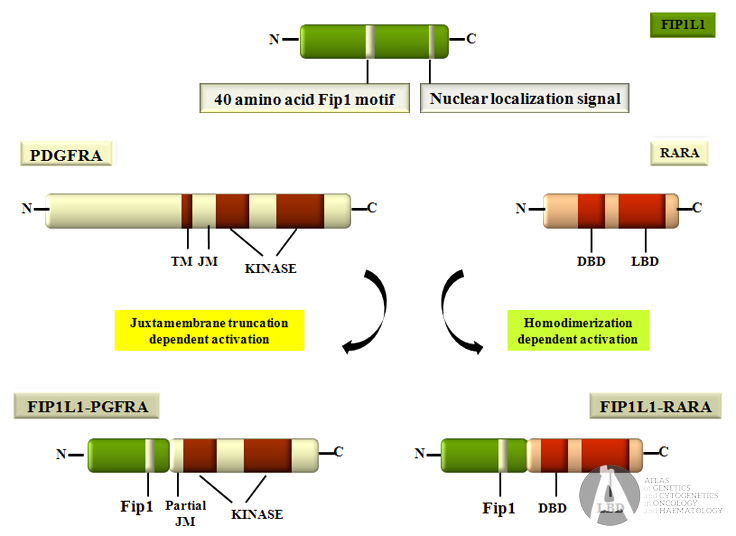
Figure 1. Mechanisms of FIP1L1 activation in hematologic malignancies. All known chimeric FIP1L1fusion proteins consists of the amino-terminal amino acids of FIP1L that includes the conserved FIP1 homology domain (40 amino acid Fip1 motif) and the carboxy-terminal part of the partner gene, thus the nuclear localization signal of FIP1L1 is absent in the fusion protein. To date, 2 fusions proteins of FIP1L1 are known: FIP1L1-PDGFRA and FIP1L1-RARA. While FIP1L1-PDGFRA is associated with hematologic disorders with primary eosinophilia, the FIP1L1-RARA fusion was identified in patients with JMML and APL, indicating that FIP1L1 may differentially contribute to the pathogenesis of distinct types of leukemia. In the FIP1L1-PDGFRa fusion protein, the C-terminal PDGFRA portion includes the entire kinase domain but only part of the autoinhibitory juxtamembrane region, making FIP1L1 dispensable for constitutive kinase activation that can be inhibited by administration of tyrosine kinase therapy (imatinib). FIP1 motif in FIP1L1-RARA seems to play a pivotal role in its homodimerization and repression of the retinoic acid response that is required for development of APL (adopted and modified from Gotlib et al., 2004). Abbreviations: N, N-terminal site; C, C-terminal site; TM, transmembrane domain; JM, juxtamembrane domain kinase, kinase domain; DBD, DNA binding domain; LBD, ligand binding domain; JMML, juvenile myelomonocytic leukemia; APL, acute promyelocytic leukemia.
Note
FIP1L1- PDGFRA (platelet-derived growth factor receptor, alpha) fusion have been reported in various neoplasms such as chronic eosinophilic Fusions leukemia, chronic neutrophilic leukemia, systemic mast cell disease, acute myeloid leukemia (AML) and T-cell lymphoblastic lymphoma, - all with overproduction of eosinophils in the blood and bone marrow; may be found in sporadic cases of myeloid sarcoma (granulocytic sarcoma) accompanied by or following AML. (Gotlib et al., 2004; Metzgeroth et al., 2007; Schmitt-Graeff et al., 2014).
Prognosis
Excellent with the use of tyrosine kinase inhibitors (imatinib).
Cytogenetics
The FIP1L1-PDGFRA fusion gene is the consequence of a cytogenetically invisible interstitial chromosomal deletion of approximately 800 kb on chromosome band 4q12. Occasionally, FIP1L1-PDGFRA fusions are caused by chromosomal translocations such as t(1;4)(q44;q12) and t(4;10)(q12;p11). In both cases, the interstitial deletion creates an in-frame fusion and as a consequence genes between FIP1L1 and PDGFRA are deleted.
Hybrid gene
5FIP1L1-3PDGFRA.
Fusion protein
The encoded FIP1L1-PDGFRA fusion protein consists of the first 233 amino acids of FIP1L1 (including the Fip1 motif) and the C-terminal part of PDGFRA, encompassing the truncated JM region and the entire kinase domain.
Oncogenesis
The genomic breakpoints within FIP1L1 have been found to be variably distributed (introns 9-13), whereas all breakpoints in PDGFRA are exclusively found within exon 12, which encompasses the juxtamembrane (JM) domain that is notable for its autoinhibitory function (The interruption of the JM domain of PDGFRA is a consistent feature of FIP1L1-PDGFRA fusions further underlying its functional significance in kinase activation (Walz et al., 2009; Iwasaki et al., 2014)). Similar to the BCR-ABL1 fusion protein in chronic myeloid leukemia, FIP1L1-PDGFRA is a constitutively activated tyrosine kinase that is causally implicated in disease pathogenesis with potential evolution from chronic phase disease to disease progression as well as sensitivity to treatments with tyrosine kinase inhibitors such as imatinib (Cools et al., 2003; Jain et al., 2013).
Entity name
t(4;17)(q12;q21)/ FIP1L1/RARA
Disease
Juvenile myelomonocytic leukemia and acute promyelocytic leukemia.
Prognosis
Unknown, as only sporadic cases have been described. Reported cases described similar ATRA response of FIP1L1-RARA to that of PML-RARA fusions.
Cytogenetics
t(4;17)(q12;q21).
Hybrid gene
In-frame fusion of 5FIP1L1-3RARA and 5RARA-3FIP1L1.
In all patients the rearrangement fused the RARA exon 3 with exon 15 (Buijs et al., 2007; Kondo et al., 2008) or exon 13 of the FIP1L1 gene (Menezes et al., 2011), in a manner identical to all known RARA associated APL fusions.
In all patients the rearrangement fused the RARA exon 3 with exon 15 (Buijs et al., 2007; Kondo et al., 2008) or exon 13 of the FIP1L1 gene (Menezes et al., 2011), in a manner identical to all known RARA associated APL fusions.
Fusion protein
832 amino acids; in-frame fusion protein composed of 428 amino-terminal amino acids of FIP1L (including the FIP1 homology domain) and 403 terminal carboxyl-amino acids of RARA, including the DNA and ligand binding domains (Kondo et al., 2008). Alternative splicing of the FIP1L1 portion results in multiple transcript variants similar to FIP1L1-PDGFRA distinct isoforms.
Oncogenesis
FIP1L1 is a subunit of the cleavage and polyadenylation specific factor (CPSF) complex that is involved in 3-end mRNA processing, therefore it is possible that FIP1L1/RARA may interfere with FIP1L1 function (Kaufmann et al., 2004). On the other hand, retinoic acid receptor alpha (RARA), also known as NR1B1 (nuclear receptor subfamily 1, group B, member 1) is a nuclear receptor that is preferentially expressed in myeloid cells. Translocations that involve the RARA gene are characteristic findings in acute promyelocytic leukemia and several RARA partner genes have been identified resulting in various fusion gene products. In all known chimeric RARA fusions the homodimerization ability of fusion proteins appears to be critical for leukemic transformation as well as for repression of retinoic acid-responsive transcriptional activity. While FIP1L1 dont have the known protein-protein interaction domain, experimental studies with deletion mutants revealed that the FIP1 motif in FIP1L1-RARA plays a role in homodimer formation and transcriptional repressor activity. In fact, homodimer formation was demonstrated in all three identified isoforms of FIP1L1-RARA, as well as RARA-FIP1L1. In addition, FIP1L1-RARA associated with either FIP1L1-RARA or FIP1L1, but not with RARA, further supporting the role of the FIP1L1 portion in homodimerization (Buijs et al., 2007; Kondo et al., 2008; Iwasaki et al., 2014). The FIP1L1 promoter regulated expression may underlie these processes and may influence FIP1L1-RARA-mediated leukemogenesis by differential gene expression of numerous potential target genes and activation of multiple signaling pathways. However, the molecular basis for FIP1L1-RARA- mediated leukemogenesis is most likely complex and still remains to be clarified.
Breakpoints
Article Bibliography
| Pubmed ID | Last Year | Title | Authors |
|---|---|---|---|
| 17301809 | 2007 | Fusion of FIP1L1 and RARA as a result of a novel t(4;17)(q12;q21) in a case of juvenile myelomonocytic leukemia. | Buijs A et al |
| 12660384 | 2003 | A tyrosine kinase created by fusion of the PDGFRA and FIP1L1 genes as a therapeutic target of imatinib in idiopathic hypereosinophilic syndrome. | Cools J et al |
| 15070659 | 2004 | The FIP1L1-PDGFRalpha fusion tyrosine kinase in hypereosinophilic syndrome and chronic eosinophilic leukemia: implications for diagnosis, classification, and management. | Gotlib J et al |
| 11238938 | 2001 | Fip1 regulates the activity of Poly(A) polymerase through multiple interactions. | Helmling S et al |
| 24763514 | 2014 | FIP1L1 presence in FIP1L1-RARA or FIP1L1-PDGFRA differentially contributes to the pathogenesis of distinct types of leukemia. | Iwasaki J et al |
| 24203930 | 2013 | Imatinib therapy in a patient with suspected chronic neutrophilic leukemia and FIP1L1-PDGFRA rearrangement. | Jain N et al |
| 14749727 | 2004 | Human Fip1 is a subunit of CPSF that binds to U-rich RNA elements and stimulates poly(A) polymerase. | Kaufmann I et al |
| 18603554 | 2008 | The seventh pathogenic fusion gene FIP1L1-RARA was isolated from a t(4;17)-positive acute promyelocytic leukemia. | Kondo T et al |
| 21750086 | 2011 | FIP1L1/RARA with breakpoint at FIP1L1 intron 13: a variant translocation in acute promyelocytic leukemia. | Menezes J et al |
| 17377585 | 2007 | Recurrent finding of the FIP1L1-PDGFRA fusion gene in eosinophilia-associated acute myeloid leukemia and lymphoblastic T-cell lymphoma. | Metzgeroth G et al |
| 7736590 | 1995 | The FIP1 gene encodes a component of a yeast pre-mRNA polyadenylation factor that directly interacts with poly(A) polymerase. | Preker PJ et al |
| 24458279 | 2014 | The FIP1L1-PDGFRA fusion gene and the KIT D816V mutation are coexisting in a small subset of myeloid/lymphoid neoplasms with eosinophilia. | Schmitt-Graeff AH et al |
| 14973504 | 2004 | Clinical and molecular features of FIP1L1-PDFGRA (+) chronic eosinophilic leukemias. | Vandenberghe P et al |
| 18987651 | 2009 | The molecular anatomy of the FIP1L1-PDGFRA fusion gene. | Walz C et al |
Other Information
Locus ID:
NCBI: 81608
MIM: 607686
HGNC: 19124
Ensembl: ENSG00000145216
Variants:
dbSNP: 81608
ClinVar: 81608
TCGA: ENSG00000145216
COSMIC: FIP1L1
RNA/Proteins
Expression (GTEx)
Pathways
Protein levels (Protein atlas)
PharmGKB
| Entity ID | Name | Type | Evidence | Association | PK | PD | PMIDs |
|---|---|---|---|---|---|---|---|
| PA10804 | imatinib | Chemical | LabelAnnotation, Literature, MultilinkAnnotation | associated | 24433361 |
References
| Pubmed ID | Year | Title | Citations |
|---|---|---|---|
| 36073787 | 2022 | Fip1 is a multivalent interaction scaffold for processing factors in human mRNA 3' end biogenesis. | 4 |
| 36073787 | 2022 | Fip1 is a multivalent interaction scaffold for processing factors in human mRNA 3' end biogenesis. | 4 |
| 34304603 | 2021 | FIP1L1-PDGFRA-Associated Hypereosinophilic Syndrome as a Treatable Cause of Watershed Infarction. | 8 |
| 34304603 | 2021 | FIP1L1-PDGFRA-Associated Hypereosinophilic Syndrome as a Treatable Cause of Watershed Infarction. | 8 |
| 32125294 | 2020 | Exquisite response to imatinib mesylate in FIP1L1-PDGFRA-mutated hypereosinophilic syndrome: a 12-year experience of the Polish Hypereosinophilic Syndrome Study Group. | 1 |
| 32125294 | 2020 | Exquisite response to imatinib mesylate in FIP1L1-PDGFRA-mutated hypereosinophilic syndrome: a 12-year experience of the Polish Hypereosinophilic Syndrome Study Group. | 1 |
| 29310833 | 2018 | Myeloid neoplasm with eosinophilia associated with isolated extramedullary FIP1L1/PDGFRA rearrangement. | 2 |
| 30157244 | 2018 | Whole exome sequencing in Finnish families identifies new candidate genes for osteoarthritis. | 2 |
| 29310833 | 2018 | Myeloid neoplasm with eosinophilia associated with isolated extramedullary FIP1L1/PDGFRA rearrangement. | 2 |
| 30157244 | 2018 | Whole exome sequencing in Finnish families identifies new candidate genes for osteoarthritis. | 2 |
| 28374041 | 2017 | Imatinib Treatment of Lymphomatoid Papulosis Associated with Myeloproliferative Hypereosinophilic Syndrome Presenting the FIP1L1-PDGFRA Fusion Gene. | 0 |
| 29274231 | 2017 | Structural insights into the assembly and polyA signal recognition mechanism of the human CPSF complex. | 48 |
| 28374041 | 2017 | Imatinib Treatment of Lymphomatoid Papulosis Associated with Myeloproliferative Hypereosinophilic Syndrome Presenting the FIP1L1-PDGFRA Fusion Gene. | 0 |
| 29274231 | 2017 | Structural insights into the assembly and polyA signal recognition mechanism of the human CPSF complex. | 48 |
| 27120808 | 2016 | Long-term outcomes of imatinib in patients with FIP1L1/ PDGFRA associated chronic eosinophilic leukemia: experience of a single center in China. | 14 |
Citation
Adriana Zamecnikova ; Soad Al Bahar
FIP1L1 (factor interacting with PAPOLA and CPSF1)
Atlas Genet Cytogenet Oncol Haematol. 2014-11-01
Online version: http://atlasgeneticsoncology.org/gene/40577/fip1l1-(factor-interacting-with-papola-and-cpsf1)
