ID1 (inhibitor of DNA binding 1, dominant negative helix-loop-helix protein)
2012-09-01 Eduardo Castañón , Ignacio Gil-Bazo AffiliationNew target therapies laboratory, Division of Oncology, Center for Applied Medical Research, 31621 Pamplona, Spain
DNA/RNA
Description
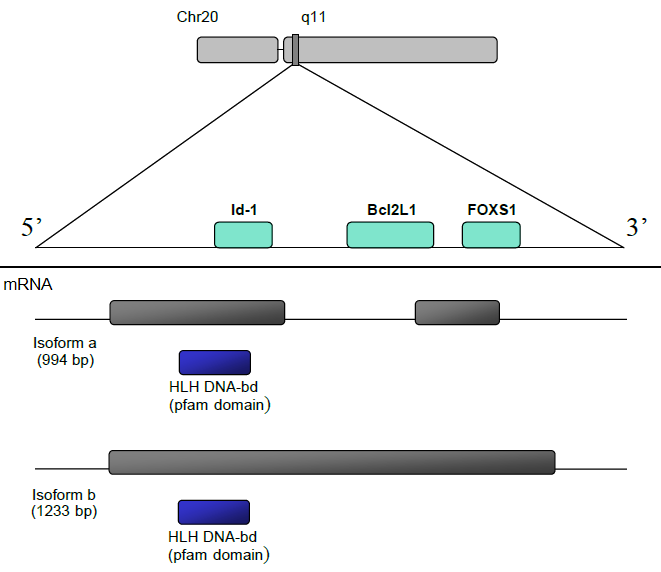
DNA contains 1239 bp encoding 2 coding exons.
Transcription
Id1 gene has 2 transcripts, called Id1-001 (or Id1A) and Id-1-002 (or Id1B). mRNA Id1A contains 994 bps whereas mRNA Id1B contains 1233 bps. Id1A is considered the "canonical sequence".
Proteins
Description
ID1 belongs to the helix-loop-helix protein family. It is composed by 155 aa. It has a main domain located on 143-155 aa responsible for the helix-loop-helix conformation. Its main motif, encoded by 14 aa is responsible for the nuclear export signaling.
Expression
High levels of ID1 are found in brain, liver, lung, skin and thyroid gland cells. It is also expressed in fetal cells and in the umbilical vein endothelial cell.
Localisation
Nucleus.
Function
Although it does not bind directly to DNA, by binding basic helix-loop-helix transcription factors through its HLH motif, ID1 may control tissue-specific genes related to cell growth, proliferation, differentiation and angiogenesis.
Homology
H.sapiens: ID1; P.troglodytes: ID1; C.lupus: ID1; B.taurus: ID1; M.musculus: Id1; R.norvegicus: Id1; G.gallus: ID1; D.rerio: id1.
Mutations
Germinal
No germinal mutations have been reported.
Somatic
No somatic mutations have been reported.
Implicated in
Entity name
Non small cell lung cancer
Note
ID1 levels are correlated with a worse prognosis in lung adenocarcinoma in both, disease free survival and overall survival. A higher expression of Id1 has been reported in squamous cell carcinoma and adenocarcinoma of the lung. ID1 expression are detected in more resistant tumors to either chemo and radiation therapy. When silencing Id1 in in vitro models, a reversal of resistance to the treatment (both chemotherapy and radiation) was observed.
Entity name
Gastric cancer
Note
Gastric cancer prognosis has also been linked to ID1 expression levels. Whereas poor differentiated gastric tumors express higher levels of ID1, those gastric cancers with a higher differentiation, and thus, a better prognosis, express a lower quantity of ID1. Nevertheless, the impact of ID1 expression on clinical outcome has not reached statistical significance when a multivariate analysis was carried out.
Entity name
Breast cancer
Note
In breast cancer, especially in those node negative tumors, ID1 expression has become an independent prognostic factor. Higher levels of ID1 are related to a worse prognosis (measured by both, overall survival and disease free survival). This may be explained by the possible relation between ID1 and the steroid-receptor, this latter considered a factor which may change therapeutic options in breast cancer patients.
Entity name
Prostate cancer
Note
In prostate cancer it has been observed that levels of ID1 are correlated to the grade of differentiation measured by the Gleason score, detecting higher levels of ID1 in those prostate tumors with a higher Gleason score. Comparing prostate cancer with benign prostate hyperplasia, ID1 expression differences may also be seen; ID1 is not expressed in benign prostate hyperplasia (BPH), whereas ID1 expression is remarkably higher in prostate cancer cells.
Entity name
Melanoma
Note
In melanoma ID1 is also positively related to tumor thickness and also with overall survival. Also, ID1 is highly expressed in those BRAF mutated melanomas compared to BRAF wild type melanomas. ID1 negative regulates CDKN2A, which has been related to malignant melanoma development. ID1 is expressed in the earliest stages of melanoma.
Entity name
Glioblastoma
Note
In recent studies, ID1 has been catalogued as a marker of brain stem cells localized at the perivascular niche. Those stem cells with higher levels of ID1 have a major capability of tumor initiation and therapeutic resistance.
Entity name
Hepatocarcinoma
Note
In Hepatitis B virus-induced hepatocarcinoma, levels of ID1 may predict both disease free survival and overall survival, in a negative manner. Also, ID1 has been related to bad prognostic features such as portal vein invasion, lymph node metastasis and a worse Child Pugh grade.
Entity name
Anaplastic thyroid tumor
Note
ID1 is highly expressed in anaplastic thyroid tumors rather than in regular thyroid cells; it may be explained by the role ID1 plays on cell growth and differentiation.
Entity name
Neurogenesis
Note
Lacking of Id1 alleles (with simultaneous Id3 downregulation) triggers neural differentiation in mice embryos development resulting in a lethal event. It has also been reported that when Id1 and Id3 are not expressed, vascular sprouting in brain does not occur.
Entity name
Heart and vessel formation
Note
Id1 has also being related to play a crucial role in heart development, since Id1 knockout mice showed ventricular defects and myocardium trabeculation impairment. ID1 is also expressed in endothelial progenitor cells, and its suppression is related to angiogenesis inhibition and in a blockade of endothelial cells mobilization.
Entity name
Hematopoiesis
Note
Higher ID1 levels are found in pro-B cells, whereas it is downregulated in pre-B and mature cells. When blocking Id1 in those cells, B-cell development is disrupted.
Entity name
Metastasis
Note
Higher levels of ID1 expression are found in those breast cancers which are more prone to metastasize to the lung. Id1 has been described as part of the genes signature for breast cancer metastasis to the lung.
Entity name
Stemcellness and selfrenewal
Note
Satellite cells are muscle stem cells related to injured muscle renewal. ID1 expression has been recently correlated to muscle stem cell self-renewal ability, showing that when ID1 is expressed, a higher capability of self-renewal may be observed. Culture cells with high ID1 expression, may retain selfrenewal ability after several passages comparing to those cells with lower levels of ID1.
Stem cells are characterized by their anchorage to an special microenviroment, also known as niche. ID1, by repressing the activation of Rap1GAP (an inhibitor of an important neural cell adhesion protein known as RAP1) assure stem cell joints to the niche. When ID1 is downregulated, neural stem cells detach from the brain stem cell niches, such as the ventricular zone in embryonic brain and the subventricular zone of post-nata brain. This detachment from the niches, may also trigger neuronal and oligodendrogial differentiation.
Stem cells are characterized by their anchorage to an special microenviroment, also known as niche. ID1, by repressing the activation of Rap1GAP (an inhibitor of an important neural cell adhesion protein known as RAP1) assure stem cell joints to the niche. When ID1 is downregulated, neural stem cells detach from the brain stem cell niches, such as the ventricular zone in embryonic brain and the subventricular zone of post-nata brain. This detachment from the niches, may also trigger neuronal and oligodendrogial differentiation.
Article Bibliography
| Pubmed ID | Last Year | Title | Authors |
|---|---|---|---|
| 21156287 | 2010 | TGF-β Receptor Inhibitors Target the CD44(high)/Id1(high) Glioma-Initiating Cell Population in Human Glioblastoma. | Anido J et al |
| 9821964 | 1998 | The helix-loop-helix transcription factors Id1 and Id3 have a functional role in control of cell division in human normal and neoplastic chondrocytes. | Asp J et al |
| 2156629 | 1990 | The protein Id: a negative regulator of helix-loop-helix DNA binding proteins. | Benezra R et al |
| 11840326 | 2001 | The Id proteins and angiogenesis. | Benezra R et al |
| 11673054 | 2001 | Role of Id proteins in embryonic and tumor angiogenesis. | Benezra R et al |
| 20414347 | 2010 | Id1 promotes tumor cell migration in nonsmall cell lung cancers. | Bhattacharya R et al |
| 21536374 | 2011 | Id1 promotes lung cancer cell proliferation and tumor growth through Akt-related pathway. | Cheng YJ et al |
| 14742319 | 2004 | Id-1-induced Raf/MEK pathway activation is essential for its protective role against taxol-induced apoptosis in nasopharyngeal carcinoma cells. | Cheung HW et al |
| 18092003 | 2007 | Id1 restrains p21 expression to control endothelial progenitor cell formation. | Ciarrocchi A et al |
| 9671467 | 1998 | A novel pathway for mammary epithelial cell invasion induced by the helix-loop-helix protein Id-1. | Desprez PY et al |
| 20574154 | 2010 | Overexpressed Id-1 is associated with patient prognosis and HBx expression in hepatitis B virus-related hepatocellular carcinoma. | Ding R et al |
| 1426618 | 1992 | The gene for the helix-loop-helix protein, Id, is specifically expressed in neural precursors. | Duncan M et al |
| 18381431 | 2008 | Regulation of Id1 expression by SRC: implications for targeting of the bone morphogenetic protein pathway in cancer. | Gautschi O et al |
| 18048329 | 2007 | ID genes mediate tumor reinitiation during breast cancer lung metastasis. | Gupta GP et al |
| 8294468 | 1994 | Id-related genes encoding helix-loop-helix proteins are required for G1 progression and are repressed in senescent human fibroblasts. | Hara E et al |
| 17227850 | 2007 | Id1 restrains myeloid commitment, maintaining the self-renewal capacity of hematopoietic stem cells. | Jankovic V et al |
| 20664928 | 2010 | Inhibition of tumourigenicity of small cell lung cancer cells by suppressing Id3 expression. | Kamalian L et al |
| 15026801 | 2004 | Overexpression of Id-1 is significantly associated with tumour angiogenesis in human pancreas cancers. | Lee KT et al |
| 12949053 | 2003 | Over-expression of Id-1 induces cell proliferation in hepatocellular carcinoma through inactivation of p16INK4a/RB pathway. | Lee TK et al |
| 17177845 | 2006 | The multiple roles of Id-1 in cancer progression. | Ling MT et al |
| 20881502 | 2011 | Downregulation of Id1 by small interfering RNA in prostate cancer PC3 cells in vivo and in vitro. | Ling YX et al |
| 21896993 | 2010 | Expression and prognostic relevance of Id1 in stage III esophageal squamous cell carcinoma. | Liu J et al |
| 10537105 | 1999 | Id1 and Id3 are required for neurogenesis, angiogenesis and vascularization of tumour xenografts. | Lyden D et al |
| 8586447 | 1995 | Chromosomal assignment of human ID1 and ID2 genes. | Mathew S et al |
| 20807818 | 2010 | Using the transcription factor inhibitor of DNA binding 1 to selectively target endothelial progenitor cells offers novel strategies to inhibit tumor angiogenesis and growth. | Mellick AS et al |
| 20191379 | 2010 | Targeting Id1 and Id3 by a specific peptide aptamer induces E-box promoter activity, cell cycle arrest, and apoptosis in breast cancer cells. | Mern DS et al |
| 19896442 | 2009 | High levels of Id1 expression define B1 type adult neural stem cells. | Nam HS et al |
| 22522171 | 2012 | Id proteins synchronize stemness and anchorage to the niche of neural stem cells. | Niola F et al |
| 16267257 | 2005 | Id1 gene transfer confers angiogenic property on fully differentiated endothelial cells and contributes to therapeutic angiogenesis. | Nishiyama K et al |
| 8415680 | 1993 | Bone morphogenetic protein 2 transiently enhances expression of a gene, Id (inhibitor of differentiation), encoding a helix-loop-helix molecule in osteoblast-like cells. | Ogata T et al |
| 22349695 | 2012 | Slow-dividing satellite cells retain long-term self-renewal ability in adult muscle. | Ono Y et al |
| 12016143 | 2002 | Id-1 stimulates serum independent prostate cancer cell proliferation through inactivation of p16(INK4a)/pRB pathway. | Ouyang XS et al |
| 17108123 | 2006 | Reassessment of id1 protein expression in human mammary, prostate, and bladder cancers using a monospecific rabbit monoclonal anti-id1 antibody. | Perk J et al |
| 8247002 | 1993 | The loop region of the helix-loop-helix protein Id1 is critical for its dominant negative activity. | Pesce S et al |
| 21606196 | 2011 | ID1 facilitates the growth and metastasis of non-small cell lung cancer in response to nicotinic acetylcholine receptor and epidermal growth factor receptor signaling. | Pillai S et al |
| 11507043 | 2001 | The transcriptional repressor of p16/Ink4a, Id1, is up-regulated in early melanomas. | Polsky D et al |
| 21540238 | 2011 | Inhibitor of differentiation-1 as a novel prognostic factor in NSCLC patients with adenocarcinoma histology and its potential contribution to therapy resistance. | Ponz-Sarvisé M et al |
| 22013995 | 2012 | Id1 maintains embryonic stem cell self-renewal by up-regulation of Nanog and repression of Brachyury expression. | Romero-Lanman EE et al |
| 20709421 | 2011 | The stem cell gene "inhibitor of differentiation 1" (ID1) is frequently expressed in non-small cell lung cancer. | Rothschild SI et al |
| 12888293 | 2003 | Id proteins in development, cell cycle and cancer. | Ruzinova MB et al |
| 15494533 | 2004 | Crucial role of inhibitor of DNA binding/differentiation in the vascular endothelial growth factor-induced activation and angiogenic processes of human endothelial cells. | Sakurai D et al |
| 21921026 | 2011 | ID1 inhibits USF2 and blocks TGF-β-induced apoptosis in mesangial cells. | Sato AY et al |
| 12640673 | 2003 | Overexpression of Id-1 is associated with poor clinical outcome in node negative breast cancer. | Schoppmann SF et al |
| 16189525 | 2005 | Strong expression of ID1 protein is associated with decreased survival, increased expression of ephrin-A1/EPHA2, and reduced thrombospondin-1 in malignant melanoma. | Straume O et al |
| 18842581 | 2008 | Cyclooxygenase-2-derived prostaglandin E2 stimulates Id-1 transcription. | Subbaramaiah K et al |
| 14566327 | 2003 | Pre-TCR-triggered ERK signalling-dependent downregulation of E2A activity in Notch3-induced T-cell lymphoma. | Talora C et al |
| 21955753 | 2011 | Cyclin D1, Id1 and EMT in breast cancer. | Tobin NP et al |
| 8628310 | 1996 | Transcription of the dominant-negative helix-loop-helix protein Id1 is regulated by a protein complex containing the immediate-early response gene Egr-1. | Tournay O et al |
| 16271072 | 2005 | Targeting Id1 and Id3 inhibits peritoneal metastasis of gastric cancer. | Tsuchiya T et al |
| 20080245 | 2011 | Expression and prognostic values of Id-1 and Id-3 in gastric adenocarcinoma. | Yang HY et al |
| 20522807 | 2010 | Smad-dependent and smad-independent induction of id1 by prostacyclin analogues inhibits proliferation of pulmonary artery smooth muscle cells in vitro and in vivo. | Yang J et al |
| 18752043 | 2009 | Inhibitor of DNA binding-1 overexpression in prostate cancer: relevance to tumor differentiation. | Yu X et al |
| 14526102 | 2003 | Angiogenesis impairment in Id-deficient mice cooperates with an Hsp90 inhibitor to completely suppress HER2/neu-dependent breast tumors. | de Candia P et al |
Other Information
Locus ID:
NCBI: 3397
MIM: 600349
HGNC: 5360
Ensembl: ENSG00000125968
Variants:
dbSNP: 3397
ClinVar: 3397
TCGA: ENSG00000125968
COSMIC: ID1
RNA/Proteins
| Gene ID | Transcript ID | Uniprot |
|---|---|---|
| ENSG00000125968 | ENST00000376105 | P41134 |
| ENSG00000125968 | ENST00000376112 | P41134 |
Expression (GTEx)
Pathways
Protein levels (Protein atlas)
References
| Pubmed ID | Year | Title | Citations |
|---|---|---|---|
| 35605606 | 2023 | Therapeutic targeting of prenatal pontine ID1 signaling in diffuse midline glioma. | 4 |
| 37032592 | 2023 | Abnormal regulation of miR-29b-ID1 signaling is involved in the process of decitabine resistance in leukemia cells. | 0 |
| 37319434 | 2023 | The non-cell-autonomous function of ID1 promotes AML progression via ANGPTL7 from the microenvironment. | 1 |
| 37759448 | 2023 | Orai3 Calcium Channel Contributes to Oral/Oropharyngeal Cancer Stemness through the Elevation of ID1 Expression. | 0 |
| 37996458 | 2023 | ID1 expressing macrophages support cancer cell stemness and limit CD8(+) T cell infiltration in colorectal cancer. | 5 |
| 35605606 | 2023 | Therapeutic targeting of prenatal pontine ID1 signaling in diffuse midline glioma. | 4 |
| 37032592 | 2023 | Abnormal regulation of miR-29b-ID1 signaling is involved in the process of decitabine resistance in leukemia cells. | 0 |
| 37319434 | 2023 | The non-cell-autonomous function of ID1 promotes AML progression via ANGPTL7 from the microenvironment. | 1 |
| 37759448 | 2023 | Orai3 Calcium Channel Contributes to Oral/Oropharyngeal Cancer Stemness through the Elevation of ID1 Expression. | 0 |
| 37996458 | 2023 | ID1 expressing macrophages support cancer cell stemness and limit CD8(+) T cell infiltration in colorectal cancer. | 5 |
| 34841646 | 2022 | Identification of liver-derived bone morphogenetic protein (BMP)-9 as a potential new candidate for treatment of colorectal cancer. | 1 |
| 35635748 | 2022 | Long non-coding RNA nuclear enriched abundant transcript 1 (NEAT1) modulates inhibitor of DNA binding 1 (ID1) to facilitate papillary thyroid carcinoma development by sponging microRNA-524-5p. | 2 |
| 35636624 | 2022 | Deubiquitinase USP8 increases ID1 stability and promotes esophageal squamous cell carcinoma tumorigenesis. | 3 |
| 35701409 | 2022 | ID proteins promote the survival and primed-to-naive transition of human embryonic stem cells through TCF3-mediated transcription. | 3 |
| 35941362 | 2022 | ID1 marks the tumorigenesis of pancreatic ductal adenocarcinoma in mouse and human. | 0 |
Citation
Eduardo Castañón ; Ignacio Gil-Bazo
ID1 (inhibitor of DNA binding 1, dominant negative helix-loop-helix protein)
Atlas Genet Cytogenet Oncol Haematol. 2012-09-01
Online version: http://atlasgeneticsoncology.org/gene/40914/id1-(inhibitor-of-dna-binding-1-dominant-negative-helix-loop-helix-protein)
