IER3 (immediate early response 3)
2009-12-01 Heiner Schäfer , Alexander Arlt Affiliation1st Department of Medicine, UKSH Campus Kiel, Schittenhelmstr. 12, 24105 Kiel, Germany
Identity
HGNC
LOCATION
6p21.33
IMAGE

LOCUSID
ALIAS
DIF-2,DIF2,GLY96,IEX-1,IEX-1L,IEX1,PRG1
FUSION GENES
DNA/RNA
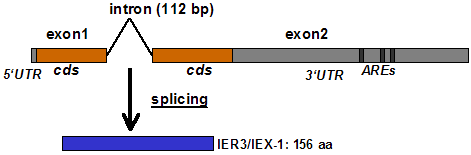
The IER3 pre-mRNA contains two exons and one intron (112 bp). cds: coding strand; 5UTR: 5untranslated region; 3UTR: 3untranslated region, ARE: A-rich element.
Description
The IER3 gene spans 1351 bp genomic DNA and consists of 2 coding exons. The coding sequence of IER3 is 498 nucleotides long.
Proteins
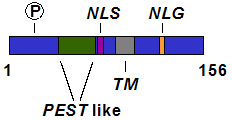
The IER3 protein contains several potential ERK phosphorylation sites - one functionally verified on Thr18 (P) (Garcia et al., 2002), a PEST like sequence a functional nuclear localization sequence (NLS) (Kruse et al., 2005), a potential transmembrane domain (TM) and a N-linked glycosylation site (NLG).
Description
IER3 as well as its rodent homologues PRG1 and gly96 consists of 156, 160 and 153 amino acids, respectively, and, to current knowledge, share no significant sequence similarities with any other known protein. IER3 shuttles between the cytoplasm and the nucleus (Kruse et al., 2005) where it accumulates in promyelocytic nuclear dots, unique structures that are involved in stress response. IER3 is also localized in the mitochondrial membrane where it interferes with the ATP producing system (Shen et al., 2009).
Expression
Epithelial cells, keratinocytes, hepatocytes, monocytes, lymphocytes.
Localisation
Nucleus, mitochondrial membrane, cytoplasm.
Function
Immediate early gene X-1 (IEX-1), also known as IER3/DIF2, is a growth and stress associated early response gene (Kondratyev et al., 1996; Schäfer et al., 1996) involved in a great variety of cellular functions (Wu, 2003). The expression of IER3 is under control of many stimuli and cellular conditions including growth factors, cytokines, viral infection, UV- and gamma-irradiation or biomechanical strain. Recent data demonstrated that IER3 modulates cell cycle progression and proliferation, as well as programmed cell death in a cell type- and stimulus-dependent fashion (Wu, 2003).
A line of functional studies revealed that IER3 exerts a dual role in cellular growth control and apoptosis. For example, in epithelial cells, hepatocytes and keratinocytes IER3 enhances apoptosis (Schilling et al., 2001; Arlt et al., 2007; Arlt et al., 2008; Sebens Muerkoster et al., 2008) whereas in hematological precursor cells and in immune cells IER3 rather favours cellular survival and differentiation (Wu, 2003; Mittal et al., 2006; Rocher et al., 2007; Rocher et al., 2007).
Recent studies revealed that IER3 expression is inversely related to the formation of malignant tumors such as colon cancer (Nambiar et al., 2004; Sebens Muerkoster et al., 2008), pancreatic cancer (Sasada et al., 2008) and endocrine tumors (Dilley et al., 2005), thus pointing to a tumor suppressive potential of IER3. Obviously, the cellular actions of IER3 are complex depending on cell type and context related conditions but one mechanism by which IER3 could affect cellular viability is the negative interference with NF-kappaB activation. To some extent this action of IER3 relies on the dampening of IkappaB degradation thereby leading to a reduced nuclear localization of NF-kappaB (Arlt et al., 2001; Arlt et al., 2003; Arlt et al., 2007).
Moreover, a recent study demonstrated that IER3 is also capable to directly bind to p65/RelA leading to the inhibition of p65-dependent gene transcription (Arlt et al., 2008). Thus, IER3 is supposed to be part of a NF-kappaB dependent counterregulatory mechanism that might be particularly relevant in the control of immune responses.
Consequently, an impaired NF-kappaB control may promote severe inflammatory processes and carcinogenesis.
A line of functional studies revealed that IER3 exerts a dual role in cellular growth control and apoptosis. For example, in epithelial cells, hepatocytes and keratinocytes IER3 enhances apoptosis (Schilling et al., 2001; Arlt et al., 2007; Arlt et al., 2008; Sebens Muerkoster et al., 2008) whereas in hematological precursor cells and in immune cells IER3 rather favours cellular survival and differentiation (Wu, 2003; Mittal et al., 2006; Rocher et al., 2007; Rocher et al., 2007).
Recent studies revealed that IER3 expression is inversely related to the formation of malignant tumors such as colon cancer (Nambiar et al., 2004; Sebens Muerkoster et al., 2008), pancreatic cancer (Sasada et al., 2008) and endocrine tumors (Dilley et al., 2005), thus pointing to a tumor suppressive potential of IER3. Obviously, the cellular actions of IER3 are complex depending on cell type and context related conditions but one mechanism by which IER3 could affect cellular viability is the negative interference with NF-kappaB activation. To some extent this action of IER3 relies on the dampening of IkappaB degradation thereby leading to a reduced nuclear localization of NF-kappaB (Arlt et al., 2001; Arlt et al., 2003; Arlt et al., 2007).
Moreover, a recent study demonstrated that IER3 is also capable to directly bind to p65/RelA leading to the inhibition of p65-dependent gene transcription (Arlt et al., 2008). Thus, IER3 is supposed to be part of a NF-kappaB dependent counterregulatory mechanism that might be particularly relevant in the control of immune responses.
Consequently, an impaired NF-kappaB control may promote severe inflammatory processes and carcinogenesis.
Homology
None.
Mutations
Note
IEX-1L : Non spliced variant encoding the apoptosis inhibitor IEX-1L (Wu et al., 1998). This gene product does not derive from regular pre-mRNA splicing nor from a second gene but represents a triple mutated form of IEX-1/IER3 (Schäfer et al., 1999). This mutant variant has been artificially produced and acts as a dominant negative suppressor of wild type IEX-1/IER3 (Schäfer et al., 1999).
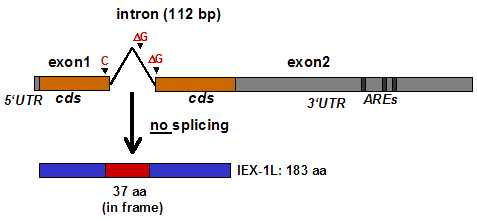
Due to triple point-mutations a variant of IER3 has lost a splicing site and encodes for a protein of 183 amino acids containing an in-frame 37 amino acids insertion (IEX-1L).
Implicated in
Entity name
Colon cancer
Disease
IER3 expression is inversely related to the formation of colon cancer (Nambiar et al., 2004; Sebens Muerkoster et al., 2008) and IER3 expression is lost during aberrant crypt formation in the murine colon (Nambiar et al., 2004)
Entity name
Pancreatic cancer
Disease
IER3 expression is inversely related to the formation of pancreatic cancer (Sasada et al., 2008). In pancreatic cancer, IER3 expression associates with poor prognosis (Sasada et al., 2008).
Entity name
Multiple Endocrine Neoplasia type 1 (MEN1) tumors
Disease
IER3 expression is inversely related to the formation of endocrine tumors (Dilley et al., 2005).
Article Bibliography
| Pubmed ID | Last Year | Title | Authors |
|---|---|---|---|
| 11244505 | 2001 | Expression of the NF-kappa B target gene IEX-1 (p22/PRG1) does not prevent cell death but instead triggers apoptosis in Hela cells. | Arlt A et al |
| 12761504 | 2003 | The early response gene IEX-1 attenuates NF-kappaB activation in 293 cells, a possible counter-regulatory process leading to enhanced cell death. | Arlt A et al |
| 17107344 | 2007 | Immediate early gene-X1 interferes with 26 S proteasome activity by attenuating expression of the 19 S proteasomal components S5a/Rpn10 and S1/Rpn2. | Arlt A et al |
| 18191642 | 2008 | IEX-1 directly interferes with RelA/p65 dependent transactivation and regulation of apoptosis. | Arlt A et al |
| 15691381 | 2005 | Global gene expression in neuroendocrine tumors from patients with the MEN1 syndrome. | Dilley WG et al |
| 12356731 | 2002 | IEX-1: a new ERK substrate involved in both ERK survival activity and ERK activation. | Garcia J et al |
| 8603392 | 1996 | Identification and characterization of a radiation-inducible glycosylated human early-response gene. | Kondratyev AD et al |
| 15855159 | 2005 | Immediate early gene X1 (IEX-1) is organized in subnuclear structures and partially co-localizes with promyelocytic leukemia protein in HeLa cells. | Kruse ML et al |
| 16455974 | 2006 | NF-kappaB-dependent regulation of the timing of activation-induced cell death of T lymphocytes. | Mittal A et al |
| 15374946 | 2004 | Genetic signatures of high- and low-risk aberrant crypt foci in a mouse model of sporadic colon cancer. | Nambiar PR et al |
| 17200115 | 2007 | Inhibition of B56-containing protein phosphatase 2As by the early response gene IEX-1 leads to control of Akt activity. | Rocher G et al |
| 18026799 | 2008 | Prognostic significance of the immediate early response gene X-1 (IEX-1) expression in pancreatic cancer. | Sasada T et al |
| 10448082 | 1999 | The putative apoptosis inhibitor IEX-1L is a mutant nonspliced variant of p22(PRG1/IEX-1) and is not expressed in vivo. | Schäfer H et al |
| 8653710 | 1996 | PRG1: a novel early-response gene transcriptionally induced by pituitary adenylate cyclase activating polypeptide in a pancreatic carcinoma cell line. | Schäfer H et al |
| 11753682 | 2001 | IEX-1, an immediate early gene, increases the rate of apoptosis in keratinocytes. | Schilling D et al |
| 17704804 | 2008 | The apoptosis-inducing effect of gastrin on colorectal cancer cells relates to an increased IEX-1 expression mediating NF-kappa B inhibition. | Sebens Müerköster S et al |
| 19096392 | 2009 | IEX-1 targets mitochondrial F1Fo-ATPase inhibitor for degradation. | Shen L et al |
| 9703517 | 1998 | IEX-1L, an apoptosis inhibitor involved in NF-kappaB-mediated cell survival. | Wu MX et al |
| 12510147 | 2003 | Roles of the stress-induced gene IEX-1 in regulation of cell death and oncogenesis. | Wu MX et al |
Other Information
Locus ID:
NCBI: 8870
MIM: 602996
HGNC: 5392
Ensembl: ENSG00000137331
Variants:
dbSNP: 8870
ClinVar: 8870
TCGA: ENSG00000137331
COSMIC: IER3
RNA/Proteins
| Gene ID | Transcript ID | Uniprot |
|---|---|---|
| ENSG00000137331 | ENST00000259874 | P46695 |
| ENSG00000137331 | ENST00000259874 | A0A1U9X7X2 |
| ENSG00000137331 | ENST00000376377 | Q5ST79 |
Expression (GTEx)
Pathways
Protein levels (Protein atlas)
References
| Pubmed ID | Year | Title | Citations |
|---|---|---|---|
| 34729939 | 2022 | IER3 (IEX-1) dysregulation serves as a potential prognostic factor in acute myeloid leukemia patients. | 2 |
| 34729939 | 2022 | IER3 (IEX-1) dysregulation serves as a potential prognostic factor in acute myeloid leukemia patients. | 2 |
| 30579899 | 2019 | LncRNA GAS5 confers the radio sensitivity of cervical cancer cells via regulating miR-106b/IER3 axis. | 49 |
| 30579899 | 2019 | LncRNA GAS5 confers the radio sensitivity of cervical cancer cells via regulating miR-106b/IER3 axis. | 49 |
| 30249226 | 2018 | Increased expression of immediate early response gene 3 protein promotes aggressive progression and predicts poor prognosis in human bladder cancer. | 12 |
| 30249226 | 2018 | Increased expression of immediate early response gene 3 protein promotes aggressive progression and predicts poor prognosis in human bladder cancer. | 12 |
| 27890615 | 2017 | EGR2 is a gonadotropin-induced survival factor that controls the expression of IER3 in ovarian granulosa cells. | 5 |
| 27890615 | 2017 | EGR2 is a gonadotropin-induced survival factor that controls the expression of IER3 in ovarian granulosa cells. | 5 |
| 26973248 | 2016 | Scaffold protein FHL2 facilitates MDM2-mediated degradation of IER3 to regulate proliferation of cervical cancer cells. | 20 |
| 27736946 | 2016 | Expression and Functions of Immediate Early Response Gene X-1 (IEX-1) in Rheumatoid Arthritis Synovial Fibroblasts. | 4 |
| 26973248 | 2016 | Scaffold protein FHL2 facilitates MDM2-mediated degradation of IER3 to regulate proliferation of cervical cancer cells. | 20 |
| 27736946 | 2016 | Expression and Functions of Immediate Early Response Gene X-1 (IEX-1) in Rheumatoid Arthritis Synovial Fibroblasts. | 4 |
| 25666857 | 2015 | IER3 is a crucial mediator of TAp73β-induced apoptosis in cervical cancer and confers etoposide sensitivity. | 19 |
| 25684507 | 2015 | Expression of IER3 in primary hepatocarcinoma: correlation with clinicopathological parameters. | 2 |
| 25666857 | 2015 | IER3 is a crucial mediator of TAp73β-induced apoptosis in cervical cancer and confers etoposide sensitivity. | 19 |
Citation
Heiner Schäfer ; Alexander Arlt
IER3 (immediate early response 3)
Atlas Genet Cytogenet Oncol Haematol. 2009-12-01
Online version: http://atlasgeneticsoncology.org/gene/40919
