INGX (inhibitor of growth family, X-linked, pseudogene)
2013-12-01 Audrey Mouche , Rémy Pedeux AffiliationINSERM U917, Microenvironnement et Cancer, Rennes, France, Universite de Rennes 1, Rennes, France (AM, RP); Etablissement Francais du Sang, Rennes, France (RP)
DNA/RNA
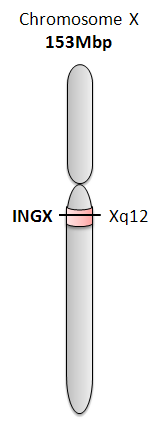
Chromosomal localization of the INGX gene in Homo sapiens.
Description
The sex chromosome linked INGX gene, homolog to ING1 has been cloned for the first time by Jäger et al., 1999. The five human ING genes and the pseudogene INGX have been mapped to six different chromosomes. In addition, ING genes are located close to the telomeric region except for ING3 and INGX. This gene has been localised on the human X chromosome at locus Xq13.1 close to the centromeric region (He et al., 2005).
Transcription
INGX gene has three transcripts and a unique exon. The sequence of this exon shares 72% of identity with exon 2 of ING1. RT-PCR analysis shows that INGX mRNA is expressed in normal tissue (brain, colon, testis, kidney, liver and breast). However, some tumor cell lines like melanoma or breast cancer showed a loss of INGX mRNA (Jäger et al., 1999).
Pseudogene
INGX is the pseudogene of ING1 (He et al., 2005).
Proteins
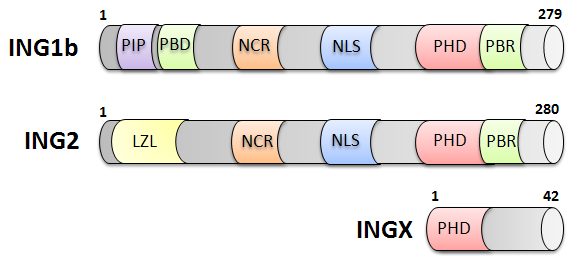
A schematic representation of the different domain of ING1b, ING2 and INGX protein.
Description
The amino acid sequence alignment of human ING proteins revealed several conserved regions: a leucine-zipper-like-region (LZL), a novel conserved region (NCR), a nuclear localization signal (NLS), a plant homeo domain (PHD) and a polybasic region (PBR). The ING proteins are characterized by the presence of a highly conserved PHD in their C-terminal part. This domain is commonly found in proteins involved in chromatin modification (Bienz, 2006; Mellor, 2006).
ING proteins are characterized by their PHD domain which is highly conserved. The longest ORF in INGX gene is only 129 bp length and would encode a predicted amino acid sequence of 42 amino acids, but there is no report about an INGX protein produced from a transcript. This INGX sequence has a high homology degree with the PHD amino acid sequence. INGX protein would have a partial PHD domain (He et al., 2005).
ING proteins are characterized by their PHD domain which is highly conserved. The longest ORF in INGX gene is only 129 bp length and would encode a predicted amino acid sequence of 42 amino acids, but there is no report about an INGX protein produced from a transcript. This INGX sequence has a high homology degree with the PHD amino acid sequence. INGX protein would have a partial PHD domain (He et al., 2005).
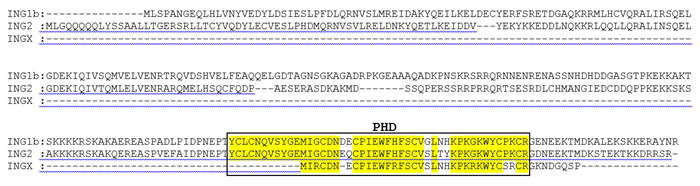
Amino acid sequences alignment of ING1b, ING2 and INGX. Plant homeo domain (PHD) is indicated by box.
Localisation
At present, there is no proof about the existence of the production of an INGX protein. Moreover, the predicted protein would not have a nuclear localization sequence (NLS) like the other members of the ING family. It could thus be located in the cytoplasm unlike the other ING proteins (for review, Guérillon et al., 2013).
Function
The tumor suppressor ING genes are lost or misregulated in different types of human tumors. Unfortunately, few data about INGX are available. We actually know that INGX, unlike the other ING, is highly truncated. So it would be interesting to determine if it has the potential to act in a dominant negative manner (He et al., 2005).
Homology
In databanks, INGX is also referred as ING1-like.
Implicated in
Entity name
Melanoma and breast cancer
Note
Several studies have shown that ING proteins are involved in critical cellular processes such as senescence, apoptosis, DNA repair, growth regulation, cell migration (for review, Guérillon et al., 2013). In tumor, ING expression is mostly lost at mRNA level (For review: Guérillon et al., 2013 and Ythier et al., 2008). Jäger et al., 1999 have shown a loss of INGX mRNA in some tumor cell lines like melanoma or breast cancer.
Article Bibliography
| Pubmed ID | Last Year | Title | Authors |
|---|---|---|---|
| 16297627 | 2006 | The PHD finger, a nuclear protein-interaction domain. | Bienz M et al |
| 24333729 | 2014 | The ING tumor suppressor genes: status in human tumors. | Guérillon C et al |
| 15356280 | 2005 | Phylogenetic analysis of the ING family of PHD finger proteins. | He GH et al |
| 10626813 | 1999 | Cancer-testis antigens and ING1 tumor suppressor gene product are breast cancer antigens: characterization of tissue-specific ING1 transcripts and a homologue gene. | Jäger D et al |
| 16839870 | 2006 | It takes a PHD to read the histone code. | Mellor J et al |
| 18636562 | 2008 | The new tumor suppressor genes ING: genomic structure and status in cancer. | Ythier D et al |
Other Information
Locus ID:
NCBI: 27160
MIM: 300452
HGNC: 6064
Ensembl: ENSG00000243468
Variants:
dbSNP: 27160
ClinVar: 27160
TCGA: ENSG00000243468
COSMIC: INGX
RNA/Proteins
Expression (GTEx)
Citation
Audrey Mouche ; Rémy Pedeux
INGX (inhibitor of growth family, X-linked, pseudogene)
Atlas Genet Cytogenet Oncol Haematol. 2013-12-01
Online version: http://atlasgeneticsoncology.org/gene/40976/ingx-(inhibitor-of-growth-family-x-linked-pseudogene)
