PML (promyelocytic leukemia)
2014-05-01 Andrea Rabellino , Pier Paolo Scaglioni AffiliationDivision of Hematology, Oncology, Simmons Cancer Center, University of Texas Southwestern Medical Center, Dallas, TX, USA
Identity
HGNC
LOCATION
15q24.1
IMAGE

LEGEND
Top: Courtesy Mariano Rocchi, Resources for Molecular Cytogenetics. Bottom: Metaphase FISH analysis of PML (green); red dots indicate centromere of chromosome 15 (Subramaniyam et al., 2006).
LOCUSID
ALIAS
MYL,PP8675,RNF71,TRIM19
FUSION GENES
DNA/RNA
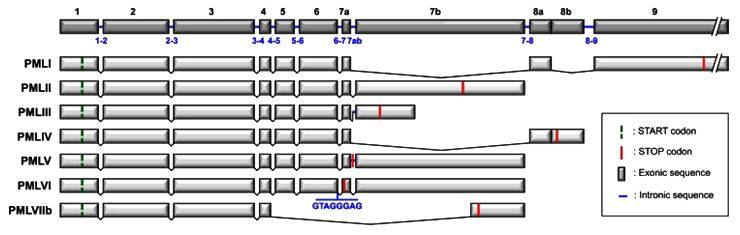
Structural organization of PML human gene (Nisole et al., 2013).
Description
PML is composed of 9 exons. Exons 7 and 8 can be divided into exons 7a, 7b, 8a and 8b.
Transcription
Transcription of PML generates 22 transcripts (splice variants) with at least 11 different isoforms (PMLI, PMLIa, PMLII, PMLIIa, PMLIII, PMLIV, PMLIVa, PMLV, PMLVI, PMLVIIa, PMLVIIb). Names of PML isoforms are based on the original nomenclature defined by Jensen et al., 2001.
Pseudogene
No pseudogenes have been reported so far.
Proteins
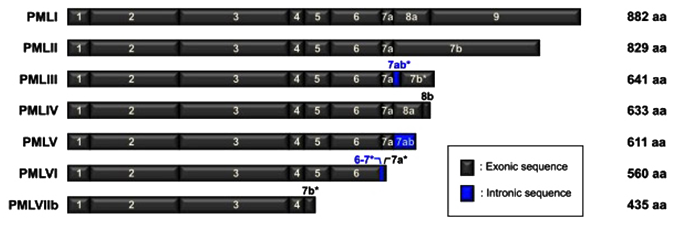
Schematic representation of PML isoforms (Nisole et al., 2013).
Description
Alternative splicing of PML gives rise to several isoforms with different molecular weight: PMLI is the longest isoform and is composed of 882 amino acids, while the shortest is PMLVIIb (435 amino acids). PML belongs to the family of the tripartite motif (TRIM). The RBCC/TRIM motif is present in all PML isoforms and is encoded by the exons 1-3. The RBCC domain is composed of a RING finger domain (R), two B-boxes domains (B1 and B2) and an α-helical coiled-coil domain (CC). The RING finger motif is a conserved cysteine-rich zinc-binding domain found in several classes of proteins. The RING domain of PML is involved in the formation of the PML nuclear bodies (PML-NBs, see below) and in several others PML functions. Adjacent to the RING domain lay two cysteine-rich domains named B-boxes: these two domains have been proposed to work as second zinc-binding domain and they are involved in PML-NBs formation and in several others PML functions. The coiled-coil domain mediate PML homo- and hetero-dimerization. The CC domain is also essential for PML-NBs formation and PML functions. A nuclear localization signal (NLS) is present in the isoforms but not in PMLVIIb. The SUMO interacting motif (SIM) of PML is required for the recognition and binding of SUMOylated proteins (Jensen et al., 2001; Nisole et al., 2013). The SIM domain also contains the PML degron, involved in the CK2-dependent PML degradation (Scaglioni et al., 2006). PML undergoes several post-translational modifications. Several kinases phosphorylate PML on serine and threonine residues regulating its functions (Bernardi et al., 2004; Hayakawa and Privalsky, 2004; Scaglioni et al., 2006; Yang et al., 2006). SUMOylation is the most intensely studied post-translational modification of PML. Both SUMO1 and SUMO2/SUMO3 bind covalently to PML. SUMOylation facilitates PML-NBs formation promoting tumor suppressive response PML-dependent, but also promotes leukemogenesis by the SUMOylation of PML-RARA. Finally, SUMOylation also promotes ubiquitin-mediate degradation of PML and PML-RARA (Fu et al., 2005; Shen et al., 2006; Lallemand-Breitenbach et al., 2008; Kamitani et al., 1998a; Kamitani et al., 1998b; Rabellino et al., 2012). Ubiquitination regulates PML functions and activity and deregulation of PML appears to be the common mechanism accounting for PML loss in tumors (reviewed in Rabellino and Scaglioni, 2013). Finally, PML can be also acetylated (Hayakawa et al., 2008).
PML is the major constituent of the PML-NBs. PML-NBs are highly dynamic nuclear structures tightly bound to the nuclear matrix. Several functions of PML are related to the PML-NBs functions (reviewed in Bernardi et al., 2007). More than 150 different proteins have been shown to localize into PML-NBs (Van Damme et al., 2010).
PML is the major constituent of the PML-NBs. PML-NBs are highly dynamic nuclear structures tightly bound to the nuclear matrix. Several functions of PML are related to the PML-NBs functions (reviewed in Bernardi et al., 2007). More than 150 different proteins have been shown to localize into PML-NBs (Van Damme et al., 2010).
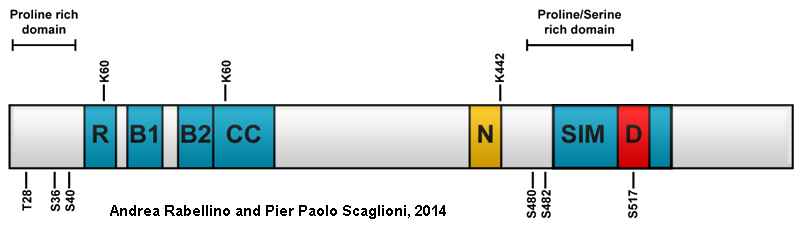
Schematic representation of PML isoform IV protein domains. R = RING-finger domains, aa 55-91; B1, B2 = B-boxes 1 aa 124-166 and 2 aa 184-228; CC = α-helical coiled-coil domain, aa 233-360; N = nuclear localization signal, aa 428-442; SIM = SUMO interacting motif, 508-518; D = degron. The three major SUMOylation sites (K60, K160 and K442) are indicated, as well as the major phosphorylation sites (T28, S36, S40, S480, T482, S517).
Expression
PML is ubiquitously expressed.
Localisation
Nuclear (PMLI-VI) and cytoplasmic (PMLVIIb).
Function
PML has been implicated in several cellular functions.
Cellular senescence: PML is a key regulator of cellular senescence. PML is involved in oncogenic-induced senescence (OIS) K-RAS dependent in a p53 dependent way (de Stanchina et al., 2004; Ferbeyre et al., 2000; Pearson et al., 2000; Scaglioni et al., 2012). PML is also involved in Rb-dependent senescence (Mallette et al., 2004).
Apoptosis: PML promotes apoptosis primarily by its ability to interact with p53 (Wang et al., 1998). Moreover, a pro-apoptotic function has been also attributed to the cytoplasmic isoform of PML (Giorgi et al., 2010).
Neoangiogenesis: PML represses HIF1 transcription, blocking de novo angiogenesis (Bernardi et al., 2006).
Cell migration: PML is involved in the regulation of cell migration by the negatively regulating of β-1 integrins (Reineke et al., 2010).
DNA damage response: several proteins involved in DNA repair have been report to reside into PML-NBs. Therefore, PML is also involved in DNA-repair, even though the mechanisms are still not completely clear (reviewed in Dellaire and Bazett-Jones, 2004).
Anti-viral response: several viral proteins interact with PML and the PML-NBs; moreover, several reports implicate PML and PML-NBs in anti-viral response (reviewed in Geoffroy and Chelbi-Alix, 2011).
Hematopoietic stem cell maintenance: PML has been reported being involved in hematopoietic stem cell maintenance by the regulation of the fatty acid oxidation (Ito et al., 2008; Ito et al., 2012).
Several functions of PML are related to its ability to form PML-NBs. PML-NBs have been involved in tumor suppression, senescence and apoptosis, DNA-damage response, cell migration, neoangiogenesis and anti-viral response (reviewed in Bernardi et al., 2007).
Cellular senescence: PML is a key regulator of cellular senescence. PML is involved in oncogenic-induced senescence (OIS) K-RAS dependent in a p53 dependent way (de Stanchina et al., 2004; Ferbeyre et al., 2000; Pearson et al., 2000; Scaglioni et al., 2012). PML is also involved in Rb-dependent senescence (Mallette et al., 2004).
Apoptosis: PML promotes apoptosis primarily by its ability to interact with p53 (Wang et al., 1998). Moreover, a pro-apoptotic function has been also attributed to the cytoplasmic isoform of PML (Giorgi et al., 2010).
Neoangiogenesis: PML represses HIF1 transcription, blocking de novo angiogenesis (Bernardi et al., 2006).
Cell migration: PML is involved in the regulation of cell migration by the negatively regulating of β-1 integrins (Reineke et al., 2010).
DNA damage response: several proteins involved in DNA repair have been report to reside into PML-NBs. Therefore, PML is also involved in DNA-repair, even though the mechanisms are still not completely clear (reviewed in Dellaire and Bazett-Jones, 2004).
Anti-viral response: several viral proteins interact with PML and the PML-NBs; moreover, several reports implicate PML and PML-NBs in anti-viral response (reviewed in Geoffroy and Chelbi-Alix, 2011).
Hematopoietic stem cell maintenance: PML has been reported being involved in hematopoietic stem cell maintenance by the regulation of the fatty acid oxidation (Ito et al., 2008; Ito et al., 2012).
Several functions of PML are related to its ability to form PML-NBs. PML-NBs have been involved in tumor suppression, senescence and apoptosis, DNA-damage response, cell migration, neoangiogenesis and anti-viral response (reviewed in Bernardi et al., 2007).
Homology
PML is conserved in Amniota (source: HomoloGene).
Mutations
Note
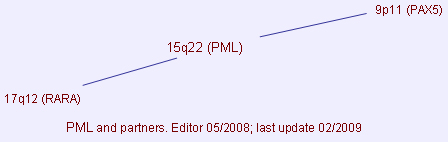
PML-RARA is the product of the chromosomal translocation t(15;17) and it causes acute promyelocytic leukemia (APL) (de Thé et al., 1990; Goddard et al., 1991; Kakizuka et al., 1991; Pandolfi et al., 1991).
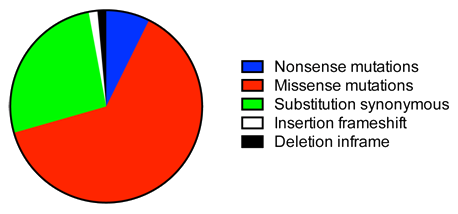
Schematic representation of the mutations type of human PML found in human tumor samples (source COSMIC).
Germinal
No germinal mutations of PML have been reported.
Somatic
At least 65 different somatic mutations have been described. All the informations in this regard can be found at the COSMIC website.
Implicated in
Entity name
Note
(de Thé et al., 1990; Goddard et al., 1991; Kakizuka et al., 1991; Pandolfi et al., 1991)
Disease
The balanced chromosomal translocation t(15;17)(q24;q21) causes APL by driving the synthesis of the PML-RARA oncoprotein. This translocation drives the production of three different PML-RARA variants, depending on the length of the PML module: a short variant PML(S)-RARA, an intermediate variant PML(V)-RARA and a long variant PML(L)-RARA. Generally, 70% of the APL patients carry the PML(L)-RARA variant, followed by the PML(S)-RARA variant (20%) and the PML(V)-RARA (10%) (Melnick and Licht, 1999). PML staining in APL cells show a characteristic pattern commonly named "microspeckles" due to the fact that PML-RARA disrupts the PML-NBs. PML-RARA acts as a transcriptional repressor of RARA target genes. At the same time PML-RARA physically interacts with PML, impairing its tumor-suppressive functions. Combined, these features lead to the aberrant self-renewal of hematopoietic stem cells and block of differentiation of myeloid precursor cells at the promyelocytic stage (de Thé et al., 2012). APL is a distinct subtype of acute myeloid leukemia (AML), is a rare condition though extremely aggressive and malignant. Clinically, APL symptoms tend to be similar to AML. APL is characterized by a severe coagulopathy, including disseminated intravascular coagulation (DIC).
Prognosis
APL is normally treated with the combination of retinoic acid (ATRA) and arsenic trioxide (ATO). This therapy leads to the remission of the disease in more than 90% of the cases. Notably, APL was the first malignant disease cured with targeted therapy (Lo-Coco et al., 2013).
Entity name
B-cell acute lymphoblastic leukemia (B-ALL)
Note
(Nebral et al., 2007; Qiu et al., 2011; Kurahashi et al., 2011)
Disease
The transcription factor PAX5 is required for development and maintenance of B-cell. Several chromosomal translocations involving PAX5 have been described, including the t(9;15)(p13;q24) in which the 5 region of PAX5 is fused to PML. So far, two cases of B-ALL PAX5-PML-dependent have been reported. The fused PAX5-PML oncoprotein has a dominant-negative effect on both PML and PAX5, inhibiting PAX5 activation of B-cell specific genes and disrupting PML-NBs formation.
Prognosis
Kurahashi and colleagues suggest that B-ALL PAX5-PML dependent could be treated with ATO (Kurahashi et al., 2011).
Entity name
Various cancers
Note
Several reports indicate a reduced PML expression in several cancer types (Gurrieri et al., 2004; Rabellino et al., 2012; Rabellino and Scaglioni, 2013).
Disease
PML protein expression was reduced or abolished in prostate adenocarcinomas (63% [95% confidence interval {CI} = 48% to 78%] and 28% [95% CI = 13% to 43%], respectively), colon adenocarcinomas (31% [95% CI = 22% to 40%] and 17% [95% CI = 10% to 24%]), breast carcinomas (21% [95% CI = 8% to 34%] and 31% [95% CI = 16% to 46%]), lung carcinomas (36% [95% CI = 15% to 57%] and 21% [95% = 3% to 39%]), lymphomas (14% [95% CI = 10% to 18%] and 69% [95% CI = 63% to 75%]), CNS tumors (24% [95% CI = 13% to 35%] and 49% [95% CI = 36% to 62%]), and germ cell tumors (36% [95% CI = 24% to 48%] and 48% [95% CI = 36% to 60%]) but not in thyroid or adrenal carcinomas (Gurrieri et al., 2004). In all the cases, PML mRNA levels are comparable to the healthy tissues and the PML gene is rarely mutated, but the protein levels of PML are reduced. This correlates with several reports that underline the role of PML degradation in tumor progression and maintenance (reviewed in Rabellino and Scaglioni, 2013).
Prognosis
In most of the cases, loss of PML is associated with tumor progression, like was reported for prostate cancer, breast cancer and CNS tumors (Gurrieri et al., 2004).
Breakpoints
Note
Breakpoint at q24, responsible of translocation t(15;17)(q24;q21).
Article Bibliography
| Pubmed ID | Last Year | Title | Authors |
|---|---|---|---|
| 17928811 | 2007 | Structure, dynamics and functions of promyelocytic leukaemia nuclear bodies. | Bernardi R et al |
| 15351967 | 2004 | PML nuclear bodies: dynamic sensors of DNA damage and cellular stress. | Dellaire G et al |
| 10950866 | 2000 | PML is induced by oncogenic ras and promotes premature senescence. | Ferbeyre G et al |
| 15940266 | 2005 | Stabilization of PML nuclear localization by conjugation and oligomerization of SUMO-3. | Fu C et al |
| 21198351 | 2011 | Role of promyelocytic leukemia protein in host antiviral defense. | Geoffroy MC et al |
| 21030605 | 2010 | PML regulates apoptosis at endoplasmic reticulum by modulating calcium release. | Giorgi C et al |
| 1720570 | 1991 | Characterization of a zinc finger gene disrupted by the t(15;17) in acute promyelocytic leukemia. | Goddard AD et al |
| 14970276 | 2004 | Loss of the tumor suppressor PML in human cancers of multiple histologic origins. | Gurrieri C et al |
| 18621739 | 2008 | Acetylation of PML is involved in histone deacetylase inhibitor-mediated apoptosis. | Hayakawa F et al |
| 18469801 | 2008 | PML targeting eradicates quiescent leukaemia-initiating cells. | Ito K et al |
| 22902876 | 2012 | A PML–PPAR-δ pathway for fatty acid oxidation regulates hematopoietic stem cell maintenance. | Ito K et al |
| 11704850 | 2001 | PML protein isoforms and the RBCC/TRIM motif. | Jensen K et al |
| 1652368 | 1991 | Chromosomal translocation t(15;17) in human acute promyelocytic leukemia fuses RAR alpha with a novel putative transcription factor, PML. | Kakizuka A et al |
| 9452416 | 1998 | Covalent modification of PML by the sentrin family of ubiquitin-like proteins. | Kamitani T et al |
| 21217775 | 2011 | PAX5-PML acts as a dual dominant-negative form of both PAX5 and PML. | Kurahashi S et al |
| 18408733 | 2008 | Arsenic degrades PML or PML-RARalpha through a SUMO-triggered RNF4/ubiquitin-mediated pathway. | Lallemand-Breitenbach V et al |
| 23841729 | 2013 | Retinoic acid and arsenic trioxide for acute promyelocytic leukemia. | Lo-Coco F et al |
| 14712214 | 2004 | Human fibroblasts require the Rb family of tumor suppressors, but not p53, for PML-induced senescence. | Mallette FA et al |
| 10233871 | 1999 | Deconstructing a disease: RARalpha, its fusion partners, and their roles in the pathogenesis of acute promyelocytic leukemia. | Melnick A et al |
| 17897302 | 2007 | Identification of PML as novel PAX5 fusion partner in childhood acute lymphoblastic leukaemia. | Nebral K et al |
| 23734343 | 2013 | Differential Roles of PML Isoforms. | Nisole S et al |
| 1650447 | 1991 | Structure and origin of the acute promyelocytic leukemia myl/RAR alpha cDNA and characterization of its retinoid-binding and transactivation properties. | Pandolfi PP et al |
| 10910364 | 2000 | PML regulates p53 acetylation and premature senescence induced by oncogenic Ras. | Pearson M et al |
| 20972455 | 2011 | The reduced and altered activities of PAX5 are linked to the protein-protein interaction motif (coiled-coil domain) of the PAX5-PML fusion protein in t(9;15)-associated acute lymphocytic leukemia. | Qiu JJ et al |
| 23526763 | 2013 | PML Degradation: Multiple Ways to Eliminate PML. | Rabellino A et al |
| 20100838 | 2010 | Promyelocytic leukemia protein controls cell migration in response to hydrogen peroxide and insulin-like growth factor-1. | Reineke EL et al |
| 22359342 | 2012 | Translation-dependent mechanisms lead to PML upregulation and mediate oncogenic K-RAS-induced cellular senescence. | Scaglioni PP et al |
| 17081985 | 2006 | The mechanisms of PML-nuclear body formation. | Shen TH et al |
| 17008891 | 2006 | Do RARA/PML fusion gene deletions confer resistance to ATRA-based therapy in patients with acute promyelocytic leukemia? | Subramaniyam S et al |
| 20087442 | 2010 | A manually curated network of the PML nuclear body interactome reveals an important role for PML-NBs in SUMOylation dynamics. | Van Damme E et al |
| 9806545 | 1998 | PML is essential for multiple apoptotic pathways. | Wang ZG et al |
| 16835227 | 2006 | Promyelocytic leukemia activates Chk2 by mediating Chk2 autophosphorylation. | Yang S et al |
| 14992722 | 2004 | PML is a direct p53 target that modulates p53 effector functions. | de Stanchina E et al |
| 2170850 | 1990 | The t(15;17) translocation of acute promyelocytic leukaemia fuses the retinoic acid receptor alpha gene to a novel transcribed locus. | de Thé H et al |
| 22778276 | 2012 | The cell biology of disease: Acute promyelocytic leukemia, arsenic, and PML bodies. | de Thé H et al |
Other Information
Locus ID:
NCBI: 5371
MIM: 102578
HGNC: 9113
Ensembl: ENSG00000140464
Variants:
dbSNP: 5371
ClinVar: 5371
TCGA: ENSG00000140464
COSMIC: PML
RNA/Proteins
Expression (GTEx)
Pathways
Protein levels (Protein atlas)
PharmGKB
| Entity ID | Name | Type | Evidence | Association | PK | PD | PMIDs |
|---|---|---|---|---|---|---|---|
| PA448486 | arsenic trioxide | Chemical | LabelAnnotation, Literature, MultilinkAnnotation | associated | 24433361 | ||
| PA451746 | tretinoin | Chemical | LabelAnnotation | associated |
References
| Pubmed ID | Year | Title | Citations |
|---|---|---|---|
| 37864298 | 2024 | PML-mediated nuclear loosening permits immunomodulation of mesenchymal stem/stromal cells under inflammatory conditions. | 1 |
| 38129745 | 2024 | Mutations at proximal cysteine residues in PML impair ATO binding by destabilizing the RBCC domain. | 0 |
| 38648485 | 2024 | PML::RARA and GATA2 proteins interact via DNA templates to induce aberrant self-renewal in mouse and human hematopoietic cells. | 1 |
| 38944257 | 2024 | Nuclear export of PML promotes p53-mediated apoptosis and ferroptosis. | 0 |
| 37864298 | 2024 | PML-mediated nuclear loosening permits immunomodulation of mesenchymal stem/stromal cells under inflammatory conditions. | 1 |
| 38129745 | 2024 | Mutations at proximal cysteine residues in PML impair ATO binding by destabilizing the RBCC domain. | 0 |
| 38648485 | 2024 | PML::RARA and GATA2 proteins interact via DNA templates to induce aberrant self-renewal in mouse and human hematopoietic cells. | 1 |
| 38944257 | 2024 | Nuclear export of PML promotes p53-mediated apoptosis and ferroptosis. | 0 |
| 36450825 | 2023 | PML at mitochondria-associated membranes governs a trimeric complex with NLRP3 and P2X7R that modulates the tumor immune microenvironment. | 12 |
| 36759620 | 2023 | Multi-omics and machine learning reveal context-specific gene regulatory activities of PML::RARA in acute promyelocytic leukemia. | 3 |
| 36778116 | 2023 | Crosstalk between PML and p53 in response to TGF-β1: A new mechanism of cardiac fibroblast activation. | 1 |
| 36912092 | 2023 | PML and PML-like exonucleases restrict retrotransposons in jawed vertebrates. | 3 |
| 37518985 | 2023 | Promyelocytic leukemia protein regulates angiogenesis and epithelial-mesenchymal transition to limit metastasis in MDA-MB-231 breast cancer cells. | 1 |
| 37823593 | 2023 | PML modulates epigenetic composition of chromatin to regulate expression of pro-metastatic genes in triple-negative breast cancer. | 4 |
| 36450825 | 2023 | PML at mitochondria-associated membranes governs a trimeric complex with NLRP3 and P2X7R that modulates the tumor immune microenvironment. | 12 |
Citation
Andrea Rabellino ; Pier Paolo Scaglioni
PML (promyelocytic leukemia)
Atlas Genet Cytogenet Oncol Haematol. 2014-05-01
Online version: http://atlasgeneticsoncology.org/gene/41
Historical Card
2000-10-01 PML (promyelocytic leukemia) by Franck Viguié Affiliation
Laboratoire de Cytogenetique - Service dHematologie Biologique, Hopital Hotel-Dieu - 75181 Paris Cedex 04, France
