MICA (MHC class I polypeptide-related sequence A)
2014-07-01 Zain Ahmed , Medhat Askar AffiliationCleveland Clinic\\\/, Cleveland, OH; [email protected]
Identity

Abstract
Human Major Histocompatibility Complex (MHC) Class I Chain-Related gene A (MICA) is located 46 Kb centromeric to the HLA-B locus on the short arm of human chromosome 6 and encodes for a 62-kda cell surface glycoprotein. It is expressed on endothelial cells, dendritic cells, fibroblasts, epithelial cells, and many tumours and serves as target for both cellular and humoral immune responses in transformed cells. MICA protein at normal states has a low level of expression in epithelial tissues but is upregulated in response to various stimuli of cellular stress. MICA also functions as a ligand recognized by the activating receptor NKG2D that is expressed on the surface of NK, NKT, CD8+ and TCRγδ+ T cells. Allelic variants of MICA due to a single amino acid substitution at position 129 in the α2 domain have been reported to result in large differences in NKG2D binding. These variable affinities have been suggested to affect thresholds of NK cell triggering and T cell modulation in autoimmune diseases and malignancies. MICA molecules exist also in soluble forms (sMICA) and altered serum levels of sMICA have been reported in multiple states of health and disease.
DNA/RNA
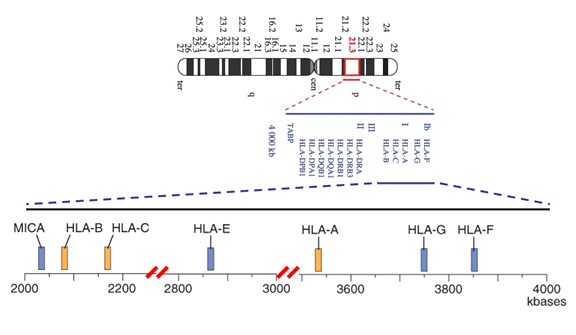
Description
MICA gene is organized into 7 exons of which exon 5 encodes the transmembrane (TM) region of the MICA molecule. TM encodes the repeat polymorphism (GCT/Ala) and eight types of repeats have been described as A4, A5, A5.1, A6, A7, A8, A9, and A10 (Gambelunghe et al., 2006; Zou et al., 2006). The combinations of extracellular and TM types facilitates the identification of the MICA alleles and reduces the number of potential ambiguous typings in heterozygous individuals. This combination identifies MICA alleles based on polymorphisms in the TM region as well as elsewhere, e.g., MICA*007:01/A4, MICA*008:01/A5.1, etc.
Transcription
Pseudogene
Proteins
Note
Allelic variants of MICA based on a single amino acid substitution at position 129 in the α2 domain have been reported to result in large differences in the affinity of binding to the activating natural killer group 2, member D (NKG2D) (Steinle et al., 2001). MICA alleles with a methionine (M) or valine (V) have been classified as having strong or weak binding affinity for NKG2D, respectively. These variable affinities have been suggested to affect thresholds of NK cell triggering and T cell modulation and consequently influencing clinical phenotypes in autoimmune disorders and malignancies (Amroun et al., 2005; Douik et al., 2009).
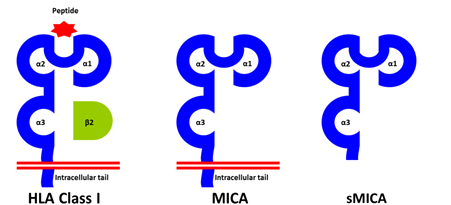
MICA molecules exist also in soluble forms (sMICA) encompassing three extracellular domains (Salih et al., 2002). ADAM, a disintegrin and metalloproteinase, is reported to mediate sMICA generation by cleavage of the molecule in the α3 domain close to the papain cleavage site (Figure X), however the precise location of the cleavage site is still unknown (Waldhauer et al., 2008). sMICA are not normally detected in sera of healthy donors and tumor cells are the major source of sMICA generation (Holdenrieder et al., 2006). In addition to patients with malignancies, sMICA is detected in the sera of patients with autoimmune diseases, acute bacterial infections, renal insufficiency, and cholestasis (Holdenrieder et al., 2007). Unlike the surface-bound form of MICA that stimulates immune responses, the secreted soluble counterpart, sMICA abates immune responses primarily by down regulating NKG2D expression which impairs the cellular cytotoxicity of T cells and NK cells against tumor cells (Groh et al., 2002). This may partly explain why higher levels of sMICA were observed in the serum of chronically infected individuals compared to healthy controls and HIV-1 controllers (Nolting et al., 2010). Similarly CMV infection triggers shedding of sMICA (Andresen et al., 2009).
Description
Expression
Localisation
Function
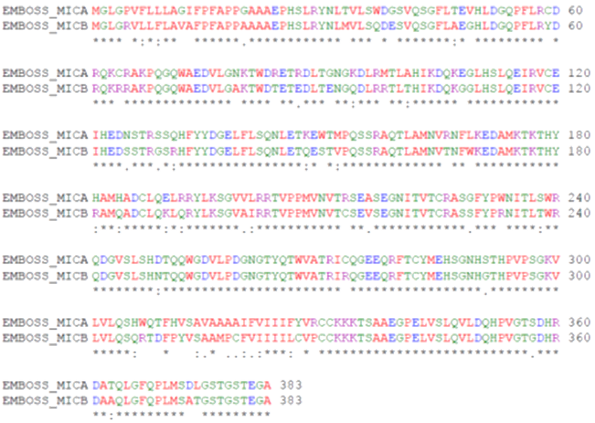
Homology
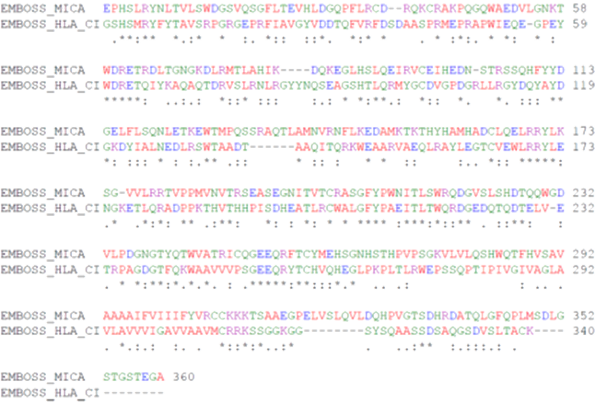
Mutations
Note
Implicated in
Because of its genomic location between MHC Class I and Class II genes, there is strong linkage disequilibrium between many MICA and HLA-B alleles. MICA could also serve as a genetic marker of recombination between MHC classes I and II in otherwise MHC matched individuals where MICA mismatched individuals would be predicted to have mismatched haplotypes whereas the MICA matched pairs may or may not be haplotype matched. This distinction is biologically relevant since MHC haplotype mismatching in otherwise HLA matched donor/recipient pairs was reported in association with a statistically significantly increased risk of severe acute GvHD (Petersdorf et al., 2007). Donor/recipient MICA mismatches were associated with increased risk of severe acute GVHD and were also reported to have a synergistic effect with HLA-DPB1 mismatches on the risk of severe acute GVHD (Askar et al., 2012). MICA-129 genotype, sMICA, and anti-MICA antibodies were reported as biomarkers of chronic GVHD (Boukouaci et al., 2009).
Donor MICA A5.1 mismatch is associated with anti-MICA antibody formation and increased proteinuria in kidney recipients. MICA*001,*004, *007, *009, *012, and *018 are more prevalent in patients with impaired renal function than normal function.
MICA-TM A9 allele is associated with a PsA susceptibility in European populations (Amroun H et. al, 2005).
Since MICA is located 46 kb centromeric to the HLA-B gene cluster, its location may explain its association.
Polymorphisms of MICA TM region have been reported in association with susceptibility to SLE (Yoshida et al., 2011).
A single nucleotide polymorphism of MICA rs2596542 located in MICA promotor region is associated with hepatitis C-induced HCC in a Japanese patients and serum levels of soluble MICA (sMICA).
Article Bibliography
| Pubmed ID | Last Year | Title | Authors |
|---|---|---|---|
| 16386647 | 2005 | Early-onset ankylosing spondylitis is associated with a functional MICA polymorphism. | Amroun H et al |
| 19553547 | 2009 | Propionic acid secreted from propionibacteria induces NKG2D ligand expression on human-activated T lymphocytes and cancer cells. | Andresen L et al |
| 8022771 | 1994 | A second lineage of mammalian major histocompatibility complex class I genes. | Bahram S et al |
| 10426993 | 1999 | Activation of NK cells and T cells by NKG2D, a receptor for stress-inducible MICA. | Bauer S et al |
| 19786616 | 2009 | MICA-129 genotype, soluble MICA, and anti-MICA antibodies as biomarkers of chronic graft-versus-host disease. | Boukouaci W et al |
| 25016613 | 2014 | Recent advances in the management of graft-versus-host disease. | Dhir S et al |
| 19000729 | 2009 | Association of MICA-129 polymorphism with nasopharyngeal cancer risk in a Tunisian population. | Douik H et al |
| 19282026 | 2009 | Graft-versus-host disease. | Ferrara JL et al |
| 17174750 | 2006 | MICA A8: a new allele within MHC class I chain-related A transmembrane region with eight GCT repeats. | Gambelunghe G et al |
| 8901601 | 1996 | Cell stress-regulated human major histocompatibility complex class I gene expressed in gastrointestinal epithelium. | Groh V et al |
| 11224526 | 2001 | Costimulation of CD8alphabeta T cells by NKG2D via engagement by MIC induced on virus-infected cells. | Groh V et al |
| 12384702 | 2002 | Tumour-derived soluble MIC ligands impair expression of NKG2D and T-cell activation. | Groh V et al |
| 16094621 | 2006 | Soluble MICA in malignant diseases. | Holdenrieder S et al |
| 21426309 | 2011 | The alteration of placental-derived soluble MHC class I chain-related protein A and B during pregnancy. | Huang SY et al |
| 23024757 | 2012 | Soluble MICA and a MICA variation as possible prognostic biomarkers for HBV-induced hepatocellular carcinoma. | Kumar V et al |
| 22170063 | 2012 | NF-κB regulates MICA gene transcription in endothelial cell through a genetically inhibitable control site. | Lin D et al |
| 23671338 | 2013 | Analysis Tool Web Services from the EMBL-EBI. | McWilliam H et al |
| 16517727 | 2006 | Placenta-derived soluble MHC class I chain-related molecules down-regulate NKG2D receptor on peripheral blood mononuclear cells during human pregnancy: a possible novel immune escape mechanism for fetal survival. | Mincheva-Nilsson L et al |
| 17614877 | 2007 | Regulation of ligands for the activating receptor NKG2D. | Mistry AR et al |
| 9177776 | 1997 | Nucleotide sequence analysis of the HLA class I region spanning the 237-kb segment around the HLA-B and -C genes. | Mizuki N et al |
| 15494508 | 2004 | NF-kappa B regulates expression of the MHC class I-related chain A gene in activated T lymphocytes. | Molinero LL et al |
| 20667578 | 2010 | MHC class I chain-related protein A shedding in chronic HIV-1 infection is associated with profound NK cell dysfunction. | Nolting A et al |
| 17378697 | 2007 | MHC haplotype matching for unrelated hematopoietic cell transplantation. | Petersdorf EW et al |
| 17586836 | 2007 | Soluble MHC Class I chain-related molecule serum levels are predictive markers of implantation failure and successful term pregnancies following IVF. | Porcu-Buisson G et al |
| 23080122 | 2013 | The IMGT/HLA database. | Robinson J et al |
| 12370336 | 2002 | Cutting edge: down-regulation of MICA on human tumors by proteolytic shedding. | Salih HR et al |
| 23274334 | 2012 | Graft-versus-host disease after solid organ transplantation: a single center experience and review of literature. | Sharma A et al |
| 23974432 | 2014 | Associations between the major histocompatibility complex class I chain-related gene A transmembrane (MICA-TM) polymorphism and susceptibility to psoriasis and psoriatic arthritis: a meta-analysis. | Song GG et al |
| 11491531 | 2001 | Interactions of human NKG2D with its ligands MICA, MICB, and homologs of the mouse RAE-1 protein family. | Steinle A et al |
| 15603871 | 2004 | Different HLA-DR-DQ and MHC class I chain-related gene A (MICA) genotypes in autoimmune and nonautoimmune gestational diabetes in a Swedish population. | Törn C et al |
| 20460636 | 2010 | MICA polymorphism identified by whole genome array associated with NKG2D-mediated cytotoxicity in T-cell large granular lymphocyte leukemia. | Viny AD et al |
| 18676862 | 2008 | Tumor-associated MICA is shed by ADAM proteases. | Waldhauer I et al |
| 17993672 | 2007 | BLAST QuickStart: example-driven web-based BLAST tutorial. | Wheeler D et al |
| 21702010 | 2011 | Role of the MICA polymorphism in systemic lupus erythematosus. | Yoshida K et al |
| 21852331 | 2012 | RSV infection modulates IL-15 production and MICA levels in respiratory epithelial cells. | Zdrenghea MT et al |
| 15728525 | 2005 | Effect of human cytomegalovirus on expression of MHC class I-related chains A. | Zou Y et al |
| 16698436 | 2006 | MICA allele-level typing by sequence-based typing with computerized assignment of polymorphic sites and short tandem repeats within the transmembrane region. | Zou Y et al |
| 17898098 | 2007 | Antibodies against MICA antigens and kidney-transplant rejection. | Zou Y et al |
| 10363723 | 1999 | Differential surface expression of MICA by endothelial cells, fibroblasts, keratinocytes, and monocytes. | Zwirner NW et al |
Other Information
Locus ID:
NCBI: 100507436
MIM: 600169
HGNC: 7090
Ensembl: ENSG00000204520
IMGT/GENE-DB:
Variants:
dbSNP: 100507436
ClinVar: 100507436
TCGA: ENSG00000204520
COSMIC: MICA
RNA/Proteins
| Gene ID | Transcript ID | Uniprot |
|---|---|---|
| ENSG00000204520 | ENST00000421350 | H0Y615 |
| ENSG00000204520 | ENST00000449934 | Q96QC4 |
| ENSG00000204520 | ENST00000616296 | A0A024RCL3 |
Expression (GTEx)
Pathways
References
| Pubmed ID | Year | Title | Citations |
|---|---|---|---|
| 37665559 | 2024 | MICA and NLRP3 gene polymorphisms interact synergistically affecting the risk of ankylosing spondylitis. | 1 |
| 38474281 | 2024 | Functional MICA Variants Are Differentially Associated with Immune-Mediated Inflammatory Diseases. | 0 |
| 37665559 | 2024 | MICA and NLRP3 gene polymorphisms interact synergistically affecting the risk of ankylosing spondylitis. | 1 |
| 38474281 | 2024 | Functional MICA Variants Are Differentially Associated with Immune-Mediated Inflammatory Diseases. | 0 |
| 36396592 | 2023 | Association of MICA gene Exon-5 polymorphism in oral submucous fibrosis. | 1 |
| 36958849 | 2023 | Associations between MICA and MICB Genetic Variants, Protein Levels, and Colorectal Cancer: Atherosclerosis Risk in Communities (ARIC). | 2 |
| 37774074 | 2023 | Association of MICA Gene Polymorphism in Opisthorchis viverrini-Induced Periductal Fibrosis in Northeastern Thais. | 0 |
| 38035108 | 2023 | High population frequencies of MICA copy number variations originate from independent recombination events. | 0 |
| 36396592 | 2023 | Association of MICA gene Exon-5 polymorphism in oral submucous fibrosis. | 1 |
| 36958849 | 2023 | Associations between MICA and MICB Genetic Variants, Protein Levels, and Colorectal Cancer: Atherosclerosis Risk in Communities (ARIC). | 2 |
| 37774074 | 2023 | Association of MICA Gene Polymorphism in Opisthorchis viverrini-Induced Periductal Fibrosis in Northeastern Thais. | 0 |
| 38035108 | 2023 | High population frequencies of MICA copy number variations originate from independent recombination events. | 0 |
| 35288692 | 2022 | The MHC class I MICA gene is a histocompatibility antigen in kidney transplantation. | 9 |
| 35451026 | 2022 | A Polynesian-specific copy number variant encompassing the MICA gene associates with gout. | 2 |
| 35525711 | 2022 | HLA class I chain-related MICA and MICB genes polymorphism in healthy individuals from the Bulgarian population. | 0 |
Citation
Zain Ahmed ; Medhat Askar
MICA (MHC class I polypeptide-related sequence A)
Atlas Genet Cytogenet Oncol Haematol. 2014-07-01
Online version: http://atlasgeneticsoncology.org/gene/41364/mica
