PGR (progesterone receptor)
2017-02-01 Gajanan Sherbet AffiliationSchool of Electrical and Electronic Engineering, University of Newcastle Upon Tyne, Newcastle Upon Tyne UK and the Institute for Molecular Medicine, Huntington Beach CA, USA; [email protected]; [email protected]
Identity

Abstract
The progesterone receptor gene PGR is located on 11q22.1. The functional gene has 8 exons and 7 introns; the transcript is translated into 933 residues. The protein occurs as three isoforms viz. PR-A; PR-B; PR-C and 11 splice variants. PR-A and PR-B are structurally similar. The function of the splice variants is unclear, although some variants might be translated and others differentially expressed. The nuclear receptor PR isoforms are ubiquitously and uniformly expressed in target tissues. They may show differential expression in neoplasia with progressive changes. In the conventional pathway, PR undergoes conformational changes upon ligand interaction, translocates into the nucleus and binds PREs of responsive genes. PR can also function by non-genomic mode. It can activate the extra nuclear receptors, mPRs and PGRMC1 to influence cell proliferation and invasion via non-canonically routes. Both genomic and non-genomic modes of signaling may determine the relevance and the validity of PR in the progression, prognosis and management of breast cancer. The PR engages several systems, among them are PI3K\/Akt\/ MAPK and Wnt to influence cell adhesion, proliferation and apoptosis. The ER\/PR axis is crucial in breast cancer, where the physiological outcome would be affected by the differential signaling initiated by the canonical and the non-canonical receptors. The crosstalk between the ER\/PR axis and the growth factor\/PI3K\/Akt\/mTOR system is also highly relevant. PGR mutations and polymorphism are infrequent in cancers. The polymorphic PROGINS has been linked, not indisputably, with cancer risk. Many SNPs have been identified, mostly inconsequential ones. Some may be related to breast, endometrial and colorectal cancer risk. PR produces good clinical outcome in breast cancer independently of ER. It displays greater correlation than ER with disease progression and prognosis. It may be differentially expressed in benign prostatic hyperplasia and progressive cancer. The expression may reflect androgen-insensitivity. PROGINS is said to increase ovarian cancer risk, but, paradoxically, reduce breast cancer risk. The use of progesterone antagonists or agonists has been advocated. PRs can act as activators or repressors of transcription, necessitating the identification of the functional PR\/ER isoforms. Some new progestins, employed in HRT, have been claimed to prevent certain forms of cancer.
DNA/RNA
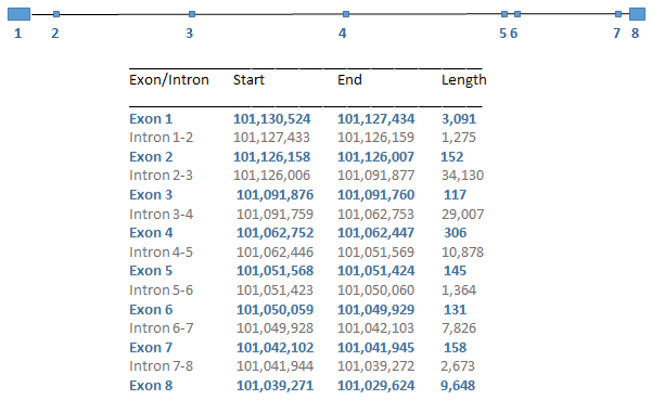
Description
Proteins
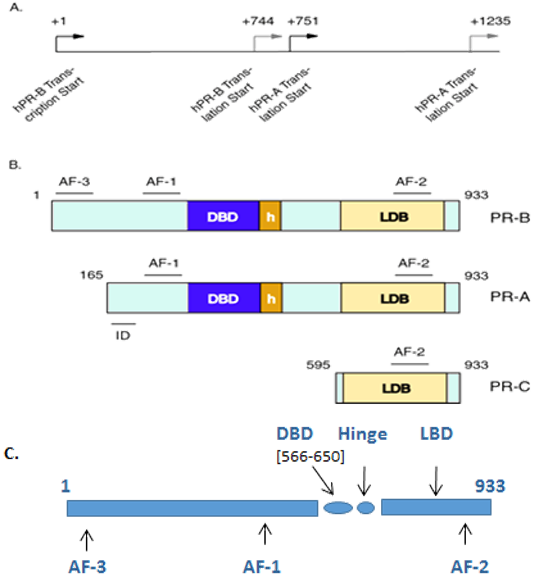
Description
Alternatively spliced variants
Many truncated splice variants of PR are generated and these are not easily detected by standard anti-PR antibodies (Cork et al. 2012) and often specimens may be designated as PR-negative. However, in the absence of firm evidence that these are functionally relevant in the cancer process, the inability to detect them may not be of much consequence.
Besides the three major isoforms, several splice variants of the gene have been identified. These are a result of the deletion of some of the eight exons of PR or by the retention of intronic sequences (see Cork et al. 2008). Two variants were translated into protein and were found to be differentially expressed in the endometrium (Springwald et al. 2010). However, the functional status of the variants is unclear. Variants with the deletion of exons 4, 6 and 4/6 (delta exons), and another one with partly deleted exon 6 have been identified. Their expression was higher in early/mid proliferative endometrium than in the secretory phase (Marshburn et al. 2005). This suggests that they might be functionally not relevant. For, in the proliferative phase oestrogen induces high mitotic activity in the epithelium and the stroma. The secretory phase is characterised by the action of progesterone towards the differentiation of the endometrium.
It ought to be pointed out here that the PR delta 4/6 showed a slight difference in expression between 1/45 normal and 5/45 breast cancer tissues of the patients (Nagao et al. 2003). Whilst reports of deletion variants are many, some earlier work has claimed the detection of insertion variants. One such is a variant with a 232 bp nucleotide insertion sequence between exons 4 and 5 in normal endometrium (Yamanaka et al. 2002). However, in the absence of information whether the variant transcript is translated, the inference of a potential relevance in normal or pathological condition of the endometrium is not warranted.
Splice variants: PR-delta4, PR-delta6, PR-delta6/7, PR-T, PR-S, PR-M, PR-i45 (insertion variant) i45a and i45b.
Expression
Function
Progesterone signalling generates its physiological effects by the conventional canonical nuclear receptor (PR) pathway and also by the seven-pass membrane receptor (mPR). The nuclear receptor PR is a transcription regulator. Upon ligand binding the principal isoforms PR-A and PR-B homo- or hetero-dimerize and function as transcription factors. The binding of ligands, agonist or antagonist, initiates a conformational change in PR leading to its translocation to the nucleus and binding to PRE of the responsive genes. The possibility that PR might function via a non-genomic mode cannot be excluded.
The rapidity of some responses to progesterone has suggested the presence of extranuclear receptor, such as the membrane associated mPRs and PGRMC1 (progesterone receptor membrane component 1). The mPRs are GPCRs belonging to the PAQR (progestin and adipoQ receptor) gene family (Tang et al, 2005. The mPRs and the PGRMC proteins belonging to a different family are encoded by different genes. It has been noted that target cells may respond to progesterone and produce biological effects via the mPRs and the PGRMC1. This would involve the engagement and activation of allied signalling systems that culminate in the phenotypic outcome. The mPRs function like GPCRs and also directly interacts with progestrone. The physiological outcome can occur independently of PR. PGRMC1 can directly interact with progesterone even in the absence of PR. The present indications are that both increase cell proliferation and migration. In fact, PGRMC1 may also facilitate cell proliferation and tumour growth. A small molecule inhibitor of PGRMC1 counteracts these effects. This inhibitor also destabilises EGFR expression, which would suggest that the PGRMC1 effects are to mediated by interaction with EGFR (Ahmed et al. 2010a, b). Although cell proliferative signalling does seem to be modulated by mPRs and the PGRMC1, there is a need to resolve whether mPRs and PGRMC1 work in the same phenotypic direction or exert opposing effects. Recent developments make it imperative that the non-canonical mode of progesterone signalling is borne in mind while assessing the validity of PR in breast cancer management
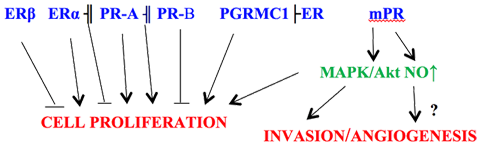
The PR-mediated response to progesterone involves Wnt signalling, PI3K/Akt/ MAPK signalling; the phenotypic outcome is on cell adhesion, proliferation and apoptosis. The ER/PR signalling axis has assumed much significance in the management of breast cancer patients. However, interpretation of their expression and physiological effects are complicated by several factors. The cell proliferation/survival results depend upon the ER/PR signalling axis subject to the provision of which isoform of ER or PR is functional and the recognition that ER does influence PR function. ERα and ERβ are two ER isoforms. ERα is pro-proliferation whilst ERβ is inhibitory of cell proliferation. ERα binds to and downregulates PR. The PR-A promoter does contain an ERE half site/Sp1 binding site and ER does bind directly to this site (Petz and Nardulli. 2000). Three functionally different PR isoforms of PR, viz. PR-A, PR-B and PR-C have been identified (reviewed by Kariagina et al. 2008). High PR-A expression has correlated with tumour relapse and with associated mutations in the breast cancer susceptibility genes BRCA1 andBRCA2 (Hopp eet al. 2004; Mote et al.2004). The differential expression of the isoforms may be due to methylation (Pathiraja et al. 2011). The PR-A and PR-B isoforms seem to regulate different sets of target genes. PR-B isoform is associated with increase in cell migration but not on cell proliferation or survival. Suppression of PR-B inhibits cell migration. Many publications have reported contradictory phenotypic effects of PR agonists and antagonists. These are most likely the outcome of the differential signalling by the canonical and the non-canonical receptors, which is not often taken into cognisance. The differential signalling is highlighted in Figure 5
The ER/PR signalling axis displays a complex circuitry of interaction and inter-regulation. When ER is non-functional the hormonal response is attenuated. When functional, ER can induce the expression of PR. Equally, PR can regulate ER function. In breast cancer cells, both oestrogen and progesterone can activate the Src/Erk pathway. PR possesses two domains that can interact with the ligand-binding domain of ERα and in this way mediate the activation of Src signalling (Ballaré et al. 2003). In fact, PR may regulate ER function in breast cancer and possibly also negatively regulate other oestrogen-activated signalling to suppress cell proliferation (Mohammed et al. 2015). Besides operating the canonical path of genetic transcription by binding to EREs in responsive genes, the ER can also function in a non-genomic fashion which does not involve direct genetic regulation. ER can influence cell proliferation by the activation of PI3K/MAPK signalling. Also, the G-protein coupled receptor GPCR30 has been recognised as a membrane receptor of oestrogen and the activation of GPCR30 leads to signalling by the non-genomic mode. The oestrogens produce many physiological effects by activating of GPCRs and driving PI3K/Akt and MAPK/ERK signalling. Oestrogens can also upregulate the expression of MMPs and promote invasion. Therefore, the overall outcome would be a result of the balance of activation of the ESR1/PR axis, including the balance of the PR isoforms. This probably applies also to the promotion or inhibition of inflammatory responses. Presumably, this is one of the reasons why so much controversy has surrounded the clinical value of PR in breast cancer, which is nonetheless shown to be a significant factor in patient management (reviewed by Sherbet, 2011, 2017). Another caveat to be considered is that the ER/PR signalling axis may be influenced by neighbouring genes such as the YAP1/ TAZ of the Hippo system.

Mutations
Somatic
Among the many polymorphic forms of the PGR gene is the polymorphism called PROGINS. This has a PV/HS-1 Alu insertion in intron 7 and two point mutations, V660L in exon 4 and H770H in exon 5. The Alu element has a half ERE/Spl binding site, which enhances the transcription function of PROGINS in response to oestradiol (Agoulnik et al. 2004). PROGINS may be associated with enhanced risk of ovarian, breast and prostate cancer (Leite et al. 2008; Govindan et al. 2007; Engehausen 2005). Equally, some studies have denied the link of PROGINS with cancer risk.
Over the past decade several SNPs in the PGR gene have been identified; many are inconsequential ones, but some have been related to possible links to the risk of development of breast, endometrial and colorectal cancers and endometriosis. The SNPs occur in the exons and some in the promoter region of the gene which is thought to have altered the expression of the receptor. These findings have not enabled substantive conclusions regarding their significance to the disease process. The presence of SNPs in the ER genes should also be sought whilst looking any PGR abnormalities. The perceived changes in the expression of PGR transcripts or the proteins cannot be assumed to be a direct consequence of the SNPs in PGR genes. The latter could well be a secondary outcome of alterations in ER.
Implicated in
Purdie et al. (2014) reported that the breast cancer molecular subtype luminal A reflects the best prognosis. Indeed, luminal A consistently shows high PR expression than luminal B (Prat et al. 2014). Caronongan et al. (2016) have analysed ER/PR data derived from both immunohistochemical and ligand binding assays, The IHC-determined PR correlated more significantly than ER with both nodal status and 5-year disease-free survival. Also in ligand binding assays, PR correlated better than ER with survival. A clear differentiation between PR and ER has emerged from this study, with PR displaying greater correlation than ER with disease progression and prognosis.
A translocation involving Xq24 of the PGRMC1 locus has been reported to be associated with reduced expression of PGRMC1 (Mansouri et al. 2006).
The deletion of 11q21 is not infrequent in lymphoproliferative disorders and non-Hodgkins lymphomas. The known translocations involving 11q21 do occur at the identified breakpoints (Fletcher et al. 1993). Whether these affect 11q22.1 is not known. The 11q22-q23.1 region itself does harbour breakpoints at which translocations and deletions occur in hematologicval malignancies including AML and non-Hodgkins lymphoma (Tanaka et al.2001). Interestingly, a breakpoint has been established which includes the PGR sequence in 11q22.2-q25 (Ben-Abdallah-Bouhjar et al. 2013). Ovarian non-Hodgkins lymphoma can be ER- and PR-negative (Johansson et al. (2003), but one should hasten to add that there is no suggestion that this is due to the loss of or translocation involving the PR locus.
Genetic recombination, whether in the form of translocations or sister chromatid recombination, tend to occur at fragile sites and these recombinations can include growth factor genes and genes linked with tumorigenesis. Sister chromatid recombination occurs more frequently at the fragile sites. Five fragile sites can be identified in the region 11q13 to q23.3, viz. three common fragile sites FRA11F 11q14.2, FRA11G 11q23.3 and FRA11H 11q13, and two rare folate sensitive fragile site r- FRA11A 11q13.3 and r-FRA11B 11q23.3 (Debacker and Kooy, 2007).
A link seems to have been established between PR expression levels and androgen-insensitivity of prostate cancer. The findings appear to suggest that PR could be taking control in the loss of androgen mediated regulation (Detchokul et al. 2015). It has been suggested this could be due to the similarities between the androgen receptor and PR in respect of their DNA binding domain sequences.
At present there is no evidence of an association in cervical neoplasia or uterine fibroids. Mutation at a low frequency and some SNPs have been related to some gynaecological malignancies and breast cancer as stated above.
Article Bibliography
| Pubmed ID | Last Year | Title | Authors |
|---|---|---|---|
| 15579801 | 2004 | A germline variation in the progesterone receptor gene increases transcriptional activity and may modify ovarian cancer risk. | Agoulnik IU et al |
| 20538600 | 2010 | Pgrmc1 (progesterone receptor membrane component 1) associates with epidermal growth factor receptor and regulates erlotinib sensitivity. | Ahmed IS et al |
| 12926157 | 2003 | Oestrogen and progesterone receptor expression influences DNA ploidy and the proliferation potential of breast cancer cells. | Andronas M et al |
| 22421057 | 2012 | 8-alkylthio-6-thio-substituted theophylline analogues as selective noncompetitive progesterone receptor antagonists. | Aninye IO et al |
| 12612073 | 2003 | Two domains of the progesterone receptor interact with the estrogen receptor and are required for progesterone activation of the c-Src/Erk pathway in mammalian cells. | Ballaré C et al |
| 23403231 | 2013 | Phenotype and micro-array characterization of duplication 11q22.1-q25 and review of the literature. | Ben-Abdallah-Bouhjar I et al |
| 27069179 | 2016 | Neural Analyses Validate and Emphasize the Role of Progesterone Receptor in Breast Cancer Progression and Prognosis. | Caronongan A 3rd et al |
| 17567780 | 2007 | Fragile sites and human disease. | Debacker K et al |
| 26553226 | 2015 | Network analysis of an in vitro model of androgen-resistance in prostate cancer. | Detchokul S et al |
| 16772533 | 2006 | WW domain binding protein-2, an E6-associated protein interacting protein, acts as a coactivator of estrogen and progesterone receptors. | Dhananjayan SC et al |
| 27320011 | 2016 | Giving another chance to mifepristone in pharmacotherapy for aggressive meningiomas-A likely synergism with hydroxyurea? | Elmaci İ et al |
| 16033068 | 2005 | Polymorphisms in the human progesterone receptor (PGR) gene of two human prostate adenocarcinoma cell lines. | Engehausen DG et al |
| 8383424 | 1993 | Schizophrenia-associated chromosome 11q21 translocation: identification of flanking markers and development of chromosome 11q fragment hybrids as cloning and mapping resources. | Fletcher JM et al |
| 17522428 | 2007 | Association of progesterone receptor gene polymorphism (PROGINS) with endometriosis, uterine fibroids and breast cancer. | Govindan S et al |
| 15102680 | 2004 | Breast cancer patients with progesterone receptor PR-A-rich tumors have poorer disease-free survival rates. | Hopp TA et al |
| 26527781 | 2015 | Double-Blind Phase III Randomized Trial of the Antiprogestin Agent Mifepristone in the Treatment of Unresectable Meningioma: SWOG S9005. | Ji Y et al |
| 7512363 | 1993 | Cytogenetic deletion maps of hematologic neoplasms: circumstantial evidence for tumor suppressor loci. | Johansson B et al |
| 18197783 | 2008 | Progesterone receptor isoform functions in normal breast development and breast cancer. | Kariagina A et al |
| 11108894 | 2000 | Progesterone antagonists and progesterone receptor modulators in the treatment of breast cancer. | Klijn JG et al |
| 10819507 | 1998 | The loss of estrogen and progesterone receptor gene expression in human breast cancer. | Lapidus RG et al |
| 18384825 | 2008 | Progesterone receptor (PROGINS) polymorphism and the risk of ovarian cancer. | Leite DB et al |
| 12893816 | 2003 | Unfolding the action of progesterone receptors. | Li X et al |
| 18782852 | 2008 | Alterations in the expression, structure and function of progesterone receptor membrane component-1 (PGRMC1) in premature ovarian failure. | Mansouri MR et al |
| 16339776 | 2005 | Variant progesterone receptor mRNAs are co-expressed with the wild-type progesterone receptor mRNA in human endometrium during all phases of the menstrual cycle. | Marshburn PB et al |
| 8241270 | 1993 | Structure of the human progesterone receptor gene. | Misrahi M et al |
| 26153859 | 2015 | Progesterone receptor modulates ERα action in breast cancer. | Mohammed H et al |
| 14732925 | 2004 | Germ-line mutations in BRCA1 or BRCA2 in the normal breast are associated with altered expression of estrogen-responsive proteins and the predominance of progesterone receptor A. | Mote PA et al |
| 12579263 | 2003 | Expression of a novel splicing variant deleting exons 4 and 6 of the progesterone receptor gene is a rare event in breast cancer. | Nagao K et al |
| 10068081 | 1998 | Steroid hormone receptors in breast cancer management. | Osborne CK et al |
| 16236516 | 2005 | Endocrine responsiveness: understanding how progesterone receptor can be used to select endocrine therapy. | Osborne CK et al |
| 21459801 | 2011 | Progesterone receptor isoform-specific promoter methylation: association of PRA promoter methylation with worse outcome in breast cancer patients. | Pathiraja TN et al |
| 10894148 | 2000 | Sp1 binding sites and an estrogen response element half-site are involved in regulation of the human progesterone receptor A promoter. | Petz LN et al |
| 23233704 | 2013 | Prognostic significance of progesterone receptor-positive tumor cells within immunohistochemically defined luminal A breast cancer. | Prat A et al |
| 24300977 | 2014 | Progesterone receptor expression is an independent prognostic variable in early breast cancer: a population-based study. | Purdie CA et al |
| 20087430 | 2009 | Progesterone action in human tissues: regulation by progesterone receptor (PR) isoform expression, nuclear positioning and coregulator expression. | Scarpin KM et al |
| 27720231 | 2016 | The association between reproductive and hormonal factors and ovarian cancer by estrogen-α and progesterone receptor status. | Shafrir AL et al |
| 21149443 | 2011 | Small molecule inhibitors as probes for estrogen and androgen receptor action. | Shapiro DJ et al |
| 11165319 | 2001 | Restricted chromosome breakpoint sites on 11q22-q23.1 and 11q25 in various hematological malignancies without MLL/ALL-1 gene rearrangement. | Tanaka K et al |
| 16044242 | 2005 | PAQR proteins: a novel membrane receptor family defined by an ancient 7-transmembrane pass motif. | Tang YT et al |
| 25591549 | 2015 | Genetic polymorphisms and gene-dosage effect in ovarian cancer risk and response to paclitaxel/cisplatin chemotherapy. | Tecza K et al |
| 16199860 | 2005 | Regulation of the amino-terminal transcription activation domain of progesterone receptor by a cofactor-induced protein folding mechanism. | Wardell SE et al |
| 12402980 | 2002 | Progesterone receptor mRNA variant containing novel exon insertions between exon 4 and exon 5 in human uterine endometrium. | Yamanaka T et al |
| 26932781 | 2016 | Pharmacoproteomic analysis reveals that metapristone (RU486 metabolite) intervenes E-cadherin and vimentin to realize cancer metastasis chemoprevention. | Yu S et al |
Other Information
Locus ID:
NCBI: 5241
MIM: 607311
HGNC: 8910
Ensembl: ENSG00000082175
Variants:
dbSNP: 5241
ClinVar: 5241
TCGA: ENSG00000082175
COSMIC: PGR
RNA/Proteins
Expression (GTEx)
Pathways
Protein levels (Protein atlas)
PharmGKB
| Entity ID | Name | Type | Evidence | Association | PK | PD | PMIDs |
|---|---|---|---|---|---|---|---|
| PA152241907 | lapatinib | Chemical | LabelAnnotation | associated | |||
| PA164747170 | fulvestrant | Chemical | LabelAnnotation | associated | |||
| PA164747674 | goserelin | Chemical | LabelAnnotation | associated | |||
| PA164920420 | olaparib | Chemical | LabelAnnotation | associated | |||
| PA165110439 | ixabepilone | Chemical | LabelAnnotation | associated | |||
| PA165290933 | pertuzumab | Chemical | LabelAnnotation | associated | |||
| PA165291472 | neratinib | Chemical | LabelAnnotation | associated | |||
| PA166153469 | palbociclib | Chemical | LabelAnnotation | associated | |||
| PA166153470 | ribociclib | Chemical | LabelAnnotation | associated | |||
| PA166153471 | abemaciclib | Chemical | LabelAnnotation | associated | |||
| PA166182723 | eribulin | Chemical | LabelAnnotation | associated | |||
| PA448432 | anastrozole | Chemical | LabelAnnotation | associated | |||
| PA449383 | docetaxel | Chemical | LabelAnnotation | associated | |||
| PA449563 | exemestane | Chemical | LabelAnnotation | associated | |||
| PA450196 | letrozole | Chemical | LabelAnnotation | associated | |||
| PA451581 | tamoxifen | Chemical | LabelAnnotation | associated | |||
| PA451743 | trastuzumab | Chemical | LabelAnnotation | associated |
References
| Pubmed ID | Year | Title | Citations |
|---|---|---|---|
| 37786383 | 2024 | Progesterone and cAMP synergistically induce SHP2 expression via PGR and CREB1 during uterine stromal decidualization. | 0 |
| 37890652 | 2024 | USP7 promotes decidualization of ESCs by STAT3/PR axis during early pregnancy. | 0 |
| 38263257 | 2024 | Progesterone receptor distribution in the human hypothalamus and its association with suicide. | 1 |
| 37786383 | 2024 | Progesterone and cAMP synergistically induce SHP2 expression via PGR and CREB1 during uterine stromal decidualization. | 0 |
| 37890652 | 2024 | USP7 promotes decidualization of ESCs by STAT3/PR axis during early pregnancy. | 0 |
| 38263257 | 2024 | Progesterone receptor distribution in the human hypothalamus and its association with suicide. | 1 |
| 36191723 | 2023 | Regulation of progesterone receptor expression in endometriosis, endometrial cancer, and breast cancer by estrogen, polymorphisms, transcription factors, epigenetic alterations, and ubiquitin-proteasome system. | 9 |
| 36334291 | 2023 | Progesterone receptor expression and prediction of benefits of adjuvant radiotherapy in de novo atypical meningiomas after gross-total resection. | 2 |
| 36402315 | 2023 | Environmental water extracts differentially activate zebrafish and human nuclear progesterone receptors. | 1 |
| 36455835 | 2023 | Activation of progesterone receptor is essential for folic acid-regulated cancer cell proliferation and migration. | 2 |
| 36572643 | 2023 | miR-297 inhibits expression of progesterone receptor and decidualization in eutopic endometria of endometriosis. | 3 |
| 36884100 | 2023 | Impact of MIR31HG polymorphisms on risk of breast cancer in Chinese women. | 1 |
| 37012401 | 2023 | Loss of the receptors ER, PR and HER2 promotes USP15-dependent stabilization of PARP1 in triple-negative breast cancer. | 3 |
| 37061938 | 2023 | Association of Val660Leu, progesterone receptor polymorphic variant, with susceptibility to RRMS disease. | 0 |
| 37130271 | 2023 | PRB inhibited cell proliferation through let-7b-E2F1 in breast cancer. | 0 |
Citation
Gajanan Sherbet
PGR (progesterone receptor)
Atlas Genet Cytogenet Oncol Haematol. 2017-02-01
Online version: http://atlasgeneticsoncology.org/gene/41700/pgr-(progesterone-receptor)
