BRCA1 (breast cancer 1, early onset)
2007-10-01 Sreeparna Banerjee AffiliationDepartment of Biology, Office: Z-16\\\/Lab: B-59, Middle East Technical University, 06531 Ankara, Turkey
Identity
HGNC
LOCATION
17q21.31
LOCUSID
ALIAS
BRCAI,BRCC1,BROVCA1,FANCS,IRIS,PNCA4,PPP1R53,PSCP,RNF53
FUSION GENES
DNA/RNA
Note
The subcellular localization and physiological function of this gene is greatly modulated by the several alternately splices isoforms that are found. Several of these alternatively spliced transcript variants have been described, however, not all have had their full-length natures identified.
Description
According to Entrez-Gene, BRCA1 gene maps to NC_000017.9 in the region between 38449840 and 38530994 on the minus strand and spans across 81.1 kilo bases. According to Spidey (mRNA to genomic sequence alignment tool, http://www.ncbi.nlm.nih.gov/spidey), BRCA1 has 24 exons, the sizes being 181, 99, 54, 78, 89, 140, 105, 47, 77, 89, 172, 127, 191, 311, 88, 78, 41, 84, 55, 74, 61, 1506.
Transcription
BRCA1 mRNA NM_007302.3 has 7388bps. The BRCA1 gene contains two separate promoters that induce transcription of mRNAs with different 5 UTRs, a shorter 5UTRa and a longer 5UTRb. The downregulation of BRCA1 gene expression in certain breast cancers is caused by a switch from expression of a 5UTRa, which enables efficient translation, to expression of 5 UTRb, which contains secondary structure and upstream open reading frames that strongly inhibit translation.
Pseudogene
According to Entrez Gene the BRCA1 pseudogene 1 (BRCA1P1) is located on 17q21.
Proteins
Note
BRCA1 sequence is not well conserved between mammals, however, two domains, the C terminal BRCT (BRCA1 C Terminal) motifs and the N-terminal RING domain are highly conserved.
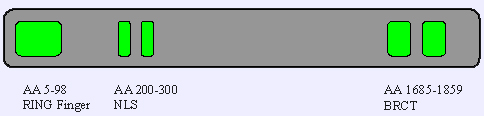
The BRCA1 protein showing the RING finger domain, the Nuclear Localisation Signal domain and the BRCT domains. AA- amino acids.
Description
BRCA1 is an 1863 amino acid 220kDa protein with an E3 ubiquitin ligase activity as well as a phospho-peptide binding activity. It has several domains that are essential for its function as depicted in the figure. The RING finger domain of BRCA1, commonly found in many DNA repair proteins, consists of a conserved core of approximately 50 amino acids in a pattern of seven cysteine residues and one histidine residue to form a structure that can bind to two Zn++ ions. This motif aids in mediating protein-protein interaction, as exemplified by the interaction of BRCA1 with BARD1 (BRCA1 associated RING domain). This interaction is critical since mutations in the Zn++ binding regions, crucial for heterodimerization with BARD1, have been found in tumours. BRCA1 accumulates in distinct foci in the nucleus during S phase and this transfer is aided by its Nuclear Localisation Signal (NLS) domain. A further role of BARD1 is also implicated whereby its association with the RING finger domain of BRCA1 is necessary for the transfer of BRCA1 to the nucleus. BRCA1 interacts with Rad50 of the MRN complex through the region AA 341-748 and can directly bind to branched, flap and four way DNA structures through a central domain spanning residues 452-1079. The protein inhibits the nucleolytic activities of the Mre11/Rad50/Nbs1 complex as a result of this direct DNA binding. The C terminus of BRCA1, which can function as a transcriptional activation domain, consists of two tandemly arranged elements called BRCT (BRCA1 C- terminal). This motif specifically binds to phosphorylated proteins, an event that is commonly associated with DNA damage response. BRCA1 is capable of interacting directly with BRCA2 and with Rad51 via BRCA2 through this motif. Another protein that interacts with BRCA1 via BRCT is the BRCA1 associated C-terminal helicase ( BACH1 ). BACH1 is said to aid BRCA1 in the DNA damage response and maintain the protein at the nuclear foci formed after DNA damage response. Other proteins that can interact with BRCA1 through the BRCT domains are C terminal Interacting protein /CtIP), RNA Polymerase II, BACH 1 (a member of DEAH helicase family) and p53 .
Expression
BRCA1 is ubiquitously expressed in humans with the highest levels observed in the ovaries, testis and thymus. It is a tumour suppressor and a reduced expression is correlated with the transformation procedure and aetiology of sporadic breast cancer. This reduction is expression is said to be transcriptionally regulated with implications of aberrant promoter methylation at CpG dinucleotides as well as CREB binding sites.
Localisation
Located in the nucleus.
Function
Role of BRCA1 in DNA repair: BRCA1 is a part of a large complex of proteins, the BASC, which monitors the genome for damage and signals downstream effectors. BRCA1 has been implicated in two pathways of DNA double strand break repair: homologous recombination (HR) and non homologous end joining (NHEJ). Upon exposure to DNA damaging agents, BRCA1 becomes hyperphosphorylated and is rapidly relocated, along with Rad51, to sites of DNA synthesis marked by proliferating cell nuclear antigen (PCNA). Rad51, a homolog of the bacterial RecA, is a central player in HR, catalyzing the invasion of the single stranded DNA in a homologous duplex and facilitating the homology search during the establishment of joint molecules. A recent study, however, has indicated that BRCA1 deficient breast cancer cells compensate for this deficiency by upregulating Rad51. The resultant HR may be erroneous and thereby lead to tumorigenesis. In addition, BRCA1 is said to inhibit the MRN complex which is is implicated in bringing together two DNA strands together for the error prone NHEJ. BRCA1-deficient cells are sensitive to ionizing radiation and DNA damaging drugs, such as mitomycin C.
Transcriptional regulation: BRCA1 is capable of transcriptional regulation and chromatin remodelling when tethered to promoters of genes important in the DNA repair process and breast cancer markers. It is a member of the core RNA polymerase II transcriptional machinery, a feature exploited by the DNA damage recognition process. In addition, BRCA1 interacts with p300/CBP, transcriptional coactivators for CREB. p300/CBP are inhibited by the viral oncoprotein E1A and the functionality of E1A as an oncogene could be in part caused by an obstruction of BRCA1:p300/CBP cooperation resulting in the loss of the tumour-suppressing function of BRCA1. BRCA1 can act as a transcriptional coactivator or co repressor of proteins implicated in chromatin remodelling, such as the histone deacetylase complexes or components of the SWI/SNF-related chromatin-remodelling complex.
Cell Cycle Regulation by BRCA1: BRCA1, based on its phosphorylation status, elicits DNA damage induced cell cycle arrest at several stages through modulation of specific downstream target genes. BRCA1 transactivates p21cip1/WAF1, which contributes to an arrest at the G1/S boundary. ATM phosphorylation of BRCA1 appears to be important for its role in the intra S phase checkpoint activation. BRCA1 is also implicated in the transcriptional regulation of several genes such as cyclinB, 14-3-3sigma, GADD45, wee-1 kinase and PLK1 associated with the G2/M checkpoint.
p53-dependent apoptosis: The BRCA1 protein is capable of physically interacting with the p53 tumour suppressor gene, and can stimulate p53-dependent transcription from the p21WAF1/CIP1 mdm2 and promoters. In addition, the BRCA1-BARD1 complex is required for the phosphorylation of p53 at Ser15 by ATM/ATR following DNA damage by IR or UV radiation. The phosphorylation of p53 at Ser-15 is essential for the G(1)/S cell cycle arrest via transcriptional induction of the cyclin-dependent kinase inhibitor p21 after DNA damage.
Ubiquitination: BRCA1 and BARD1 interact together to form an E3 ubiquitin ligase. RNA polII stalled at sites of DNA damage is a target for this ubiquitin ligase mediated degradation following DNA damage, thereby allowing access to the repair machinery. BRCA1 ubiquitinates the transcriptional preinitiation complex, not for proteasomal degradation, but to prevent a stable association of TFIIE and TFIIH; thereby blocking the initiation of mRNA synthesis.
Transcriptional regulation: BRCA1 is capable of transcriptional regulation and chromatin remodelling when tethered to promoters of genes important in the DNA repair process and breast cancer markers. It is a member of the core RNA polymerase II transcriptional machinery, a feature exploited by the DNA damage recognition process. In addition, BRCA1 interacts with p300/CBP, transcriptional coactivators for CREB. p300/CBP are inhibited by the viral oncoprotein E1A and the functionality of E1A as an oncogene could be in part caused by an obstruction of BRCA1:p300/CBP cooperation resulting in the loss of the tumour-suppressing function of BRCA1. BRCA1 can act as a transcriptional coactivator or co repressor of proteins implicated in chromatin remodelling, such as the histone deacetylase complexes or components of the SWI/SNF-related chromatin-remodelling complex.
Cell Cycle Regulation by BRCA1: BRCA1, based on its phosphorylation status, elicits DNA damage induced cell cycle arrest at several stages through modulation of specific downstream target genes. BRCA1 transactivates p21cip1/WAF1, which contributes to an arrest at the G1/S boundary. ATM phosphorylation of BRCA1 appears to be important for its role in the intra S phase checkpoint activation. BRCA1 is also implicated in the transcriptional regulation of several genes such as cyclinB, 14-3-3sigma, GADD45, wee-1 kinase and PLK1 associated with the G2/M checkpoint.
p53-dependent apoptosis: The BRCA1 protein is capable of physically interacting with the p53 tumour suppressor gene, and can stimulate p53-dependent transcription from the p21WAF1/CIP1 mdm2 and promoters. In addition, the BRCA1-BARD1 complex is required for the phosphorylation of p53 at Ser15 by ATM/ATR following DNA damage by IR or UV radiation. The phosphorylation of p53 at Ser-15 is essential for the G(1)/S cell cycle arrest via transcriptional induction of the cyclin-dependent kinase inhibitor p21 after DNA damage.
Ubiquitination: BRCA1 and BARD1 interact together to form an E3 ubiquitin ligase. RNA polII stalled at sites of DNA damage is a target for this ubiquitin ligase mediated degradation following DNA damage, thereby allowing access to the repair machinery. BRCA1 ubiquitinates the transcriptional preinitiation complex, not for proteasomal degradation, but to prevent a stable association of TFIIE and TFIIH; thereby blocking the initiation of mRNA synthesis.
Homology
Dog (Canis familiaris): BRCA1
Chimpanzee(Pan troglodytes): BRCA1
Rat (Rattus norvegicus): Brca1
Mouse(Mus musculus): Brca1
Chicken(Gallus gallus): BRCA1
Chimpanzee(Pan troglodytes): BRCA1
Rat (Rattus norvegicus): Brca1
Mouse(Mus musculus): Brca1
Chicken(Gallus gallus): BRCA1
Mutations
Note
BRCA1 germline mutations contribute significantly to the development of familial/hereditary breast and ovarian cancer. However, each gene carries as many as 1000 different disease associated mutations, many of which are rare. These mutations are distributed uniformly along the entire coding region and intronic sequences flanking each exon. The mutations are at a high penetrance therefore women who carry these mutations have a lifetime risk of 80-90% to develop breast cancer. Founder mutations such as the BRCA1-185delAG and 5382insC are found among Ashkenazi Jews. Larger and complex genomic rearrangements in the exons 21 and 22 of the BRCA1 gene, resulting in a lack of the BRCT motif have been reported.
Implicated in
Entity name
Breast Cancer
Disease
Heterozygous carriers of high-risk mutations in the general Caucasian population have been estimated to be about one in 1000 for the BRCA1 gene. The lifetime risk of the development of hereditary breast cancer with the presence of BRCA1 mutations is very high. In addition, for sporadic breast cancer, a reduction in the expression of BRCA1 rather than the presence of mutations has been observed. The lack of a functional BRCA1 leads to impaired repair of DNA double strand breaks, cell cycle progression and transcriptional regulation, thereby causing the development of neoplasms.
Entity name
Ovarian Cancer
Disease
Mutations of the BRCA1 gene is the major cause for familial breast and ovarian cancer incidence. The lifetime risks of ovarian cancer associated with a BRCA1 gene mutation carrier has been estimated as 40 to 50%. The most common mutations are frameshift and nonsense mutations that are predicted to cause premature truncation of the BRCA1 protein. In addition, mutations that are predicted to affect splice-site consensus sequences as well as missense mutation have also been seen in ovarian cancer. Large genomic alterations, such as the gains in copy number of exon 13 as well as deletion of exons in the BRCA1 gene is also associated with the development of ovarian cancer.
Entity name
Other cancers
Disease
An increased relative risk to the development of cancer of the colon, cervix, uterus, pancreas and prostate has been suggested in BRCA1-mutation carriers.
Article Bibliography
| Pubmed ID | Last Year | Title | Authors |
|---|---|---|---|
| 11704836 | 2001 | A CREB site in the BRCA1 proximal promoter acts as a constitutive transcriptional element. | Atlas E et al |
| 8929543 | 1996 | Human Rad51 protein promotes ATP-dependent homologous pairing and strand transfer reactions in vitro. | Baumann P et al |
| 17052168 | 2006 | Cellular functions of the BRCA tumour-suppressor proteins. | Boulton SJ et al |
| 16357529 | 2006 | Assessing the link between BACH1 and BRCA1 in the FA pathway. | Cantor SB et al |
| 9926942 | 1999 | The second BRCT domain of BRCA1 proteins interacts with p53 and stimulates transcription from the p21WAF1/CIP1 promoter. | Chai YL et al |
| 8751436 | 1996 | Transcriptional activation by BRCA1. | Chapman MS et al |
| 9774970 | 1998 | Stable interaction between the products of the BRCA1 and BRCA2 tumor suppressor genes in mitotic and meiotic cells. | Chen J et al |
| 16103751 | 2005 | Good timing in the cell cycle for precise DNA repair by BRCA1. | Durant ST et al |
| 11925436 | 2002 | BARD1 induces BRCA1 intranuclear foci formation by increasing RING-dependent BRCA1 nuclear import and inhibiting BRCA1 nuclear export. | Fabbro M et al |
| 15159397 | 2004 | BRCA1-BARD1 complexes are required for p53Ser-15 phosphorylation and a G1/S arrest following ionizing radiation-induced DNA damage. | Fabbro M et al |
| 17591843 | 2007 | Founder mutations in BRCA1 and BRCA2 genes. | Ferla R et al |
| 11278247 | 2001 | The RING heterodimer BRCA1-BARD1 is a ubiquitin ligase inactivated by a breast cancer-derived mutation. | Hashizume R et al |
| 17420471 | 2007 | A mechanism for transcriptional repression dependent on the BRCA1 E3 ubiquitin ligase. | Horwitz AA et al |
| 12483514 | 2002 | Homologous repair of DNA damage and tumorigenesis: the BRCA connection. | Jasin M et al |
| 17942895 | 2007 | RAD51 up-regulation bypasses BRCA1 function and is a common feature of BRCA1-deficient breast tumors. | Martin RW et al |
| 7545954 | 1994 | A strong candidate for the breast and ovarian cancer susceptibility gene BRCA1. | Miki Y et al |
| 16998500 | 2006 | The role of BRCA1 in transcriptional regulation and cell cycle control. | Mullan PB et al |
| 17498966 | 2007 | Genetic susceptibility for breast cancer: how many more genes to be found? | Oldenburg RA et al |
| 9482880 | 1998 | BRCA1 regulates p53-dependent gene expression. | Ouchi T et al |
| 10655477 | 2000 | CBP/p300 interact with and function as transcriptional coactivators of BRCA1. | Pao GM et al |
| 11353843 | 2001 | Direct DNA binding by Brca1. | Paull TT et al |
| 16462773 | 2006 | BACH1 is a DNA repair protein supporting BRCA1 damage response. | Peng M et al |
| 17688236 | 2007 | Contribution of BRCA1 and BRCA2 mutations to inherited ovarian cancer. | Ramus SJ et al |
| 9778046 | 1998 | Aberrant methylation of the BRCA1 CpG island promoter is associated with decreased BRCA1 mRNA in sporadic breast cancer cells. | Rice JC et al |
| 9207057 | 1997 | BRCA1 is a cell cycle-regulated nuclear phosphoprotein. | Ruffner H et al |
| 9159119 | 1997 | BRCA1 is a component of the RNA polymerase II holoenzyme. | Scully R et al |
| 9267023 | 1997 | Dynamic changes of BRCA1 subnuclear location and phosphorylation state are initiated by DNA damage. | Scully R et al |
| 15280660 | 2004 | Molecular functions of BRCA1 in the DNA damage response. | Scully R et al |
| 11877386 | 2002 | Structural determinants of BRCA1 translational regulation. | Sobczak K et al |
| 16551709 | 2006 | Spectrum of mutations in BRCA1, BRCA2, CHEK2, and TP53 in families at high risk of breast cancer. | Walsh T et al |
| 10783165 | 2000 | BASC, a super complex of BRCA1-associated proteins involved in the recognition and repair of aberrant DNA structures. | Wang Y et al |
| 10426999 | 1999 | Association of BRCA1 with the hRad50-hMre11-p95 complex and the DNA damage response. | Zhong Q et al |
| 17868747 | 2008 | Novel complex genomic rearrangement of the BRCA1 gene. | Zikan M et al |
Other Information
Locus ID:
NCBI: 672
MIM: 113705
HGNC: 1100
Ensembl: ENSG00000012048
Variants:
dbSNP: 672
ClinVar: 672
TCGA: ENSG00000012048
COSMIC: BRCA1
RNA/Proteins
Expression (GTEx)
Pathways
Protein levels (Protein atlas)
PharmGKB
| Entity ID | Name | Type | Evidence | Association | PK | PD | PMIDs |
|---|---|---|---|---|---|---|---|
| PA164920420 | olaparib | Chemical | LabelAnnotation | associated | |||
| PA166131610 | niraparib | Chemical | LabelAnnotation | associated | |||
| PA166158714 | [GRCh37]chr17:41276046 | Variant | VipGene | associated | 11896095, 7550349, 7606717, 7837387, 7894492, 8841191, 8898735, 9333265, 11466700 | ||
| PA166158719 | [GRCh37]chr17:41209080 | Variant | VipGene | associated | 11896095, 7550349, 7837387, 7894492, 8841191, 8898735, 9333265, 11466700 | ||
| PA166163418 | rucaparib | Chemical | LabelAnnotation | associated | |||
| PA166182740 | talazoparib | Chemical | LabelAnnotation | associated | |||
| PA443560 | Breast Neoplasms | Disease | VipGene | associated | 11034065, 11130383, 11896095, 12237281, 12237282, 15197194, 15254424, 16331614, 16445371, 16636335, 7545954, 7837387, 9145676, 9333265, 10208417 | ||
| PA443685 | Uterine Cervical Neoplasms | Disease | VipGene | associated | 12237281 | ||
| PA443756 | Colonic Neoplasms | Disease | VipGene | associated | 12237282 | ||
| PA444144 | Fallopian Tube Neoplasms | Disease | VipGene | associated | 12237282 | ||
| PA445062 | Neoplasms | Disease | VipGene | associated | 11034065, 11130383, 11896095, 12237281, 12237282, 15197194, 15254424, 16331614, 16636335, 7837387, 9145676, 9333265, 10208417 | ||
| PA445204 | Ovarian Neoplasms | Disease | VipGene | associated | 11034065, 11130383, 11896095, 12237281, 12237282, 15197194, 15254424, 16331614, 16636335, 7545954, 7837387, 9145676, 9333265, 10208417 | ||
| PA445218 | Pancreatic Neoplasms | Disease | VipGene | associated | 12237282, 12237281 | ||
| PA445425 | Prostatic Neoplasms | Disease | VipGene | associated | 12237282, 9145676, 12237281 | ||
| PA445742 | Stomach Neoplasms | Disease | VipGene | associated | 12237282 | ||
| PA446004 | Uterine Neoplasms | Disease | VipGene | associated | 12237281 | ||
| PA446745 | Breast Neoplasms, Male | Disease | VipGene | associated | 12237282, 11896095 | ||
| PA451581 | tamoxifen | Chemical | VipGene | associated | 15197194, 16331614, 16636335, 11130383 |
References
| Pubmed ID | Year | Title | Citations |
|---|---|---|---|
| 37714298 | 2024 | BRCA1/2 Haploinsufficiency: Exploring the Impact of Losing one Allele. | 1 |
| 37748860 | 2024 | Mosaic BRCA1 promoter methylation contribution in hereditary breast/ovarian cancer pedigrees. | 2 |
| 37833038 | 2024 | Subset of retinoblastoma tumours is associated with BRCA1/2 mutations. | 0 |
| 37850614 | 2024 | Causality and functional relevance of BRCA1 and BRCA2 pathogenic variants in non-high-grade serous ovarian carcinomas. | 3 |
| 38015775 | 2024 | Correlates of Circulating Osteoprotegerin in Women with a Pathogenic or Likely Pathogenic Variant in the BRCA1 Gene. | 0 |
| 38030749 | 2024 | Risk-reducing mastectomy and breast cancer mortality in women with a BRCA1 or BRCA2 pathogenic variant: an international analysis. | 1 |
| 38037490 | 2024 | NMR-identification of the interaction between BRCA1 and the intrinsically disordered monomer of the Myc-associated factor X. | 1 |
| 38057686 | 2024 | Presence of crown-like structures in breast adipose tissue; differences between healthy controls, BRCA1/2 gene mutation carriers and breast cancer patients. | 0 |
| 38063999 | 2024 | Inherited BRCA1 and RNF43 pathogenic variants in a familial colorectal cancer type X family. | 1 |
| 38096711 | 2024 | Male breast cancer: No evidence for mosaic BRCA1 promoter methylation involvement. | 0 |
| 38167124 | 2024 | BRCA1 and BRCA2 germline mutations in Chinese Hakka breast cancer patients. | 0 |
| 38171988 | 2024 | Beyond BRCA: Diagnosis and management of homologous recombination repair deficient pancreatic cancer. | 0 |
| 38172369 | 2024 | Simulation and Computational Study of RING Domain Mutants of BRCA1 and Ube2k in AD/PD Pathophysiology. | 0 |
| 38242199 | 2024 | Variant of uncertain significance Arg866Cys enhances disorderedness of h-BRCA1 (759-1064) region. | 0 |
| 38244928 | 2024 | Longitudinal profiling identifies co-occurring BRCA1/2 reversions, TP53BP1, RIF1 and PAXIP1 mutations in PARP inhibitor-resistant advanced breast cancer. | 4 |
Citation
Sreeparna Banerjee
BRCA1 (breast cancer 1, early onset)
Atlas Genet Cytogenet Oncol Haematol. 2007-10-01
Online version: http://atlasgeneticsoncology.org/gene/163/brca1-(breast-cancer-1-early-onset)
