WNK2 (WNK lysine deficient protein kinase 2)
2010-04-01 Peter Jordan AffiliationDepartamento de Genetica, Instituto Nacional de Saude Dr Ricardo Jorge, Avenida Padre Cruz, 1649-016 Lisboa, Portugal
Identity
HGNC
LOCATION
9q22.31
LOCUSID
ALIAS
NY-CO-43,P/OKcl.13,PRKWNK2,SDCCAG43
FUSION GENES
DNA/RNA

Human WNK2 gene structure. The gene spans 136 Kbp, contains 31 exons and localizes to chromosome 9q22.31. Exons (vertical boxes) and separating introns are shown in proportion to their sizes; however, intron scale differs from exon scale.
Description
The human WNK2 gene is composed of 31 exons spanning 136 Kbp on chromosome 9q22.31. The promoter region contains a 700 bp CpG island between 1103 bp and 396 bp upstream of the ATG translation start codon. A second CpG island spans exon 1 from 135 bp upstream of the ATG translation start codon until 638 bp downstream of the ATG and close to the end of exon 1.
Transcription
Two major alternative transcripts exist depending on the terminal exon chosen. One variant uses exons 1-30, has a coding sequence of 6894 bp and yields WNK2(1-2297) (related to clone KIAA1760, Acc. Nb. AB051547). The other variant skips exon 30 and includes exon 31, has a coding sequence of 6765 bp and yields WNK2(1-2254) (related to clone Kaia302; Acc. Nb. AK000694). Both terminal exons 30 and 31 carry their own 3-untranslated regions and polyadenylation signals. In addition, there is evidence for alternative splicing in other exons and in a tissue-specific manner.
Pseudogene
None known.
Proteins
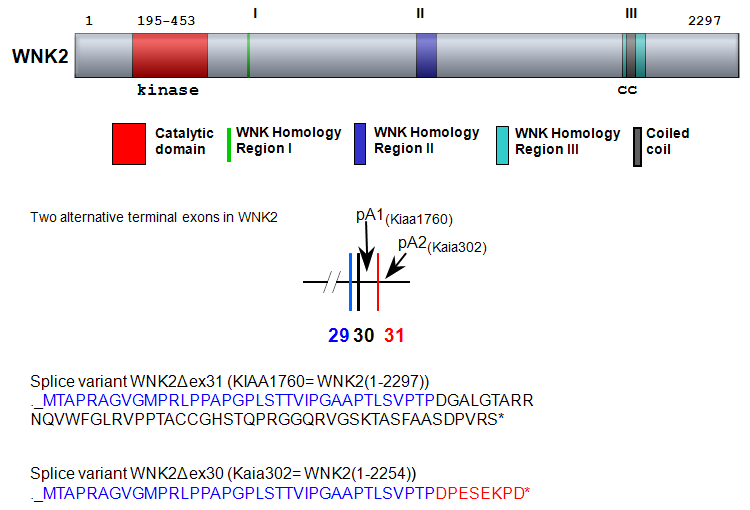
Diagram of the WNK2 protein in scale. The sequence contains a catalytic domain near the N-terminus and a coiled coil domain near the C-terminus. Except for three short homology regions shared with the three other human WNK kinases, no other functional domains are known. The two splicing variants WNK2(1-2297) and WNK2(1-2254) differ in the C-terminal protein sequence.
Description
Amino acids: 2297 or 2254. Molecular Weight: 243000 Daltons. The WNK2 protein encodes a cytoplasmic serine-threonine kinase that lacks a lysine in subdomain II required for ATP-binding in most protein kinases and instead uses an alternative lysine in subdomain I. WNK kinase form a separate family branch, most closely related to kinases MEKK, Raf and PAK.
Expression
WNK2 is preferentially expressed in heart, skeletal muscle and brain but also in small intestine, colon and liver. Loss of expression was reported in a large percentage of human gliomas (Hong et al., 2007) and grade II and III meningiomas (Jun et al., 2009) due to extensive methylation in the CpG island at the 5 end of the WNK2 gene. In contrast, promoter methylation was rare in other tumor types. This finding makes WNK2 a candidate tumor suppressor gene in brain tumors.
Localisation
The subcellular localization of GFP-tagged WNK2 in HeLa cells was predominantly cytoplasmic. Part of the endogenous WNK2 pool in HT29 colorectal cells localized to the plasma membrane and overexpression of a WNK2(1922-2156) that contains the coiled-coil domain was targeted to the plasma membrane.
Function
Human WNK2 modulates the activation level of ERK1 and ERK2. Experimental depletion of WNK2 or overexpression of a kinase-dead WNK2K207M mutant led to increased phospho-ERK1/2 levels when a basal ERK stimulation was present but not, for example, in serum-free culture conditions (Moniz et al., 2007). This increase in ERK1/2 activation promoted cell cycle progression through G1/S and sensitized cells to respond to lower concentrations of EGF. From these data one might predict that loss of WNK2 expression will promote cell cycle progression in tumor cells. Interestingly, WNK2 expression is silenced in a significant percentage of human gliomas (Hong et al., 2007) suggesting that this pathway may be used in some tumor types to promote cell proliferation. The molecular mechanism through which a reduction in WNK2 expression can increase ERK1/2 activation involves phosphorylation of MEK1 at serine 298, a modification that increases MEK1 affinity towards ERK1/2. Apparently, WNK2 affects PAK1 activation via Rac1 and PAK1 is the kinase responsible for MEK1 S298 phosphorylation (Moniz et al., 2008).
Homology
The catalytic domain of WNK2 is 90% identical to WNK1, 91% identical to WNK3 and 81% identical to WNK4. The remaining sequence of WNK2 has little homology to other WNK members except for three small WNK homology regions (Holden et al., 2004; Moniz et al., 2007). These include an acidic motif (residues 586-597) to which hereditary mutations in WNK4 cluster (Wilson et al., 2001), residues 1186-1261 without any recognizable motif, and residues 1918-1988 including a coiled-coil domain.
Mutations
Note
At present it is unclear whether the observed somatic mutations have a functional impact on the WNK2 protein or confer any selective advantage to tumors cells.
Germinal
No germinal mutations described.
Somatic
Somatic mutations in WNK2 have been found in the course of large scale tumor genome sequencing efforts (see Table below).
| Tissue | Histology/Type | cDNA | Protein | Mutation | Ref | ||||||||||||||||||||||||||||||||||||||||||||||||||||||||||||||||||||||||||||||||||||||||||||||||||||||||||||||||||||||||||||||||
| Colorectal | adenocarcinoma | c.1964delC | p.P655fs*2 | Frameshift deletion | Greenman et al., 2007 | ||||||||||||||||||||||||||||||||||||||||||||||||||||||||||||||||||||||||||||||||||||||||||||||||||||||||||||||||||||||||||||||||
| Brain | glioblastoma | c.3799G>A | p.A1267T | Missense | Parsons et al., 2008 | ||||||||||||||||||||||||||||||||||||||||||||||||||||||||||||||||||||||||||||||||||||||||||||||||||||||||||||||||||||||||||||||||
| Stomach | adenocarcinoma | c.4269delC | p.S1424fs*5 | Frameshift deletion | Greenman et al., 2007 | ||||||||||||||||||||||||||||||||||||||||||||||||||||||||||||||||||||||||||||||||||||||||||||||||||||||||||||||||||||||||||||||||
| Lung | neuroendocrine carcinoma | c.5009G>A | p.G1670E | Missense | Greenman et al., 2007; Davies et al., 2005 | ||||||||||||||||||||||||||||||||||||||||||||||||||||||||||||||||||||||||||||||||||||||||||||||||||||||||||||||||||||||||||||||||
| Lung | adenocarcinoma | c.6089G>T | p.S2030I | Missense | Greenman et al., 2007; Davies et al., 2005 | ||||||||||||||||||||||||||||||||||||||||||||||||||||||||||||||||||||||||||||||||||||||||||||||||||||||||||||||||||||||||||||||||
| Ovary | serous carcinoma | c.1528G>T | p.V510L | Missense | Greenman et al., 2007 | ||||||||||||||||||||||||||||||||||||||||||||||||||||||||||||||||||||||||||||||||||||||||||||||||||||||||||||||||||||||||||||||||
| Ovary | mucinous carcinoma | c.6798delC | p.T2267fs*31 | Frameshift deletion | Greenman et al., 2007Implicated inEntity name Brain tumors Note Promoter methylation leads to loss of expression. Disease Glioma and meningioma. Prognosis Unknown. Entity name Colon cancer Note WNK2 clone was isolated as a serologically defined colon cancer antigen 43; WNK2 is expressed in colon. Article Bibliography
Other InformationLocus ID:
NCBI: 65268 Variants:
dbSNP: 65268 RNA/ProteinsExpression (GTEx)Pathways
Protein levels (Protein atlas)References
CitationPeter Jordan WNK2 (WNK lysine deficient protein kinase 2) Atlas Genet Cytogenet Oncol Haematol. 2010-04-01 Online version: http://atlasgeneticsoncology.org/gene/41867/wnk2-(wnk-lysine-deficient-protein-kinase-2) |
