SPINK1 (Serine Peptidase Inhibitor, Kazal Type 1)
2014-12-01 Hannu Koistinen , Outi Itkonen , Ulf-Hakan Stenman AffiliationDepartment of Clinical Chemistry, University of Helsinki (HK,OI, UHS),, Laboratory Division HUSLAB, Helsinki University Central Hospital (OI), Helsinki, Finland [email protected]; [email protected]; [email protected]
Identity
HGNC
LOCATION
5q32
LOCUSID
ALIAS
PCTT,PSTI,Spink3,TATI,TCP
FUSION GENES
Abstract
Review on SPINK1, with data on DNA, on the protein encoded, and where the gene is implicated.
DNA/RNA
Note
Some other SPINK family members are similar in size, are encoded for by 4 exons and contain a single Kazal type serine protease inhibitor domain.
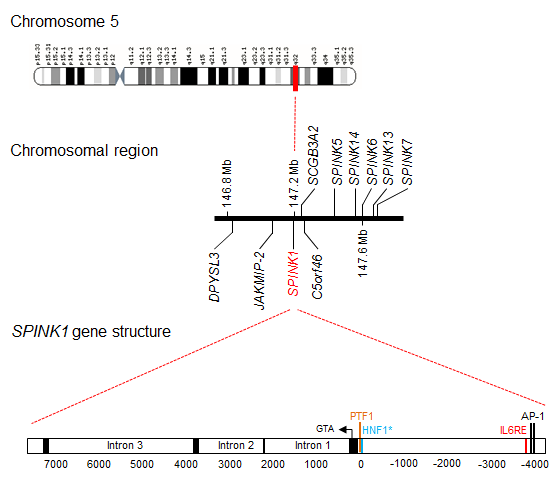
Chromosomal location and gene structure of SPINK1 gene (extracted from Ensembl database release 73). Some putative regulatory elements are also shown (Ohmachi et al., 1993; Yasuda et al., 1993; Yasuda et al., 1998; Boulling et al., 2011). After the translation-initiating codon (ATG) exons of the major transcript are shown in black. One splicing variant also contains parts outside of these exons. *, CAATCAATAAC, potential pancreas-specific regulatory element; IL6RE, interleukin-6 responsive element; AP-1, activator protein-1 element; HNF1, hepatic nuclear factor; PTF1, pancreas-specific transcription factor 1.
Description
Maps to chromosomal region 5q32: 147,204,131-147,211,349 on reverse (minus) strand (7,219 bp). Gene consists of 4 exons (Horii et al., 1987). Region between 3.8 and 4.0 kb upstream from the translation initiation codon contains an interleukin-6 responsive element (IL6RE) and two potential AP-1 binding sites (Ohmachi et al., 1993; Yasuda et al., 1993). CAATCAATAAC sequence (-149 to -139) is a potential pancreas-specific regulatory element (Yasuda et al., 1998). This region in the SPINK1 promoter has been subsequently identified as a binding site for hepatic nuclear factor (HNF1) (Boulling et al., 2011). A putative binding site for pancreas-specific transcription factor 1 (PTF1) has also been identified within the SPINK1 promoter (Boulling et al., 2011).
Transcription
SPINK1 mRNA (NCBI Reference Sequence: NM_003122.3) has 454 bp (Yamamoto et al., 1985). Expression, at least in some cell lines, is regulated by IL-6 (Yasuda et al., 1993). Three differentially spliced mRNA forms have been described (Ensembl, release 73). Two of these have been classified as protein encoding.
Proteins
Note
In the literature, SPINK1 is widely referred to as TATI (tumor-associated trypsin inhibitor) and PSTI (pancreatic secretory trypsin inhibitor).
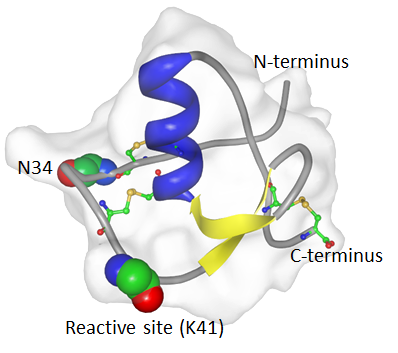
Ribbon diagram of recombinant SPINK1 variant (RSCB Protein Data Bank code 1HPT (Hecht et al., 1991)). Protein Workshop program (Moreland et al., 2005) with the surfaces feature (Xu and Zhang, 2009) was used for visualization. Cysteines, forming three disulfide bonds, are shown as balls and sticks. The atoms of asparagine-34 (N34) residue, mutation in which is associated with chronic pancreatitis, and reactive site lysine (K41) are shown as balls without side-chains. Alpha-helix is shown in blue and beta-sheets in yellow.
Description
SPINK1(NCBI Reference Sequence: NP_003113.2 ; UniProtKB/Swiss-Prot: ISK1_HUMAN, P00995; PDB: 1cgj; 1cgi; 1hpt) is a 6242 Da secreted protein, containing 79 amino acids. Mature SPINK1 contains 56 amino acids and three disulfide bonds. It has a Kazal-type serine protease inhibitor domain and belongs to the SPINK (serine peptidase inhibitor, Kazal-type) family. SPINK1 has been reported to inhibit several proteases, including human trypsin-1 and -2 (cationic and anionic trypsins), acrosin and granzyme A (Pubols et al., 1974; Huhtala et al., 1984; Turpeinen et al., 1988; Tsuzuki et al., 2003).
Expression
SPINK1 was first characterized in bovine pancreas (Kazal et al. 1948) and pancreatic juice (Greene 1966), and later from human pancreatic juice (Fritz et al 1967). SPINK1 is mainly expressed in the pancreas, but to a lesser extent also in several other tissues, e.g., in the gastrointestinal tract, including the liver, duodenum, small intestine, gall bladder, colon, appendix, stomach, and in the genitourinary tract, e.g., prostate and urothelium (Paju and Stenman, 2006; Itkonen and Stenman, 2014). Expression has been found also in kidney, lung, breast, brain, spleen and ovary. SPINK1 is often strongly expressed in ETS-rearrangement-negative prostate cancers (Tomlins et al., 2008). A putative bipartite pancreas-specific transcription factor 1 (PTF1)-binding sequence has been identified (Boulling et al., 2011) in the SPINK1 gene. Outside the pancreas, SPINK1 has been considered an inflammatory pleiotropic cytokine, which is regulated by immune and inflammatory responses. In some cell lines, the expression is regulated by IL-6 (Yasuda et al., 1993). In cultured prostate cancer cells, SPINK1 expression has been shown to be regulated by androgens (Paju et al., 2007). In mouse, the synthesis of Spink3 (mouse orthologue of SPINK1) is dependent upon testicular androgens in the sex accessory tissues, but not in the pancreas (Mills et al., 1987). Very high serum and urine concentrations occur in patients with pancreatitis (Ogawa, 1988). Serum levels of SPINK1 may also be elevated in several cancers, including prostate cancer, ovarian cancer and benign cysts, renal-cell carcinoma, bladder carcinoma, and colorectal cancer (Paju and Stenman, 2006; Itkonen and Stenman, 2014). Severe inflammation, tissue destruction and major trauma leads to an acute phase reaction causing increased circulating SPINK1 concentrations.
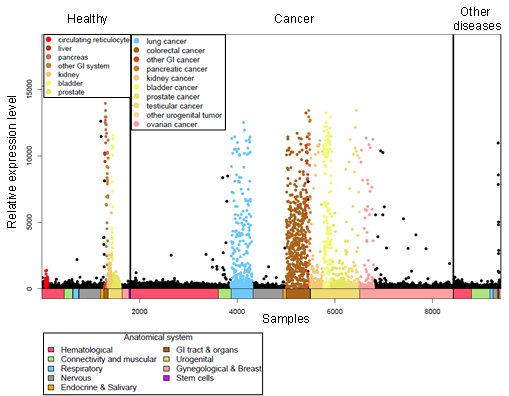
Relative mRNA expression levels of SPINK1 in different tissues. The data is from the IST4 database containing gene expression data in ~10 000 samples (http://ist.medisapiens.com/) (Kilpinen et al., 2008).
Localisation
SPINK1 is highly expressed in the pancreas (Kazal et al., 1948). It has been localized to the zymogen granules of pancreatic acinar cells, where it protects the pancreas from premature activation of trypsinogens. SPINK1 is secreted into the pancreatic fluid along with digestive enzymes. Many cancers secrete SPINK1 causing elevated serum concentrations (Paju and Stenman, 2006; Itkonen and Stenman, 2014).
Function
SPINK1 is a protease inhibitor and has been reported to inhibit human trypsin-1 and -2 (cationic and anionic trypsins), but not trypsin-3 (mesotrypsin)(Sahin-Tóth, 2005). SPINK1 also inhibits granzyme A (Tsuzuki et al., 2003), plasmin, urokinase, tissue plasminogen activator (Turpeinen et al., 1988) and acrosin (Huhtala et al., 1984). SPINK1 has been reported to exert growth stimulation of cultured cells (Niinobu et al., 1990) and to activate the EGF-receptor (Ozaki 2009; Ateeq et al., 2011). However, growth stimulation by mechanisms other than via EGF receptor cannot be ruled out. It has been suggested that SPINK1 mediates tumor growth, differentiation, and angiogenesis via stimulation of the EGF-receptor or by suppression of serine-protease- or caspase-dependent apoptosis (Ateeq et al., 2011; Gouyer et al., 2008). There is evidence that SPINK1 plays a role in tissue differentiation (Ohmuraya et al., 2005) and repair (Marchbank et al., 1996), reproduction (Huhtala, 1984) and regulation of apoptosis (Lu et al., 2011). Over-expression of SPINK1 in cancer could block cancer cell apoptosis resulting in suppression of the immune response and escape of cancer cells from immune surveillance (Lamontagne et al., 2010).
Homology
SPINK1 contains a Kazal-type serine protease inhibitor domain, found in many other proteins and especially in members of SPINK family. Apart from this domain, SPINKs do not share high sequence similarity. Apart from SPINK5, SPINKs are of similar size and most genes contain the same number of exons. Some of the family members lack functional annotatation. A functional SPINK1 orthologue, Spink3 (NP_033284.1), has been found in mouse. The rat has two orthologues, Spink1 (NP_690919.1) and Spink3 (NP_036806.1) (HomoloGene, Release 67). Orhologues have been found also in common chimpanzee (XP_001160275.1), rhesus macaque (XP_001102888.1), grey wolf (XP_850557.1) and cattle (NP_001020519.1). Sequence similarity between SPINK1 and EGF has been reported (Hunt et al., 1974).
Mutations
Note
NCBI SNP database (http://www.ncbi.nlm.nih.gov/SNP/) reports 631 SPINK1 SNPs (Homo sapiens, December 29., 2014). At least 15 missense mutations have been described in the mature polypeptide and three in the signal peptide (Chen and Férec, 2009). Association of mutations with familial pancreatitis and other diseases has been described (see below).
Implicated in
Entity name
Liver cancer
Note
Up-regulation of SPINK1 in tissue has been shown to distinguish hepatocellular carcinoma (HCC) from benign liver disease and normal liver (Marshall A 2013). Elevated serum concentrations of SPINK1 are associated with adverse prognosis of hepatocellular cancer (Lyytinen et al., 2013). Serum SPINK1 is also a useful marker for distinguishing between patients with or without liver metastasis of colorectal and breast cancer (Taccone W 1991; Gaber A 2010).
Disease
HCC is the fifth most frequently diagnosed cancer and the second most common cause of cancer death worldwide in men (Jemal et al., 2011). In females the rate is about half of that of men. Half of the cases occur in China and liver cancer is less common in Western countries. HCC is the most common type of liver cancer. It may be caused by viral infections, like hepatitis B and C, or cirrhosis. Most tumors in the liver are not primary liver cancers, but metastases of other cancers.
Prognosis
Plasma SPINK1 concentration is elevated in HCC patients and it correlates with tumor size (Ohmachi et al., 1993). Overexpression of SPINK1 mRNA is a stage-independent prognostic factor and a predictor of early tumor recurrence in HCC (Lee et al., 2007) and in cholangiocarcinoma (Tonouchi et al., 2006). Serum SPINK1 has been shown to predict adverse prognosis in HCC (Lyytinen I 2013).
Entity name
Prostate cancer
Note
SPINK1 is often overexpressed in ETS-rearrangement-negative prostate cancers (Tomlins et al., 2008).
Disease
Prostate cancer is a considerable health care problem with 342 000 new cases and about 71 000 deaths annually in the EU countries, it is the most frequently diagnosed cancer in men and the third most common cause of cancer death (data from GLOBOCAN 2008). Prostate cancer can be diagnosed by screening at an early stage, when most patients can be cured by radical prostatectomy or radiotherapy. However, about one third of the tumors relapse. Most of these cases can be treated by androgen ablation, but within 3 - 5 years the tumor usually becomes castration-resistant.
Prognosis
High SPINK1 expression has been associated with adverse prognosis in prostate cancer in some (Tomlins et al., 2008; Paju et al., 2007), but not all studies (Leinonen et al., 2013; Grupp et al., 2013; Lippolis et al., 2013). The differences may be related to the type of treatment, e.g., surgery or androgen ablation (Leinonen et al., 2013).
Entity name
Breast cancer
Disease
Breast cancer is the most common cancer among women worldwide, accounting for 23% of all cases (Jemal et al., 2011). Although the prognosis has improved due to early diagnosis and therapies, breast cancer remains a major cause of death among women (14% of the cancer deaths). Most neoplasms of the breast originate from the ductal epithelium, while a minority originates from the lobular epithelium. A family history of breast cancer is associated with a 2-3-fold higher risk of the disease.
Prognosis
SPINK1 expression is associated with poor prognosis in estrogen receptor-positive breast cancer (Soon et al., 2011).
Entity name
Colorectal cancer
Note
Elevated serum SPINK1 has been observed in some patients with colorectal cancer. (Solakidi et al., 2004; Pasanen et al., 1995)
Disease
Colorectal cancer is the third most commonly diagnosed cancer in males and the second in females (Jemal et al., 2011). It originates from colon or rectum, but, based on genetic studies, these are the same tumor. When locally confined, colorectal cancer is often curable by surgery.
Prognosis
High expression of SPINK1 has been associated with adverse prognosis and liver metastases (Gaber et al., 2010; Gaber at al., 2009)
Entity name
Bladder cancer
Note
Urinary SPINK1 is a useful marker for high-grade bladder cancer (Kelloniemi et al., 2003; Shariat et al., 2005; Gkialas et al., 2008, Patschan et al., 2012).
Disease
Bladder cancer is more common in males than in females and there is great geographic variation in incidence (Jemal et al., 2011). The highest incidence rates are found in Europe, North America and Northern Africa. Smoking, occupational exposures and chronic infection with Schistosoma hematobium are major risk factors. Most bladder cancers originate from the epithelial lining of the urinary bladder. Transitional cell carcinoma is the most common type of bladder cancer.
Prognosis
Serum SPINK1 has been shown to be an independent prognostic factor for bladder cancer (Kelloniemi et al., 2003) and for prediction of the response to chemotherapy (Pectasides et al., 1996). SPINK1 expression is stronger in noninvasive than in invasive tumors and decreases with advancing tumor stage (Hotakainen et al., 2006; Patschan et al., 2012).
Entity name
Ovarian cancer
Note
The association of SPINK1 (TATI) and cancer was first observed in a patients with ovarian cancer (Stenman et al. 1982)
Disease
Ovarian cancer is the leading cause of death from gynecologic cancer. Most cases are diagnosed at advanced stages and, thus have relatively poor prognosis. The vast majority of ovarian cancers are epithelial. Cancer of the fallopian tubes is similar to ovarian cancer.
Prognosis
Increased SPINK1 expression is associated with adverse outcome in epithelial ovarian cancer (Huhtala et al., 1983; Paju et al., 2004). Elevated serum SPINK1 is an independent prognostic factor (Venesmaa et al., 1994; Venesmaa et al., 1998; Paju et al., 2004).
Entity name
Gastric cancer
Note
SPINK1 is detected in the normal gastric mucosa.
Disease
Gastric cancers account for 8% of all cancer cases and 10% of the deaths (Jamal et al., 2011). Over 70% of new cases and deaths occur in developing countries and rates are higher in males than in females. Helicobacter pylori infection is the main risk factor, but smoking also increases the risk of gastric cancer.
Prognosis
The prognosis of gastric cancer is generally poor and metastases develop frequently. High tissue expression of SPINK1 is a sign of favorable outcome and loss of SPINK1 immunoreactivity in tumor tissue is associated with adverse prognosis (Wiksten et al., 2008). Serum SPINK1 is elevated in 50% of patients with gastric cancer (Solakidi et al., 2004).
Entity name
Renal cell carcinoma
Disease
Renal cancer comprises five distinct histological types. Within each type, there is considerable variation in clinical course and survival. Presently, many tumors are detected at an early stage by sonography performed for various reasons.
Prognosis
Prognosis of metastatatic and advanced disease is poor, but surgical treatment of localized disease is often curative. There are no specific serum markers for RCC. Elevated serum SPINK1 has been shown to be an independent prognostic factor in renal cell carcinoma (Meria et al., 1995; Paju et al., 2001).
Entity name
Pancreatitis, hereditary (Online Mendelian Inheritance in Man (OMIM): 167800)
Note
SPINK1 polymorphisms are found more frequently in patients with hereditary and idiopatic chronic pancreatitis (23%) than in healthy controls (0.4%) (Witt et al., 2000; Chen and Férec, 2009). Several mutations of SPINK1 cause loss-of-function by splicing, frameshift, deletion or initiation codon mutation. Some missense mutations have been suggested to affect polypeptide folding, leading to intracellular retention and degradation of the mutated polypeptide (Boulling et al., 2012). These mutations are suggested to cause pancreatitis because of SPINK1 deficiency. The most common mutation worldwide is a 101A>G transition within exon 3 resulting in the substitution of Asp by Ser at codon 34 (N34S) (Witt et al., 2000). The frequency of the N34S mutation in pancreatitis patients is 9-29 % as compared to 0.5-2.5 % in the general population. In functional studies no differences in SPINK1 expression, trypsin inhibitory activity or binding to trypsin have been found between wild-type and N34S-SPINK1. The mutations D50E, Y54H and R67C result in marked reduction or complete loss of SPINK1 secretion, and are classified as disease-causing mutations although trypsin inhibitory activity of the mutated proteins was retained (Király et al., 2007). The P55S mutation of SPINK1 is found in healthy controls as well as in pancreatitis patients with an incidence of 0.5-1.3 % and 0.9-7 %, respectively (Witt et al., 2000; Pfutzer et al., 2000). The role of this mutation in pancreatitis remains unclear.
Disease
Elevated serum and urine concentrations are caused by pancreatitis, i.e., inflammation of pancreas. Some hereditary mutations of the SPINK1 gene, increase the risk of pancreatitis. These cases are characterized by recurrent episodes of pancreatitis starting at young age. These episodes often lead to tissue damage and loss of pancreatic function, including insulin production. This also increases the risk of pancreatic cancer.
Prognosis
The life expectancy of the pancreatitis patients is close to normal. However, patients have an increased risk of developing pancreatic cancer (Weiss, 2014).
Entity name
Tropical calcific pancreatitis
Note
SPINK1 mutations, especially the N34S mutation has been reported to associate with tropical calcific pancreatitis (Bhatia et al., 2002).
Disease
Tropical calcific pancreatitis (OMIM: 608189) is a special type of chronic pancreatitis that occurs only in tropical countries.
Prognosis
Patients usually present at young age with recurrent abdominal pain and nutritional deficiencies. The disease often leads to beta-cell deficiency and diabetes requiring insulin before the age of 30. Prognosis is dismal and many patients succumb to complications caused by malnutrition.
Article Bibliography
| Pubmed ID | Last Year | Title | Authors |
|---|---|---|---|
| 21368222 | 2011 | Therapeutic targeting of SPINK1-positive prostate cancer. | Ateeq B et al |
| 12360463 | 2002 | Tropical calcific pancreatitis: strong association with SPINK1 trypsin inhibitor mutations. | Bhatia E et al |
| 22343981 | 2012 | Functional analysis of eight missense mutations in the SPINK1 gene. | Boulling A et al |
| 19453252 | 2009 | Chronic pancreatitis: genetics and pathogenesis. | Chen JM et al |
| 4231655 | 1967 | [On protease inhibitors, V. On the chemistry and physiology of the specific trypsin inhibitors from the ox, dog, pig and human pancreas]. | Fritz H et al |
| 19384300 | 2009 | High expression of tumour-associated trypsin inhibitor correlates with liver metastasis and poor prognosis in colorectal cancer. | Gaber A et al |
| 20849596 | 2010 | Increased serum levels of tumour-associated trypsin inhibitor independently predict a poor prognosis in colorectal cancer patients. | Gaber A et al |
| 18514770 | 2008 | Evaluation of urine tumor-associated trypsin inhibitor, CYFRA 21-1, and urinary bladder cancer antigen for detection of high-grade bladder carcinoma. | Gkialas I et al |
| 5928200 | 1966 | Trypsin inhibitor from bovine pancreatic juice. | Greene LJ et al |
| 23843146 | 2013 | SPINK1 expression is tightly linked to 6q15- and 5q21-deleted ERG-fusion negative prostate cancers but unrelated to PSA recurrence. | Grupp K et al |
| 1870127 | 1991 | Three-dimensional structure of the complexes between bovine chymotrypsinogen A and two recombinant variants of human pancreatic secretory trypsin inhibitor (Kazal-type). | Hecht HJ et al |
| 3501289 | 1987 | Primary structure of human pancreatic secretory trypsin inhibitor (PSTI) gene. | Horii A et al |
| 16327984 | 2006 | Differential expression of trypsinogen and tumor-associated trypsin inhibitor (TATI) in bladder cancer. | Hotakainen K et al |
| 6384012 | 1984 | Demonstration of a new acrosin inhibitor in human seminal plasma. | Huhtala ML et al |
| 6190763 | 1983 | Excretion of a tumor-associated trypsin inhibitor (TATI) in urine of patients with gynecological malignancy. | Huhtala ML et al |
| 4429557 | 1974 | Epidermal growth factor: internal duplication and probable relationship to pancreatic secretory trypsin inhibitor. | Hunt LT et al |
| 24583226 | 2014 | TATI as a biomarker. | Itkonen O et al |
| 21296855 | 2011 | Global cancer statistics. | Jemal A et al |
| 18882536 | 1948 | Isolation of a crystalline trypsin inhibitor-anticoagulant protein from pancreas. | KAZAL LA et al |
| 12893328 | 2003 | Tumor-associated trypsin inhibitor as a prognostic factor during follow-up of bladder cancer. | Kelloniemi E et al |
| 18803840 | 2008 | Systematic bioinformatic analysis of expression levels of 17,330 human genes across 9,783 samples from 175 types of healthy and pathological tissues. | Kilpinen S et al |
| 17525091 | 2007 | Missense mutations in pancreatic secretory trypsin inhibitor (SPINK1) cause intracellular retention and degradation. | Király O et al |
| 22526274 | 2012 | Do genetic variants in the SPINK1 gene affect the level of serum PSTI? | Kume K et al |
| 19864383 | 2010 | Hepatitis B and hepatitis C virus replication upregulates serine protease inhibitor Kazal, resulting in cellular resistance to serine protease-dependent apoptosis. | Lamontagne J et al |
| 17267202 | 2007 | Overexpression of tumour-associated trypsin inhibitor (TATI) enhances tumour growth and is associated with portal vein invasion, early recurrence and a stage-independent prognostic factor of hepatocellular carcinoma. | Lee YC et al |
| 24083995 | 2013 | Loss of PTEN is associated with aggressive behavior in ERG-positive prostate cancer. | Leinonen KA et al |
| 23459095 | 2013 | A high-density tissue microarray from patients with clinically localized prostate cancer reveals ERG and TATI exclusivity in tumor cells. | Lippolis G et al |
| 22043941 | 2011 | Role of the inflammatory protein serine protease inhibitor Kazal in preventing cytolytic granule granzyme A-mediated apoptosis. | Lu F et al |
| 23889187 | 2013 | Prognostic significance of tumor-associated trypsin inhibitor (TATI) and human chorionic gonadotropin-β (hCGβ) in patients with hepatocellular carcinoma. | Lyytinen I et al |
| 8774127 | 1996 | Distribution and expression of pancreatic secretory trypsin inhibitor and its possible role in epithelial restitution. | Marchbank T et al |
| 23527199 | 2013 | Global gene expression profiling reveals SPINK1 as a potential hepatocellular carcinoma marker. | Marshall A et al |
| 7601186 | 1995 | Tumour-associated trypsin inhibitor and renal cell carcinoma. | Meria P et al |
| 3428272 | 1987 | A secretory protease inhibitor requires androgens for its expression in male sex accessory tissues but is expressed constitutively in pancreas. | Mills JS et al |
| 15694009 | 2005 | The Molecular Biology Toolkit (MBT): a modular platform for developing molecular visualization applications. | Moreland JL et al |
| 2170560 | 1990 | Identification and characterization of receptors specific for human pancreatic secretory trypsin inhibitor. | Niinobu T et al |
| 2449986 | 1988 | Pancreatic secretory trypsin inhibitor as an acute phase reactant. | Ogawa M et al |
| 8244568 | 1993 | Specific expression of the pancreatic-secretory-trypsin-inhibitor (PSTI) gene in hepatocellular carcinoma. | Ohmachi Y et al |
| 16083722 | 2005 | Autophagic cell death of pancreatic acinar cells in serine protease inhibitor Kazal type 3-deficient mice. | Ohmuraya M et al |
| 19737965 | 2009 | Serine protease inhibitor Kazal type 1 promotes proliferation of pancreatic cancer cells through the epidermal growth factor receptor. | Ozaki N et al |
| 17306443 | 2007 | Increased expression of tumor-associated trypsin inhibitor, TATI, in prostate cancer and in androgen-independent 22Rv1 cells. | Paju A et al |
| 11176522 | 2001 | Tumor associated trypsin inhibitor as a prognostic factor in renal cell carcinoma. | Paju A et al |
| 16517420 | 2006 | Biochemistry and clinical role of trypsinogens and pancreatic secretory trypsin inhibitor. | Paju A et al |
| 15269150 | 2004 | Expression of trypsinogen-1, trypsinogen-2, and tumor-associated trypsin inhibitor in ovarian cancer: prognostic study on tissue and serum. | Paju A et al |
| 7667604 | 1995 | Tumour-associated trypsin inhibitor (TATI) in patients with colorectal cancer: a comparison with CEA, CA 50 and CA 242. | Pasanen P et al |
| 21739120 | 2012 | Association of tumor-associated trypsin inhibitor (TATI) expression with molecular markers, pathologic features and clinical outcomes of urothelial carcinoma of the urinary bladder. | Patschan O et al |
| 10982753 | 2000 | SPINK1/PSTI polymorphisms act as disease modifiers in familial and idiopathic chronic pancreatitis. | Pfützer RH et al |
| 4818832 | 1974 | Trypsin inhibitor from human pancreas and pancreatic juice. | Pubols MH et al |
| 16029158 | 2005 | Human mesotrypsin defies natural trypsin inhibitors: from passive resistance to active destruction. | Sahin-Tóth M et al |
| 15963628 | 2005 | Urinary levels of tumor-associated trypsin inhibitor (TATI) in the detection of transitional cell carcinoma of the urinary bladder. | Shariat SF et al |
| 14675563 | 2004 | Tumour-associated trypsin inhibitor, carcinoembryonic antigen and acute-phase reactant proteins CRP and alpha1-antitrypsin in patients with gastrointestinal malignancies. | Solakidi S et al |
| 21656687 | 2011 | Combined genomic and phenotype screening reveals secretory factor SPINK1 as an invasion and survival factor associated with patient prognosis in breast cancer. | Soon WW et al |
| 3202976 | 1988 | Characterization of a tumor-associated serine protease. | Stenman UH et al |
| 1780686 | 1991 | Evaluation of TATI and other markers in solid tumors. | Taccone W et al |
| 18538735 | 2008 | The role of SPINK1 in ETS rearrangement-negative prostate cancers. | Tomlins SA et al |
| 16863567 | 2006 | Relationship between pancreatic secretory trypsin inhibitor and early recurrence of intrahepatic cholangiocarcinoma following surgical resection. | Tonouchi A et al |
| 12590650 | 2003 | Purification and identification of a binding protein for pancreatic secretory trypsin inhibitor: a novel role of the inhibitor as an anti-granzyme A. | Tsuzuki S et al |
| 2461702 | 1988 | Reaction of a tumour-associated trypsin inhibitor with serine proteinases associated with coagulation and tumour invasion. | Turpeinen U et al |
| 9637119 | 1998 | Pre-operative serum level of tumour-associated trypsin inhibitor and residual tumour size as prognostic indicators in Stage III epithelial ovarian cancer. | Venesmaa P et al |
| 24600409 | 2014 | Pancreatic cancer risk in hereditary pancreatitis. | Weiss FU et al |
| 18751407 | 2008 | Comparison of the prognostic value of a panel of tissue tumor markers and established clinicopathological factors in patients with gastric cancer. | Wiksten JP et al |
| 10835640 | 2000 | Mutations in the gene encoding the serine protease inhibitor, Kazal type 1 are associated with chronic pancreatitis. | Witt H et al |
| 19956577 | 2009 | Generating triangulated macromolecular surfaces by Euclidean Distance Transform. | Xu D et al |
| 3877508 | 1985 | Molecular cloning and nucleotide sequence of human pancreatic secretory trypsin inhibitor (PSTI) cDNA. | Yamamoto T et al |
| 7691687 | 1993 | Identification of the IL-6-responsive element in an acute-phase-responsive human pancreatic secretory trypsin inhibitor-encoding gene. | Yasuda T et al |
| 9852108 | 1998 | Identification of novel pancreas-specific regulatory sequences in the promoter region of human pancreatic secretory trypsin inhibitor gene. | Yasuda T et al |
Other Information
Locus ID:
NCBI: 6690
MIM: 167790
HGNC: 11244
Ensembl: ENSG00000164266
Variants:
dbSNP: 6690
ClinVar: 6690
TCGA: ENSG00000164266
COSMIC: SPINK1
RNA/Proteins
| Gene ID | Transcript ID | Uniprot |
|---|---|---|
| ENSG00000164266 | ENST00000296695 | P00995 |
| ENSG00000164266 | ENST00000510027 | D6RIU5 |
Expression (GTEx)
Protein levels (Protein atlas)
References
| Pubmed ID | Year | Title | Citations |
|---|---|---|---|
| 38781741 | 2024 | High expression of serine protease inhibitor kazal type 1 predicts poor prognosis and promotes the progression and invasion of oral tongue squamous cell carcinoma. | 0 |
| 38781741 | 2024 | High expression of serine protease inhibitor kazal type 1 predicts poor prognosis and promotes the progression and invasion of oral tongue squamous cell carcinoma. | 0 |
| 34807350 | 2023 | Hereditary Pancreatitis Related to SPINK-1 Mutation. Is There an Increased Risk of Developing Pancreatic Cancer? | 2 |
| 36883543 | 2023 | [Influence of environmental factors and polymorphic loci rs6580502 of the SPINK1 gene, rs10273639 of the PRSS1 gene, rs213950 of the CFTR gene on the risk of developing acute alcoholic-alimentary pancreatitis]. | 0 |
| 34807350 | 2023 | Hereditary Pancreatitis Related to SPINK-1 Mutation. Is There an Increased Risk of Developing Pancreatic Cancer? | 2 |
| 36883543 | 2023 | [Influence of environmental factors and polymorphic loci rs6580502 of the SPINK1 gene, rs10273639 of the PRSS1 gene, rs213950 of the CFTR gene on the risk of developing acute alcoholic-alimentary pancreatitis]. | 0 |
| 34794144 | 2022 | TATI, TAT-2, and CRP as Prognostic Factors in Colorectal Cancer. | 2 |
| 35050902 | 2022 | Collision tumors revealed by prospectively assessing subtype-defining molecular alterations in 904 individual prostate cancer foci. | 4 |
| 35102613 | 2022 | Nuclear magnetic resonance spectroscopy reveals dysregulation of monounsaturated fatty acid metabolism upon SPINK1 attenuation in colorectal cancer. | 0 |
| 35194087 | 2022 | Raised SPINK1 levels play a role in angiogenesis and the transendothelial migration of ALL cells. | 1 |
| 35408828 | 2022 | Structural and Biophysical Insights into SPINK1 Bound to Human Cationic Trypsin. | 3 |
| 35924241 | 2022 | Serine Protease Inhibitor Kazal Type 1, A Potential Biomarker for the Early Detection, Targeting, and Prediction of Response to Immune Checkpoint Blockade Therapies in Hepatocellular Carcinoma. | 5 |
| 36053457 | 2022 | Serine protease inhibitor Kazal type 1 (SPINK1) promotes proliferation, migration, invasion and radiation resistance in rectal cancer patients receiving concurrent chemoradiotherapy: a potential target for precision medicine. | 3 |
| 36112498 | 2022 | The roles of mutated SPINK1 gene in prostate cancer cells. | 0 |
| 36194314 | 2022 | Identification and Exploration of Serine Peptidase Inhibitor Kazal Type I (SPINK1) as a Potential Biomarker Correlated with the Progression of Non-Small Cell Lung Cancer. | 1 |
Citation
Hannu Koistinen ; Outi Itkonen ; Ulf-Hakan Stenman
SPINK1 (Serine Peptidase Inhibitor, Kazal Type 1)
Atlas Genet Cytogenet Oncol Haematol. 2014-12-01
Online version: http://atlasgeneticsoncology.org/gene/42375/
