TMPRSS2 (transmembrane protease, serine 2)
2010-03-01 Youngwoo Park AffiliationTherapeutic Antibody Research Center, Korea Research Institute of Bioscience, Biotechnology, Daejon, Korea
DNA/RNA

Description
TMPRSS2 gene approximately extends 43.59 kb-long on chromosome 21 in the region q22.3, containing 14 exons.
Transcription
Two alternative splicing variants have been described, producing transcripts of 3.25 kb and 3.21 kb, respectively.
Proteins

TMPRSS2 is a 492 amino acid single-pass type II membrane protein. It contains a Serine protease domain (aa 255-492) of the S1 family, followed by a Scavenger receptor cysteine-rich domain (SRDR, aa 149-242) of group A; an LDL receptor class A (LDLRA, aa 113-148) domain forms a binding site for calcium; a predicted transmembrane domain (aa 84-106). Letters H, D and S in the serine protease domain indicate the position of the three catalytic residues histidine, aspartate and serine, respectively.
Description
TMPRSS2 is a 492 amino acid type II transmembrane serine proteases (TTSPs) which are expressed at the cell surface and are thus ideally located to regulate cell-cell and cell-matrix interactions.
Expression
TMPRSS2 is expressed in normal and diseased human tissues. Especially, TMPRSS2 is highly expressed in small intestine, but also in lower levels in several other tissues. Also expressed in prostate, colon, stomach and salivary gland.
Localisation
Subcellular location: Cell membrane; Single-pass type II membrane protein.
Activated by cleavage and secreted.
Activated by cleavage and secreted.
Function
This gene was demonstrated to be up-regulated by androgenic hormones in prostate cancer cells and down-regulated in androgen-independent prostate cancer tissue. To containing intra- and extracellular domains, TMPRSS2 could work as a receptor for specific ligand(s) mediating signals between the environment and the cell. TMPRSS2 has been proposed to regulate epithelial sodium currents in the lung through proteolytic cleavage of the epithelial sodium channel and inflammatory responses in the prostate via the proteolytic activation of PAR-2.
Homology
TTPs (type II transmembrane serine proteases) contain an integral transmembrane domain and remain cell-surface-associated, even after proteolytic activation of the protease zymogen. Human TTSPs, which consists of 17 members, were grouped into four subfamilies based on similarity in domain structure and phylogenetic analysis of the serine protease domains, namely the matriptase, corin, hepsin/TMPRSS and HAT/DESC subfamilies.
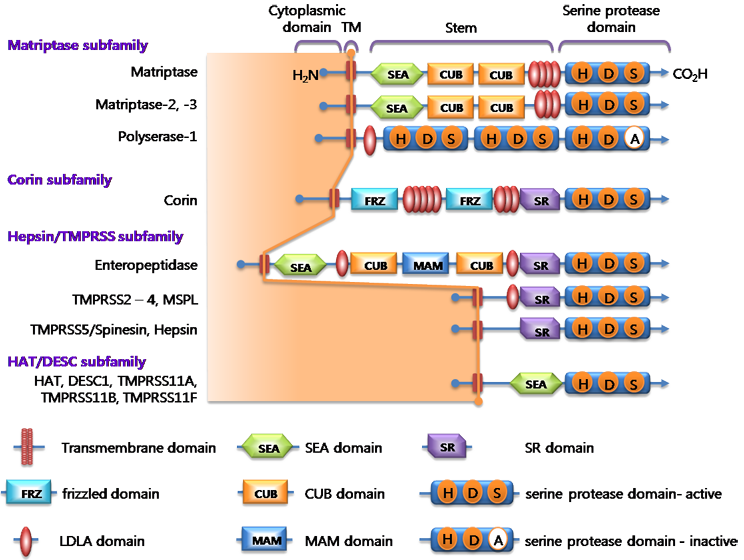
Multidomain structure of human TTSPs. Human TTSPs were grouped into four subfamilies based on similarity in domain structure and phylogenetic analysis of the serine protease domains, namely the matriptase, corin, hepsin/TMPRSS and HAT/DESC subfamilies. Consensus domains are shown below. Each diagram was drawn using the web-based SMART software (http://smart.embl-heidelberg.de) with TTSP amino acid sequences obtained from GenBank.
Abbreviations: CUB, Cls/Clr, urchin embryonic growth factor and bone morphogenic protein-1 domain; DESC1, differentially expressed squamous cell carcinoma gene 1; FRZ, frizzled domain; HAT, human airway trypsin-like protease; LDLA, low-density lipoprotein receptor domain class A; MAM, a meprin, A5 antigen and receptor protein phosphatase m domain; MSPL, mosaic serine protease long-form; Polyserase-1, polyserine protease-1; SEA, a single sea urchin sperm protein, enteropeptidase, agrin domain; SR, scavenger receptor cysteine-rich domain; TM, transmembrane domain. Letters H, D and S in the serine protease domain (active) indicate the position of the three catalytic residues histidine, aspartate and serine, respectively. Letter A in the serine protease domain (inactive) indicates a serine to alanine exchange.
Implicated in
Entity name
Prostate cancer
Prognosis
TMPRSS2 was originally reported to be a small intestine-associated serine protease. Later, however, its gene turned out to be expressed mainly in the prostate in an androgen dependent manner.
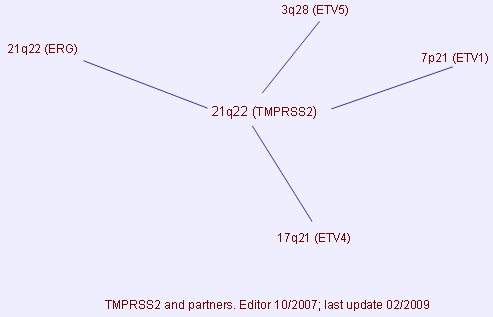
In the prostate adenocarcinoma, TMPRSS2-EGR fusion mRNAs is highly expressed. Because of its location on the surface of prostatic cells, TMPRSS2 is a potential new diagnostic marker for prostate cancer.
In the prostate adenocarcinoma, TMPRSS2-EGR fusion mRNAs is highly expressed. Because of its location on the surface of prostatic cells, TMPRSS2 is a potential new diagnostic marker for prostate cancer.
Breakpoints
Article Bibliography
| Pubmed ID | Last Year | Title | Authors |
|---|---|---|---|
| 20068566 | 2010 | Prostate cancer genes associated with TMPRSS2-ERG gene fusion and prognostic of biochemical recurrence in multiple cohorts. | Barwick BG et al |
| 19487698 | 2009 | Type II transmembrane serine proteases. | Bugge TH et al |
| 19581128 | 2009 | Type II transmembrane serine proteases in cancer and viral infections. | Choi SY et al |
| 9325052 | 1997 | Cloning of the TMPRSS2 gene, which encodes a novel serine protease with transmembrane, LDLRA, and SRCR domains and maps to 21q22.3. | Paoloni-Giacobino A et al |
| 11169526 | 2001 | Expression of transmembrane serine protease TMPRSS2 in mouse and human tissues. | Vaarala MH et al |
Other Information
Locus ID:
NCBI: 7113
MIM: 602060
HGNC: 11876
Ensembl: ENSG00000184012
Variants:
dbSNP: 7113
ClinVar: 7113
TCGA: ENSG00000184012
COSMIC: TMPRSS2
RNA/Proteins
Expression (GTEx)
Pathways
| Pathway | Source | External ID |
|---|---|---|
| Influenza A | KEGG | ko05164 |
| Influenza A | KEGG | hsa05164 |
| Transcriptional misregulation in cancer | KEGG | ko05202 |
| Transcriptional misregulation in cancer | KEGG | hsa05202 |
Protein levels (Protein atlas)
References
| Pubmed ID | Year | Title | Citations |
|---|---|---|---|
| 37326579 | 2024 | The relationship between the clinical course of SARS-CoV-2 infections and ACE2 and TMPRSS2 expression and polymorphisms. | 2 |
| 38212998 | 2024 | Expression of the SARS-CoV-2 Receptor ACE2 and Protease TMPRSS2 in Ocular Hypertension Eyes of Nonhuman Primate and Human. | 0 |
| 38246035 | 2024 | Increased ACE2 and TMPRSS2 expression in ulcerative colitis. | 0 |
| 38254046 | 2024 | Evaluation of relationship between TMPRSS2 p.(Val197Met) variant and COVID-19 susceptibility and severity. | 0 |
| 38263160 | 2024 | Genetic association of ACE2 and TMPRSS2 polymorphisms with COVID-19 severity; a single centre study from Egypt. | 0 |
| 38307396 | 2024 | Host genetics and the profile of COVID-19 in indigenous people from the Brazilian Amazon: A pilot study with variants of the ACE1, ACE2 and TMPRSS2 genes. | 0 |
| 38470058 | 2024 | ACE2 acts as a novel regulator of TMPRSS2-catalyzed proteolytic activation of influenza A virus in airway cells. | 1 |
| 38855114 | 2024 | Association of specific ACE2 and TMPRSS2 variants with circulatory cytokines of COVID-19 Emirati patients. | 0 |
| 38868968 | 2024 | Association of ACE2 and TMPRSS2 genes variants with disease severity and most important biomarkers in COVID-19 patients in Bosnia and Herzegovina. | 0 |
| 37326579 | 2024 | The relationship between the clinical course of SARS-CoV-2 infections and ACE2 and TMPRSS2 expression and polymorphisms. | 2 |
| 38212998 | 2024 | Expression of the SARS-CoV-2 Receptor ACE2 and Protease TMPRSS2 in Ocular Hypertension Eyes of Nonhuman Primate and Human. | 0 |
| 38246035 | 2024 | Increased ACE2 and TMPRSS2 expression in ulcerative colitis. | 0 |
| 38254046 | 2024 | Evaluation of relationship between TMPRSS2 p.(Val197Met) variant and COVID-19 susceptibility and severity. | 0 |
| 38263160 | 2024 | Genetic association of ACE2 and TMPRSS2 polymorphisms with COVID-19 severity; a single centre study from Egypt. | 0 |
| 38307396 | 2024 | Host genetics and the profile of COVID-19 in indigenous people from the Brazilian Amazon: A pilot study with variants of the ACE1, ACE2 and TMPRSS2 genes. | 0 |
Citation
Youngwoo Park
TMPRSS2 (transmembrane protease, serine 2)
Atlas Genet Cytogenet Oncol Haematol. 2010-03-01
Online version: http://atlasgeneticsoncology.org/gene/42592/tmprss2-(transmembrane-protease-serine-2)
