TNFRSF11B (tumor necrosis factor receptor superfamily, member 11b)
2008-08-01 Maria Grazia Di Iasio , Federica Corallini , Paola Secchiero , Silvano Capitani AffiliationDepartment of Morfology, Embryology, Human Anatomy Section - Ferrara University, 44100 ferrara, Italy
Identity
HGNC
LOCATION
8q24.12
LOCUSID
ALIAS
OCIF,OPG,PDB5,TR1
FUSION GENES
DNA/RNA

Organization of the human OPG gene.
Description
START: 120,004,977 BP from PTER
END: 120,033,492 BP from PTER
SIZE: 28,516 bases
ORIENTATION: Minus strand
REFSEQ GENOMIC ASSEMBLIES: NC-000008.9 NT-008046.15
END: 120,033,492 BP from PTER
SIZE: 28,516 bases
ORIENTATION: Minus strand
REFSEQ GENOMIC ASSEMBLIES: NC-000008.9 NT-008046.15
Transcription
5 exons; cDNA SIZE 2354 BP (NM-002546); CDS: 1206 nt.
Pseudogene
No known pseudogenes.
Proteins
Note
RefSeq NP-002537.3; Size: 401 amino acids; 46040 Da; Subunit: Homodimer; Subcellular location: Secreted.
Osteoprotegerin (OPG) was isolated independently by two laboratories in 1997 (Tsuda et al., 1997; Simonet et al., 1997), as being a protein that exhibits a protective effect on bone. OPG is a member of the TNF-receptor superfamily, which consists of proteins that evoke different signal transduction, mediating several biological responses, such as cytotoxicity, apoptosis and cell survival, proliferation and differentiation. OPG has two known TNF family ligands: receptor activator of NF-kB ligand (RANKL) (Yasuda et al., 1998b) and TRAIL (Emery et al.,1998) (Diagram 1). RANKL normally binds to its membrane receptor RANK inducing differentiation, activation, and survival of osteoclasts. By binding to RANKL, OPG acts as a soluble inhibitor that prevents RANKL/RANK interaction and subsequent osteoclastogenesis (Yasuda et al., 1998b) (Diagram 1). However, it has been reported that also OPG binding to TRAIL inhibits TRAIL/TRAIL-receptors (TR-R1/R2) interaction, as revealed by the inhibition of TRAIL-induced apoptosis (Emery et al.,1998) (Diagram 1). Vice-versa, TRAIL can block the inhibitory activity of OPG on osteoclastogenesis (Emery et al.,1998).
Osteoprotegerin (OPG) was isolated independently by two laboratories in 1997 (Tsuda et al., 1997; Simonet et al., 1997), as being a protein that exhibits a protective effect on bone. OPG is a member of the TNF-receptor superfamily, which consists of proteins that evoke different signal transduction, mediating several biological responses, such as cytotoxicity, apoptosis and cell survival, proliferation and differentiation. OPG has two known TNF family ligands: receptor activator of NF-kB ligand (RANKL) (Yasuda et al., 1998b) and TRAIL (Emery et al.,1998) (Diagram 1). RANKL normally binds to its membrane receptor RANK inducing differentiation, activation, and survival of osteoclasts. By binding to RANKL, OPG acts as a soluble inhibitor that prevents RANKL/RANK interaction and subsequent osteoclastogenesis (Yasuda et al., 1998b) (Diagram 1). However, it has been reported that also OPG binding to TRAIL inhibits TRAIL/TRAIL-receptors (TR-R1/R2) interaction, as revealed by the inhibition of TRAIL-induced apoptosis (Emery et al.,1998) (Diagram 1). Vice-versa, TRAIL can block the inhibitory activity of OPG on osteoclastogenesis (Emery et al.,1998).
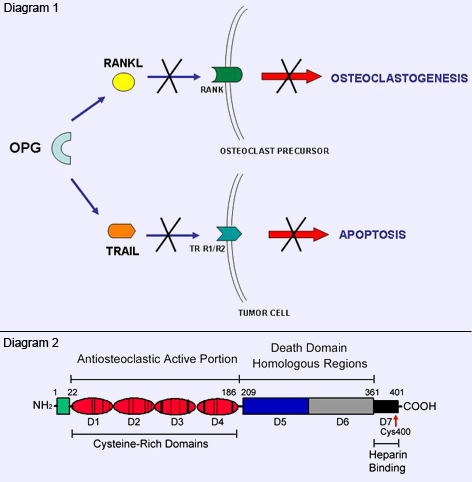
Diagram 1. Schematic representation of OPG/OPG-ligands and cellular processes inhibited from their interactions.
Diagram 2. Schematic representation of the structure of OPG protein.
Description
OPG comprises 401 amino acids of which 21 are a signal peptide which is cleaved, generating a mature form of 380 amino acids. OPG is produced as a monomer (55-62 kDa), but undergoes homodimerization and is secreted as a disulphide-linked homodimeric glycoprotein with four or five potential glycosylation sites, generating a mature form of OPG of 110-120 kDa (Yamaguchi et al., 1998). OPG consists of 7 structural domains, of which the amino-terminal cysteine rich domains 1 to 4 (D1-D4) are necessary for binding to RANKL (Schneeweis et al., 2005) and share some features with the extracellular domains of other members of the TNF-receptor family (Diagram 2) (Baker et al., 1998). The carboxy-terminal portion of the protein contains two putative death domain homologous regions (D5 and D6). Finally, domain 7 (D7) harbors a heparin-binding region, a common feature of peptide growth factors and signal molecules, as well as an unpaired cysteine residue, at position 400, required for disulfide bond formation and dimerization (Diagram 2) (Yamaguchi et al., 1998). It is the dimeric form of the protein, which has the highest heparin-binding capacity and also the highest hypocalcemic ability.
Expression
OPG is expressed ubiquitously and abundantly in many tissues and cell types. First of all it is produced from osteoblasts (Wada et al., 2006), where its expression is regulated by most of the factors that induce RANKL expression by osteoblasts. Although there are contradictory data, in general upregulation of RANKL is associated with downregulation of OPG, or at least lower induction of OPG, such that the ratio of RANKL to OPG changes in favor of osteoclastogenesis. Many reports have supported the assertion that the RANKL/OPG ratio is a major determinant of bone mass (Hofbauer et al., 2004). Concerning the cellular sources of OPG, it has been shown that besides cells belonging to the osteoblastic lineage, also bone marrow stromal cells (reviewed in Theoleyre et al., 2004), hematopoietic and immune cells (B cells and dendritic cells) (Tan et al., 1997) produce and release OPG. Importantly, OPG is also produced by endothelial (Collin-Osdoby et al., 2001) and vascular smooth muscle cells (Olesen et al., 2005), which likely represent the major contributors to the circulating pool of OPG. Recent studies on the intracellular localization of OPG in endothelial cells have indicated that OPG protein is found in the Weibel-Palade Bodies (WPB), in physical association with von Willebrand Factor (Zannettino et al., 2005).
Finally, OPG is produced by a variety of tissues including the cardiovascular system (heart, arteries, veins), lung, kidney, liver, spleen, intestine, stomach (Simonet et al., 1997; Wada et al., 2006).
Finally, OPG is produced by a variety of tissues including the cardiovascular system (heart, arteries, veins), lung, kidney, liver, spleen, intestine, stomach (Simonet et al., 1997; Wada et al., 2006).
Localisation
OPG, unlike all other receptors of the family, lacks a transmembrane and cytoplasmic domain and is secreted as a soluble protein (Yamaguchi et al., 1998). It has also been detected in a cell surface-associated form with some cell types (Yun et al., 1998), although sequence analysis failed to detect a classical hydrophobic transmembrane domain.
Function
The best characterized activity of OPG is the inhibition of osteoclast differentiation and activity (Simonet et al., 1997; Yasuda et al., 1998a), by binding to RANKL. Initially, the physiological roles of OPG have been revealed by studies in OPG knockout mice, produced by targeted disruption of the gene (Bucay et al., 1998; Mizuno et al.,1998). OPG (-/-) mice were viable and fertile, but they exhibited severe osteoporosis caused by enhanced osteoclast formation and function. These results have indicated that OPG is a physiological regulator of osteoclast-mediated bone resorption during postnatal bone growth.
In the context of vascular system, it has been reported that exposure of both micro and macro-vascular endothelial cells to the inflammatory cytokines elevates OPG expression and release (Collin-Osdoby et al., 2001; Secchiero et al., 2006), and OPG in turn promotes leukocyte adhesion (Zauli et al., 2007; Mangan et al., 2007), acting as a chemotactic factor for monocyte. These observations strongly support a modulatory role of OPG in hemostasis, vascular injury and inflammation, suggesting an involvement of OPG in the inflammatory functions of endothelial cells, with endothelium acting as both cellular source and target of vascular OPG production. In this respect, there are accumulating data in vitro indicating a role for OPG in endothelial cell biology and angiogenesis; in particular in the regulation of endothelial cell survival (Scatena et al., 2002; Pritzker et al., 2004), stimulation of endothelial cell growth, as well as the formation of cord-like structures on a matrigel substrate (Cross et al., 2006), providing the evidence that OPG may modulate also endothelial cell migration and differentiation. In this context, OPG also appears to protect large blood vessels from medial calcification, based on the observation of renal and aortic calcification occurring in OPG knockout mice (Bucay et al., 1998). Furthermore, the absence of OPG in OPG/apolipoprotein E double knockout mice accelerates the calcific atherosclerosis that develops in apolipoprotein E knockout mice, suggesting that OPG protects against this complication of atherosclerosis (Bennett et al., 2006).
Moreover, OPG has also been shown to regulate B-cell development and function and dendritic cell function (Yun et al., 1998; Yun et al., 2001), making OPG a paracrine mediator of both bone metabolism and immune functions.
In the context of vascular system, it has been reported that exposure of both micro and macro-vascular endothelial cells to the inflammatory cytokines elevates OPG expression and release (Collin-Osdoby et al., 2001; Secchiero et al., 2006), and OPG in turn promotes leukocyte adhesion (Zauli et al., 2007; Mangan et al., 2007), acting as a chemotactic factor for monocyte. These observations strongly support a modulatory role of OPG in hemostasis, vascular injury and inflammation, suggesting an involvement of OPG in the inflammatory functions of endothelial cells, with endothelium acting as both cellular source and target of vascular OPG production. In this respect, there are accumulating data in vitro indicating a role for OPG in endothelial cell biology and angiogenesis; in particular in the regulation of endothelial cell survival (Scatena et al., 2002; Pritzker et al., 2004), stimulation of endothelial cell growth, as well as the formation of cord-like structures on a matrigel substrate (Cross et al., 2006), providing the evidence that OPG may modulate also endothelial cell migration and differentiation. In this context, OPG also appears to protect large blood vessels from medial calcification, based on the observation of renal and aortic calcification occurring in OPG knockout mice (Bucay et al., 1998). Furthermore, the absence of OPG in OPG/apolipoprotein E double knockout mice accelerates the calcific atherosclerosis that develops in apolipoprotein E knockout mice, suggesting that OPG protects against this complication of atherosclerosis (Bennett et al., 2006).
Moreover, OPG has also been shown to regulate B-cell development and function and dendritic cell function (Yun et al., 1998; Yun et al., 2001), making OPG a paracrine mediator of both bone metabolism and immune functions.
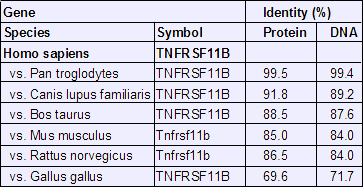
For details see: http://www.ncbi.nlm.nih.gov/sites/entrez?cmd=Retrieve&db=homologene&dopt=AlignmentScores&list_uids=1912
Mutations
Note
http://www.ncbi.nlm.nih.gov/sites/entrez (look for TNFRSF11B into dbSNP)

11 Exonic variations
For details see: http://www.ncbi.nlm.nih.gov/SNP/snp_ref.cgi?locusId=4982
Implicated in
Entity name
Cancer
Note
A potential role of full-lenght OPG in tumor cell biology is supported by different studies that have investigated the OPG serum levels, OPG tissue expression and OPG polymorphisms in cancer patients. In fact, it has been shown that the serum levels of OPG are elevated in a variety of human malignancies, in particular in patients with more advanced cancer. Of note, OPG levels were increased in the serum of patients with prostate or breast cancer metastatized to the bone (Lipton et al., 2001). Surprisingly, OPG serum levels were elevated also in other types of tumors, which do not show a preferential tropism for bone, such as B cell lymphomas (Lipton et al., 2001), but also in patients with bladder carcinoma (Mizutani et al., 2004), where OPG levels were found to be associated with high tumour stage and grade. After a follow up period of 5 years, patients who had low serum OPG levels had a longer post-operative tumour-free interval and increased survival compared with patients with high levels of serum OPG (Mizutani et al., 2004), suggesting that serum OPG correlates with tumour stage and is also predictive of early recurrence of bladder carcinoma.
Moreover, in different studies, it was shown that OPG is overexpressed in epithelial carcinomas of the gastroenteric tract (Ito et al., 2003; Pettersen et al., 2005). In particular, it was reported a significant correlation between OPG expression and tumor stage, suggesting that OPG expression may be a marker of aggressive gastric carcinomas. In addition, investigation of various human cancers demonstrated that OPG is highly expressed by endothelial cells in the majority of malignant tumors examined (60% of malignant tumors), although endothelial cells in benign tumors do not express high levels of OPG. In particular, in breast cancers endothelial expression of OPG seems to be associated with increasing tumor grade (Cross et al., 2006). Taken together, these observations suggest that the increased levels of OPG expression may be associated with tumor development and/or progression.
Finally, a recent study has addressed the possible role of OPG promoter polymorphisms as genetic modifiers in the etiology of prostate cancer and disease progression (Narita et al., 2008). Patients affected by prostate cancer with TC and TT genotypes in the 950 T/C polymorphism had a significantly increased risk of extraprostatic and metastatic disease compared with those with the CC genotype. In addition, analysis of the metastatic prostatic cancer patients showed that the presence of the T allele of the OPG 950 T/C polymorphism was an independent risk factor, predicting survival by Cox proportional hazard regression analyses (Narita et al., 2008).
Moreover, in different studies, it was shown that OPG is overexpressed in epithelial carcinomas of the gastroenteric tract (Ito et al., 2003; Pettersen et al., 2005). In particular, it was reported a significant correlation between OPG expression and tumor stage, suggesting that OPG expression may be a marker of aggressive gastric carcinomas. In addition, investigation of various human cancers demonstrated that OPG is highly expressed by endothelial cells in the majority of malignant tumors examined (60% of malignant tumors), although endothelial cells in benign tumors do not express high levels of OPG. In particular, in breast cancers endothelial expression of OPG seems to be associated with increasing tumor grade (Cross et al., 2006). Taken together, these observations suggest that the increased levels of OPG expression may be associated with tumor development and/or progression.
Finally, a recent study has addressed the possible role of OPG promoter polymorphisms as genetic modifiers in the etiology of prostate cancer and disease progression (Narita et al., 2008). Patients affected by prostate cancer with TC and TT genotypes in the 950 T/C polymorphism had a significantly increased risk of extraprostatic and metastatic disease compared with those with the CC genotype. In addition, analysis of the metastatic prostatic cancer patients showed that the presence of the T allele of the OPG 950 T/C polymorphism was an independent risk factor, predicting survival by Cox proportional hazard regression analyses (Narita et al., 2008).
Entity name
Vascular diseases
Note
A growing number of experimental data have demonstrated that the serum levels of OPG are significantly increased in both diabetic and non-diabetic patients affected by coronary artery disease (Jono et al., 2002; Schoppet et al., 2003; Avignon et al., 2005; Rasmussen et al., 2006), with a strong association between levels of OPG and the presence and severity of coronary artery disease (Browner et al., 2001). Serum OPG levels have shown to have prognostic value in heart failure after acute myocardial infarction as well as in patients affected by abdominal aortic aneurysm and peripheral artery disease (Karan et al., 2005; Ziegler et al., 2005). Remarkably, two OPG genetic polymorphisms have been associated with an increased risk of coronary artery disease in Caucasian men, and serum OPG levels correlated with one of these polymorphisms (Soufi et al., 2004). Thus, these studies strongly indicate that serum OPG levels frequently rise in clinical conditions that favor vascular dysfunction or atherosclerosis. In this respect, the presence of OPG has been documented in atherosclerotic lesions (Schoppet et al., 2004). Moreover, in a large observational study, plasma concentrations of OPG were higher in diabetic than in non-diabetic subjects, in particular in diabetic patients with vascular complications (Knudsen et al., 2003), suggesting that elevated levels of OPG may reflect vascular damage among patients with diabetes rather than the diabetic state per se.
At present it is unclear whether OPG plays a pathogenetic or compensatory role in the vascular dysfunction and atherosclerosis. However, the ability of recombinant OPG to enhance the recruitment and infiltration of monocyte/macrophages ( Mosheimer et al., 2005) is particularly noteworthy in the hypothesis that an abnormal and prolonged elevation of OPG levels may be involved in the devolopment of vascular dysfunction.
At present it is unclear whether OPG plays a pathogenetic or compensatory role in the vascular dysfunction and atherosclerosis. However, the ability of recombinant OPG to enhance the recruitment and infiltration of monocyte/macrophages ( Mosheimer et al., 2005) is particularly noteworthy in the hypothesis that an abnormal and prolonged elevation of OPG levels may be involved in the devolopment of vascular dysfunction.
Article Bibliography
| Pubmed ID | Last Year | Title | Authors |
|---|---|---|---|
| 16123486 | 2005 | Osteoprotegerin is associated with silent coronary artery disease in high-risk but asymptomatic type 2 diabetic patients. | Avignon A et al |
| 9916988 | 1998 | Modulation of life and death by the TNF receptor superfamily. | Baker SJ et al |
| 16840715 | 2006 | Osteoprotegerin inactivation accelerates advanced atherosclerotic lesion progression and calcification in older ApoE-/- mice. | Bennett BJ et al |
| 11158021 | 2001 | Associations of serum osteoprotegerin levels with diabetes, stroke, bone density, fractures, and mortality in elderly women. | Browner WS et al |
| 9573043 | 1998 | osteoprotegerin-deficient mice develop early onset osteoporosis and arterial calcification. | Bucay N et al |
| 11274143 | 2001 | Receptor activator of NF-kappa B and osteoprotegerin expression by human microvascular endothelial cells, regulation by inflammatory cytokines, and role in human osteoclastogenesis. | Collin-Osdoby P et al |
| 16287088 | 2006 | Osteoprotegerin (OPG)--a potential new role in the regulation of endothelial cell phenotype and tumour angiogenesis? | Cross SS et al |
| 9603945 | 1998 | Osteoprotegerin is a receptor for the cytotoxic ligand TRAIL. | Emery JG et al |
| 15280347 | 2004 | Clinical implications of the osteoprotegerin/RANKL/RANK system for bone and vascular diseases. | Hofbauer LC et al |
| 12838418 | 2003 | Expression of osteoprotegerin correlates with aggressiveness and poor prognosis of gastric carcinoma. | Ito R et al |
| 12208791 | 2002 | Serum osteoprotegerin levels are associated with the presence and severity of coronary artery disease. | Jono S et al |
| 12824864 | 2003 | Increased plasma concentrations of osteoprotegerin in type 2 diabetic patients with microvascular complications. | Knudsen ST et al |
| 12114435 | 2002 | Serum osteoprotegerin levels in healthy controls and cancer patients. | Lipton A et al |
| 17706953 | 2007 | Osteoprotegerin upregulates endothelial cell adhesion molecule response to tumor necrosis factor-alpha associated with induction of angiopoietin-2. | Mangan SH et al |
| 9647741 | 1998 | Severe osteoporosis in mice lacking osteoclastogenesis inhibitory factor/osteoprotegerin. | Mizuno A et al |
| 15386310 | 2004 | Prognostic significance of serum osteoprotegerin levels in patients with bladder carcinoma. | Mizutani Y et al |
| 15939823 | 2005 | Association of osteoprotegerin with human abdominal aortic aneurysm progression. | Moran CS et al |
| 15728209 | 2005 | Syndecan-1 is involved in osteoprotegerin-induced chemotaxis in human peripheral blood monocytes. | Mosheimer BA et al |
| 18684318 | 2008 | A genetic polymorphism of the osteoprotegerin gene is associated with an increased risk of advanced prostate cancer. | Narita N et al |
| 15700136 | 2005 | Arterial osteoprotegerin: increased amounts in diabetes and modifiable synthesis from vascular smooth muscle cells by insulin and TNF-alpha. | Olesen P et al |
| 16309167 | 2005 | Osteoprotegerin is expressed in colon carcinoma cells. | Pettersen I et al |
| 15064358 | 2004 | The role of osteoprotegerin and tumor necrosis factor-related apoptosis-inducing ligand in human microvascular endothelial cell survival. | Pritzker LB et al |
| 16381994 | 2006 | Plasma osteoprotegerin levels are associated with glycaemic status, systolic blood pressure, kidney function and cardiovascular morbidity in type 1 diabetic patients. | Rasmussen LM et al |
| 16215261 | 2005 | Functional dissection of osteoprotegerin and its interaction with receptor activator of NF-kappaB ligand. | Schneeweis LA et al |
| 15292354 | 2004 | Localization of osteoprotegerin, tumor necrosis factor-related apoptosis-inducing ligand, and receptor activator of nuclear factor-kappaB ligand in Mönckeberg's sclerosis and atherosclerosis. | Schoppet M et al |
| 17148684 | 2006 | An increased osteoprotegerin serum release characterizes the early onset of diabetes mellitus and may contribute to endothelial cell dysfunction. | Secchiero P et al |
| 9108485 | 1997 | Osteoprotegerin: a novel secreted protein involved in the regulation of bone density. | Simonet WS et al |
| 15292302 | 2004 | Osteoprotegerin gene polymorphisms in men with coronary artery disease. | Soufi M et al |
| 9434163 | 1997 | Characterization of a novel TNF-like ligand and recently described TNF ligand and TNF receptor superfamily genes and their constitutive and inducible expression in hematopoietic and non-hematopoietic cells. | Tan KB et al |
| 15561602 | 2004 | The molecular triad OPG/RANK/RANKL: involvement in the orchestration of pathophysiological bone remodeling. | Theoleyre S et al |
| 9168977 | 1997 | Isolation of a novel cytokine from human fibroblasts that specifically inhibits osteoclastogenesis. | Tsuda E et al |
| 16356770 | 2006 | RANKL-RANK signaling in osteoclastogenesis and bone disease. | Wada T et al |
| 9478964 | 1998 | Characterization of structural domains of human osteoclastogenesis inhibitory factor. | Yamaguchi K et al |
| 9520411 | 1998 | Osteoclast differentiation factor is a ligand for osteoprotegerin/osteoclastogenesis-inhibitory factor and is identical to TRANCE/RANKL. | Yasuda H et al |
| 9834095 | 1998 | OPG/FDCR-1, a TNF receptor family member, is expressed in lymphoid cells and is up-regulated by ligating CD40. | Yun TJ et al |
| 11160187 | 2001 | Osteoprotegerin, a crucial regulator of bone metabolism, also regulates B cell development and function. | Yun TJ et al |
| 15799029 | 2005 | Osteoprotegerin (OPG) is localized to the Weibel-Palade bodies of human vascular endothelial cells and is physically associated with von Willebrand factor. | Zannettino AC et al |
| 17363729 | 2007 | Osteoprotegerin increases leukocyte adhesion to endothelial cells both in vitro and in vivo. | Zauli G et al |
| 16115489 | 2005 | Osteoprotegerin plasma concentrations correlate with severity of peripheral artery disease. | Ziegler S et al |
Other Information
Locus ID:
NCBI: 4982
MIM: 602643
HGNC: 11909
Ensembl: ENSG00000164761
Variants:
dbSNP: 4982
ClinVar: 4982
TCGA: ENSG00000164761
COSMIC: TNFRSF11B
RNA/Proteins
| Gene ID | Transcript ID | Uniprot |
|---|---|---|
| ENSG00000164761 | ENST00000297350 | O00300 |
| ENSG00000164761 | ENST00000517352 | E5RFV7 |
Expression (GTEx)
Pathways
Protein levels (Protein atlas)
PharmGKB
| Entity ID | Name | Type | Evidence | Association | PK | PD | PMIDs |
|---|---|---|---|---|---|---|---|
| PA443560 | Breast Neoplasms | Disease | ClinicalAnnotation | associated | PD | ||
| PA448432 | anastrozole | Chemical | ClinicalAnnotation | associated | PD | ||
| PA450196 | letrozole | Chemical | ClinicalAnnotation | associated | PD |
References
| Pubmed ID | Year | Title | Citations |
|---|---|---|---|
| 37937620 | 2024 | Osteoprotegerin is associated with subclinical left ventricular systolic dysfunction in non-dipper hypertensive patients: a 2D speckle tracking echocardiographic study. | 0 |
| 38015775 | 2024 | Correlates of Circulating Osteoprotegerin in Women with a Pathogenic or Likely Pathogenic Variant in the BRCA1 Gene. | 0 |
| 38374135 | 2024 | Circulating osteoprotegerin levels and cardiovascular outcomes in patients with pre-dialysis chronic kidney disease: results from the KNOW-CKD study. | 0 |
| 38443806 | 2024 | Osteopontin, osteoprotegerin and musculoskeletal ultrasound findings in first-degree relatives of rheumatoid arthritis: potential markers of preclinical disease. | 1 |
| 38583439 | 2024 | Osteoprotegerin and receptor activator of the nuclear factor kappa B ligand (RANKL) in healthy pubertal girls - relationships with physical growth and classical bone turnover markers. | 0 |
| 38906326 | 2024 | Osteoprotegerin mediates adipogenesis in obesity. | 0 |
| 37937620 | 2024 | Osteoprotegerin is associated with subclinical left ventricular systolic dysfunction in non-dipper hypertensive patients: a 2D speckle tracking echocardiographic study. | 0 |
| 38015775 | 2024 | Correlates of Circulating Osteoprotegerin in Women with a Pathogenic or Likely Pathogenic Variant in the BRCA1 Gene. | 0 |
| 38374135 | 2024 | Circulating osteoprotegerin levels and cardiovascular outcomes in patients with pre-dialysis chronic kidney disease: results from the KNOW-CKD study. | 0 |
| 38443806 | 2024 | Osteopontin, osteoprotegerin and musculoskeletal ultrasound findings in first-degree relatives of rheumatoid arthritis: potential markers of preclinical disease. | 1 |
| 38583439 | 2024 | Osteoprotegerin and receptor activator of the nuclear factor kappa B ligand (RANKL) in healthy pubertal girls - relationships with physical growth and classical bone turnover markers. | 0 |
| 38906326 | 2024 | Osteoprotegerin mediates adipogenesis in obesity. | 0 |
| 36639139 | 2023 | Cellular voids in the pathogenesis of otosclerosis. | 0 |
| 36675029 | 2023 | The Mechanism of Osteoprotegerin-Induced Osteoclast Pyroptosis In Vitro. | 3 |
| 36768925 | 2023 | Osteoprotegerin, Chitinase 3-like Protein 1, and Cardiotrophin-1 as Potential Biomarkers of Obstructive Sleep Apnea in Adults-A Case-Control Study. | 3 |
Citation
Maria Grazia Di Iasio ; Federica Corallini ; Paola Secchiero ; Silvano Capitani
TNFRSF11B (tumor necrosis factor receptor superfamily, member 11b)
Atlas Genet Cytogenet Oncol Haematol. 2008-08-01
Online version: http://atlasgeneticsoncology.org/gene/42610/tnfrsf11b-%28tumor-necrosis-factor-receptor-superfamily-member-11b%29
