SFRP2 (secreted frizzled-related protein 2)
2013-08-01 Darragh S ODonovan , Antoinette S Perry AffiliationProstate Molecular Oncology, Institute of Molecular Medicine, Trinity College, Dublin, Ireland
Identity
HGNC
LOCATION
4q31.3
LOCUSID
ALIAS
FRP-2,SARP1,SDF-5
FUSION GENES
DNA/RNA
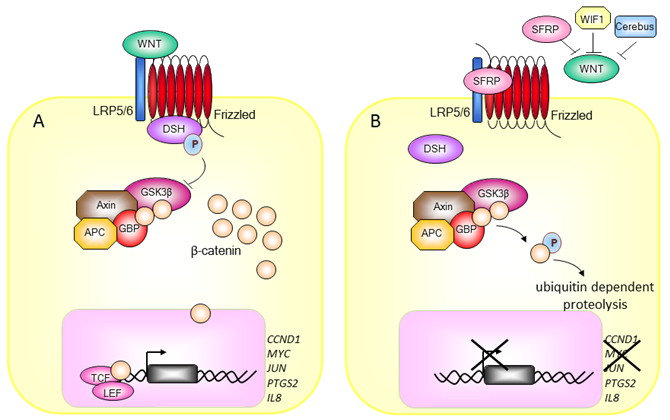
Wnt (wingless-type)/β-catenin signaling is a major regulator of cell proliferation, migration and differentiation, controlling tissue homeostasis and tumor progression (Klaus et al., 2008). A) The binding of a canonical Wnt ligand to its cell-surface receptor complex, consisting of Frizzled (FZD) and one of two low-density-lipoprotein- receptor-related proteins (LRP-5 and LRP-6), initiates a signaling cascade that activates disheveled (DVL), which releases β-catenin from an inhibitory complex consisting of Axin, APC and glycogen synthase kinase 3b (GSK3B). On dephosphorylation and release, β-catenin translocates to the nucleus, where it interacts with members of the T-cell factor/lymphoid enhancer factor (TCF/LEF) families of transcription factors to stimulate expression of genes involved in cell survival, proliferation and osteoblastic differentiation (e.g., MMPs, CCND1, PTGS2, MYC, JUN and VEGFR) (Reya et al., 2005). B) Wnt signaling is regulated by several classes of negative regulators. The Secreted Frizzled-Related Protein (SFRP) class comprises SFRP1-SFRP5, Wnt inhibitory factor 1 (WIF1) and Cerberus. SFRPs are a family of soluble glycoproteins that possess a cysteine- rich domain (CRD) structurally similar to the extracellular Wnt-binding domain of the FZD receptors. SFRPs can thus modulate Wnt signaling by sequestering Wnts through their CRD or by acting as dominant-negative inhibitors, forming inactive complexes with the FZD receptors.
Description
Size: 8487 bases. The SFRP2 gene is located on the long arm of Chromosome 4, and consists of 3 coding exons, with exon 2 being significantly smaller than the other two. No known splice variants.
Transcription
mRNA size 2005 bp, ORF size 888 bp.
Proteins
Description
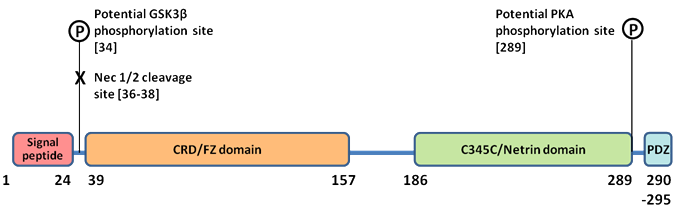
SFRP2 contains several domains which potentially govern protein-protein interactions.
- Beginning at the N-terminus there is a 24 aa hydrophobic signal domain, which presumably governs the targeting of SFRP2 to the secretory pathway.
- The CRD/FZ (cysteine-rich/Frizzled) domain allows SFRP proteins to antagonise Wnt/Frizzled binding at the plasma membrane either by sequestration of the Wnt ligand or dominant-negative binding to complimentary regions within the Frizzled protein.
- The C345C/Netrin domain is an accessory binding domain for SFRP2-Wnt interaction.
- The PDZ ligand domain is a short sequence which is recognised by PDZ proteins such as Dishevelled (Dvl), and other proteins which interact with the cytoplasmic portion of Frizzled (Schulte and Bryja, 2007). Notably, a recent study (Zhang et al., 2009) has used synthetic PDZ ligands to interfere with Dvl/FZD cytoplasmic interaction, and thus antagonise canonical Wnt signalling. Additionally, another group subsequently showed that the NSAID Sulindac inhibits canonical Wnt signaling by blocking the PDZ domain of Dvl (Lee et al., 2009). These data suggest that the presence of a PDZ ligand in SFRP2 may indicate a previously-unexplored role for SFRP2 as a cytoplasmic antagonist of Wnt signalling.
- A phosphoproteomic study has revealed phosphorylation of SFRP2 at serine-289 in response to growth factor stimulation (Olsen et al., 2006). Bioinformatic analysis suggests that this site is a motif for recognition and phosphorylation by PKA. Additionally, bioinformatic analysis of the SFRP2 sequence suggests a site for phosphorylation by GSK3β (itself an inhibitor of β-catenin) at either serine-34 or serine-38. Although the potential significance of phosphorylation at this site is unclear, it may overlap with the Nec 1/Nec 2 cleavage site and prevent removal of the N-terminal signal domain. Typically, Nec 1/2 is responsible for the cleavage of pro-proteins into their active form, and perhaps phosphorylation in this region is a mechanism by which GSK3β may regulate SFRP2 activity.
- Beginning at the N-terminus there is a 24 aa hydrophobic signal domain, which presumably governs the targeting of SFRP2 to the secretory pathway.
- The CRD/FZ (cysteine-rich/Frizzled) domain allows SFRP proteins to antagonise Wnt/Frizzled binding at the plasma membrane either by sequestration of the Wnt ligand or dominant-negative binding to complimentary regions within the Frizzled protein.
- The C345C/Netrin domain is an accessory binding domain for SFRP2-Wnt interaction.
- The PDZ ligand domain is a short sequence which is recognised by PDZ proteins such as Dishevelled (Dvl), and other proteins which interact with the cytoplasmic portion of Frizzled (Schulte and Bryja, 2007). Notably, a recent study (Zhang et al., 2009) has used synthetic PDZ ligands to interfere with Dvl/FZD cytoplasmic interaction, and thus antagonise canonical Wnt signalling. Additionally, another group subsequently showed that the NSAID Sulindac inhibits canonical Wnt signaling by blocking the PDZ domain of Dvl (Lee et al., 2009). These data suggest that the presence of a PDZ ligand in SFRP2 may indicate a previously-unexplored role for SFRP2 as a cytoplasmic antagonist of Wnt signalling.
- A phosphoproteomic study has revealed phosphorylation of SFRP2 at serine-289 in response to growth factor stimulation (Olsen et al., 2006). Bioinformatic analysis suggests that this site is a motif for recognition and phosphorylation by PKA. Additionally, bioinformatic analysis of the SFRP2 sequence suggests a site for phosphorylation by GSK3β (itself an inhibitor of β-catenin) at either serine-34 or serine-38. Although the potential significance of phosphorylation at this site is unclear, it may overlap with the Nec 1/Nec 2 cleavage site and prevent removal of the N-terminal signal domain. Typically, Nec 1/2 is responsible for the cleavage of pro-proteins into their active form, and perhaps phosphorylation in this region is a mechanism by which GSK3β may regulate SFRP2 activity.
Expression
Widely expressed.
Localisation
Nucleus, cytoplasm and secreted.
Function
SFRP2 is a member of the secreted Frizzled-related protein (SFRP) family of soluble extracellular Wnt antagonists, which act in conjunction with the Dickkopf (DKK) class of Wnt antagonists. SFRP2 is thought to act primarily by binding directly to and sequestering Wnt ligands, but may also act by direct binding to the Wnt-receptor complex. Binding occurs primarily via the cysteine-rich domain, which bears a high degree of homology to similar domains in the Frizzled (Fzd) receptor. SFRP activity may conversely promote Wnt pathway signalling in some contexts, as a consequence of SFRP proteins interacting with each other and titrating each others activity, or by SFRP binding and stabilising Wnt-Fzd complexes.
Homology
SFRP2 has a high degree of homology to both other SFRP family members, as well as Fzd receptors via the cysteine-rich domain.
Implicated in
Entity name
Colorectal cancer and prostate cancer
Note
Methylation of SFRP2 and its promoter regions, and consequent loss of SFRP2 expression, is a potential diagnostic and prognostic marker of disease progression in both colorectal and prostate cancers.
Article Bibliography
| Pubmed ID | Last Year | Title | Authors |
|---|---|---|---|
| 18322270 | 2008 | Beyond Wnt inhibition: new functions of secreted Frizzled-related proteins in development and disease. | Bovolenta P et al |
| 12210517 | 2002 | Secreted Frizzled-related proteins: searching for relationships and patterns. | Jones SE et al |
| 18432252 | 2008 | Wnt signalling and its impact on development and cancer. | Klaus A et al |
| 20856206 | 2011 | Blocking Wnt signaling by SFRP-like molecules inhibits in vivo cell proliferation and tumor growth in cells carrying active β-catenin. | Lavergne E et al |
| 19637179 | 2009 | Sulindac inhibits canonical Wnt signaling by blocking the PDZ domain of the protein Dishevelled. | Lee HJ et al |
| 22175903 | 2011 | The role of secreted frizzled-related protein 2 expression in prostate cancer. | O'Hurley G et al |
| 17081983 | 2006 | Global, in vivo, and site-specific phosphorylation dynamics in signaling networks. | Olsen JV et al |
| 22915211 | 2013 | Gene expression and epigenetic discovery screen reveal methylation of SFRP2 in prostate cancer. | Perry AS et al |
| 15829953 | 2005 | Wnt signalling in stem cells and cancer. | Reya T et al |
| 17884187 | 2007 | The Frizzled family of unconventional G-protein-coupled receptors. | Schulte G et al |
| 19252499 | 2009 | Inhibition of Wnt signaling by Dishevelled PDZ peptides. | Zhang Y et al |
Other Information
Locus ID:
NCBI: 6423
MIM: 604157
HGNC: 10777
Ensembl: ENSG00000145423
Variants:
dbSNP: 6423
ClinVar: 6423
TCGA: ENSG00000145423
COSMIC: SFRP2
RNA/Proteins
| Gene ID | Transcript ID | Uniprot |
|---|---|---|
| ENSG00000145423 | ENST00000274063 | Q96HF1 |
| ENSG00000145423 | ENST00000274063 | A0A140VJU3 |
Expression (GTEx)
Pathways
References
| Pubmed ID | Year | Title | Citations |
|---|---|---|---|
| 37951508 | 2024 | Sfrp2 promotes renal dysfunction of diabetic kidney disease via modulating Fzd5-induced cytosolic calcium ion concentration and CaMKII/Mek/Erk pathway in mesangial cells. | 0 |
| 38802858 | 2024 | Identification of epigenetic silencing of the SFRP2 gene in colorectal cancer as a clinical biomarker and molecular significance. | 0 |
| 37951508 | 2024 | Sfrp2 promotes renal dysfunction of diabetic kidney disease via modulating Fzd5-induced cytosolic calcium ion concentration and CaMKII/Mek/Erk pathway in mesangial cells. | 0 |
| 38802858 | 2024 | Identification of epigenetic silencing of the SFRP2 gene in colorectal cancer as a clinical biomarker and molecular significance. | 0 |
| 36773293 | 2023 | Nitric oxide suppression by secreted frizzled-related protein 2 drives retinoblastoma. | 1 |
| 36894665 | 2023 | Novel method of differentiating human induced pluripotent stem cells to mature cardiomyocytes via Sfrp2. | 4 |
| 36991319 | 2023 | The DNA demethylation-regulated SFRP2 dictates the progression of endometriosis via activation of the Wnt/β-catenin signaling pathway. | 1 |
| 36773293 | 2023 | Nitric oxide suppression by secreted frizzled-related protein 2 drives retinoblastoma. | 1 |
| 36894665 | 2023 | Novel method of differentiating human induced pluripotent stem cells to mature cardiomyocytes via Sfrp2. | 4 |
| 36991319 | 2023 | The DNA demethylation-regulated SFRP2 dictates the progression of endometriosis via activation of the Wnt/β-catenin signaling pathway. | 1 |
| 35499710 | 2022 | Evaluation of combined detection of multigene mutation and SDC2/SFRP2 methylation in stool specimens for colorectal cancer early diagnosis. | 3 |
| 36002889 | 2022 | Identification of novel early pancreatic cancer biomarkers KIF5B and SFRP2 from "first contact" interactions in the tumor microenvironment. | 7 |
| 36552843 | 2022 | SFRP2 Overexpression Induces an Osteoblast-like Phenotype in Prostate Cancer Cells. | 3 |
| 35499710 | 2022 | Evaluation of combined detection of multigene mutation and SDC2/SFRP2 methylation in stool specimens for colorectal cancer early diagnosis. | 3 |
| 36002889 | 2022 | Identification of novel early pancreatic cancer biomarkers KIF5B and SFRP2 from "first contact" interactions in the tumor microenvironment. | 7 |
Citation
Darragh S ODonovan ; Antoinette S Perry
SFRP2 (secreted frizzled-related protein 2)
Atlas Genet Cytogenet Oncol Haematol. 2013-08-01
Online version: http://atlasgeneticsoncology.org/gene/42952/new-content/deep-insight-explorer/
