GLMN (Glomulin)
2007-07-01 Virginie Aerts , Pascal Brouillard , Laurence M. Boon , Miikka Vikkula AffiliationHuman Molecular Genetics (GEHU) de Duve Institute, Universite catholique de Louvain, Avenue Hippocrate 74(+5), bp. 75.39, B-1200 Brussels, Belgium
Identity
HGNC
LOCATION
1p22.1
LOCUSID
ALIAS
FAP,FAP48,FAP68,FKBPAP,GLML,GVM,VMGLOM
FUSION GENES
DNA/RNA
Description
The genomic DNA of the glomulin gene spans about 55 kbp and contains 19 exons coding for 1785 bp. The first exon is non coding, the start codon is located on the second exon and the stop codon in the last exon.
Transcription
In all human and murine tissues tested, a about 2 kb transcript was observed by Northern blot hybridization, suggesting that glomulin expression is ubiquitous. This could be due to the presence of glomulin-expressing blood vessels in the various tissues analysed.
By in situ hybridisation on murine embryos, glomulin expression was evident at embryonic E10.5 days post-coitum (dpc) and localized to the cardiac outflow tract. Between E11.5 to 14.5 dpc, glomulin mRNA is most abundant in the walls of large vessels (e.g. dorsal aorta). At E14.5 dpc, E16.5 dpc, and in adult tissues, expression of glomulin is clearly restricted to vascular smooth muscle cells. The high level of glomulin expression in the murine vasculature indicates that glomulin may have an important role in blood vessel development and/or maintenance.
A truncated form of glomulin, called FAP48, with an altered carboxy-terminal end, was isolated from a Jurkat-cell library. However FAP48, which presents 70% homology with glomulin, was not detected in other tissues and cells tested. Thus, it might be an aberrant transcript in this library.
By in situ hybridisation on murine embryos, glomulin expression was evident at embryonic E10.5 days post-coitum (dpc) and localized to the cardiac outflow tract. Between E11.5 to 14.5 dpc, glomulin mRNA is most abundant in the walls of large vessels (e.g. dorsal aorta). At E14.5 dpc, E16.5 dpc, and in adult tissues, expression of glomulin is clearly restricted to vascular smooth muscle cells. The high level of glomulin expression in the murine vasculature indicates that glomulin may have an important role in blood vessel development and/or maintenance.
A truncated form of glomulin, called FAP48, with an altered carboxy-terminal end, was isolated from a Jurkat-cell library. However FAP48, which presents 70% homology with glomulin, was not detected in other tissues and cells tested. Thus, it might be an aberrant transcript in this library.
Pseudogene
In man, no paralogue exists. Yet, a pseudogene is located on chromosome 21. It contains only a few exons (exons 6 to 10), without intervening introns and with several nucleotide differences. Thus, glomulin seems to be unique in the human genome.
Proteins
Note
Glomulin was identified by reverse genetics, and its function is currently unknown.
Description
Glomulin gene encodes a protein of 594 amino acids (68 kDa). In silico analysis reveals no known functional or structural domains, but a few potential phosphorylation and glycosylation sites.
Expression
(see above, para Transcription)
Localisation
By in silico analysis, no signal sequence or clear transmembrane domain in glomulin has been identified. Glomulin (FAP68) is likely an intracellular protein.
Function
The exact function of glomulin is unknown.
Glomulin (under the name of FAP48) has been described to interact with FKBP12, an immunophilin that binds the immunosuppressive drugs FK506 and rapamycin. FKBP12 interacts with the receptor, and prevents its phosphorylation by the type II receptor in the absence of TGFbeta. Thus, FKBP12 safeguards against the ligand-independent activation of this pathway. Glomulin, through its interaction with FKBP12, could act as a repressor of this inhibition.
Glomulin has also been described to interact with the last 30 amino acids of the C-terminal part of the HGF receptor, c-MET. This receptor is a transmembrane tyrosine kinase, which becomes tyrosine-phosphorylated upon activation by HGF. Glomulin interacts with the inactive, non phosphorylated form of c-MET. When c-MET is activated by HGF, glomulin is released in a phosphorylated form. This leads to p70 S6 protein kinase (p70S6K) phosphorylation. This activation occurs synergistically with the activation by the c-MET-activated PI3 kinase. It is not known whether glomulin activates p70S6K directly or indirectly. The p70S6K is a key regulator of protein synthesis. Glomulin could thereby control cellular events such as migration and cell division.
The third reported glomulin partner is Cul7, a Cul1 homologue. This places glomulin in an SCF-like complex, which is implicated in protein ubiquitination and degradation.
Glomulin (under the name of FAP48) has been described to interact with FKBP12, an immunophilin that binds the immunosuppressive drugs FK506 and rapamycin. FKBP12 interacts with the receptor, and prevents its phosphorylation by the type II receptor in the absence of TGFbeta. Thus, FKBP12 safeguards against the ligand-independent activation of this pathway. Glomulin, through its interaction with FKBP12, could act as a repressor of this inhibition.
Glomulin has also been described to interact with the last 30 amino acids of the C-terminal part of the HGF receptor, c-MET. This receptor is a transmembrane tyrosine kinase, which becomes tyrosine-phosphorylated upon activation by HGF. Glomulin interacts with the inactive, non phosphorylated form of c-MET. When c-MET is activated by HGF, glomulin is released in a phosphorylated form. This leads to p70 S6 protein kinase (p70S6K) phosphorylation. This activation occurs synergistically with the activation by the c-MET-activated PI3 kinase. It is not known whether glomulin activates p70S6K directly or indirectly. The p70S6K is a key regulator of protein synthesis. Glomulin could thereby control cellular events such as migration and cell division.
The third reported glomulin partner is Cul7, a Cul1 homologue. This places glomulin in an SCF-like complex, which is implicated in protein ubiquitination and degradation.
Homology
Glomulin seems to be an unique protein. No paralogue has been found and its lack in GVM is not compensated by another protein. Orthologues of glomulin have been identified in other species (cat, chimpanzee, cow, dog, mouse, rat, rhesus macaque, xenopus, zebrafish) and thus it is present in all vertebrates but not in insects or bacteries.
Mutations
Note
There is no phenotype-genotype correlation in GVM.
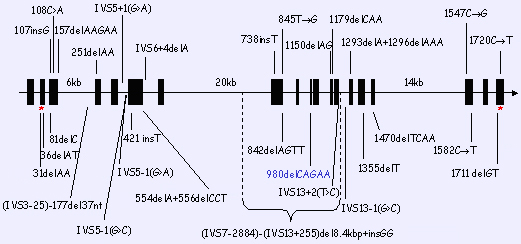
Schematic representation of glomulin : The two stars (*) indicate the start and the stop codons, in exon 2 and 19 respectively. All known mutations are shown. Somatic second hit is in blue.
Germinal
To date, 29 different inherited mutations (deletions, insertions and nonsense substitutions) have been identified. The most 5 mutation are located in the first coding exon. The majority of them cause premature truncation of the protein and likely result in loss-of-function. One mutation deletes 3 nucleotides resulting in the deletion of an asparagine at position 394 of the protein.
More than 70% of GVMs are caused by eight different mutations in glomulin: 157delAAGAA (40,7%), 108C>A (9,3%), 1179delCAA (8,1%), 421insT and 738insT (4,65% each), 554delA+556delCCT (3,5%), 107insG and IVS5-1(G>A) (2,3% each).
More than 70% of GVMs are caused by eight different mutations in glomulin: 157delAAGAA (40,7%), 108C>A (9,3%), 1179delCAA (8,1%), 421insT and 738insT (4,65% each), 554delA+556delCCT (3,5%), 107insG and IVS5-1(G>A) (2,3% each).
Somatic
The phenotypic variability observed in GVM could be explained by the need of a somatic second-hit mutation. Such a mechanism was discovered in one GVM (somatic mutation 980delCAGAA), suggesting that the lesion is due to a complete localized loss-of-function of glomulin. This concept can explain why some patients have bigger lesions than others, why new lesions appear, and why they are multifocal. This could also explain, why some mutation carriers are unaffected.
Implicated in
Entity name
Glomuvenous malformation (GVM)
Note
GVM is often, if not always, hereditary, and transmitted as an autosomal dominant disorder.
Disease
GVM is a localized bluish-purple cutaneous vascular lesion, histologically consisting of distended venous channels with flattened endothelium surrounded by variable number of maldifferentiated smooth muscle-like "glomus cells" in the wall. GVM account for 5% of venous anomalies referred to centers for vascular anomalies.
Seven features characterize GVM lesions : (1) Colour: GVMs can be pink in infants, the most are bluish-purple; (2) Affected tissues: the lesions are localized to the skin and subcutis; (3) Localization: lesions are more often located on the extremities; (4) Appearance : lesions are usually nodular and multifocal. They are often hyperkeratotic; (5) The lesions are not compressible; The lesions are painful on palpation; (7) New lesions can appear with time, likely after trauma
GVM has no neoplastic histological characteristics and never becomes malignant.
Seven features characterize GVM lesions : (1) Colour: GVMs can be pink in infants, the most are bluish-purple; (2) Affected tissues: the lesions are localized to the skin and subcutis; (3) Localization: lesions are more often located on the extremities; (4) Appearance : lesions are usually nodular and multifocal. They are often hyperkeratotic; (5) The lesions are not compressible; The lesions are painful on palpation; (7) New lesions can appear with time, likely after trauma
GVM has no neoplastic histological characteristics and never becomes malignant.
Article Bibliography
| Pubmed ID | Last Year | Title | Authors |
|---|---|---|---|
| 12904573 | 2003 | Targeted disruption of p185/Cul7 gene results in abnormal vascular morphogenesis. | Arai T et al |
| 10364524 | 1999 | A gene for inherited cutaneous venous anomalies ("glomangiomas") localizes to chromosome 1p21-22. | Boon LM et al |
| 15313813 | 2004 | Glomuvenous malformation (glomangioma) and venous malformation: distinct clinicopathologic and genetic entities. | Boon LM et al |
| 17005307 | 2006 | [Medical and surgical treatment of venous malformations]. | Boon LM et al |
| 8955134 | 1996 | FAP48, a new protein that forms specific complexes with both immunophilins FKBP59 and FKBP12. Prevention by the immunosuppressant drugs FK506 and rapamycin. | Chambraud B et al |
| 9233797 | 1997 | Mechanism of TGFbeta receptor inhibition by FKBP12. | Chen YG et al |
| 4321799 | 1971 | Multiple glomus tumors. A clinical and electron microscopic study. | Goodman TF et al |
| 11571281 | 2001 | Ligand-regulated binding of FAP68 to the hepatocyte growth factor receptor. | Grisendi S et al |
| 11175297 | 2001 | Linkage disequilibrium narrows locus for venous malformation with glomus cells (VMGLOM) to a single 1.48 Mbp YAC. | Irrthum A et al |
| 16847206 | 2006 | Congenital plaque-type glomuvenous malformations presenting in childhood. | Mallory SB et al |
| 15053987 | 2004 | Glomulin is predominantly expressed in vascular smooth muscle cells in the embryonic and adult mouse. | McIntyre BA et al |
Other Information
Locus ID:
NCBI: 11146
MIM: 601749
HGNC: 14373
Ensembl: ENSG00000174842
Variants:
dbSNP: 11146
ClinVar: 11146
TCGA: ENSG00000174842
COSMIC: GLMN
RNA/Proteins
| Gene ID | Transcript ID | Uniprot |
|---|---|---|
| ENSG00000174842 | ENST00000370360 | Q92990 |
| ENSG00000174842 | ENST00000463560 | M0QX84 |
| ENSG00000174842 | ENST00000495106 | Q92990 |
| ENSG00000174842 | ENST00000495852 | M0QXG8 |
Expression (GTEx)
Protein levels (Protein atlas)
References
| Pubmed ID | Year | Title | Citations |
|---|---|---|---|
| 38489583 | 2024 | Loss-of-function variants in GLMN are associated with generalized skin hyperpigmentation with or without glomuvenous malformation. | 0 |
| 38489583 | 2024 | Loss-of-function variants in GLMN are associated with generalized skin hyperpigmentation with or without glomuvenous malformation. | 0 |
| 35732373 | 2022 | GLMN causing vascular malformations: the clinical and genetic differentiation of cutaneous venous malformations. | 0 |
| 35732373 | 2022 | GLMN causing vascular malformations: the clinical and genetic differentiation of cutaneous venous malformations. | 0 |
| 30325312 | 2018 | Glomulin mutation and glomuvenous malformations: two case reports with the same mutation but different phenotypes. | 0 |
| 30325312 | 2018 | Glomulin mutation and glomuvenous malformations: two case reports with the same mutation but different phenotypes. | 0 |
| 24961656 | 2014 | Incomplete penetrance of GLMN gene c.395-1G>C mutation in a family with glomuvenous malformations. | 1 |
| 24961656 | 2014 | Incomplete penetrance of GLMN gene c.395-1G>C mutation in a family with glomuvenous malformations. | 1 |
| 22280104 | 2012 | Glomulin: a permissivity factor for vaccinia virus infection. | 2 |
| 22405651 | 2012 | The glomuvenous malformation protein Glomulin binds Rbx1 and regulates cullin RING ligase-mediated turnover of Fbw7. | 35 |
| 22678819 | 2012 | Role of FAP48 in HIV-associated lipodystrophy. | 3 |
| 22748924 | 2012 | Structure of a glomulin-RBX1-CUL1 complex: inhibition of a RING E3 ligase through masking of its E2-binding surface. | 50 |
| 22280104 | 2012 | Glomulin: a permissivity factor for vaccinia virus infection. | 2 |
| 22405651 | 2012 | The glomuvenous malformation protein Glomulin binds Rbx1 and regulates cullin RING ligase-mediated turnover of Fbw7. | 35 |
| 22678819 | 2012 | Role of FAP48 in HIV-associated lipodystrophy. | 3 |
Citation
Virginie Aerts ; Pascal Brouillard ; Laurence M. Boon ; Miikka Vikkula
GLMN (Glomulin)
Atlas Genet Cytogenet Oncol Haematol. 2007-07-01
Online version: http://atlasgeneticsoncology.org/gene/43022
