GCNT3 (glucosaminyl (N-acetyl) transferase 3, mucin type)
2007-11-01 Prakash Radhakrishnan , Pi-Wan Cheng AffiliationDepartment of Biochemistry, Molecular Biology, College of Medicine, University of Nebraska Medical Center, 985870 Nebraska Medical Center, Omaha, NE 68198-5870, USA
Identity
HGNC
LOCATION
15q22.2
LOCUSID
ALIAS
C2/4GnT,C24GNT,C2GNT2,C2GNTM,GNTM
FUSION GENES
DNA/RNA
Note
Human GCNT3/C2GnT-M is located on chromosome 15 in the region of q21.3, oriented from centromere to telomere.
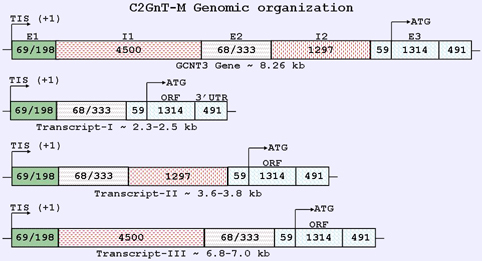
Schematic representation of Human GCNT3/C2GnT-M gene and transcripts. There are three different sized transcripts. (TIS, Transcription Initiation Site designated as +1; E, Exon; I, Intron; UTR, Untranslated region; ATG, start codon; ORF, Open reading frame).
Description
Human GCNT3/C2GnT-M gene is approximatively 8.26 kb in size and located in chromosome 15q21.3 at the position of 57,691,415 - 57,699,501. Recently, the GCNT3/C2GnT-M promoter (-417/+187) containing two basal cis-regulatory region (-291/-182 and -62/-43) was identified. The Th2 cytokine and retinoic acid responsive cis-regulatory elements reside in -417/+187 region.
Transcription
Human GCNT3/C2GnT-M contains three different sized transcripts: 2.3-2.5, 3.6-3.8 and 6.8-7.0 kb. The transcript 1 (approximatively 2.3-2.5kb) is made of 3 exons, exon 1 (69-198 bp), exon 2 (333-401 bp), and exon 3 (1864 bp). Exon 3 contains 59 bp of 5 UTR, 1314 bp of ORF and 491 bp of 3UTR. It does not contain any introns. Whereas, the intermediate sized transcript (3.6-3.8kb) contains 1.3kb of intron 2 and the large sized transcript (6.8-7.0 kb) contains 4.5kb of intron 1 in addition to all three exons. Exon 1 is heterogeneous in size, which ranges from 69 to 198 bp depending on tissues and cells. Exon 1 is present in all transcripts and has same 3 end but different 5 ends. A 333 bp Exon 2 is identified in most of the mucus secreting tissues and airway epithelial cells while a 401 bp of exon 2 is only detected in A549 cells.
Proteins
Note
Human GCNT3/C2GnT-M (EC 2.4.1.102) has 438 amino acids and molecular weight of 50,863 Da.

The predicted GCNT3/C2GnT-M structure shows a short N-terminal cytoplasmic tail (CT), a transmembrane domain (TM), a stem region and a long catalytic domain at the C-terminal region.
Description
GCNT3/C2GnT-M is a type II membrane protein located in the Golgi apparatus. It contains a nine-amino acid peptide tail at the N-terminus located in the cytoplasm, which is followed by a transmembrane domain consisted of 18 amino acids, a stem region, and a catalytic domain located in the Golgi lumen. The protein contains 13 cysteines, including 4 at the N-terminal region, which are conserved among GCNT3/C2GnT-M across species, and 9 at the C-terminal region, which are conserved among all mucin glycan b6GlcNAc branching enzymes. Structural information obtained from bovine GCNT3/C2GnT-M shows that among the 9 conserved cysteines, the second cysteine is unconjugated and the other 8 cysteines form 4 cystine bonds between first and ninth, third and seventh, fourth and fifth, and sixth and eighth. The disulfide bonds formed from the nine conserved cysteines are different between GCNT3/C2GnT-M and C2GnT-L. GCNT3/C2GnT-M contains two potential N-glycosyltaion sites at N-69 and N-289.
Expression
Human GCNT3/C2GnT-M gene is expressed in mucus-secretory tissues in the following decreasing order of expression: Colon; testis; stomach; small intestine; adrenal gland; kidney; trachea; thyroid gland; Uterus; Ovary; Pancreas; fetal liver; Prostate. Unlike bovine GCNT3/C2GnT-M gene, the type of transcript expressed by hC2GnT-M gene is not tissue specific among the mucus secretory tissues. Expression of GCNT3/C2GnT-M gene is down regulated in colon and colorectal tumors and various colorectal cancer cells. GCNT3/C2GnT-M expression is regulated by various external agent(s). It is inhibited by EGF and enhanced by Th2 cytokines, retinoic acids and sodium butyrate.
Localisation
Golgi membrane.
Function
GCNT3/C2GnT-M is responsible for the synthesis of all three branch structures, including core 2, core 4, and I antigen found in the glycans of secreted mucins. These three branch structures are generated by the transfer of GlcNAc from UDP-GlcNAc to core 1, core 3, and I antigen, respectively as shown below.
1. UDP-GlcNAc + Galbeta1-3GalNAca1-S/T gives Galbeta1-3(GlcNAcbeta1-6) GalNAca1-S/T + UDP
2. UDP-GlcNAc + GlcNAcbeta1-3GalNAc1a-S/T gives GlcNAcbeta1-3(GlcNAcbeta1-6) GalNAca1-S/T + UDP
3. UDP-GlcNAc + GlcNAcbeta1-3Galbeta1-R gives GlcNAcbeta1-3(GlcNAcbeta1-6)Galbeta1-R + UDP(R: sugars)
The primary function of secreted mucins is to protect mucus secretory epithelium by retention of water and maintenance of the rheological properties of the mucus, and adherence to airborne and ingested pathogens to facilitate their removal from these tissues. The first two properties depend primarily on the carbohydrate content and this property depends on the heterogeneity of carbohydrate structure. Secreted mucins contain very high carbohydrate content, i.e. 70-90% by weight, and very heterogeneous carbohydrate structure, e.g. up to 100 different oligosaccharides in mucins isolated from a single donor. The three b6GlcNAc branch structures found in the secreted mucins are responsible for the increase of carbohydrate content and structural complexity. Decrease of GCNT3/C2GnT-M in the secretory epithelium can result in dehydration of the mucus and compromise of bacterial clearance.
1. UDP-GlcNAc + Galbeta1-3GalNAca1-S/T gives Galbeta1-3(GlcNAcbeta1-6) GalNAca1-S/T + UDP
2. UDP-GlcNAc + GlcNAcbeta1-3GalNAc1a-S/T gives GlcNAcbeta1-3(GlcNAcbeta1-6) GalNAca1-S/T + UDP
3. UDP-GlcNAc + GlcNAcbeta1-3Galbeta1-R gives GlcNAcbeta1-3(GlcNAcbeta1-6)Galbeta1-R + UDP(R: sugars)
The primary function of secreted mucins is to protect mucus secretory epithelium by retention of water and maintenance of the rheological properties of the mucus, and adherence to airborne and ingested pathogens to facilitate their removal from these tissues. The first two properties depend primarily on the carbohydrate content and this property depends on the heterogeneity of carbohydrate structure. Secreted mucins contain very high carbohydrate content, i.e. 70-90% by weight, and very heterogeneous carbohydrate structure, e.g. up to 100 different oligosaccharides in mucins isolated from a single donor. The three b6GlcNAc branch structures found in the secreted mucins are responsible for the increase of carbohydrate content and structural complexity. Decrease of GCNT3/C2GnT-M in the secretory epithelium can result in dehydration of the mucus and compromise of bacterial clearance.
Homology
Human GCNT3/C2GnT-M shows a very high level of similarity to other non-human GCNT3/C2GnT-M: bovine (83%), rat (78%) and mouse (77%). Further, it shows moderate level of (48% and 38%) similarity to human C2GnT-L and C2GnT-T, respectively.
Implicated in
Entity name
Colorectal cancer
Note
GCNT3/C2GnT-M enzyme is down regulated in colon and colorectal tumors and most cancerous cells derived from mucus-secretory tissues. Re-expression of GCNT3/C2GnT-M suppresses tumor growth in the xenografts of nude mice.
Disease
Colorectal cancer is the 3rd most common form of cancer and the 2nd leading cause of cancer-related death among men and women in the Western world. It causes 655,000 deaths worldwide per year. The survival rate of colorectal cancer is not much higher than 50% even if the disease is diagnosed at an early stage. Colorectal cancer is mostly formed from adenomatous polyps. These polyps can be detected and removed during colonoscopy, which would decrease cancer death by greater than 80%. Metastasis of cancer cells through bowel wall of the colon to lymph nodes is very common. If metastasis is detected, 5 year survival rate is less than 10%.
Prognosis
Recent reports suggest that deficiency or down regulation of human GCNT3/C2GnT-M expression is associated with development of colitis and colorectal cancer. This enzyme may be used as a prognostic marker for colorectal cancer.
Oncogenesis
GCNT3/C2GnT-M expression is down regulated in colorectal cancers. Down regulation of GCNT3/C2GnT-M would lead to the production of secreted mucins with lower carbohydrate content and less heterogeneous carbohydrate, which would compromise the protective function of these mucins. As a result, bacteria can not be cleared effectively, which causes irritation of the epithelium and chronic inflammation, and eventually cancer. Its re-expression suppresses tumor cell spreading, adhesion, motility, and invasion. It also inhibits cell growth and colony-forming ability, and induces apoptotic cell death. In addition, expression of C2GnT-M suppresses tumor growth in the xenografts of nude mice. The results suggest that GCNT3/C2GnT-M is important in protecting the normal functional architecture of colon epithelial cells.
Article Bibliography
| Pubmed ID | Last Year | Title | Authors |
|---|---|---|---|
| 15591039 | 2005 | Mucin biosynthesis: upregulation of core 2 beta 1,6 N-acetylglucosaminyltransferase by retinoic acid and Th2 cytokines in a human airway epithelial cell line. | Beum PV et al |
| 14533804 | 2001 | Biosynthesis and function of beta 1,6 branched mucin-type glycans. | Beum PV et al |
| 17591617 | 2007 | Mucin biosynthesis: molecular cloning and expression of mouse mucus-type core 2 beta1,6 N-acetylglucosaminyltransferase. | Hashimoto M et al |
| 16418723 | 2006 | C2GnT-M is downregulated in colorectal cancer and its re-expression causes growth inhibition of colon cancer cells. | Huang MC et al |
| 15864435 | 2005 | Regulation of sialyl-Lewis x epitope expression by TNF-alpha and EGF in an airway carcinoma cell line. | Ishibashi Y et al |
| 17553459 | 2007 | Butyrate induces sLex synthesis by stimulation of selective glycosyltransferase genes. | Radhakrishnan P et al |
| 9988682 | 1999 | Control of O-glycan branch formation. Molecular cloning of human cDNA encoding a novel beta1,6-N-acetylglucosaminyltransferase forming core 2 and core 4. | Schwientek T et al |
| 15226299 | 2004 | Identification of disulfide bonds among the nine core 2 N-acetylglucosaminyltransferase-M cysteines conserved in the mucin beta6-N-acetylglucosaminyltransferase family. | Singh J et al |
| 17303715 | 2007 | Mucin biosynthesis: identification of the cis-regulatory elements of human C2GnT-M gene. | Tan S et al |
| 9915862 | 1999 | Molecular cloning and expression of a novel beta-1, 6-N-acetylglucosaminyltransferase that forms core 2, core 4, and I branches. | Yeh JC et al |
Other Information
Locus ID:
NCBI: 9245
MIM: 606836
HGNC: 4205
Ensembl: ENSG00000140297
Variants:
dbSNP: 9245
ClinVar: 9245
TCGA: ENSG00000140297
COSMIC: GCNT3
RNA/Proteins
Expression (GTEx)
Pathways
Protein levels (Protein atlas)
References
| Pubmed ID | Year | Title | Citations |
|---|---|---|---|
| 35399076 | 2022 | LINC00511 enhances LUAD malignancy by upregulating GCNT3 via miR-195-5p. | 4 |
| 35867813 | 2022 | Functional analysis of GCNT3 for cell migration and EMT of castration-resistant prostate cancer cells. | 1 |
| 35399076 | 2022 | LINC00511 enhances LUAD malignancy by upregulating GCNT3 via miR-195-5p. | 4 |
| 35867813 | 2022 | Functional analysis of GCNT3 for cell migration and EMT of castration-resistant prostate cancer cells. | 1 |
| 32203219 | 2020 | Global analysis of human glycosyltransferases reveals novel targets for pancreatic cancer pathogenesis. | 18 |
| 32203219 | 2020 | Global analysis of human glycosyltransferases reveals novel targets for pancreatic cancer pathogenesis. | 18 |
| 28923134 | 2018 | β-1,3-Galactosyl-O-Glycosyl-Glycoprotein β-1,6-N-Acetylglucosaminyltransferase 3 Increases MCAM Stability, Which Enhances S100A8/A9-Mediated Cancer Motility. | 14 |
| 30355927 | 2018 | Downregulation of N-Acetylglucosaminyltransferase GCNT3 by miR-302b-3p Decreases Non-Small Cell Lung Cancer (NSCLC) Cell Proliferation, Migration and Invasion. | 19 |
| 28923134 | 2018 | β-1,3-Galactosyl-O-Glycosyl-Glycoprotein β-1,6-N-Acetylglucosaminyltransferase 3 Increases MCAM Stability, Which Enhances S100A8/A9-Mediated Cancer Motility. | 14 |
| 30355927 | 2018 | Downregulation of N-Acetylglucosaminyltransferase GCNT3 by miR-302b-3p Decreases Non-Small Cell Lung Cancer (NSCLC) Cell Proliferation, Migration and Invasion. | 19 |
| 28039261 | 2017 | Molecular Pathways: Mucins and Drug Delivery in Cancer. | 26 |
| 28039261 | 2017 | Molecular Pathways: Mucins and Drug Delivery in Cancer. | 26 |
| 25466507 | 2015 | Clinical relevance of the differential expression of the glycosyltransferase gene GCNT3 in colon cancer. | 23 |
| 25605727 | 2015 | Keratin 1 plays a critical role in golgi localization of core 2 N-acetylglucosaminyltransferase M via interaction with its cytoplasmic tail. | 16 |
| 25701318 | 2015 | Core 2 Mucin-Type O-Glycan Is Related to EPEC and EHEC O157:H7 Adherence to Human Colon Carcinoma HT-29 Epithelial Cells. | 8 |
Citation
Prakash Radhakrishnan ; Pi-Wan Cheng
GCNT3 (glucosaminyl (N-acetyl) transferase 3, mucin type)
Atlas Genet Cytogenet Oncol Haematol. 2007-11-01
Online version: http://atlasgeneticsoncology.org/gene/44105/gcnt3-(glucosaminyl-(n-acetyl)-transferase-3-mucin-type)
