ARID1A (AT rich interactive domain 1A (SWI-like))
2013-11-01 Yohan Suryo Rahmanto , Tian-Li Wang AffiliationDepartments of Gynecology\\\/Obstetrics, Oncology Johns Hopkins Medical Institutions CRBII, Rm: 306, 1550 Orleans Street Baltimore, MD 21231, USA
Identity
HGNC
LOCATION
1p36.11
LOCUSID
ALIAS
B120,BAF250,BAF250a,BM029,C1orf4,CSS2,ELD,MRD14,OSA1,P270,SMARCF1,hELD,hOSA1
FUSION GENES
DNA/RNA

DNA organization of ARID1A.
Description
ARID1A gene is encoded by 20 exons spanning 86,08 Mb.
Transcription
Human ARID1A has 2 transcript variants. The long variant (isoform 1) transcribed into 8585 bp mRNA, the coding sequence is from 374 bp - 7231 bp. The short variant (isoform 2) transcribed into 7934 bp mRNA, the coding sequence is from 374 bp - 6580 bp. Isoform 2 has a shorter exon 18 compared to isoform 1.
Proteins
Note
The longer isoform of ARID1A consists of 2285 amino acids (pI: 6.24), with predicted molecular mass of 242,04 kDa. The shorter isoform of ARID1A consists of 2068 amino acids (pI: 6.08), with predicted molecular mass of 218,33 kDa. Both isoforms contain a single "ARID" DNA binding domain and four "LXXLL" nuclear receptor coactivator motifs.
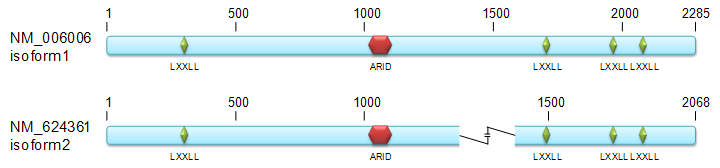
ARID1A protein.
Description
ARID1A is a member of the SWI/SNF family that can regulate genes transcription by chromatin structure alteration through its helicase and ATPase activities. The encoded ARID1A nuclear protein is part of the BRG/BRM chromatin remodeling complex that has been shown to play an integral role in controlling gene expression.
Expression
Ubiquitously expressed in various normal tissues, with the highest expression seen in brain, blood and female tissues.
Localisation
Mainly located at cell nucleus but not at nucleolus.
Function
ARID1A contains a conserved DNA-binding domain (ARID) that could be important for its function and can specifically bind an AT-rich DNA sequence. ARID1A is part of the large ATP-dependent chromatin remodeling complex SNF/SWI, which is required for transcriptional activation of genes. Changes in this SNF/SWI complex has been implicated in many cellular processes, including development, differentiation, proliferation, DNA repair, and tumor suppression.
ARID1A has been reported to act as tumor suppressor in gynecological cancers (Guan et al., 2011b). Molecular studies using over-expression and RNAi silencing models have demonstrated that ARID1A negatively regulates cellular proliferation and tumorigenicity. This negative regulation is achieved through molecular collaboration between ARID1A/BRG1 and p53, to regulate tumor-inhibiting p53-downstream target genes such as CDKN1A and SMAD3. Using mutational studies, Guan et al. (2012) have further confirmed ARID1A role as tumor suppressor, with all of the in-frame indel mutants have lost their ability to inhibit cellular proliferation.
ARID1A has been reported to act as tumor suppressor in gynecological cancers (Guan et al., 2011b). Molecular studies using over-expression and RNAi silencing models have demonstrated that ARID1A negatively regulates cellular proliferation and tumorigenicity. This negative regulation is achieved through molecular collaboration between ARID1A/BRG1 and p53, to regulate tumor-inhibiting p53-downstream target genes such as CDKN1A and SMAD3. Using mutational studies, Guan et al. (2012) have further confirmed ARID1A role as tumor suppressor, with all of the in-frame indel mutants have lost their ability to inhibit cellular proliferation.
Mutations
Germinal
ARID1A mutations have been implicated in Coffin-Siris syndrome, a rare genetic disorder that causes developmental delay and abnormities in 5th fingers or toes (Tsurusaki et al., 2012; Santen et al., 2013; Wieczorek et al., 2013).
Somatic
ARID1A is located at chromosome 1p that is frequently deleted in tumours. ARID1A sequence mutations, deletions, and rearrangements were identified in ovarian, kidney, breast, lung, pancreatic and stomach cancer.
Implicated in
Entity name
Ovarian clear cell carcinoma
Oncogenesis
ARID1A somatic mutations were identified in 57% of the 42 ovarian clear cell carcinomas (Jones et al., 2010). Maeda et al. (2010) has demonstrated that ARID1a genetic mutations resulted in loss of ARID1A protein expression in 59% of the 149 ovarian clear cell carcinomas.
Study with a larger cohort of 210 patient samples has also demonstrated that ARID1A somatic mutation were found in 46% of patients with ovarian clear-cell carcinoma and 30% of patients ovarian endometrioid carcinoma (Wiegand et al., 2010).
ARID1A inactivation by ARID1A mutations has been suggested as an early molecular event that can lead to tumor progression from benign ovarian endometroid cysts into an aggressive ovarian clear cell and endometrioid carcinoma (Ayhan et al., 2012).
Study with a larger cohort of 210 patient samples has also demonstrated that ARID1A somatic mutation were found in 46% of patients with ovarian clear-cell carcinoma and 30% of patients ovarian endometrioid carcinoma (Wiegand et al., 2010).
ARID1A inactivation by ARID1A mutations has been suggested as an early molecular event that can lead to tumor progression from benign ovarian endometroid cysts into an aggressive ovarian clear cell and endometrioid carcinoma (Ayhan et al., 2012).
Entity name
Uterine endometroid carcinoma
Oncogenesis
ARID1A mutations were observed in 40% of uterine endometrioid carcinoma with none presented in uterine serous carcinomas (Guan et al., 2011a). All of the mutations in endometrioid carcinomas were the nonsense or insertion/deletion types (Guan et al., 2011a) and expected to result in complete loss or clonal loss of ARID1A expression. Immunostaining confirmed the relatively significant frequency of loss of ARID1A protein expression with 25-26% and 44% in uterine low-grade and high-grade endometrioid carcinomas, respectively (Guan et al., 2011a; Werner et al., 2013; Mao et al., 2013). Hence, mutation-related loss of ARID1A expression has also been hypothesized as an early event and played an important role in tumor progression of uterine endometrioid carcinoma (Ayhan et al., 2012; Werner et al., 2013; Mao et al., 2013).
Entity name
Cervical cancer
Oncogenesis
Loss of ARID1A protein expression was observed in 31% (14/45) of cervical adenocarcinomas/adenosquamous carcinomas with no correlation to any clinicopathological features (Katagiri et al., 2012). Later studies using a large series of cervical cancer tissue specimens, ARID1A expression was found to be significantly decreased in cervical cancer tissues than in non-adjacent normal cervical epithelial tissues (Cho et al., 2013). The decrease of ARID1A expression was also found to be associated with transition from normal cells to cervical carcinoma and a more aggressive tumor phenotype (Cho et al., 2013). Overall survival was also found to be reduced in cervical cancer patients with loss of ARID1A (Cho et al., 2013).
Entity name
Breast cancer
Oncogenesis
Low ARID1A expression was observed in 56% (63/112) of the breast cancers samples and was significantly associated with advanced tumor stage, higher P53 expression, increase Ki-67 and triple negative (ER-/PR-/Her-2-) molecular subtype (Zhang et al., 2012; Mamo et al., 2012). Low ARID1A expression was a predictor of poor overall survival of breast cancer patients (Zhang et al., 2012; Mamo et al., 2012). Breast cancer also exhibited a low rate (3-4%) of ARID1A mutations (Jones et al., 2010; Cornen et al., 2012).
Entity name
Gastric cancer
Oncogenesis
Inactivating mutation of ARID1A has also been identified gastric cancer (Wang et al., 2011; Abe et al., 2012; Zhang et al., 2012). Loss of ARID1A expression has been correlated with increasing depth of tumor infiltration, higher tumor grade, and poor overall patient survival (Abe et al., 2012; Wang et al., 2012). Moreover, ARID1A expression has been shown as an independent prognostic factor of overall survival in multiple studies (Abe et al., 2012; Wang et al., 2012).
Entity name
Coffin-Siris syndrome
Prognosis
Hepatoblastoma and multiple congenital anomalies.
Oncogenesis
ARID1A mutations in individual with Coffin-Siris syndrome lead to a truncation and nonfunctional ARID1A protein (Tsurusaki et al., 2012; Santen et al., 2013; Wieczorek et al., 2013). As a result, affected individuals developed abnormalities, such as missing the fifth fingers or toes and coarse characteristic of facial features. Moreover, cancer was not detected in any of the individual with ARID1A mutation, reported in this study.
Article Bibliography
| Pubmed ID | Last Year | Title | Authors |
|---|---|---|---|
| 22915242 | 2012 | ARID1A expression loss in gastric cancer: pathway-dependent roles with and without Epstein-Barr virus infection and microsatellite instability. | Abe H et al |
| 22976498 | 2012 | Loss of ARID1A expression is an early molecular event in tumor progression from ovarian endometriotic cyst to clear cell and endometrioid carcinoma. | Ayhan A et al |
| 23427874 | 2013 | Loss of ARID1A/BAF250a expression is linked to tumor progression and adverse prognosis in cervical cancer. | Cho H et al |
| 22249247 | 2012 | Mutations and deletions of ARID1A in breast tumors. | Cornen S et al |
| 23097632 | 2012 | Functional analysis of in-frame indel ARID1A mutations reveals new regulatory mechanisms of its tumor suppressor functions. | Guan B et al |
| 21412130 | 2011 | Mutation and loss of expression of ARID1A in uterine low-grade endometrioid carcinoma. | Guan B et al |
| 21900401 | 2011 | ARID1A, a factor that promotes formation of SWI/SNF-mediated chromatin remodeling, is a tumor suppressor in gynecologic cancers. | Guan B et al |
| 20826764 | 2010 | Frequent mutations of chromatin remodeling gene ARID1A in ovarian clear cell carcinoma. | Jones S et al |
| 22274316 | 2012 | Frequent loss of tumor suppressor ARID1A protein expression in adenocarcinomas/adenosquamous carcinomas of the uterine cervix. | Katagiri A et al |
| 21614196 | 2010 | Clinicopathological significance of loss of ARID1A immunoreactivity in ovarian clear cell carcinoma. | Maeda D et al |
| 21892209 | 2012 | An integrated genomic approach identifies ARID1A as a candidate tumor-suppressor gene in breast cancer. | Mamo A et al |
| 24076775 | 2013 | Loss of ARID1A expression correlates with stages of tumor progression in uterine endometrioid carcinoma. | Mao TL et al |
| 23929686 | 2013 | Coffin-Siris syndrome and the BAF complex: genotype-phenotype study in 63 patients. | Santen GW et al |
| 22426308 | 2012 | Mutations affecting components of the SWI/SNF complex cause Coffin-Siris syndrome. | Tsurusaki Y et al |
| 22808142 | 2012 | Decreased expression of the ARID1A gene is associated with poor prognosis in primary gastric cancer. | Wang DD et al |
| 22037554 | 2011 | Exome sequencing identifies frequent mutation of ARID1A in molecular subtypes of gastric cancer. | Wang K et al |
| 23080032 | 2013 | ARID1A loss is prevalent in endometrial hyperplasia with atypia and low-grade endometrioid carcinomas. | Werner HM et al |
| 23906836 | 2013 | A comprehensive molecular study on Coffin-Siris and Nicolaides-Baraitser syndromes identifies a broad molecular and clinical spectrum converging on altered chromatin remodeling. | Wieczorek D et al |
| 20942669 | 2010 | ARID1A mutations in endometriosis-associated ovarian carcinomas. | Wiegand KC et al |
| 22484628 | 2012 | Exome sequencing of gastric adenocarcinoma identifies recurrent somatic mutations in cell adhesion and chromatin remodeling genes. | Zang ZJ et al |
| 21889920 | 2012 | Frequent low expression of chromatin remodeling gene ARID1A in breast cancer and its clinical significance. | Zhang X et al |
Other Information
Locus ID:
NCBI: 8289
MIM: 603024
HGNC: 11110
Ensembl: ENSG00000117713
Variants:
dbSNP: 8289
ClinVar: 8289
TCGA: ENSG00000117713
COSMIC: ARID1A
RNA/Proteins
Expression (GTEx)
Pathways
| Pathway | Source | External ID |
|---|---|---|
| Chromatin organization | REACTOME | R-HSA-4839726 |
| Chromatin modifying enzymes | REACTOME | R-HSA-3247509 |
| RMTs methylate histone arginines | REACTOME | R-HSA-3214858 |
Protein levels (Protein atlas)
References
| Pubmed ID | Year | Title | Citations |
|---|---|---|---|
| 38100120 | 2024 | ARID1A loss induces P4HB to activate fibroblasts to support lung cancer cell growth, invasion, and chemoresistance. | 2 |
| 38166741 | 2024 | ARID1A deficiency promotes progression and potentiates therapeutic antitumour immunity in hepatitis B virus-related hepatocellular carcinoma. | 0 |
| 38358891 | 2024 | The ARID1A-METTL3-m6A axis ensures effective RNase H1-mediated resolution of R-loops and genome stability. | 3 |
| 38358974 | 2024 | ARID1A loss is associated with increased NRF2 signaling in human head and neck squamous cell carcinomas. | 0 |
| 38457226 | 2024 | Treatments, prognostic factors, and genetic heterogeneity in advanced cholangiocarcinoma: A multicenter real-world study. | 1 |
| 38458187 | 2024 | ARID1A orchestrates SWI/SNF-mediated sequential binding of transcription factors with ARID1A loss driving pre-memory B cell fate and lymphomagenesis. | 4 |
| 38489371 | 2024 | Increased genomic instability and reshaping of tissue microenvironment underlie oncogenic properties of Arid1a mutations. | 2 |
| 38508586 | 2024 | Prognostic role of transcription factor ARID1A in patients with endometrial cancer of no specific molecular profile (NSMP) subtype. | 0 |
| 38587186 | 2024 | ARID1A regulates DNA repair through chromatin organization and its deficiency triggers DNA damage-mediated anti-tumor immune response. | 1 |
| 38600891 | 2024 | Deep-targeted gene sequencing reveals ARID1A mutation as an important driver of glioblastoma. | 1 |
| 38754421 | 2024 | ARID1A suppresses R-loop-mediated STING-type I interferon pathway activation of anti-tumor immunity. | 0 |
| 38858765 | 2024 | Genome-wide DNA methylation in relation to ARID1A deficiency in ovarian clear cell carcinoma. | 0 |
| 38100120 | 2024 | ARID1A loss induces P4HB to activate fibroblasts to support lung cancer cell growth, invasion, and chemoresistance. | 2 |
| 38166741 | 2024 | ARID1A deficiency promotes progression and potentiates therapeutic antitumour immunity in hepatitis B virus-related hepatocellular carcinoma. | 0 |
| 38358891 | 2024 | The ARID1A-METTL3-m6A axis ensures effective RNase H1-mediated resolution of R-loops and genome stability. | 3 |
Citation
Yohan Suryo Rahmanto ; Tian-Li Wang
ARID1A (AT rich interactive domain 1A (SWI-like))
Atlas Genet Cytogenet Oncol Haematol. 2013-11-01
Online version: http://atlasgeneticsoncology.org/gene/44231
