GPC1 (glypican 1)
2013-11-01 Wael Awad , Derek T Logan , Katrin Mani AffiliationDept. of Biochemistry & Structural Biology, Lund University, Box 124, S-221 00 Lund, Sweden (WA,DTL); Glycobiology, Dept. of Experimental Medical Science, BMC A13, S-221 84 Lund, Sweden (KM)
DNA/RNA
Description
The gene spans 32381 pb of DNA, comprising 9 exons.
Transcription
1676 bp open reading frame.
Proteins
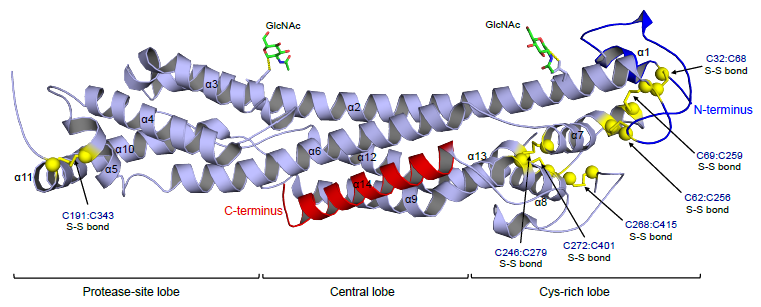
Crystal structure of the N-glycosylated human Gpc-1 core protein (PDB entry 4ACR). Cartoon diagram of Gpc-1 in which the body of the structure is coloured light blue, the N-terminal helix and loop in dark blue and the C-terminal helix in red. Important loops (L1:L3) and all of the α-helices (α1:α14) are labelled. The seven disulphide bonds common to all glypicans are indicated in yellow. The assignment of different lobes in the Gpc-1 structure (Svensson et al., 2011) is displayed on the bottom line.
Description
The glypican-1 gene codes for a protein of 558 amino acids with a predicted molecular weight of 62 kDa. It is a cell surface, lipid-raft-associated heparan sulfate proteoglycan (HSPG), composed of a glycosylphosphatidylinositol (GPI)-anchored core protein substituted with a three chains of heparan sulfate near its C-terminus. It shares, along with all other glypicans, an N-terminal secretory signal, heparan sulfate attachment sites, 14 evolutionary conserved cysteine residues and hydrophobic domain near the C-terminus for the addition of the glycosylphosphatidylinositol (GPI) anchor. Also, the glypican-1 core protein contains two N-glycosylation sites at Asn79 & Asn116, which are found to be invariably occupied. The N-linked glycans at these sites affect Gpc-1 protein expression and heparan sulfate substitution. Nevertheless the protein is folded correctly even in the absence of N-linked glycans (Svensson et al., 2011). Recently, the structure of C-terminally truncated human N-glycosylated Gpc-1 core protein was determined at 2.55 Å resolution (Svensson et al., 2012; Awad et al., 2013), which revealed a highly extended, cylindrical (dimensions 120 x 30 x 30 Å), stable all-α-helical fold. Its structural similarity to the Dally-like protein from Drosophila (Kim et al., 2011) confirmed a conserved overall fold for the glypican family. The Gpc-1 structure consists of 14 α-helices (α1- α14) and three major loops (L1-L3). The extended helix α2 (83Å) traverses the whole protein, carrying two N-linked glycans close to its ends. The Gpc-1 structure revealed the complete arrangement of the 14 Cys residues conserved across the glypican family, in 7 disulfide bonds, 6 of them located near the molecule N terminus at a region termed "Cys-rich lobe". This lobe is followed by a region forms the heart of the structure called the "central lobe". This lobe is stabilized by evolutionary conserved hydrophobic centers. The last region of the Gpc-1 molecule is termed the "protease site lobe" because of the presence of a protease site in this part. No additional electron density was observed in the electron density maps from crystals of non-truncated glypican-1 containing the HS attachment region near the C-terminus, which suggests that this part is highly disordered. This extended long C terminus (50 residues) might thus give the core protein a freedom in its orientation when Gpc-1 is anchored to the cell membrane (Svensson et al., 2012).
Expression
GPC1 is expressed mainly in the central nervous system (CNS) and skeletal system during development but also in many other tissues in the adult.
Localisation
GPC1 is a cell surface HSPG that can be internalized via a caveolin-1 associated pathway. GPC1 undergoes a recycling from cell surface to endosomes and back to the cell surface via Golgi. During recycling, the HS chains of GPC1 are degraded by heparanase and further on by a novel copper, nitric oxide and vitamin C-dependent deaminative cleavage. New HS chains are synthesized on the stubs remaining on the core protein (Cheng et al., 2002; Fransson and Mani, 2007).
Function
Many of the functions of GPC1 are dependent on the HS side chains, which are capable of binding and/or activating and/or transporting a variety of growth factors (FGF2), cytokines, enzymes, viral proteins, and polyamines. It is known that both the core protein and the HS chains of GPC1 are important for brain function, as knock-out of GPC1 gene expression results in reduction of brain size by 30% (Jen et al., 2009) and errors in HS metabolism result in neurodegeneration and mental retardation accompanied by accumulation of amyloid β in human brain (Ohmi et al., 2011). A role for GPC1 in axonal guidance and regeneration via Slit has been proposed (Bloechlinger et al., 2004; Lau and Margolis, 2010). Several studies indicate involvement of Gpc1 in prion conversion and scrapie infection (Löfgren et al., 2008; Taylor et al., 2009; Hooper, 2011).
Homology
GPC1 belongs to the glypican family. To date, six different glypicans have been identified in vertebrates (GPC1, GPC2, GPC3, GPC4, GPC5, and GPC6), two in Drosophila melanogaster (Dally and Dally-like protein), two in C. elegans (Gpn-1 and Lon-2) and one in zebrafish (knypek). Based on sequence comparisons, vertebrate glypicans fall into two subfamilies: glypicans 1, 2, 4, 6 and glypicans 3 and 5, with approximately 25% amino acid identity between the groups.
Implicated in
Entity name
Various cancers
Note
Many studies have shown that GPC1 is crucial for efficient cancer cell growth, metastasis, and angiogenesis of many human and mouse cancer cell types (Ding et al., 2005; Kayed et al., 2006; Aikawa et al., 2008; Whipple et al., 2012). GPC1 is up-regulated in human cancer cells such as glioma, pancreatic and breast cancers and supports and maintains the mitogenic effect of several HS-binding growth factors (Matsuda et al., 2001; Kayed et al., 2006; Su et al., 2006). Downregulation of GPC1 results in prolonged doubling times and decreased growth of cancer cells in vitro, as well as attenuated tumor growth, angiogenesis, and metastasis in vivo.
Entity name
Neurodegenerative diseases
Note
A number of studies indicate involvement of GPC1 in the pathogenesis of several neurodegenerative diseases including Alzheimers disease (van Horssen et al., 2001; Watanabe et al., 2004; Cappai et al., 2005; OCallaghan et al., 2008; Timmer et al., 2009; Cheng et al., 2011), prion disease (Cheng et al., 2006; Löfgren et al., 2008; Taylor et al., 2009; Hooper, 2011), and Niemann-Pick type C1 disease (Mani et al., 2006). GPC1 has been localized to the amyloid plaques of Alzheimers disease. Both nitric oxide- and heparanase-induced degraded GPC1 HS have found to be associated with amyloid deposits, including the toxic amyloid β peptide aggregates in brain of human Alzheimers patients and transgenic Alzheimers mice (Sandwall et al., 2010; Cheng et al., 2011). Further, it has been shown that the HS oligosaccharides released from GPC1 by Cu/NO-vitamin C form conjugates with amyloid β peptides, thereby modulating and suppressing oligomerization of amyloid β and dissolving toxic amyloid β oligomers in hippocampal slices from Alzheimers mice (Cheng et al., 2011). Other studies have shown that amyloid β toxicity is attenuated in cells overexpressing heparanase, suggesting that HS oligosaccharides generated by cleavage with heparanase could also have a protective effect (Sandwall et al., 2010; Zhang et al., 2012).
Article Bibliography
| Pubmed ID | Last Year | Title | Authors |
|---|---|---|---|
| 18064304 | 2008 | Glypican-1 modulates the angiogenic and metastatic potential of human and mouse cancer cells. | Aikawa T et al |
| 24311593 | 2013 | Improvements in the order, isotropy and electron density of glypican-1 crystals by controlled dehydration. | Awad W et al |
| 15016071 | 2004 | Dynamic changes in glypican-1 expression in dorsal root ganglion neurons after peripheral and central axonal injury. | Bloechlinger S et al |
| 15677459 | 2005 | The amyloid precursor protein (APP) of Alzheimer disease and its paralog, APLP2, modulate the Cu/Zn-Nitric Oxide-catalyzed degradation of glypican-1 heparan sulfate in vivo. | Cappai R et al |
| 21642435 | 2011 | Suppression of amyloid beta A11 antibody immunoreactivity by vitamin C: possible role of heparan sulfate oligosaccharides derived from glypican-1 by ascorbate-induced, nitric oxide (NO)-catalyzed degradation. | Cheng F et al |
| 16923158 | 2006 | Copper-dependent co-internalization of the prion protein and glypican-1. | Cheng F et al |
| 12226079 | 2002 | Nitric oxide-dependent processing of heparan sulfate in recycling S-nitrosylated glypican-1 takes place in caveolin-1-containing endosomes. | Cheng F et al |
| 16286510 | 2005 | Growth factor-induced shedding of syndecan-1 confers glypican-1 dependence on mitogenic responses of cancer cells. | Ding K et al |
| 17344097 | 2007 | Novel aspects of vitamin C: how important is glypican-1 recycling? | Fransson LA et al |
| 20681952 | 2011 | Glypican-1 facilitates prion conversion in lipid rafts. | Hooper NM et al |
| 19732411 | 2009 | Glypican-1 controls brain size through regulation of fibroblast growth factor signaling in early neurogenesis. | Jen YH et al |
| 17016645 | 2006 | Correlation of glypican-1 expression with TGF-beta, BMP, and activin receptors in pancreatic ductal adenocarcinoma. | Kayed H et al |
| 21828006 | 2011 | Structure of the protein core of the glypican Dally-like and localization of a region important for hedgehog signaling. | Kim MS et al |
| 19843094 | 2010 | Inhibitors of slit protein interactions with the heparan sulphate proteoglycan glypican-1: potential agents for the treatment of spinal cord injury. | Lau E et al |
| 18717736 | 2008 | Involvement of glypican-1 autoprocessing in scrapie infection. | Löfgren K et al |
| 16645004 | 2006 | Defective nitric oxide-dependent, deaminative cleavage of glypican-1 heparan sulfate in Niemann-Pick C1 fibroblasts. | Mani K et al |
| 11454708 | 2001 | Glypican-1 is overexpressed in human breast cancer and modulates the mitogenic effects of multiple heparin-binding growth factors in breast cancer cells. | Matsuda K et al |
| 18422760 | 2008 | Heparan sulfate accumulation with Abeta deposits in Alzheimer's disease and Tg2576 mice is contributed by glial cells. | O'Callaghan P et al |
| 22096577 | 2011 | Defects in the medial entorhinal cortex and dentate gyrus in the mouse model of Sanfilippo syndrome type B. | Ohmi K et al |
| 20053627 | 2010 | Heparan sulfate mediates amyloid-beta internalization and cytotoxicity. | Sandwall E et al |
| 16723715 | 2006 | Glypican-1 is frequently overexpressed in human gliomas and enhances FGF-2 signaling in glioma cells. | Su G et al |
| 22351761 | 2012 | Crystal structure of N-glycosylated human glypican-1 core protein: structure of two loops evolutionarily conserved in vertebrate glypican-1. | Svensson G et al |
| 19936054 | 2009 | Glypican-1 mediates both prion protein lipid raft association and disease isoform formation. | Taylor DR et al |
| 19166823 | 2009 | Amyloid beta induces cellular relocalization and production of agrin and glypican-1. | Timmer NM et al |
| 15084524 | 2004 | Glypican-1 as an Abeta binding HSPG in the human brain: its localization in DIG domains and possible roles in the pathogenesis of Alzheimer's disease. | Watanabe N et al |
| 21996748 | 2012 | A KrasG12D-driven genetic mouse model of pancreatic cancer requires glypican-1 for efficient proliferation and angiogenesis. | Whipple CA et al |
| 22692572 | 2012 | Heparanase overexpression impairs inflammatory response and macrophage-mediated clearance of amyloid-β in murine brain. | Zhang X et al |
| 11761721 | 2001 | Heparan sulfate proteoglycan expression in cerebrovascular amyloid beta deposits in Alzheimer's disease and hereditary cerebral hemorrhage with amyloidosis (Dutch) brains. | van Horssen J et al |
Other Information
Locus ID:
NCBI: 2817
MIM: 600395
HGNC: 4449
Ensembl: ENSG00000063660
Variants:
dbSNP: 2817
ClinVar: 2817
TCGA: ENSG00000063660
COSMIC: GPC1
RNA/Proteins
Expression (GTEx)
Pathways
Protein levels (Protein atlas)
References
| Pubmed ID | Year | Title | Citations |
|---|---|---|---|
| 38154549 | 2024 | Glypican-1 may be a plasma biomarker for predicting the rupture of small intracranial aneurysms. | 1 |
| 38204202 | 2024 | Extracellular Vesicular Analysis of Glypican 1 mRNA and Protein for Pancreatic Cancer Diagnosis and Prognosis. | 5 |
| 38154549 | 2024 | Glypican-1 may be a plasma biomarker for predicting the rupture of small intracranial aneurysms. | 1 |
| 38204202 | 2024 | Extracellular Vesicular Analysis of Glypican 1 mRNA and Protein for Pancreatic Cancer Diagnosis and Prognosis. | 5 |
| 36790131 | 2023 | Interplay between APP and glypican-1 processing and α-synuclein aggregation in undifferentiated and differentiated human neural progenitor cells. | 2 |
| 36944188 | 2023 | Attenuation of cancer proliferation by suppression of glypican-1 and its pleiotropic effects in neoplastic behavior. | 4 |
| 36790131 | 2023 | Interplay between APP and glypican-1 processing and α-synuclein aggregation in undifferentiated and differentiated human neural progenitor cells. | 2 |
| 36944188 | 2023 | Attenuation of cancer proliferation by suppression of glypican-1 and its pleiotropic effects in neoplastic behavior. | 4 |
| 35348113 | 2022 | Glypican-1 drives unconventional secretion of fibroblast growth factor 2. | 10 |
| 35671267 | 2022 | GPC1 promotes the growth and migration of colorectal cancer cells through regulating the TGF-β1/SMAD2 signaling pathway. | 8 |
| 36158119 | 2022 | GPC1 Is Associated with Poor Prognosis and Treg Infiltration in Colon Adenocarcinoma. | 2 |
| 36159010 | 2022 | Exosomal glypican-1 is elevated in pancreatic cancer precursors and can signal genetic predisposition in the absence of endoscopic ultrasound abnormalities. | 2 |
| 35348113 | 2022 | Glypican-1 drives unconventional secretion of fibroblast growth factor 2. | 10 |
| 35671267 | 2022 | GPC1 promotes the growth and migration of colorectal cancer cells through regulating the TGF-β1/SMAD2 signaling pathway. | 8 |
| 36158119 | 2022 | GPC1 Is Associated with Poor Prognosis and Treg Infiltration in Colon Adenocarcinoma. | 2 |
Citation
Wael Awad ; Derek T Logan ; Katrin Mani
GPC1 (glypican 1)
Atlas Genet Cytogenet Oncol Haematol. 2013-11-01
Online version: http://atlasgeneticsoncology.org/gene/44301/gpc1
