STEAP1 (Six Transmembrane Epithelial Antigene of the Prostate 1)
2009-06-01 Cecília Santos , Sílvia Socorro , Cláudio Maia AffiliationUniversidade da Beira Interior, Research Centre of Health Sciences, Av. Infante D. Henrique, 6200-506, Covilha, Portugal
Identity
HGNC
LOCATION
7q21.13
IMAGE

LEGEND
Surrounding genes from Entrez (updated 12-Feb-2009).
LOCUSID
ALIAS
PRSS24,STEAP
FUSION GENES
DNA/RNA
Description
10,4Kb consisting of 5 exons.
Transcription
1,330Kb transcript; 1195bp ORF.
Proteins
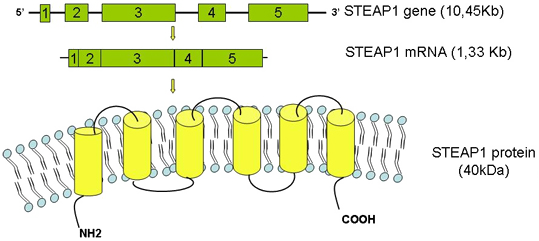
STEAP gene organization, mRNA transcripts and predicted protein structure. Green boxes correspond to exons.
Description
339 amino acids (NCBI: AF186249); MW 40kDa, contains 6 transmembrane helical domains (table 1) and a theoretical pI of 9.28.
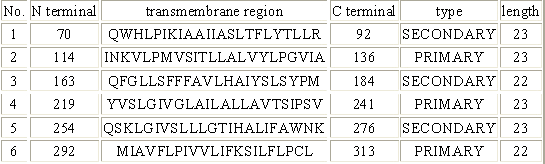
Table 1-Sequence of the 6 transmembrane helices.
Expression
Cell lines: Prostate-LnCAP, LAPC4, PC3, DU145, breast-MCF7, melanoma-624mel, 697mel, 888mel, MM331, gastrointestinal tract-MKN45, WiDR, lung-1355.
Normal murine tissues: bone marrow, brain, colon, duodenum, liver, heart, ileum, kidney, lung, pancreas, placenta, prostate, skeletal muscle, thymus, testis.
Normal murine tissues: bone marrow, brain, colon, duodenum, liver, heart, ileum, kidney, lung, pancreas, placenta, prostate, skeletal muscle, thymus, testis.
Localisation
Cell membrane.
Function
STEAP1 was first identified as a prostate-specific cell-surface antigen, over-expressed in human prostate cancer, and in the spontaneous transgenic mouse model of prostate cancer, by suppressive subtractive hybridization. It is also expressed in several human cancer cell lines obtained from prostate, breast, pancreas, bladder, gastrointestinal tract, testis, ovary, cervix, Ewing sarcoma, and melanomas, and in malignant tumours from several different tissues (eg. Prostate, breast, bladder, lung), with little or no expression in vital organs. Recent data showed that STEAP1 is involved in intercellular communication between adjacent cells in culture, and that it seems to favour tumour development. Its structure prediction, and location at cell-cell junctions, suggest that STEAP1 must be a channel, or a transport protein. Its cell surface location in all tumour types analyzed so far, and its absence in most vital organs in humans, turned STEAP1 into a potential target for anti-tumour immunotherapy, which has already been used in animal models of cancer with promising results. In addition, high levels of STEAP mRNA have been detected in the circulation of cancer patients increasing the potential of STEAP as a diagnosing marker for human cancer.
Mutations
Note
No mutations have been identified so far.
Implicated in
Entity name
Various cancers
Note
Prostate cancer, breast cancer, bladder cancer, lung cancer. STEAP1 is overexpressed in all these types of tumours compared to normal tissue.
Article Bibliography
| Pubmed ID | Last Year | Title | Authors |
|---|---|---|---|
| 16622681 | 2006 | STEAP, a prostate tumor antigen, is a target of human CD8+ T cells. | Alves PM et al |
| 17575147 | 2007 | Monoclonal antibodies to six-transmembrane epithelial antigen of the prostate-1 inhibit intercellular communication in vitro and growth of human tumor xenografts in vivo. | Challita-Eid PM et al |
| 17283172 | 2007 | In vivo effects of vaccination with six-transmembrane epithelial antigen of the prostate: a candidate antigen for treating prostate cancer. | Garcia-Hernandez Mde L et al |
| 10588738 | 1999 | STEAP: a prostate-specific cell-surface antigen highly expressed in human prostate tumors. | Hubert RS et al |
| 17545632 | 2007 | Recognition of prostate and melanoma tumor cells by six-transmembrane epithelial antigen of prostate-specific helper T lymphocytes in a human leukocyte antigen class II-restricted manner. | Kobayashi H et al |
| 16024648 | 2005 | Human CTL epitopes prostatic acid phosphatase-3 and six-transmembrane epithelial antigen of prostate-3 as candidates for prostate cancer immunotherapy. | Machlenkin A et al |
| 18958632 | 2008 | STEAP1 is over-expressed in breast cancer and down-regulated by 17beta-estradiol in MCF-7 cells and in the rat mammary gland. | Maia CJ et al |
| 15958640 | 2005 | Recognition of six-transmembrane epithelial antigen of the prostate-expressing tumor cells by peptide antigen-induced cytotoxic T lymphocytes. | Rodeberg DA et al |
| 11479226 | 2001 | Murine six-transmembrane epithelial antigen of the prostate, prostate stem cell antigen, and prostate-specific membrane antigen: prostate-specific cell-surface antigens highly expressed in prostate cancer of transgenic adenocarcinoma mouse prostate mice. | Yang D et al |
Other Information
Locus ID:
NCBI: 26872
MIM: 604415
HGNC: 11378
Ensembl: ENSG00000164647
Variants:
dbSNP: 26872
ClinVar: 26872
TCGA: ENSG00000164647
COSMIC: STEAP1
RNA/Proteins
| Gene ID | Transcript ID | Uniprot |
|---|---|---|
| ENSG00000164647 | ENST00000297205 | Q9UHE8 |
| ENSG00000164647 | ENST00000412573 | H7C0D8 |
Expression (GTEx)
Pathways
| Pathway | Source | External ID |
|---|---|---|
| Mineral absorption | KEGG | ko04978 |
| Mineral absorption | KEGG | hsa04978 |
Protein levels (Protein atlas)
References
| Pubmed ID | Year | Title | Citations |
|---|---|---|---|
| 36660947 | 2023 | STEAP1 regulation and its influence modulating the response of LNCaP prostate cancer cells to bicalutamide, enzalutamide and apalutamide. | 2 |
| 37209327 | 2023 | Inhibition of STEAP1 ameliorates inflammation and ferroptosis of acute lung injury caused by sepsis in LPS-induced human pulmonary microvascular endothelial cells. | 1 |
| 37315586 | 2023 | Proteomic analysis of STEAP1 knockdown in human LNCaP prostate cancer cells. | 1 |
| 38062846 | 2023 | Six Transmembrane Epithelial Antigen 1 as a Prognostic Biomarker in Carcinomas: A Meta-Analysis. | 0 |
| 36660947 | 2023 | STEAP1 regulation and its influence modulating the response of LNCaP prostate cancer cells to bicalutamide, enzalutamide and apalutamide. | 2 |
| 37209327 | 2023 | Inhibition of STEAP1 ameliorates inflammation and ferroptosis of acute lung injury caused by sepsis in LPS-induced human pulmonary microvascular endothelial cells. | 1 |
| 37315586 | 2023 | Proteomic analysis of STEAP1 knockdown in human LNCaP prostate cancer cells. | 1 |
| 38062846 | 2023 | Six Transmembrane Epithelial Antigen 1 as a Prognostic Biomarker in Carcinomas: A Meta-Analysis. | 0 |
| 35313641 | 2022 | The Prognostic Value and Immunological Role of STEAP1 in Pan-Cancer: A Result of Data-Based Analysis. | 9 |
| 35313641 | 2022 | The Prognostic Value and Immunological Role of STEAP1 in Pan-Cancer: A Result of Data-Based Analysis. | 9 |
| 33589770 | 2021 | Clinical significance of STEAP1 extracellular vesicles in prostate cancer. | 11 |
| 34073779 | 2021 | Identification of a New Transcriptional Co-Regulator of STEAP1 in Ewing's Sarcoma. | 6 |
| 34649092 | 2021 | Predictive potential of STEAP family for survival, immune microenvironment and therapy response in glioma. | 10 |
| 33589770 | 2021 | Clinical significance of STEAP1 extracellular vesicles in prostate cancer. | 11 |
| 34073779 | 2021 | Identification of a New Transcriptional Co-Regulator of STEAP1 in Ewing's Sarcoma. | 6 |
Citation
Cecília Santos ; Sílvia Socorro ; Cláudio Maia
STEAP1 (Six Transmembrane Epithelial Antigene of the Prostate 1)
Atlas Genet Cytogenet Oncol Haematol. 2009-06-01
Online version: http://atlasgeneticsoncology.org/gene/44482/)
