SLC19A3 (solute carrier family 19 (thiamine transporter), member 3)
2014-08-01 Ava Kwong , Vivian Y Shin , John C W Ho AffiliationDepartment of Surgery, The University of Hong Kong, Hong Kong, China
Identity
HGNC
LOCATION
2q36.3
IMAGE

LEGEND
Genes flanking SLC19A3 on chromosome 2q37. The red box indicates the position and orientation of SLC19A3.
LOCUSID
ALIAS
BBGD,THMD2,THTR2,thTr-2
DNA/RNA
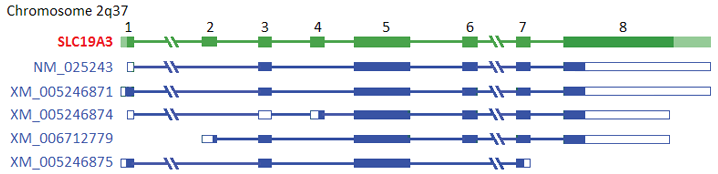
The exon/intron structure of SLC19A3 gene (green) and its transcript variants (blue). The coding sequences and untranslated regions are indicated by filled and empty boxes, respectively.
Description
The human SLC19A3 gene spans 32.9 kb of genomic DNA and is comprised of 8 exons. Orthologs of SLC19A3 are found in 47 different organisms.
Transcription
5 transcript variants for SLC19A3 are described from the NCBI Homo sapiens Annotation Release 106. NM_025243 (GenBank accession #) represents the main transcript (6 exons, 3775 bp) that encodes a peptide of 496 amino acids (Thiamine transporter-2, THTR-2). The remaining 4 variants were identified from computational annotation and include XM_005246871 (3836 bp, 6 exons, 546 aa), XM_005246874 (3288 bp, 7 exons, 492 aa), XM_006712779 (3210 bp, 6 exons, 501 aa) and XM_005246875 (1257 bp, 4 exons, 383 aa).
The stimulating protein-1 (SP1)/ guanosine cytidine (GC) box has been identified in the thiamine-responsive region of SLC19A3 promoter, and SP1 transcriptional factor was reported for regulating THTR-2 expression in response to extracellular thiamine level (Nabokina et al., 2013).
The stimulating protein-1 (SP1)/ guanosine cytidine (GC) box has been identified in the thiamine-responsive region of SLC19A3 promoter, and SP1 transcriptional factor was reported for regulating THTR-2 expression in response to extracellular thiamine level (Nabokina et al., 2013).
Pseudogene
Two SLC19A3-related pseudogenes have been reported, namely LOC100130121 locating at chromosome 7p11, and LOC100420667 locating at chromosome 2q37.
Proteins
Note
The protein product of SLC19A3 gene is often referred as thiamine transporter-2 (THTR-2).
Description
A thiamine transporter protein of 496 amino acid residues, 56 kDa, containing 12 transmembrane domains, and cytosolic N- and C-terminals (Eudy et al., 2000).
Expression
SLC19A3 expression has been widely detetced in human tissues including brain, heart, gastrointestinal tract, lung, pancreas, muscle, ovary, testis, adrenal gland, with the highest levels observed in placenta, liver and kidney (Eudy et al., 2000). A more restricted pattern of SLC19A3 expression was found in mouse tissues, including only brain, heart, lung, kidney and small intestine.
Localisation
Plasma membrane. In polarized intestinal epithelial cells, THTR-2 are restrictedly localized at the apical membrane domain (Subramanian et al., 2006a).
Function
THTR-2 mediates the transmembrane uptake of thiamine (vitamin B1) via a proton anti-port mechanism (Rajgopal et al., 2001). This thiamine uptake process was reported to be temperature-, energy- and pH-dependent (Ashokkumar et al., 2006; Subramanian et al., 2007), and is adaptively regulated by the extracellular thiamine level through transcriptional regulation of the SLC19A3 gene (Nabokina et al., 2013). In human intestinal epithelial cells, THTR-2 interacts with the human transmembrane 4 super-family 4 (TM4SF4) and influences the intestinal thiamine uptake (Subramanian et al., 2014).
Homology
THTR-2 protein belongs to the SLC19 gene family (folate/thiamine transporter family) of solute carriers. Two other members of the family are SLC19A1 (a folate transporter) and SLC19A2 (a thiamine transporter, THTR-1), which share 42% and 53% amino acid sequence identities to the human THTR-2 (Ganapathy et al., 2004). The human SLC19A3 gene is conserved in chimpanzee, Rhesus monkey, dog, cow, mouse, rat, chicken, zebrafish, fruit fly, and mosquito.
Mutations
Germinal
Mutations in SLC19A3 (homozygous and compound heterozygous) have been associated with different neurological disorders, including biotin responsive basal ganglia disease (BBGD), Wernickes-like encephalopathy, and Leigh syndrome. The pathogenic mutations identified to date include p.Gly23Val, p.Thr422Ala (Zeng et al., 2005), p.Lys44Glu, p.Glu320Gln (Kono et al., 2009; Yamada et al., 2010), c.74dupT, IVS3-14A>G (Debs et al., 2010), p.Ser7* (Gerards et al., 2013), p.Gln393*, p.Ser181Pro, p.Leu385Arg, p.Tyr169*, p.Ser176Tyr, p.Val299fs and p.Ser444Arg (Kevelam et al., 2013).
Implicated in
Entity name
Breast cancer
Note
SLC19A3 expression was downregulated in breast cancer tumors as compared to the normal tissues (Ng et al., 2011). Exogenous expression of SLC19A3 in breast cancer cells resulted in an increased sensitivity to doxorubicin- and radiation-induced apoptosis (Liu et al., 2003), and modulated the gene expression associated with prostaglandin metabolism (Liu et al., 2004).
Entity name
Gastric cancer
Note
Hypermethylation of SLC19A3 promoter was detected in gastric cancer cell lines and carcinoma tissues, which led to the epigenetic downregulation of SLC19A3 expression (Liu et al., 2009). The methylation status of SLC19A3 promoter was further validated in plasma samples of breast and gastric cancer patients, suggesting it as a potential blood biomarker for cancer diagnosis (Ng et al., 2011).
Entity name
Biotin-responsive basal ganglia disease
Note
Biotin-responsive basal ganglia disease (BBGD) is a recessive metabolic disorder caused by the homozygous or compound heterozygous mutations in SLC19A3 (Zeng et al., 2005; Debs et al., 2010). Functional study of SLC19A3 [p.Gly23Val and p.Thr422Ala] mutants demonstrated that these 2 mutations did not affect THTR-2 protein trafficking to the apical membrane, but resulting in impaired thiamine transport activity (Subramanian et al., 2006b).
Entity name
Leigh syndrome
Note
Mutational dysfunction of SLC19A3 has been reported to be associated with Leigh syndrome. A nonsense mutation (c.20C>A; p.Ser7*) has been detected in SLC19A3, and was described as a founder mutation in the Moroccan population (Gerards et al., 2013).
Entity name
Wernickes-like encephalopathy
Note
Compound mutations in SLC19A3 [p.Lys44Glu and p.Glu320Gln] were reported in patients with Wernickes-like encephalopathy. From the expression study, p.Lys44Glu mutantion resulted in impaired THTR-2 intracellular transport, whereas the p.Glu320Gln mutant showed normal cell surface localization but a significiantly decreased thiamine uptake activity (Kono et al., 2009).
Entity name
Apoptosis
Note
THTR2-transfected breast cancer cells were found an increase in sensitivity to chemotherapy agent doxorubicin and ionizing radiation, and an increase in apoptosis involving the caspase-3-dependent pathway (Liu et al., 2003).
Entity name
Diabetic nephropathy
Note
SLC19A3 expression was demonstrated to be down-regulated in kidney proximal tubular epithelium under high glucose concentration, which led to the impaired renal re-uptake of thiamine, and producing thiamine insufficiency. This implies a novel mechanism of renal thiamine mishandling linked to the development of diabetic nephropathy (Larkin et al., 2012).
Entity name
Biotin deficiency
Note
SLC19A3 expression was found to be strikingly repressed in human leukocytes upon marginal biotin deficiency, suggesting it as a potential indicator of biotin status (Vlasova et al., 2005).
Article Bibliography
| Pubmed ID | Last Year | Title | Authors |
|---|---|---|---|
| 16705148 | 2006 | Thiamin uptake by the human-derived renal epithelial (HEK-293) cells: cellular and molecular mechanisms. | Ashokkumar B et al |
| 20065143 | 2010 | Biotin-responsive basal ganglia disease in ethnic Europeans with novel SLC19A3 mutations. | Debs R et al |
| 11136550 | 2000 | Identification and characterization of the human and mouse SLC19A3 gene: a novel member of the reduced folate family of micronutrient transporter genes. | Eudy JD et al |
| 14770311 | 2004 | SLC19: the folate/thiamine transporter family. | Ganapathy V et al |
| 23423671 | 2013 | Exome sequencing reveals a novel Moroccan founder mutation in SLC19A3 as a new cause of early-childhood fatal Leigh syndrome. | Gerards M et al |
| 23482991 | 2013 | Exome sequencing reveals mutated SLC19A3 in patients with an early-infantile, lethal encephalopathy. | Kevelam SH et al |
| 19387023 | 2009 | Mutations in a thiamine-transporter gene and Wernicke's-like encephalopathy. | Kono S et al |
| 23285265 | 2012 | Glucose-induced down regulation of thiamine transporters in the kidney proximal tubular epithelium produces thiamine insufficiency in diabetes. | Larkin JR et al |
| 12861052 | 2003 | Down-regulation of thiamine transporter THTR2 gene expression in breast cancer and its association with resistance to apoptosis. | Liu S et al |
| 15328374 | 2004 | Thiamine transporter gene expression and exogenous thiamine modulate the expression of genes involved in drug and prostaglandin metabolism in breast cancer cells. | Liu S et al |
| 19816091 | 2009 | Promoter hypermethylation mediates downregulation of thiamine receptor SLC19A3 in gastric cancer. | Liu X et al |
| 23989004 | 2013 | Adaptive regulation of human intestinal thiamine uptake by extracellular substrate level: a role for THTR-2 transcriptional regulation. | Nabokina SM et al |
| 21789241 | 2011 | Quantitative analysis and diagnostic significance of methylated SLC19A3 DNA in the plasma of breast and gastric cancer patients. | Ng EK et al |
| 11731220 | 2001 | SLC19A3 encodes a second thiamine transporter ThTr2. | Rajgopal A et al |
| 24282057 | 2014 | Association of TM4SF4 with the human thiamine transporter-2 in intestinal epithelial cells. | Subramanian VS et al |
| 15623830 | 2005 | Biotin deficiency reduces expression of SLC19A3, a potential biotin transporter, in leukocytes from human blood. | Vlasova TI et al |
| 21176162 | 2010 | A wide spectrum of clinical and brain MRI findings in patients with SLC19A3 mutations. | Yamada K et al |
| 15871139 | 2005 | Biotin-responsive basal ganglia disease maps to 2q36.3 and is due to mutations in SLC19A3. | Zeng WQ et al |
Other Information
Locus ID:
NCBI: 80704
MIM: 606152
HGNC: 16266
Ensembl: ENSG00000135917
Variants:
dbSNP: 80704
ClinVar: 80704
TCGA: ENSG00000135917
COSMIC: SLC19A3
RNA/Proteins
Expression (GTEx)
Pathways
Protein levels (Protein atlas)
PharmGKB
| Entity ID | Name | Type | Evidence | Association | PK | PD | PMIDs |
|---|---|---|---|---|---|---|---|
| PA450395 | metformin | Chemical | MultilinkAnnotation | associated | 26528626 |
References
| Pubmed ID | Year | Title | Citations |
|---|---|---|---|
| 34614013 | 2021 | Alpha-mannosidosis in Tunisian consanguineous families: Potential involvement of variants in GHR and SLC19A3 genes in the variable expressivity of cognitive impairment. | 1 |
| 34614013 | 2021 | Alpha-mannosidosis in Tunisian consanguineous families: Potential involvement of variants in GHR and SLC19A3 genes in the variable expressivity of cognitive impairment. | 1 |
| 32238601 | 2020 | Obesity status modifies the association between rs7556897T>C in the intergenic region SLC19A3-CCL20 and blood pressure in French children. | 1 |
| 33008889 | 2020 | pH-dependent pyridoxine transport by SLC19A2 and SLC19A3: Implications for absorption in acidic microclimates. | 8 |
| 32238601 | 2020 | Obesity status modifies the association between rs7556897T>C in the intergenic region SLC19A3-CCL20 and blood pressure in French children. | 1 |
| 33008889 | 2020 | pH-dependent pyridoxine transport by SLC19A2 and SLC19A3: Implications for absorption in acidic microclimates. | 8 |
| 31095747 | 2019 | Genetic defects of thiamine transport and metabolism: A review of clinical phenotypes, genetics, and functional studies. | 42 |
| 31095747 | 2019 | Genetic defects of thiamine transport and metabolism: A review of clinical phenotypes, genetics, and functional studies. | 42 |
| 30054086 | 2018 | Are diagnostic magnetic resonance patterns life-saving in children with biotin-thiamine-responsive basal ganglia disease? | 4 |
| 30054086 | 2018 | Are diagnostic magnetic resonance patterns life-saving in children with biotin-thiamine-responsive basal ganglia disease? | 4 |
| 27905264 | 2017 | Biotin-thiamine-responsive basal ganglia disease: catastrophic consequences of delay in diagnosis and treatment. | 13 |
| 28402605 | 2017 | Biotin-thiamine responsive basal ganglia disease: Identification of a pyruvate peak on brain spectroscopy, novel mutation in SLC19A3, and calculation of prevalence based on allele frequencies from aggregated next-generation sequencing data. | 11 |
| 28696212 | 2017 | Compound heterozygous SLC19A3 mutations further refine the critical promoter region for biotin-thiamine-responsive basal ganglia disease. | 10 |
| 27905264 | 2017 | Biotin-thiamine-responsive basal ganglia disease: catastrophic consequences of delay in diagnosis and treatment. | 13 |
| 28402605 | 2017 | Biotin-thiamine responsive basal ganglia disease: Identification of a pyruvate peak on brain spectroscopy, novel mutation in SLC19A3, and calculation of prevalence based on allele frequencies from aggregated next-generation sequencing data. | 11 |
Citation
Ava Kwong ; Vivian Y Shin ; John C W Ho
SLC19A3 (solute carrier family 19 (thiamine transporter), member 3)
Atlas Genet Cytogenet Oncol Haematol. 2014-08-01
Online version: http://atlasgeneticsoncology.org/gene/45635/slc19a3-(solute-carrier-family-19-(thiamine-transporter)-member-3)
