GPX3 (Glutathione peroxidase 3)
2014-11-01 Yan-Ping Yu , Jianhua Luo AffiliationDepartment of Pathology, University of Pittsburgh \\\/ [email protected]; [email protected]
Identity
HGNC
LOCATION
5q33.1
LOCUSID
ALIAS
GPx-P,GSHPx-3,GSHPx-P
FUSION GENES
Abstract
Review on GPX3, with data on DNA, on the protein encoded, and where the gene is implicated.
DNA/RNA

The human GPx3 gene is located at the forward strand of chromosome 5 in the region between 151,020,438 to 151,028,993 bps (GRCh38), comprising 5 exons and adjacent to TNIP1 gene. There are 10 to 11 variant transcripts of GPx3, but only 7 are processed as proteins, according Ensemble Genome Browser database (ENSG00000211445), of which only one with known function (NCBI database).
Transcription
Human GPx3 gene is transcribed to the GPx3 transcript of 1779 bp (NM_002084), consisting of exon 1 (1-304 bp), exon 2 (305-458), exon 3 (459-576), exon 4 (577-676), and exon 5 (677-1761). The coding DNA sequence (CDS) 218..898 bp, encodes for a protein of 226 aa, comprising a leading signal peptide sequence at 218..277 bp followed by the main coding sequence for GPx3. An OPAL codon (TGA) at 434-436 bp is translated to a Selenocycteine (Chambers et al. 1986; Fu et al. 2002; Fu et al. 2002).
Pseudogene
Unknown.
Proteins

Description
Plasma glutathione peroxidase 3 is a member of glutathione peroxidase family, and is the only secretary glutathione peroxidase, accounting for the all glutatione peroxidase in extracellular compartment. Structurally, intracellular GPx3 has a leading signal peptide. GPx3, similar to other selenoproteins, contains a UGA OPAL codon at codon 73, which is coded for a selenocystein residue in the presence of selenium. IMAGE_2
Expression
GPx3 is a plasma glutathione peroxidase, being secreted to extracellular compartment after synthesized in cells. GPx3 mRNA is expressed in different tissues, lung, heart, breast, prostate, placenta,and kidney. But majority (almost 70%) of plasma GPx3 is thought kidney originated(Avissar et al. 1994; Tham et al. 1998). GPx3 is transported through circulation and binds to the basement membrane of epithelia of GI (Burk et al. 2011). GPx3 mRNA is detected in a variety of tissues, while most of them are not joining in the plasma GPx3(Chu et al. 1992; Maeda et al. 1997; Tham, Whitin et al. 1998), implicating the unknown function of GPx3 in other tissues or organs.
Function
Glutathione peroxydase 3, as other tetrameric GPx enzymes using reduced glutatione as electron donor, catalyses the oxydation of reduced glutathione and the simultaneous reduction of a variety of hydrogen peroxide and organoperoxides. As a result, the GPx3 functions in the system to relieve oxidative stress as an antioxidant enzyme. The catalytic residues in GPx3 have been mapped to the location of U73, Q107 and W181(Ren et al. 1997). U73 codes for selenocycteine, a residue that is involved in the reduction of hydrogen peroxide in a catalytic cycle of its atom, from reduced selenolate anion (R-se) to oxidized selenic acid (R-Se-OH). Latter regenerates selenolate anion by GSH. In physiological PH, selenole forms anion, a good reducing source in the system(Ren, Huang et al. 1997). However, electron donor GSH is limited in the extracellular space, implicating a rate limiting factor in the antioxidative function of GPx3. Conserved domain analysis classifies glutathione peroxidase as thioredoxin-like-superfamily protein (Conserved domains database[gi|6006001|ref|NP_002075|]).
In recent studies, GPx3 protein expression was found in a variety of normal tissues or cells, while down-regulated in a number of cancers. Through Yeast Two-Hybrid analyses, GPx3 was found interacting with several proteins in cells. One of such proteins is a TP53 transactivated protein, PIG3, which positively regulates apoptosis and mediates UV-induced cell death. The interaction between GPx3 and PIG3 leads to apoptotic cell death. GPx3 with mutated OPAL codon retains its capabilities in promoting cell death, suggesting that GPx3 contains pro-apoptotic activity independent of its peroxidase function(Wang et al. 2012).
In recent studies, GPx3 protein expression was found in a variety of normal tissues or cells, while down-regulated in a number of cancers. Through Yeast Two-Hybrid analyses, GPx3 was found interacting with several proteins in cells. One of such proteins is a TP53 transactivated protein, PIG3, which positively regulates apoptosis and mediates UV-induced cell death. The interaction between GPx3 and PIG3 leads to apoptotic cell death. GPx3 with mutated OPAL codon retains its capabilities in promoting cell death, suggesting that GPx3 contains pro-apoptotic activity independent of its peroxidase function(Wang et al. 2012).

Homology
Glutathion peroxidase activity of GPx3 is conserved in other seven GPx selenocysteine containing proteins. Though encoded from different genes, all contain a common UGA OPAL codon, encoding a selenocysteine residue in coding region, an active site of enzyme activity(Tosatto et al. 2008). GPx3 sequence, if excluding signal peptide, has the highest homology (84%) and identities (72%) with GPx5 encompassing 200 out of 226 aa in the coding region; while 60% homology with GPx1, GPx2 ; but low, 46-47% with GPx4,6,7,and 8.
GPx3 is expressed in other species. Human GPx3 shares sequece homology (94%) and identities (89%) with mouse GPx3 over 226 aa including signal peptide sequence; 95-96% homology and 91-92% identities with rat(NP_071970.2)and dog (NP_001157926.1) of full coding region, but is of only limited homology to GPx3 in Xenopus Laevis (NP_001085319.2)and Zebra fish (NP_001131027.1).
GPx3 is expressed in other species. Human GPx3 shares sequece homology (94%) and identities (89%) with mouse GPx3 over 226 aa including signal peptide sequence; 95-96% homology and 91-92% identities with rat(NP_071970.2)and dog (NP_001157926.1) of full coding region, but is of only limited homology to GPx3 in Xenopus Laevis (NP_001085319.2)and Zebra fish (NP_001131027.1).
Mutations
Note
Not known.
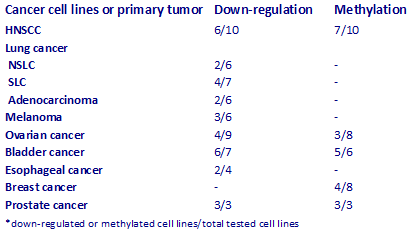
Expression and methylation of GPx3 gene in multiple cancer cell lines(Yu et al. 2004; Yu, Yu et al. 2007; Chen, Rao et al. 2011)GERMINAL
Implicated in
Entity name
Prostate cancer
Oncogenesis
Silencing of GPx3 gene with hypermethylation of GPx3 promoter was first found in a microarray study of three prostate cancer cell lines, in which treated with 5-aza-2 deoxycytidine, GPx3 expression was induced in these cells originally silenced in GPx3 (Lodygin et al. 2005). GPx3 down-regulation was subsequently confirmed in several gene expression-array analyses of a large number of human prostate cancer specimens with high rate of occurrence (LaTulippe et al. 2002; Luo et al. 2002; Yu, Landsittel et al. 2004; Yu, Yu et al. 2007). Complete inactivation of GPx3 was closely correlated with the poor clinical outcome of prostate cancer. Hemizygous and homozygous deletion of GPx3 gene occurs in a subset of prostate cancer samples(39%). CpG island hypermethylation in GPx3 promoter occurs in over 90% of prostate cancer samples (Lodygin, Epanchintsev et al. 2005; Yu, Yu et al. 2007). The frequent CpG hypermethylation in GPx3 in cancer suggests that hypermethylation plays a significant role in GPx3 down-regulation in cells. Down-regulation of GPx3 increases these cells vulnerability to oxidative damages. Conditions predisposed to prostate cancer, such as high animal fat diet in TRAM mice and loss of tumor suppressor Nkx3.1, has been found accompanied with decrease in GPx3 expression in animal (Chang et al. 2014), (Ouyang et al. 2005).
Entity name
Cervical cancer
Oncogenesis
GPx3 is down-regulated in cervical cancer tissues when compared with normal cervical tissues, and the down-regulation is closely correlated to lymph node metastasis and prognosis in cervical cancer patients. Promoter methylation is the major cause of GPX3 down-regulation(Zhang et al. 2014).
Entity name
Esophageal squamous cell carcinoma(ESCC) and Barretts adenocarcinomas (BA)
Oncogenesis
Down-regulation of GPx3 expression in ESCC was revealed in a DNA micro-array study and GPx3 gene methylation was indicated by demethylation treatment of ESCC tissues with 5-aza-2-deoxycytidine, where GPx3 expression was restored in 71.4% of tumor samples and 10.7% of adjacent normal tissues(He et al. 2011). The GPx3 gene methylation was significantly correlated with the downregulation of GPx3 mRNAs in tumors.
In Barretts adenocarcinomas (BA), quantitative RT-PCR revealed 91% of tumor samples with reduced levels of GPx3 mRNA. Similarly, GPx3 promoter hypermethylation was detected in 88% of BA samples with the mostly bi-alleles hypermethylation(Lee et al. 2005; Peng et al. 2009).
In Barretts adenocarcinomas (BA), quantitative RT-PCR revealed 91% of tumor samples with reduced levels of GPx3 mRNA. Similarly, GPx3 promoter hypermethylation was detected in 88% of BA samples with the mostly bi-alleles hypermethylation(Lee et al. 2005; Peng et al. 2009).
Entity name
Gastric cancer
Oncogenesis
Down-regulation of GPx3 expression in gastric cancer was identified in gastric cancer tissues, which displayed a high occurrence rate of 8/9 cancer cell lines, and 83% (90/108) of gastric cancer samples. Hypermethylation of GPx3 promoter in 6 out of 9 cancer cell lines and 60% of gastric cancer samples significantly contributed to the silencing of GPx3 gene(Zhang, Yang et al. 2010; Peng et al. 2012), although loss of copy number of GPx3 gene was also detected in the cancer samples. Silencing of GPx3 was correlated to the lymph node metastasis of gastric cancer and was also detected in the adjacent normal gastric tissue samples, suggestive of cancer field effects in gastric tract. In addition, a study showed that two intronic SNPs in GPx3 significantly altered gene expression, a possible link to the increasing risks of gastric cancer (Wang et al. 2010). Wound healing analyses showed that retoring GPx3 expression in cells decreased cell motility, a possible feature involved in cancer metastasis.
Entity name
Breast cancer
Oncogenesis
Down-regulation of GPX3 expression in breast cancer was identified through immunohistochemistry (IHC) analyses of breast cancer samples by comparing with the normal tissues. The inflammatory breast cancer (IBC), with higher frequency of GPx3 promoter methylation, had GPx3 expression significantly lower than those in non-inflammatory breast cancer (non-IBC)(Mohamed et al. 2014).
Entity name
Ovarian carcinoma
Oncogenesis
Similar to breast cancer, abberation of GPx3 expression in ovarian cancer distinguishes cancer stage and cell type of ovarian cancer ; Decreased levels of serous glutathione peroxidase 3 were associated with late stages of papillary serous ovarian cancer or disease progression(Lau et al. 2014), while clear cell subtype showed elevated GPx3 expression(Hough et al. 2001).
Entity name
Colorectal Carcinoma
Oncogenesis
Tumor suppression of GPx3 in the inflammatory colonic tumorigenesis (colitis associated carcinoma) model was suggested in the GPx3-knockout mice as the manifestation of the increased number of tumor with higher degree of dysplasia in colon. Knockdown of GPx3 in the colon cancer cell line resulted in increase of inflammation, proliferation, DNA damage and apoptosis following the exposure to oxidative stress (Barrett et al. 2013). Genotype analyses of three SNPs in GPx3 indicates that the genetic variations in GPx3 contribute to the risk of rectal cancer (Haug et al. 2012)
Article Bibliography
| Pubmed ID | Last Year | Title | Authors |
|---|---|---|---|
| 23221387 | 2013 | Tumor suppressor function of the plasma glutathione peroxidase gpx3 in colitis-associated carcinoma. | Barrett CW et al |
| 21493731 | 2011 | Glutathione peroxidase-3 produced by the kidney binds to a population of basement membranes in the gastrointestinal tract and in other tissues. | Burk RF et al |
| 3015592 | 1986 | The structure of the mouse glutathione peroxidase gene: the selenocysteine in the active site is encoded by the 'termination' codon, TGA. | Chambers I et al |
| 25053105 | 2014 | High animal fat intake enhances prostate cancer progression and reduces glutathione peroxidase 3 expression in early stages of TRAMP mice. | Chang SN et al |
| 21684681 | 2011 | GPx3 promoter hypermethylation is a frequent event in human cancer and is associated with tumorigenesis and chemotherapy response. | Chen B et al |
| 1339300 | 1992 | Expression of plasma glutathione peroxidase in human liver in addition to kidney, heart, lung, and breast in humans and rodents. | Chu FF et al |
| 11973339 | 2002 | A selenoprotein in the plant kingdom. Mass spectrometry confirms that an opal codon (UGA) encodes selenocysteine in Chlamydomonas reinhardtii gluththione peroxidase. | Fu LH et al |
| 22371331 | 2012 | Glutathione peroxidase tagSNPs: associations with rectal cancer but not with colon cancer. | Haug U et al |
| 20725785 | 2011 | Identification of GPX3 epigenetically silenced by CpG methylation in human esophageal squamous cell carcinoma. | He Y et al |
| 11358798 | 2001 | Coordinately up-regulated genes in ovarian cancer. | Hough CD et al |
| 12154061 | 2002 | Comprehensive gene expression analysis of prostate cancer reveals distinct transcriptional programs associated with metastatic disease. | LaTulippe E et al |
| 24186266 | 2014 | Altered expression of inflammation-associated genes in oviductal cells following follicular fluid exposure: implications for ovarian carcinogenesis. | Lau A et al |
| 16229808 | 2005 | Hypermethylation and loss of expression of glutathione peroxidase-3 in Barrett's tumorigenesis. | Lee OJ et al |
| 15899813 | 2005 | Functional epigenomics identifies genes frequently silenced in prostate cancer. | Lodygin D et al |
| 11807955 | 2002 | Gene expression analysis of prostate cancers. | Luo JH et al |
| 9197538 | 1997 | Analysis of an expression profile of genes in the human adipose tissue. | Maeda K et al |
| 24790704 | 2014 | Promoter hypermethylation and suppression of glutathione peroxidase 3 are associated with inflammatory breast carcinogenesis. | Mohamed MM et al |
| 16061659 | 2005 | Loss-of-function of Nkx3.1 promotes increased oxidative damage in prostate carcinogenesis. | Ouyang X et al |
| 23071548 | 2012 | Silencing of glutathione peroxidase 3 through DNA hypermethylation is associated with lymph node metastasis in gastric carcinomas. | Peng DF et al |
| 18664505 | 2009 | DNA hypermethylation regulates the expression of members of the Mu-class glutathione S-transferases and glutathione peroxidases in Barrett's adenocarcinoma. | Peng DF et al |
| 9180378 | 1997 | The crystal structure of seleno-glutathione peroxidase from human plasma at 2.9 A resolution. | Ren B et al |
| 9843785 | 1998 | Expression of extracellular glutathione peroxidase in human and mouse gastrointestinal tract. | Tham DM et al |
| 18500926 | 2008 | The catalytic site of glutathione peroxidases. | Tosatto SC et al |
| 22461624 | 2012 | p53-induced gene 3 mediates cell death induced by glutathione peroxidase 3. | Wang H et al |
| 20576521 | 2010 | Functional glutathione peroxidase 3 polymorphisms associated with increased risk of Taiwanese patients with gastric cancer. | Wang JY et al |
| 24167362 | 2013 | Positive ALDH1A3 and negative GPX3 expressions are biomarkers for poor prognosis of gallbladder cancer. | Yang ZL et al |
| 17804715 | 2007 | Glutathione peroxidase 3, deleted or methylated in prostate cancer, suppresses prostate cancer growth and metastasis. | Yu YP et al |
| 20043075 | 2010 | An 8-gene signature, including methylated and down-regulated glutathione peroxidase 3, of gastric cancer. | Zhang X et al |
| 24788695 | 2014 | Downregulation of glutathione peroxidase 3 is associated with lymph node metastasis and prognosis in cervical cancer. | Zhang X et al |
Other Information
Locus ID:
NCBI: 2878
MIM: 138321
HGNC: 4555
Ensembl: ENSG00000211445
Variants:
dbSNP: 2878
ClinVar: 2878
TCGA: ENSG00000211445
COSMIC: GPX3
RNA/Proteins
Expression (GTEx)
Pathways
Protein levels (Protein atlas)
References
| Pubmed ID | Year | Title | Citations |
|---|---|---|---|
| 38299269 | 2024 | Advances in the role of GPX3 in ovarian cancer (Review). | 0 |
| 38322113 | 2024 | GPX3-Mediated Oxidative Stress Affects Pyrimidine Metabolism Levels in Stomach Adenocarcinoma via the AMPK/mTOR Pathway. | 0 |
| 38420829 | 2024 | TRIM6 Promotes ROS-Mediated Inflammasome Activation and Pyroptosis in Renal Tubular Epithelial Cells via Ubiquitination and Degradation of GPX3 Protein. | 0 |
| 38927092 | 2024 | Insights into the Role of Glutathione Peroxidase 3 in Non-Neoplastic Diseases. | 0 |
| 38299269 | 2024 | Advances in the role of GPX3 in ovarian cancer (Review). | 0 |
| 38322113 | 2024 | GPX3-Mediated Oxidative Stress Affects Pyrimidine Metabolism Levels in Stomach Adenocarcinoma via the AMPK/mTOR Pathway. | 0 |
| 38420829 | 2024 | TRIM6 Promotes ROS-Mediated Inflammasome Activation and Pyroptosis in Renal Tubular Epithelial Cells via Ubiquitination and Degradation of GPX3 Protein. | 0 |
| 38927092 | 2024 | Insights into the Role of Glutathione Peroxidase 3 in Non-Neoplastic Diseases. | 0 |
| 37087463 | 2023 | Glutathione peroxidase 3 is a novel clinical diagnostic biomarker and potential therapeutic target for neutrophils in rheumatoid arthritis. | 1 |
| 37310002 | 2023 | Decreased GPX3 mRNA level in peripheral blood mononuclear cells is associated with HBV-related hepatocellular carcinoma. | 0 |
| 37629712 | 2023 | GPX3 rs8177412 Polymorphism Modifies Risk of Upper Urothelial Tumors in Patients with Balkan Endemic Nephropathy. | 1 |
| 37633909 | 2023 | Glutathione Peroxidase 3 induced mitochondria-mediated apoptosis via AMPK /ERK1/2 pathway and resisted autophagy-related ferroptosis via AMPK/mTOR pathway in hyperplastic prostate. | 5 |
| 38003341 | 2023 | GPX3 Variant Genotype Affects the Risk of Developing Severe Forms of COVID-19. | 1 |
| 37087463 | 2023 | Glutathione peroxidase 3 is a novel clinical diagnostic biomarker and potential therapeutic target for neutrophils in rheumatoid arthritis. | 1 |
| 37310002 | 2023 | Decreased GPX3 mRNA level in peripheral blood mononuclear cells is associated with HBV-related hepatocellular carcinoma. | 0 |
Citation
Yan-Ping Yu ; Jianhua Luo
GPX3 (Glutathione peroxidase 3)
Atlas Genet Cytogenet Oncol Haematol. 2014-11-01
Online version: http://atlasgeneticsoncology.org/gene/46158/case-report-explorer/meetings/
