POU1F1 (POU class 1 homeobox 1)
2014-02-01 Jean-Louis Franc , Denis Becquet , Anne-Marie François-Bellan AffiliationCRN2M, UMR7286 Aix-Marseille Universite, CNRS, Faculte de Medecine, Bd P. Dramard, Marseille, France
Identity
HGNC
LOCATION
3p11.2
LOCUSID
ALIAS
CPHD1,GHF-1,PIT1,POU1F1a,Pit-1
FUSION GENES
DNA/RNA
Note
The anterior pituitary-specific transcription factor POU1F1 was initially identified and cloned as a transactivator of prolactin (PRL), growth hormone (GH), and TSHβ-subunit genes (Bodner et al., 1988; Ingraham et al., 1988). Transcription produces 2 alternatively spliced mRNAs α (NM_000306.2) and β (NM_001122757.1).
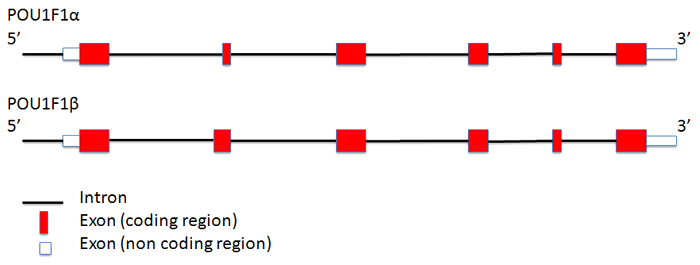
Structure of POU1F1 gene and its transcripts encoded on minus strand of chromosome 3.
Description
The human POU1F1 gene is composed of 6 exons (Theill et al., 1992).
Transcription
Two transcripts have been reported for this gene.
Proteins
Description
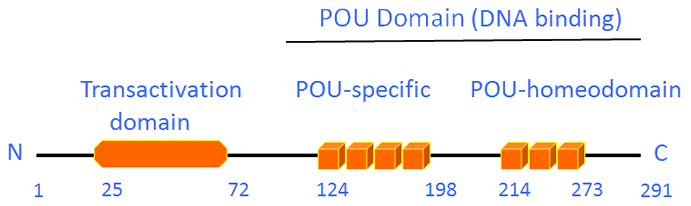
The main protein isoform expressed in pituitary cells is POU1F1α. This isoform, also named PIT-1.b or PIT-1α, has 291 aa. The predicted protein corresponding to POU1F1β, also named PIT-1.a or PIT-1β, has 317 aa and acts as a repressor in pituitary cells (Theill et al., 1992; Jonsen et al., 2009). POU1F1 is structurally related to the POU family of transcriptional regulators, containing a characteristic POU domain divided into two regions, the POU-specific and homeo subdomains. The POUs-specific domain consists of 75 amino acids, comprises 4 α-helices, and contributes to the DNA binding specificity and protein / protein interactions (Ingraham et al., 1990; Jacobson et al., 1997). The homeodomain is composed of 60 amino and contains 3 α-helices. The N-terminal part of POU1F1 is involved in the transcriptional activity. POU1F1 binds as a dimer to most DNA response elements (for review see Phillips and Luisi, 2000).
Expression
The expression of POU1F1 is largely restricted in the pituitary gland in somato- thyreo- and lacto-trope cells, but this factor is also expressed in some extrapituitary tissues and cell lines, including the mammary gland (Gil-Puig et al., 2002).
Localisation
The localization of POU1F1 is nuclear.
Function
POU1F1 is a member of the POU family of transcription factors. This factor is required for terminal differentiation of the somatotrope, lactotrope and thyrotrope cell types (Ingraham et al., 1988; Cohen et al., 1996). This factor is also implicated in the cell growth and prevents the apoptotic cell death (Pellegrini et al., 2006).
Mutations
Note
In humans, mutation in the POU1F1 gene has been shown to be responsible for combined pituitary hormone deficiency (for review see Quentien et al., 2006) (see below).
Implicated in
Entity name
Pituitary adenoma
Prognosis
POU1F1 is overexpressed in GH, PRL and TSH pituitary adenomas (Asa et al., 1993; Delhase et al., 1993; Pellegrini et al., 1994) and the increased expression in adenomas is compatible with the role of POU1F1 in cell proliferation. Interestingly, human non-functioning pituitary adenomas also express POU1F1, especially it was expressed in all alpha SU positive nonfunctioning adenomas (Osamura et al., 1999).
Entity name
Combined pituitary hormone deficiency (CPHD)
Prognosis
In humans, mutation in the POU1F1 gene has been shown to be responsible for combined pituitary hormone deficiency. This syndrome is a disease characterized by the lack of PRL, GH, and TSHbeta produced by the somato- lacto- and thyreo-tropes cells. At least sixteen distinct recessive or dominant POU1F1 mutations have been described to date (Cushman et al., 2002; Dattani, 2005). The molecular mechanisms underlying their effects can be dominant inhibition of transcription or inability to bind to DNA. The R271W mutation is the most commonly occurring POU1F1 gene defect (Radovick et al., 1992). Other mutations, such as F135C, show a decreased transactivation activity although the DNA binding property is conserved (Vallette-Kasic et al., 2001).
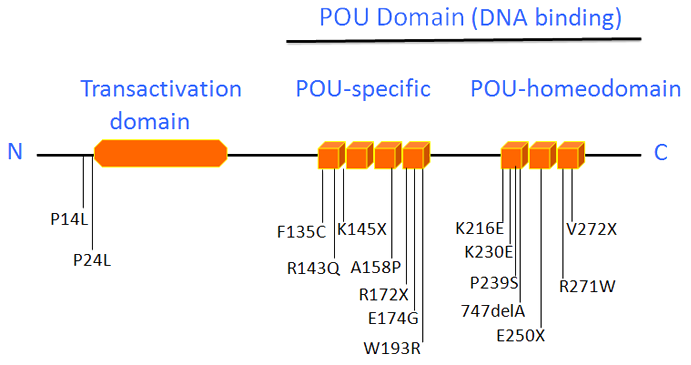
Location of the Pit-1 gene mutation.
Entity name
Breast carcinoma
Prognosis
POU1F1 was expressed in normal human breast tissue but its mRNA expression levels is significantly higher in breast adenocarcinoma. This deregulation promotes tumor growth and metastasis (Gil-Puig et al., 2005; Ben-Batalla et al., 2010).
Entity name
Prognosis
In acute myeloid leukemia POU1F1 has been identified as a new fusion partner of NUP98 gene (Lisboa et al., 2013).
Article Bibliography
| Pubmed ID | Last Year | Title | Authors |
|---|---|---|---|
| 8077321 | 1993 | Cell type-specific expression of the pituitary transcription activator pit-1 in the human pituitary and pituitary adenomas. | Asa SL et al |
| 21060149 | 2010 | Deregulation of the Pit-1 transcription factor in human breast cancer cells promotes tumor growth and metastasis. | Ben-Batalla I et al |
| 2902927 | 1988 | The pituitary-specific transcription factor GHF-1 is a homeobox-containing protein. | Bodner M et al |
| 8879985 | 1996 | Role of Pit-1 in the gene expression of growth hormone, prolactin, and thyrotropin. | Cohen LE et al |
| 12173688 | 2002 | Genetic defects in the development and function of the anterior pituitary gland. | Cushman LJ et al |
| 16060904 | 2005 | Growth hormone deficiency and combined pituitary hormone deficiency: does the genotype matter? | Dattani MT et al |
| 8297469 | 1993 | Pit-1/GHF-1 expression in pituitary adenomas: further analogy between human adenomas and rat SMtTW tumours. | Delhase M et al |
| 16061841 | 2005 | Pit-1 is expressed in normal and tumorous human breast and regulates GH secretion and cell proliferation. | Gil-Puig C et al |
| 2350782 | 1990 | The POU-specific domain of Pit-1 is essential for sequence-specific, high affinity DNA binding and DNA-dependent Pit-1-Pit-1 interactions. | Ingraham HA et al |
| 9009203 | 1997 | Structure of Pit-1 POU domain bound to DNA as a dimer: unexpected arrangement and flexibility. | Jacobson EM et al |
| 19556346 | 2009 | The 26-amino acid beta-motif of the Pit-1beta transcription factor is a dominant and independent repressor domain. | Jonsen MD et al |
| 23332017 | 2013 | POU1F1 is a novel fusion partner of NUP98 in acute myeloid leukemia with t(3;11)(p11;p15). | Lisboa S et al |
| 11081207 | 1999 | Pit-1 positive alpha-subunit positive nonfunctioning human pituitary adenomas: a dedifferentiated GH cell lineage? | Osamura RY et al |
| 16901973 | 2006 | Involvement of the pituitary-specific transcription factor pit-1 in somatolactotrope cell growth and death: an approach using dominant-negative pit-1 mutants. | Pellegrini I et al |
| 11183772 | 2000 | The virtuoso of versatility: POU proteins that flex to fit. | Phillips K et al |
| 16879162 | 2006 | Pituitary transcription factors: from congenital deficiencies to gene therapy. | Quentien MH et al |
| 1509262 | 1992 | A mutation in the POU-homeodomain of Pit-1 responsible for combined pituitary hormone deficiency. | Radovick S et al |
| 1600947 | 1992 | Differential splicing of the GHF1 primary transcript gives rise to two functionally distinct homeodomain proteins. | Theill LE et al |
| 11222742 | 2001 | Combined pituitary hormone deficiency due to the F135C human Pit-1 (pituitary-specific factor 1) gene mutation: functional and structural correlates. | Vallette-Kasic S et al |
Other Information
Locus ID:
NCBI: 5449
MIM: 173110
HGNC: 9210
Ensembl: ENSG00000064835
Variants:
dbSNP: 5449
ClinVar: 5449
TCGA: ENSG00000064835
COSMIC: POU1F1
RNA/Proteins
| Gene ID | Transcript ID | Uniprot |
|---|---|---|
| ENSG00000064835 | ENST00000344265 | P28069 |
| ENSG00000064835 | ENST00000350375 | P28069 |
| ENSG00000064835 | ENST00000560656 | H0YK06 |
| ENSG00000064835 | ENST00000561167 | H0YNM5 |
Expression (GTEx)
Protein levels (Protein atlas)
References
| Pubmed ID | Year | Title | Citations |
|---|---|---|---|
| 38134555 | 2024 | CTGF regulates mineralization in human mature chondrocyte by controlling Pit-1 and modulating ANK via the BMP/Smad signalling. | 0 |
| 38146732 | 2024 | Clinical features of anti-pituitary-specific transcription factor-1 (PIT-1) hypophysitis: a new aspect of paraneoplastic autoimmune condition. | 0 |
| 38228887 | 2024 | Pituitary neuroendocrine tumors with PIT1/SF1 co-expression show distinct clinicopathological and molecular features. | 0 |
| 38134555 | 2024 | CTGF regulates mineralization in human mature chondrocyte by controlling Pit-1 and modulating ANK via the BMP/Smad signalling. | 0 |
| 38146732 | 2024 | Clinical features of anti-pituitary-specific transcription factor-1 (PIT-1) hypophysitis: a new aspect of paraneoplastic autoimmune condition. | 0 |
| 38228887 | 2024 | Pituitary neuroendocrine tumors with PIT1/SF1 co-expression show distinct clinicopathological and molecular features. | 0 |
| 35951005 | 2023 | Heterozygous variants in SIX3 and POU1F1 cause pituitary hormone deficiency in mouse and man. | 2 |
| 37268858 | 2023 | Multilineage Pituitary Neuroendocrine Tumors (PitNETs) Expressing PIT1 and SF1. | 6 |
| 37948564 | 2023 | Genetic diagnosis of congenital hypopituitarism in Turkish patients by a target gene panel: novel pathogenic variants in GHRHR, GLI2, LHX4 and POU1F1 genes. | 0 |
| 38139044 | 2023 | Phosphate (Pi) Transporter PIT1 Induces Pi Starvation in Salmonella-Containing Vacuole in HeLa Cells. | 1 |
| 35951005 | 2023 | Heterozygous variants in SIX3 and POU1F1 cause pituitary hormone deficiency in mouse and man. | 2 |
| 37268858 | 2023 | Multilineage Pituitary Neuroendocrine Tumors (PitNETs) Expressing PIT1 and SF1. | 6 |
| 37948564 | 2023 | Genetic diagnosis of congenital hypopituitarism in Turkish patients by a target gene panel: novel pathogenic variants in GHRHR, GLI2, LHX4 and POU1F1 genes. | 0 |
| 38139044 | 2023 | Phosphate (Pi) Transporter PIT1 Induces Pi Starvation in Salmonella-Containing Vacuole in HeLa Cells. | 1 |
| 35456463 | 2022 | A Novel Splice-Site Deletion in the POU1F1 Gene Causes Combined Pituitary Hormone Deficiency in Multiple Sudanese Pedigrees. | 1 |
Citation
Jean-Louis Franc ; Denis Becquet ; Anne-Marie François-Bellan
POU1F1 (POU class 1 homeobox 1)
Atlas Genet Cytogenet Oncol Haematol. 2014-02-01
Online version: http://atlasgeneticsoncology.org/gene/46362/deep-insight-explorer/meetings/
