PIWIL1 (piwi-like RNA-mediated gene silencing 1)
2013-05-01 Shozo Honda , Yohei Kirino AffiliationDepartment of Biomedical Sciences, Samuel Oschin Comprehensive Cancer Institute, Cedars-Sinai Medical Center, Los Angeles, California 90048, USA
Identity
HGNC
LOCATION
12q24.33
LOCUSID
ALIAS
CT80.1,HIWI,MIWI,PIWI
FUSION GENES
DNA/RNA
Note
HIWI cDNA was first partially isolated as an ortholog of Drosophila PIWI (Cox et al., 1998) and then fully identified in a human testis cDNA library (Qiao et al., 2002; Sharma et al., 2001).
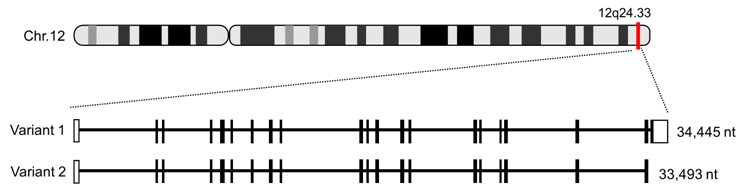
HIWI gene occupies a 34445-bp region from positions 130822433 to 130856877 on chromosome 12.
Transcription
HIWI has two transcript variants. Variant 1 (NCBI Ref Seq: NM_004764.4) was cloned from a human testis cDNA library (Qiao et al., 2002; Sharma et al., 2001). It is 3591 nt in length and comprises 21 verified exons, of which 20 are coding exons with a total length of 2586 nt. The 5- and 3-UTRs are 271 and 734 nt long, respectively. Variant 2 has an alternative 3-UTR, resulting in shorter protein with truncated C-terminus compared with variant 1. Variant 2 was detected by transcriptome analyses of the "full-length long JAPAN" (FLJ) collection (Ota et al., 2004).
Proteins
Note
HIWI protein (NCBI Ref Seq: NP_004755.2) belongs to the PIWI subgroup of Argonaute family proteins, evolutionarily conserved proteins containing two characteristic protein motifs, PAZ and PIWI (Carmell et al., 2002). Argonaute family proteins can be divided into two subclades, AGO and PIWI, and form complexes with small RNAs to regulate gene expressions (Carmell et al., 2002; Hock and Meister, 2008).

Description
The HIWI gene encodes an 861-amino-acid protein (98 kDa). The HIWI protein contains two characteristic protein motifs: a PAZ domain (aa 278-413) and a PIWI domain (aa 556-847). In Argonaute family proteins, the PAZ domain serves as a docking site for the 3-end of small RNA, whereas the PIWI domain has a structure similar to RNaseH, which cleaves the RNA strand of an RNA-DNA hybrid (Elkayam et al., 2012; Parker and Barford, 2006). Indeed, all three species of the Drosophila PIWI protein family show small RNA-guided RNA cleavage (slicer) activity (Gunawardane et al., 2007; Nishida et al., 2007; Saito et al., 2006). In mouse, MIWI (mouse orthologs of HIWI) and MILI also have the slicer activity, which is essential for transposon silencing and fertility (De Fazio et al., 2011; Reuter et al., 2011). In addition, the HIWI protein contains glycine-arginine-rich repeats mainly in its N-terminus (aa 3-15:GRARARARGRARG; aa18-20:GRG; aa728-730:GRG), and these are the motifs for symmetrical dimethylarginine (sDMA) modifications catalyzed by PRMT5 methyltransferase (Kirino et al., 2009). sDMA positions of MIWI were determined by mass spectrometry (Chen et al., 2009; Vagin et al., 2009). PIWI sDMAs serve as binding elements for TUDOR-domain containing proteins, and the sDMA-dependent protein interactions play crucial roles in piRNA function and germline development (Chen et al., 2011; Siomi et al., 2010).
Expression
Expression of the PIWI protein family is restricted to germline cells (Farazi et al., 2008).
Function
PIWI protein family was named after the Drosophila protein PIWI (P-element induced wimpy testis) (Carmell et al., 2002; Farazi et al, 2008). The Drosophila PIWI was first identified in a genetic screen for mutants that affect stem cell division in the germline, and subsequent studies demonstrated that Drosophila PIWI is essential for gametogenesis and is a key regulator of female germline stem cells (Cox et al., 1998; Cox et al., 2000; Lin and Spradling, 1997). PIWI protein mutations in various organisms, including mice and zebrafish, commonly cause defects in gametogenesis, indicating evolutionarily conserved essential roles for PIWI proteins in germline development (Carmell et al., 2007; Deng and Lin, 2002; Houwing et al., 2008; Houwing et al., 2007; Kuramochi-Miyagawa et al., 2004). Since 2006, the small RNAs bound to PIWI proteins have been identified and termed PIWI-interacting RNAs (piRNAs) (Siomi et al., 2011). piRNAs are 24-31 nt in length and are a highly complex mix of sequences derived from defined genomic regions called piRNA clusters. Many piRNAs are derived from transposable elements, and PIWI/piRNA complexes play a crucial role in silencing transposons during germline development (Siomi et al., 2011).
Implicated in
Entity name
Various cancers
Note
Although the expression of PIWI family proteins is normally restricted to germline cells, HIWI has been reported to be aberrantly expressed in a variety of cancers (Suzuki et al., 2012).
Entity name
Seminoma
Note
The first report on PIWI expression in cancer was in seminomas (Qiao et al., 2002). HIWI was detected in seminomas but not in non-seminomas, spermatocytic seminomas, or testicular tumors originating from somatic cells such as Sertoli cells and Leydig cells (Qiao et al., 2002).
Entity name
Gastric cancer
Note
HIWI was expressed in gastric cancer cell lines and tissues, and its expression was correlated with precancerous development and cell proliferation (Liu et al., 2006). HIWI expression was also positively correlated with T stage, lymph node metastasis, and clinical TNM, and patients with higher HIWI expression had shorter survival times (Wang et al., 2012).
Entity name
Sarcoma
Note
An increased expression of HIWI mRNA was correlated with prognosis of patients with soft-tissue sarcomas (Taubert et al., 2007). HIWI expression promoted sarcomagenesis in cells, developed sarcoma in mice, and correlated with DNA methylation in sarcoma cells (Siddiqi et al., 2012).
Entity name
Pancreatic cancer
Note
Patients with altered levels of HIWI mRNA had increased risk of tumor-related death (Grochola et al., 2008).
Entity name
Esophageal cancer
Note
The cytoplasmic expression of HIWI significantly correlated with histological grade and poorer clinical outcome (He et al., 2009).
Entity name
Cervical cancer
Note
Elevated HIWI expression was associated with cervical cancer invasion and human papillomavirus infection, but not with patient age or histological grade (Liu et al., 2010a).
Entity name
Endometrial cancer
Note
HIWI was expressed in endometrial adenocarcinoma but did not correlate with pathological features (Liu et al., 2010b).
Entity name
Glioma
Note
The expression level of HIWI was positively correlated with tumor grade, and patients with high HIWI expression had poorer clinical outcomes (Sun et al., 2011).
Entity name
Colon cancer
Note
In colorectal cancer, HIWI expression in early stage and in adjacent non-cancerous tissues negatively correlated with survival rates and times of the patients (Zeng et al., 2011). Among colon cancer patients without lymph node metastasis, those with HIWI-positive tumors had a significantly lower survival rate than those with HIWI-negative tumors (Liu et al., 2012).
Entity name
Liver cancer
Note
HIWI expression in hepatocellular carcinoma tissues was significantly higher than in adjacent normal hepatic tissue and was correlated with metastasis (Jiang et al., 2011). HIWI expression positively correlated with tumor size and metastasis and negatively correlated with survival rates in hepatocellular carcinoma cells and tissues (Zhao et al., 2012).
Entity name
Lung cancer
Note
HIWI knockdown decreased cell proliferation and promoted apoptosis of lung cancer stem cells (Liang et al., 2013; Liang et al., 2012).
Article Bibliography
| Pubmed ID | Last Year | Title | Authors |
|---|---|---|---|
| 17395546 | 2007 | MIWI2 is essential for spermatogenesis and repression of transposons in the mouse male germline. | Carmell MA et al |
| 19918066 | 2009 | Mouse Piwi interactome identifies binding mechanism of Tdrkh Tudor domain to arginine methylated Miwi. | Chen C et al |
| 21915143 | 2011 | Deciphering arginine methylation: Tudor tells the tale. | Chen C et al |
| 10631171 | 2000 | piwi encodes a nucleoplasmic factor whose activity modulates the number and division rate of germline stem cells. | Cox DN et al |
| 22020280 | 2011 | The endonuclease activity of Mili fuels piRNA amplification that silences LINE1 elements. | De Fazio S et al |
| 12062093 | 2002 | miwi, a murine homolog of piwi, encodes a cytoplasmic protein essential for spermatogenesis. | Deng W et al |
| 22682761 | 2012 | The structure of human argonaute-2 in complex with miR-20a. | Elkayam E et al |
| 18287206 | 2008 | The growing catalog of small RNAs and their association with distinct Argonaute/Piwi family members. | Farazi TA et al |
| 18781170 | 2008 | The stem cell-associated Hiwi gene in human adenocarcinoma of the pancreas: expression and risk of tumour-related death. | Grochola LF et al |
| 17322028 | 2007 | A slicer-mediated mechanism for repeat-associated siRNA 5' end formation in Drosophila. | Gunawardane LS et al |
| 19995427 | 2009 | Expression of HIWI in human esophageal squamous cell carcinoma is significantly associated with poorer prognosis. | He W et al |
| 18304383 | 2008 | The Argonaute protein family. | Höck J et al |
| 18833190 | 2008 | Zili is required for germ cell differentiation and meiosis in zebrafish. | Houwing S et al |
| 17418787 | 2007 | A role for Piwi and piRNAs in germ cell maintenance and transposon silencing in Zebrafish. | Houwing S et al |
| 21327579 | 2011 | Expression of HIWI in human hepatocellular carcinoma. | Jiang J et al |
| 19377467 | 2009 | Arginine methylation of Piwi proteins catalysed by dPRMT5 is required for Ago3 and Aub stability. | Kirino Y et al |
| 14736746 | 2004 | Mili, a mammalian member of piwi family gene, is essential for spermatogenesis. | Kuramochi-Miyagawa S et al |
| 23621188 | 2013 | Hiwi knockdown inhibits the growth of lung cancer in nude mice. | Liang D et al |
| 22807978 | 2012 | Effect of RNA interference-related HiWi gene expression on the proliferation and apoptosis of lung cancer stem cells. | Liang D et al |
| 9199372 | 1997 | A novel group of pumilio mutations affects the asymmetric division of germline stem cells in the Drosophila ovary. | Lin H et al |
| 22261620 | 2012 | Combined phenotype of 4 markers improves prognostic value of patients with colon cancer. | Liu C et al |
| 20502058 | 2010 | Expression of PSCA, PIWIL1, and TBX2 in endometrial adenocarcinoma. | Liu WK et al |
| 16287078 | 2006 | Expression of hiwi gene in human gastric cancer was associated with proliferation of cancer cells. | Liu X et al |
| 17872506 | 2007 | Gene silencing mechanisms mediated by Aubergine piRNA complexes in Drosophila male gonad. | Nishida KM et al |
| 14702039 | 2004 | Complete sequencing and characterization of 21,243 full-length human cDNAs. | Ota T et al |
| 17029813 | 2006 | Argonaute: A scaffold for the function of short regulatory RNAs. | Parker JS et al |
| 12037681 | 2002 | Molecular characterization of hiwi, a human member of the piwi gene family whose overexpression is correlated to seminomas. | Qiao D et al |
| 22121019 | 2011 | Miwi catalysis is required for piRNA amplification-independent LINE1 transposon silencing. | Reuter M et al |
| 16882972 | 2006 | Specific association of Piwi with rasiRNAs derived from retrotransposon and heterochromatic regions in the Drosophila genome. | Saito K et al |
| 12906857 | 2003 | Identification of eight members of the Argonaute family in the human genome. | Sasaki T et al |
| 11154219 | 2001 | Human CD34(+) stem cells express the hiwi gene, a human homologue of the Drosophila gene piwi. | Sharma AK et al |
| 22438986 | 2012 | Hiwi mediated tumorigenesis is associated with DNA hypermethylation. | Siddiqi S et al |
| 20360382 | 2010 | How does the royal family of Tudor rule the PIWI-interacting RNA pathway? | Siomi MC et al |
| 21427766 | 2011 | PIWI-interacting small RNAs: the vanguard of genome defence. | Siomi MC et al |
| 21138738 | 2011 | Clinical significance of Hiwi gene expression in gliomas. | Sun G et al |
| 23087701 | 2012 | PIWI Expression and Function in Cancer. | Suzuki R et al |
| 16953229 | 2007 | Expression of the stem cell self-renewal gene Hiwi and risk of tumour-related death in patients with soft-tissue sarcoma. | Taubert H et al |
| 19584108 | 2009 | Proteomic analysis of murine Piwi proteins reveals a role for arginine methylation in specifying interaction with Tudor family members. | Vagin VV et al |
| 22670175 | 2012 | The PIWI protein acts as a predictive marker for human gastric cancer. | Wang Y et al |
| 21933617 | 2011 | HIWI expression profile in cancer cells and its prognostic value for patients with colorectal cancer. | Zeng Y et al |
| 21989785 | 2012 | HIWI is associated with prognosis in patients with hepatocellular carcinoma after curative resection. | Zhao YM et al |
Other Information
Locus ID:
NCBI: 9271
MIM: 605571
HGNC: 9007
Ensembl: ENSG00000125207
Variants:
dbSNP: 9271
ClinVar: 9271
TCGA: ENSG00000125207
COSMIC: PIWIL1
RNA/Proteins
Expression (GTEx)
Pathways
Protein levels (Protein atlas)
References
| Pubmed ID | Year | Title | Citations |
|---|---|---|---|
| 38056635 | 2024 | A novel piwi-interacting RNA associates with type 2-high asthma phenotypes. | 1 |
| 38056635 | 2024 | A novel piwi-interacting RNA associates with type 2-high asthma phenotypes. | 1 |
| 37382906 | 2023 | Impact of PIWIL1 Single Nucleotide Polymorphisms on Gastric Cancer Risk in a Chinese Population. | 0 |
| 38012622 | 2023 | Relationship between PIWIL1 gene polymorphisms and epithelial ovarian cancer susceptibility among southern Chinese woman: a three-center case-control study. | 1 |
| 37382906 | 2023 | Impact of PIWIL1 Single Nucleotide Polymorphisms on Gastric Cancer Risk in a Chinese Population. | 0 |
| 38012622 | 2023 | Relationship between PIWIL1 gene polymorphisms and epithelial ovarian cancer susceptibility among southern Chinese woman: a three-center case-control study. | 1 |
| 33620673 | 2022 | Association of MicroRNA Biogenesis Genes Polymorphisms with Risk of Large Artery Atherosclerosis Stroke. | 4 |
| 35273654 | 2022 | PIWI-Interacting RNA Pathway Genes: Potential Biomarkers for Clear Cell Renal Cell Carcinoma. | 2 |
| 35403682 | 2022 | Noncanonical functions of PIWIL1/piRNAs in animal male germ cells and human diseases†. | 4 |
| 33620673 | 2022 | Association of MicroRNA Biogenesis Genes Polymorphisms with Risk of Large Artery Atherosclerosis Stroke. | 4 |
| 35273654 | 2022 | PIWI-Interacting RNA Pathway Genes: Potential Biomarkers for Clear Cell Renal Cell Carcinoma. | 2 |
| 35403682 | 2022 | Noncanonical functions of PIWIL1/piRNAs in animal male germ cells and human diseases†. | 4 |
| 33146725 | 2021 | DNA methylation profiling identifies epigenetic differences between early versus late stages of diabetic chronic kidney disease. | 11 |
| 33389678 | 2021 | PIWIL1 interacting RNA piR-017061 inhibits pancreatic cancer growth via regulating EFNA5. | 13 |
| 33406417 | 2021 | Piwil1 Regulates Glioma Stem Cell Maintenance and Glioblastoma Progression. | 26 |
Citation
Shozo Honda ; Yohei Kirino
PIWIL1 (piwi-like RNA-mediated gene silencing 1)
Atlas Genet Cytogenet Oncol Haematol. 2013-05-01
Online version: http://atlasgeneticsoncology.org/gene/46561/piwil1
