DUSP26 (dual specificity phosphatase 26)
2015-05-01 Simona Panni , Raffaella Gallo AffiliationDiBEST Department (Biologia, Ecologia, Scienze della Terra), via Pietro Bucci, Cubo 6C 87036 Arcavacata di Rende, CS,Italy [email protected]; [email protected]
Identity

Abstract
The DUSP26 gene encodes for an atypical dual specificity phosphatase commonly referred to as Dusp26 or MPK8. Although its physiological role is poorly understood, different substrates have been reported to be dephosphorylated by Dusp26, including p53, Kif3, Erk and p38. In this report we summarize the current knowledge on DUSP26 gene, its transcripts, the encoded protein and its function in normal and tumorous tissues. Notably, the phosphatase is overexpressed in neuroblastoma and ATC cells, where it promotes chemoresistance by inhibiting the p53 and the p38 proteins, respectively. Dusp26 represents a promising novel therapeutic target to be integrated with others and with conventional medicine, to improve survival outcome in patients and to reduce toxicity.
DNA/RNA
Description
Transcription
Pseudogene
Proteins
Description
Expression
Localisation
Function
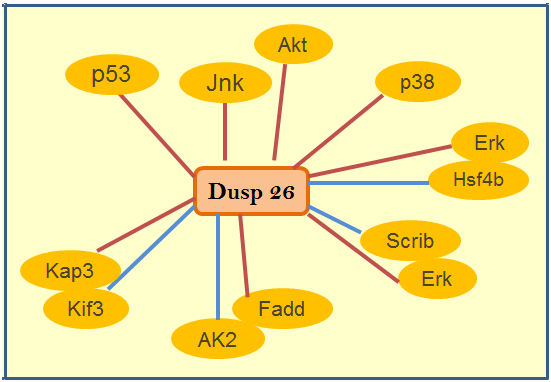
As a result of its function as MAPKs, KIF3 and p53 regulator, modulation of its activity and/or its expression has been proposed, as well as that of other atypical Dusps, as a promising anti-cancer therapy (Nunes-Xavier et al, 2011; Song et al, 2009). The challenge for the future infact, is to complement various therapeutical targets, to treat patients with specific and more effective therapies. A current priority is the elucidation of the molecular basis for the insorgece of acquired drug resistance during therapy, and for the selection of apoptosis-resistant cells. Although more than 50% of all human cancers have p53 deletion or mutation, neuroblastoma (NB) is known to maintain functional p53, but to defect in apoptotic pathways. It was shown that Dusp26 has an important role in the chemoresistance of NB cancer cells, and inhibits doxorubicin- and genotoxic-stress-induced apoptosis by dephosphorylation and inactivation of p53. In Dusp26 knockdown cells there is a significant enhancement of apoptosis and a concomitant iperphosphorylation of p53, while the overexpression of the phosphatase promotes cell resistance (Shang et al, 2010). Althought Dusp26 is overexpressed in neuroblastoma cells, as described below, no specific drug has been developed yet to selectively target Dusp26 (Song et al, 2009). However it is reasonable to think that interfering Dusp26 dephosphorylation of p53 would promote NB cells apoptosis and help chemosensitivity (Shang et al, 2010). Similarly, in anaplastic tyroid cancer cells (ATC), the phosphatase downregulates apoptosis by inhibiting p38 MAPK (Yu et al, 2007). In PC12 cells, however, low levels of the phosphatase are required for differentation, while Dusp26 overexpression down-regulates the PI3K/Akt pathway. In these conditions, NGF-induced phosphorylation of mTOR on Ser2448, the Akt specific targeted serine, is decreased, and PC12 cells are more sensible to cisplatin-induced apoptotic stimuli (Wang et al, 2006).
Beyond regulating cell differentiation and apoptosis in these cell systems, Dusp26 was also hypothesized to control cell transformation in other human malignancies, by exerting a tumour-suppressor activity enhancing cell-cell adhesion. Dephosphorylation of the Kap3 subunit of the KIF3 microtubule-dependent protein motor infact, results, by unknown mechanism, to N-cadherin/beta-catenin colocalization in membrane ruffles and in sites of cell contacts (Tanuma et al, 2009).
These findings suggest that the final effect of the phosphatase depends on tissue-specific substrates and a fine characterization of its fuctional role in different cancer cells is necessary to develop selective therapies. While the catalytic core of the atypical Dusps is well conserved among the members of the family, the binding of ligands to more specific N and C terminal regions (Sacco et al, 2014) allows for the design of selective inhibitors.
Homology
The human Dusp26 protein is highly conserved within Mammalia, and shows 100%, 98%, 97% and 94% of identity with chimpanzee, rat, mouse and pig orthologs, respectively (percentages according to Blast bl2seq). Dusp26 also shows high similarity with chicken, chamaleon, western clawed frog, Japanese ricefish and zebrafish homologous proteins.
Mutations
Somatic
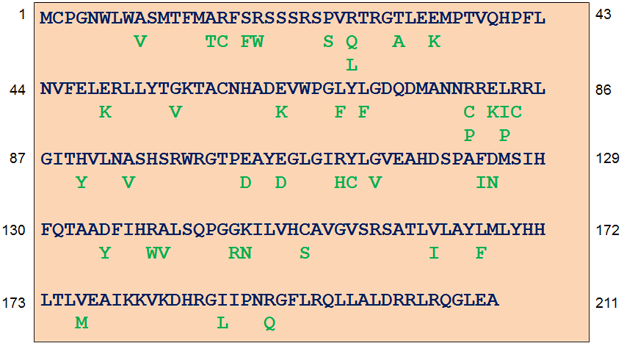
The mutation C152S instead, inactivates the phosphatase function of the protein (Vasudevan et al, 2005; Wang et al, 2006).
Amplification of genomic copy number of DUSP26 gene, overexpression of its transcript, as well as downregulation, have all been reported to be related to human cancers (see also below). Actually, the amplification of the genomic copy number of DUSP26 was reported in Anaplastic Thyroid Cancer cells, and the consequential overexpression of the transcript was determined by RT-PCR (Yu et al, 2007). Overexpression of DUSP26 was determined at RNA and protein level in neuroblastoma cell lines and in primary tumour samples(Shang et al, 2010). Downregulation of Dusp26 RNA was also observed in ovarian cancer, medulloblastoma and glioblastoma cell lines (Patterson et al, 2010)
Implicated in
The downregulation of Dusp26 mRNA has been observed also in ovarian cancer and medulloblastoma cell lines (Patterson et al, 2010)
Article Bibliography
| Pubmed ID | Last Year | Title | Authors |
|---|---|---|---|
| 1446944 | 1992 | Ruptured calcified tendo Achilles: successful non-operative treatment. | Banerjee A et al |
| 25331179 | 2014 | Mechanisms of neuroblastoma regression. | Brodeur GM et al |
| 25355519 | 2015 | COSMIC: exploring the world's knowledge of somatic mutations in human cancer. | Forbes SA et al |
| 24548998 | 2014 | The DUSP26 phosphatase activator adenylate kinase 2 regulates FADD phosphorylation and cell growth. | Kim H et al |
| 22804825 | 2013 | HuPho: the human phosphatase portal. | Liberti S et al |
| 23298255 | 2013 | Atomic structure of dual-specificity phosphatase 26, a novel p53 phosphatase. | Lokareddy RK et al |
| 21288197 | 2011 | Dual-specificity MAP kinase phosphatases as targets of cancer treatment. | Nunes-Xavier C et al |
| 20347885 | 2010 | DUSP26 negatively affects the proliferation of epithelial cells, an effect not mediated by dephosphorylation of MAPKs. | Patterson KI et al |
| 25757426 | 2015 | VHR/DUSP3 phosphatase: structure, function and regulation. | Pavic K et al |
| 24155099 | 2014 | Targeting DUSPs in glioblastomas - wielding a double-edged sword? | Prabhakar S et al |
| 24847354 | 2014 | Combining affinity proteomics and network context to identify new phosphatase substrates and adapters in growth pathways. | Sacco F et al |
| 15623643 | 2004 | Epidermal growth factor receptor (EGFR) is overexpressed in anaplastic thyroid cancer, and the EGFR inhibitor gefitinib inhibits the growth of anaplastic thyroid cancer. | Schiff BA et al |
| 20562916 | 2010 | Dual-specificity phosphatase 26 is a novel p53 phosphatase and inhibits p53 tumor suppressor functions in human neuroblastoma. | Shang X et al |
| 19233143 | 2009 | NSC-87877, inhibitor of SHP-1/2 PTPs, inhibits dual-specificity phosphatase 26 (DUSP26). | Song M et al |
| 17001450 | 2007 | Characterization of a novel low-molecular-mass dual specificity phosphatase-4 (LDP-4) expressed in brain. | Takagaki K et al |
| 19043453 | 2009 | Protein phosphatase Dusp26 associates with KIF3 motor and promotes N-cadherin-mediated cell-cell adhesion. | Tanuma N et al |
| 25477751 | 2014 | Glioblastoma multiforme - an overview. | Urbańska K et al |
| 15796912 | 2005 | MKP-8, a novel MAPK phosphatase that inhibits p38 kinase. | Vasudevan SA et al |
| 25705639 | 2015 | Advances and challenges in the molecular biology and treatment of glioblastoma-is there any hope for the future? | Veliz I et al |
| 16805799 | 2006 | Biochemical and biological characterization of a neuroendocrine-associated phosphatase. | Wang JY et al |
| 19014381 | 2008 | NEAP causes down-regulation of EGFR, subsequently induces the suppression of NGF-induced differentiation in PC12 cells. | Wang JY et al |
| 23695260 | 2013 | High-resolution crystal structure of the catalytic domain of human dual-specificity phosphatase 26. | Won EY et al |
| 16924234 | 2007 | A novel amplification target, DUSP26, promotes anaplastic thyroid cancer cell growth by inhibiting p38 MAPK activity. | Yu W et al |
Other Information
Locus ID:
NCBI: 78986
MIM: 618368
HGNC: 28161
Ensembl: ENSG00000133878
Variants:
dbSNP: 78986
ClinVar: 78986
TCGA: ENSG00000133878
COSMIC: DUSP26
RNA/Proteins
| Gene ID | Transcript ID | Uniprot |
|---|---|---|
| ENSG00000133878 | ENST00000256261 | Q9BV47 |
| ENSG00000133878 | ENST00000522982 | E5RHD0 |
| ENSG00000133878 | ENST00000523956 | Q9BV47 |
Expression (GTEx)
Protein levels (Protein atlas)
References
| Pubmed ID | Year | Title | Citations |
|---|---|---|---|
| 35278641 | 2022 | Falnidamol and cisplatin combinational treatment inhibits non-small cell lung cancer (NSCLC) by targeting DUSP26-mediated signal pathways. | 9 |
| 35313355 | 2022 | Dusp26 phosphatase regulates mitochondrial respiration and oxidative stress and protects neuronal cell death. | 0 |
| 36053282 | 2022 | Upregulation of dual-specificity phosphatase-26 is required for transforming growth factor β1(TGFβ1)-induced Epithelial-mesenchymal transition in A549 and PANC1 cells. | 2 |
| 35278641 | 2022 | Falnidamol and cisplatin combinational treatment inhibits non-small cell lung cancer (NSCLC) by targeting DUSP26-mediated signal pathways. | 9 |
| 35313355 | 2022 | Dusp26 phosphatase regulates mitochondrial respiration and oxidative stress and protects neuronal cell death. | 0 |
| 36053282 | 2022 | Upregulation of dual-specificity phosphatase-26 is required for transforming growth factor β1(TGFβ1)-induced Epithelial-mesenchymal transition in A549 and PANC1 cells. | 2 |
| 33466673 | 2021 | A Review of DUSP26: Structure, Regulation and Relevance in Human Disease. | 7 |
| 34179958 | 2021 | DUSP26 induces aortic valve calcification by antagonizing MDM2-mediated ubiquitination of DPP4 in human valvular interstitial cells. | 18 |
| 33466673 | 2021 | A Review of DUSP26: Structure, Regulation and Relevance in Human Disease. | 7 |
| 34179958 | 2021 | DUSP26 induces aortic valve calcification by antagonizing MDM2-mediated ubiquitination of DPP4 in human valvular interstitial cells. | 18 |
| 30582764 | 2019 | Dual-Specificity Phosphatase 26 Protects Against Nonalcoholic Fatty Liver Disease in Mice Through Transforming Growth Factor Beta-Activated Kinase 1 Suppression. | 26 |
| 31155289 | 2019 | DUSP26 regulates podocyte oxidative stress and fibrosis in a mouse model with diabetic nephropathy through the mediation of ROS. | 10 |
| 30582764 | 2019 | Dual-Specificity Phosphatase 26 Protects Against Nonalcoholic Fatty Liver Disease in Mice Through Transforming Growth Factor Beta-Activated Kinase 1 Suppression. | 26 |
| 31155289 | 2019 | DUSP26 regulates podocyte oxidative stress and fibrosis in a mouse model with diabetic nephropathy through the mediation of ROS. | 10 |
| 26924229 | 2016 | Dual-specificity phosphatase 26 (DUSP26) stimulates Aβ42 generation by promoting amyloid precursor protein axonal transport during hypoxia. | 10 |
Citation
Simona Panni ; Raffaella Gallo
DUSP26 (dual specificity phosphatase 26)
Atlas Genet Cytogenet Oncol Haematol. 2015-05-01
Online version: http://atlasgeneticsoncology.org/gene/46622/dusp26-(dual-specificity-phosphatase-26)
