UTS2 (urotensin 2)
2015-01-01 Kaifee Arman , Esra Bozgeyik , Hasan Dagli , Yusuf Ziya Igci AffiliationUniversity of Gaziantep, Faculty of Medicine, Department of Medical Biology, Gaziantep, Turkey [email protected]; [email protected]; [email protected]; [email protected]
Identity
HGNC
LOCATION
1p36.23
LOCUSID
ALIAS
PRO1068,U-II,UCN2,UII
FUSION GENES
Abstract
Review on UTS2, with data on DNA\/RNA, on the protein encoded and where the gene is implicated.
DNA/RNA
Description
The human UTS2 gene is an active cyclic heptapeptide and encodes a mature peptide. This gene is located on the reverse strand of chromosome 1. It consists of an open reading frame (ORF) having 372 nucleotides which encodes 124 amino acids. Its size is about 14.3 kDa and has an isoelectric point 7.67.
Transcription
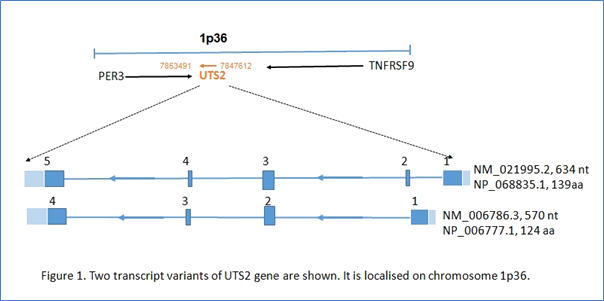
Till date three transcript variants encoding different isoforms are known for UTS2. These are transcript variant 1 (accession number NM_021995.2), transcript variant 2 (NM_006786.3) and transcript variant 3 (Ensembl version: ENST00000377516.4). Transcript variant (1) encodes 139 amino acids which is a longer preproprotein isoform. It has a transcript length of 420 bps and has 5 coding exons. Transcript variant (2) encodes 124 amino acids and is shorter preproprotein isoform. It has a transcript length of 559 bps and has 4 coding exons. The mature peptide for both transcript variants (TV1 and TV2) is known to be identical but has different amino-terminal end as compared to transcript variant 1. The two most common transcript variants (TV1 and TV2) are shown in Figure1. The third transcript variant is known to be putative protein coding. It has a transcript length of 1601 bps with a translational length of 139 residues and has a total of 7 exons with 6 coding exons. UII is most abundantly expressed in the central nervous system, for example in the brainstem and spinal cord. Apart from the CNS, UII mRNA is also expressed in the liver, kidney, cardiomyocytes, coronary and in multiple endocrine glands (Ames et al., 1999, Nothacker et al., 1999).
Pseudogene
There is no pseudogene for UTS2.
Proteins
Description
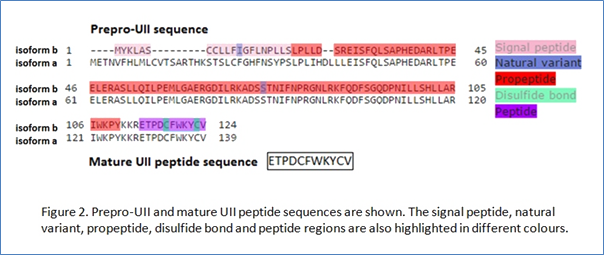
Urotensin II is known to be a potent vasoactive peptide in humans and in several other animal models. It is a cyclic peptide of 12 amino acids. The cyclic region of the peptide (Cys-Phe-Trp-Lys-Tyr-Cys) of UII is evolutionary conserved but the N-terminal region of UII is highly variable (Conlon, 2000, Conlon, 2008). U-II is known to be the endogenous ligand of an orphan G-protein-coupled receptor (GPR 14). In humans, UTS2 originated from a large precursor molecule i.e prepro-U-II and is encoded by a gene on chromosome 1p36. The prepro and mature UII peptide sequences are shown in Figure2. Two splice variants of the precursor are known, one consist of124 amino acids while the other has 139 amino acids. Actually human UTS2 derived from post-translational processing of two different precursors, which are alternate splice variants (Ames et al., 1999, Coulouarn et al., 1998). Ensembl mentions a third transcript variant that is known to be putative protein coding. It has a translational length of 139 amino acids. UTS2 is having a molecular mass of approximately 14.3 kDa and has an isoelectric point 7.67.
The amino acid sequence of UTS2 is highly conserved across several vertebrates and shares structural similarity to somatostatin. Due to the structural similarities between U-II and somatostatin, it was wrongly interpreted that UTS2 shared binding sites with somatostatin. The human GPR14 (G-Protein-Coupled Receptor-14) has been found out to function as a UTS2 receptor (Ames et al., 1999, Liu et al., 1999, Mori et al., 1999, Nothacker et al., 1999). It is also known as sensory epithelium neuropeptide like receptor (SENR) (Tal et al., 1995). This receptor was later called the urotensin receptor (UTR) because of the high selectivity of GPR 14 for UTS2(Liu et al., 1999). The binding of U-II with UTR is functionally coupled to calcium mobilization.
The amino acid sequence of UTS2 is highly conserved across several vertebrates and shares structural similarity to somatostatin. Due to the structural similarities between U-II and somatostatin, it was wrongly interpreted that UTS2 shared binding sites with somatostatin. The human GPR14 (G-Protein-Coupled Receptor-14) has been found out to function as a UTS2 receptor (Ames et al., 1999, Liu et al., 1999, Mori et al., 1999, Nothacker et al., 1999). It is also known as sensory epithelium neuropeptide like receptor (SENR) (Tal et al., 1995). This receptor was later called the urotensin receptor (UTR) because of the high selectivity of GPR 14 for UTS2(Liu et al., 1999). The binding of U-II with UTR is functionally coupled to calcium mobilization.
Expression
UTS2 is widely distributed and is found in a variety of different tissues. In humans it has been found in the heart (Matsushita et al., 2001), kidney (Matsushita et al., 2001, Shenouda et al., 2002, Totsune et al., 2003), liver (Totsune et al., 2003, Coulouarn et al., 1998) and in the brain and spinal cord of several other species. However the distribution of UTS2 is somewhat unusual as it is found in motor neurons of the spinal cord and motor nuclei in the brain (Coulouarn et al., 1998, Dun et al., 2001). The pre-pro UTS2 has been found to co-localize with androgen receptors in motor nuclei (Pelletier et al., 2002). Immunohistochemistry for the UII peptide reveals its presence in the neuronal cell soma of the brain and spinal cord (Ames et al., 1999, Chartrel et al., 1996, Dun et al., 2001). UTS2 is also shown to be expressed in pancreas (Totsune et al., 2003). There is very high expression of UTS2 proteins in cerebral cortex, hippocampus, lateral ventricle and cerebellum of CNS. It is also highly expressed in pancreas, duodenum, small intestine, placenta and thyroid gland. UII is moderately expressed in gall bladder, stomach, colon, kidney, testis, prostate, breast, lung, heart muscle, bronchus. It has low expression in skin, soft tissue and bone marrow. But it has not been detected in oral mucosa, adipose tissue, skeletal muscle and smooth muscle.
Localisation
UTS2 has primarily extracellular localisation. This protein is found mainly in the human spinal cord generally in motoneurons.
Function
UTS2 (U-II) is a well known vasoactive hormone whose action is mainly dependent on seven transmembrane spanning G-protein-coupled receptor called GPR14 (Onan et al., 2004). UII play an indispensable role in the physiological regulation of several organ systems especially within the cardiovasculature. It is known to be the most potent mammalian vasoconstrictor possessing both vasoconstrictor and vasodilatory action properties as well as profibrotic and antiapoptotic activity (Langham & Kelly, 2013). UTS2 possesses several cardiovascular actions such as potent vasoactive and cardiac inotropic and hypertropic properties (Douglas et al., 2002). It activates the G protein-coupled receptor UTS2R and thus exerts various cardiovascular effects and has a role in the pathophysiology of atherosclerosis (Segain et al., 2007). It negatively regulates blood pressure. U-II is supposed to have several behavioral activities as it occurs in the central nervous system and is widely distributed in the brain. It has been shown in studies conducted in rodents that central administration of U-II stimulates locomotion, stimulates anxiety and depressive-like conditions, provokes feeding activity and increases the duration of paradoxical sleep episodes (do Rego et al., 2008). UII also exerts a wide range of actions in other systems, such as proliferation of vascular smooth muscle cells, fibroblasts, and cancer cells (Wu et al., 2010, Lin et al., 2004, Ross et al., 2010). In addition it also increases foam cell formation, chemotaxis of inflammatory cells, and inotropic and hypertrophic effects on heart muscle, inhibits insulin release (Saez et al., 2011), modulates glomerular filtration (Langham & Kelly, 2013) and release of catecholamines and may help in the regulation of food intake and the sleep cycle (Huitron-Resendiz et al., 2005). Guidolin et al. stated that urotensin-II has an angiogenic role (Guidolin et al., 2010). Furthermore endogenous urotensin II has a role in erectile functioning by selectively modulating its mechanism through eNOS (Bianca et al., 2012).
Homology
UTS2 is a partial homologue of somatostatin and shares structural similarity to somatostatin. It was also demonstrated that both rat and mouse homologs share sequence homology with human prepro UTS2 (Coulouarn et al., 1999). All the known homologs of UTS2 are known to share a highly conserved cyclic region in the peptide which predicts that this region has a functional significance.
Mutations
Note
Different genetic polymorphisms in UTS2 and their association with diseases:
Several single nucleotide polymorphisms (SNPs) in genes encoding for urotensin II (UTS2) are known and have been well studied. According to the US National Center for Biotechnology Information (NCBI) database, over 60 single nucleotide polymorphisms (SNP) have been noted in the human UTS2 gene. Three of these SNP show amino acid changes in the UTS2 gene sequence. The well known SNP, 143G>A (T21M, rs228648) in the UTS2 gene is found to be associated with type 2 diabetes in Han people residing in northern China (Suguro et al., 2007, Zhu et al., 2002) while the other SNP, 3836C>T (S89N, rs2890565) has association with higher plasma insulin level, insulin resistance, and susceptibility of developing type 2 diabetes in Hong Kong Chinese and Japanese (Ong et al., 2006, Suzuki et al., 2004, Wenyi et al., 2003). The SNP, 3836C>T is supposed to be a functional SNP as it has association with higher plasma UTS2 level (Ong et al., 2006). Recently it has been found that Thr21Met (T21M) polymorphisms of the UTS2 gene were associated with higher risk of developing Behcets disease as well as Systemic Sclerosis (Oztuzcu et al., 2013, Pehlivan et al., 2012). Both Thr21Met (T21M) and Ser89Asn (S89N) polymorphisms of the UTS2 gene have been found to be pathologically associated with the risk of developing diabetes and Diabetic Retinopathy (Okumus et al., 2012). The exchange of serine instead of asparagine at amino acid position 89 changes the structure of UTS2. Due to this, mutation at this particular point is likely to form immature UII peptide that might cause several pathological conditions (Okumus et al., 2012).
Several single nucleotide polymorphisms (SNPs) in genes encoding for urotensin II (UTS2) are known and have been well studied. According to the US National Center for Biotechnology Information (NCBI) database, over 60 single nucleotide polymorphisms (SNP) have been noted in the human UTS2 gene. Three of these SNP show amino acid changes in the UTS2 gene sequence. The well known SNP, 143G>A (T21M, rs228648) in the UTS2 gene is found to be associated with type 2 diabetes in Han people residing in northern China (Suguro et al., 2007, Zhu et al., 2002) while the other SNP, 3836C>T (S89N, rs2890565) has association with higher plasma insulin level, insulin resistance, and susceptibility of developing type 2 diabetes in Hong Kong Chinese and Japanese (Ong et al., 2006, Suzuki et al., 2004, Wenyi et al., 2003). The SNP, 3836C>T is supposed to be a functional SNP as it has association with higher plasma UTS2 level (Ong et al., 2006). Recently it has been found that Thr21Met (T21M) polymorphisms of the UTS2 gene were associated with higher risk of developing Behcets disease as well as Systemic Sclerosis (Oztuzcu et al., 2013, Pehlivan et al., 2012). Both Thr21Met (T21M) and Ser89Asn (S89N) polymorphisms of the UTS2 gene have been found to be pathologically associated with the risk of developing diabetes and Diabetic Retinopathy (Okumus et al., 2012). The exchange of serine instead of asparagine at amino acid position 89 changes the structure of UTS2. Due to this, mutation at this particular point is likely to form immature UII peptide that might cause several pathological conditions (Okumus et al., 2012).
Implicated in
Entity name
Breast cancer
Note
In a recent study, Balakan et al. (2014) found that U-II and UTR mRNA is being expressed in the breast tissue and breast cancer tissue. Consequently they found an association of UTS2 with menopausal status, and extra-nodal and lymphatic invasion in breast cancer patients (Balakan et al., 2014).
Entity name
Atherosclerosis
Note
Atherosclerosis is vascular inflammation which is chronic in nature and results in the deposition of lipid and leucocyte in the arterial wall (Loirand et al., 2008). In hypertensive patients, plasma U-II level is found to be positively correlated with carotid atherosclerosis (Suguro et al., 2007) as well as in patients with coronary artery isease (Heringlake et al., 2004)
Entity name
Metabolic syndrome
Note
UTS2 is considered to give rise to the metabolic syndrome and its components, like hyperglycemia, hypertension, insulin resistance and inflammation. It has a role in inflammation by effecting ingestive behavior. Plasma UTS2 level has a positive correlation with systolic blood pressure and insulin resistance (Cheung et al., 2004, Ong et al., 2006, Suguro et al., 2007). The two well known disorders i.e hypertension and insulin resistance are known to occur together as components of the metabolic syndrome ( Reaven G.M, 1988).
Entity name
Behcets disease
Note
Oztuzcu et al. (2013) described that Thr21Met (T21M) polymorphisms of the UTS2 gene is known to be associated with Behcets disease (BD) in Turkish population (Oztuzcu et al., 2013).
Entity name
Diabetes Mellitus and Diabetic Retinopathy
Note
An association between Thr21Met and Ser89Asn polymorphisms of the UTS2 gene, Diabetes Mellitus and Diabetic Retinopathy has been found by Okumus et al. (Okumus et al., 2012).
Entity name
Systemic Sclerosis
Note
Pehlivan et al. (2011) suggested that Thr21Met, but not Ser89Asn has an important role in the development of Systemic Sclerosis, and a powerful indicator of severe skin and lung involvement in patients with Systemic Sclerosis (Pehlivan et al., 2012).
Entity name
Renal disease
Note
Totsune et al. (2001) reported higher levels of plasma UTS2 i.e an increase in three fold and two fold in patients with renal dysfunction, with and without dialysis respectively as compared with healthy control (Totsune et al., 2001). This indicated a role of UTS2 in renal function.
Entity name
Congestive Heart Failure
Note
It has been found that myocardial UII is significantly expressed in heart samples taken from patients with congestive heart failure as compared to controls, which was inversely correlated with ejection fraction (Douglas et al., 2002).
Entity name
Type 2 diabetes mellitus
Note
Wenyi et al. reported the association of S89N polymorphism in the UTS2 with the development of Type 2 diabetes, via insulin sensitivity, in Japanese subjects (Wenyi et al., 2003).
Entity name
Pre-eclampsia.
Note
ElSharkawy et al. showed the elevation of UTS2 in the serum of PE patients which could be correlated to the severity and/or progression of the disease. The UTS2 genotype frequencies between patients and control groups showed a significant difference, which implies a potential benefit for UTS2 gene or level in serum as a diagnostic or prognostic indicator in pre-eclampsia (ElSharkawy et al., 2014). Endothelial nitric oxide synthase (eNOS) (Glu298Asp) and UTS2 (UTS2 S89N) gene polymorphisms are promising markers for early prediction of preeclampsia in Egyptian females (El-Sherbiny et al., 2013).
Entity name
Schizophrenia
Note
Higher UTS2 expression was found in schizophrenia patients suggesting that UTS2 level may be a probable candidate related to the pathology of the disease (Bulbul et al., 2014).
Article Bibliography
| Pubmed ID | Last Year | Title | Authors |
|---|---|---|---|
| 10499587 | 1999 | Human urotensin-II is a potent vasoconstrictor and agonist for the orphan receptor GPR14. | Ames RS et al |
| 25112588 | 2014 | The relationship between urotensin II and its receptor and the clinicopathological parameters of breast cancer. | Balakan O et al |
| 22319601 | 2012 | Endogenous urotensin II selectively modulates erectile function through eNOS. | Bianca Rd et al |
| 24552634 | 2014 | New molecule in the etiology of schizophrenia: urotensin II. | Bulbul F et al |
| 8788253 | 1996 | Urotensin II in the central nervous system of the frog Rana ridibunda: immunohistochemical localization and biochemical characterization. | Chartrel N et al |
| 15201550 | 2004 | Plasma concentration of urotensin II is raised in hypertension. | Cheung BM et al |
| 17544546 | 2008 | Liberation of urotensin II from the teleost urophysis: an historical overview. | Conlon JM et al |
| 9861051 | 1998 | Cloning of the cDNA encoding the urotensin II precursor in frog and human reveals intense expression of the urotensin II gene in motoneurons of the spinal cord. | Coulouarn Y et al |
| 12076554 | 2002 | Congestive heart failure and expression of myocardial urotensin II. | Douglas SA et al |
| 11356295 | 2001 | Urotensin II-immunoreactivity in the brainstem and spinal cord of the rat. | Dun SL et al |
| 23905608 | 2013 | Endothelial nitric oxide synthase (eNOS) (Glu298Asp) and urotensin II (UTS2 S89N) gene polymorphisms in preeclampsia: prediction and correlation with severity in Egyptian females. | El-Sherbiny WS et al |
| 25134283 | 2014 | Study of urotensin II gene and serum levels in relation to pre-eclampsia. | ElSharkawy RM et al |
| 11368702 | 2001 | Executive Summary of The Third Report of The National Cholesterol Education Program (NCEP) Expert Panel on Detection, Evaluation, And Treatment of High Blood Cholesterol In Adults (Adult Treatment Panel III). | |
| 20346384 | 2010 | Urotensin-II as an angiogenic factor. | Guidolin D et al |
| 15256283 | 2004 | The relationship between urotensin II plasma immunoreactivity and left ventricular filling pressures in coronary artery disease. | Heringlake M et al |
| 15944374 | 2005 | Urotensin II modulates rapid eye movement sleep through activation of brainstem cholinergic neurons. | Huitron-Resendiz S et al |
| 23197158 | 2013 | Urotensin II and the kidney. | Langham RG et al |
| 15097239 | 2004 | Role of ERK and Rho kinase pathways in central pressor action of urotensin II. | Lin Y et al |
| 10581185 | 1999 | Identification of urotensin II as the endogenous ligand for the orphan G-protein-coupled receptor GPR14. | Liu Q et al |
| 17933432 | 2008 | Urotensin II and atherosclerosis. | Loirand G et al |
| 11725162 | 2001 | Co-expression of urotensin II and its receptor (GPR14) in human cardiovascular and renal tissues. | Matsushita M et al |
| 10548501 | 1999 | Urotensin II is the endogenous ligand of a G-protein-coupled orphan receptor, SENR (GPR14). | Mori M et al |
| 10559967 | 1999 | Identification of the natural ligand of an orphan G-protein-coupled receptor involved in the regulation of vasoconstriction. | Nothacker HP et al |
| 22587369 | 2012 | Association between Thr21Met and Ser89Asn polymorphisms of the urotensin-II (UTS2) gene, diabetes mellitus, and diabetic retinopathy. | Okumus S et al |
| 15109617 | 2004 | Urotensin II: the old kid in town. | Onan D et al |
| 16597476 | 2006 | Haplotypes in the urotensin II gene and urotensin II receptor gene are associated with insulin resistance and impaired glucose tolerance. | Ong KL et al |
| 23333481 | 2013 | Thr21Met (T21M) but not Ser89Asn (S89N) polymorphisms of the urotensin-II (UTS-II) gene are associated with Behcet's disease (BD). | Oztuzcu S et al |
| 22045841 | 2012 | Association between Thr21Met and Ser89Asn polymorphisms of the urotensin II gene and systemic sclerosis. | Pehlivan Y et al |
| 12421619 | 2002 | Role of androgens in the regulation of urotensin II precursor mRNA expression in the rat brainstem and spinal cord. | Pelletier G et al |
| 3056758 | 1988 | Banting lecture 1988. Role of insulin resistance in human disease. | Reaven GM et al |
| 20421634 | 2010 | Role of urotensin II in health and disease. | Ross B et al |
| 21559414 | 2011 | Association analysis of urotensin II gene (UTS2) and flanking regions with biochemical parameters related to insulin resistance. | Sáez ME et al |
| 17617581 | 2007 | Urotensin II is a new chemotactic factor for UT receptor-expressing monocytes. | Segain JP et al |
| 12070267 | 2002 | Localization of urotensin-II immunoreactivity in normal human kidneys and renal carcinoma. | Shenouda A et al |
| 17261470 | 2007 | Increased human urotensin II levels are correlated with carotid atherosclerosis in essential hypertension. | Suguro T et al |
| 15476949 | 2004 | Genetic variations at urotensin II and urotensin II receptor genes and risk of type 2 diabetes mellitus in Japanese. | Suzuki S et al |
| 7733947 | 1995 | A novel putative neuropeptide receptor expressed in neural tissue, including sensory epithelia. | Tal M et al |
| 11564491 | 2001 | Role of urotensin II in patients on dialysis. | Totsune K et al |
| 12830381 | 2003 | Role of urotensin II gene in genetic susceptibility to Type 2 diabetes mellitus in Japanese subjects. | Wenyi Z et al |
| 20878108 | 2010 | Expression of urotensin II and its receptor in human lung adenocarcinoma A549 cells and the effect of urotensin II on lung adenocarcinoma growth in vitro and in vivo. | Wu YQ et al |
| 12509909 | 2002 | [The role of urotensin II gene in the genetic susceptibility to type 2 diabetes in Chinese population]. | Zhu F et al |
| 18294732 | 2008 | Behavioral actions of urotensin-II. | do Rego JC et al |
Other Information
Locus ID:
NCBI: 10911
MIM: 604097
HGNC: 12636
Ensembl: ENSG00000049247
Variants:
dbSNP: 10911
ClinVar: 10911
TCGA: ENSG00000049247
COSMIC: UTS2
RNA/Proteins
| Gene ID | Transcript ID | Uniprot |
|---|---|---|
| ENSG00000049247 | ENST00000054668 | O95399 |
| ENSG00000049247 | ENST00000361696 | O95399 |
| ENSG00000049247 | ENST00000377516 | Q5H8X8 |
Expression (GTEx)
Pathways
Protein levels (Protein atlas)
References
| Pubmed ID | Year | Title | Citations |
|---|---|---|---|
| 38262555 | 2024 | Evidence for heterodimerization and functional interaction of the urotensin II and the angiotensin II type 1 receptors. | 0 |
| 38262555 | 2024 | Evidence for heterodimerization and functional interaction of the urotensin II and the angiotensin II type 1 receptors. | 0 |
| 37371494 | 2023 | Serum Urotensin II Levels Are Elevated in Patients with Obstructive Sleep Apnea. | 1 |
| 37371494 | 2023 | Serum Urotensin II Levels Are Elevated in Patients with Obstructive Sleep Apnea. | 1 |
| 33605830 | 2022 | Role of miR-146a rs2910164 and UTS2 rs228648 Genetic Variants in Behçet's Disease. | 5 |
| 36188724 | 2022 | Urotensin II level is elevated in inflammatory bowel disease patients. | 0 |
| 33605830 | 2022 | Role of miR-146a rs2910164 and UTS2 rs228648 Genetic Variants in Behçet's Disease. | 5 |
| 36188724 | 2022 | Urotensin II level is elevated in inflammatory bowel disease patients. | 0 |
| 33172302 | 2021 | Urotensin-II, oxidative stress, and inflammation increase in hypertensive and resistant hypertensive patients. | 6 |
| 33371762 | 2021 | Expression of urotensin II is positively correlated with pyroptosis-related molecules in patients with severe preeclampsia. | 2 |
| 34173803 | 2021 | Dynamic Changes in Plasma Urotensin II and Its Correlation With Plaque Stability. | 1 |
| 33172302 | 2021 | Urotensin-II, oxidative stress, and inflammation increase in hypertensive and resistant hypertensive patients. | 6 |
| 33371762 | 2021 | Expression of urotensin II is positively correlated with pyroptosis-related molecules in patients with severe preeclampsia. | 2 |
| 34173803 | 2021 | Dynamic Changes in Plasma Urotensin II and Its Correlation With Plaque Stability. | 1 |
| 33269434 | 2020 | Association of resistin (rs3745367) and urotensin II (rs228648 and rs2890565) gene polymorphisms with risk of type 2 diabetes mellitus in Indian population. | 5 |
Citation
Kaifee Arman ; Esra Bozgeyik ; Hasan Dagli ; Yusuf Ziya Igci
UTS2 (urotensin 2)
Atlas Genet Cytogenet Oncol Haematol. 2015-01-01
Online version: http://atlasgeneticsoncology.org/gene/50338/uts2-(urotensin-2)
