TALDO1 (transaldolase 1)
2013-07-01 Zachary Oaks , Andras Perl AffiliationDepartments of Medicine, Microbiology,, Immunology, Biochemistry, Molecular Biology, Neuroscience, Physiology,, Pathology, SUNY Upstate Medical University, Syracuse, New York, USA
Identity
HGNC
LOCATION
11p15.5
IMAGE

LOCUSID
ALIAS
TAL,TAL-H,TALDOR,TALH
FUSION GENES
DNA/RNA
Note
Starts at 747432 bp from pter and ends at 765024 bp from pter according to hg19-Feb_2009.
Size: 17593 bases; Orientation: TALDO1 is on the plus strand.
Size: 17593 bases; Orientation: TALDO1 is on the plus strand.
Description
Exons 2 and 3 of TALDO1 contain retrotransposable elements (Banki et al., 1994).
Transcription
TALDO1 has 8 exons and its mRNA is composed of 1319 bp.
Pseudogene
TALDO1P1 (Transaldolase 1 pseudogene 1).
Proteins
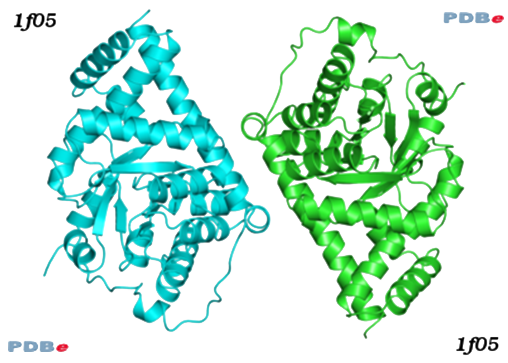
The 3-dimensional structure of transaldolase from Thorell et al., 2000. Image downloaded from http://www.ebi.ac.uk.
Description
Transaldolase (TAL) is a 337 amino acid protein in the non-oxidative phase of the pentose phosphate pathway (PPP) with a predicted mass of 37.55kDa. TAL has an α/β barrel and that includes lysine 142 which is responsible for generating the Schiff base intermediate during sugar phosphate metabolism (Thorell et al.,200). A mass spectrometry based investigation of the acetylome identified TAL acetylation at lysines 286, 269, 321, 219 (Choudhary et al., 2009). It has also been proposed that TAL activity may be affected by phosphorylation (Lachaise et al., 2001).
Expression
TALDO1 is ubiquitously expressed, except in erythrocytes.
Localisation
Cytosol and nucleus (Colombo et al., 1997).
Function
The reversible reaction carried out by TAL is: erythros-4-phosphate+fructose-6-phophateglyceraldehydes-3-phosphate+sedoheptulose-7-phosphate. TAL has been proposed as the rate limiting enzyme in the non-oxidative PPP (Banki et al., 1996; Heinrich et al., 1976; Perl, 2007; Wood, 1985).
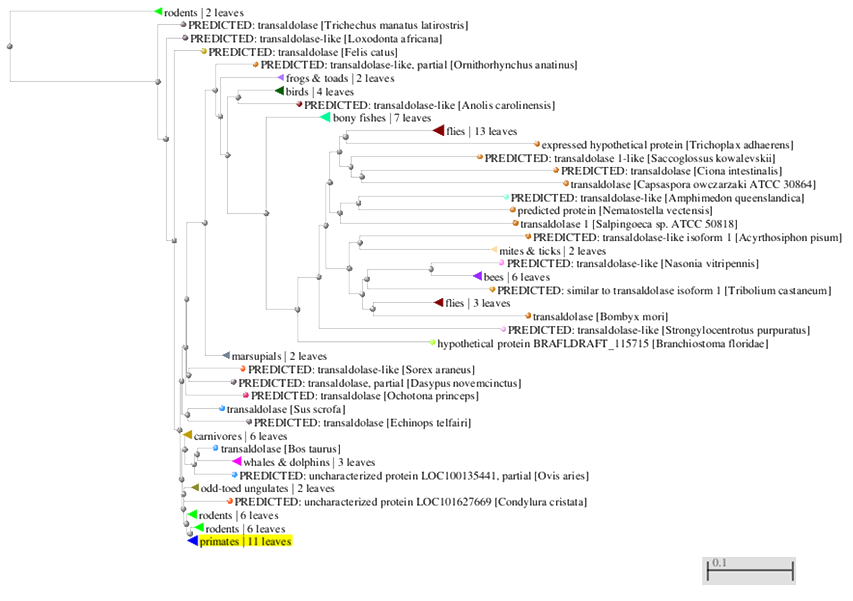
From blast of reference proteins (Refseq) against human Transaldolase (NP_006746.1).
Homology
Using the blastp function within Homo sapiens, the only protein to share homology within humans (a paralog) was sorting nexin 32 (SNX32) with an identity of 36%.
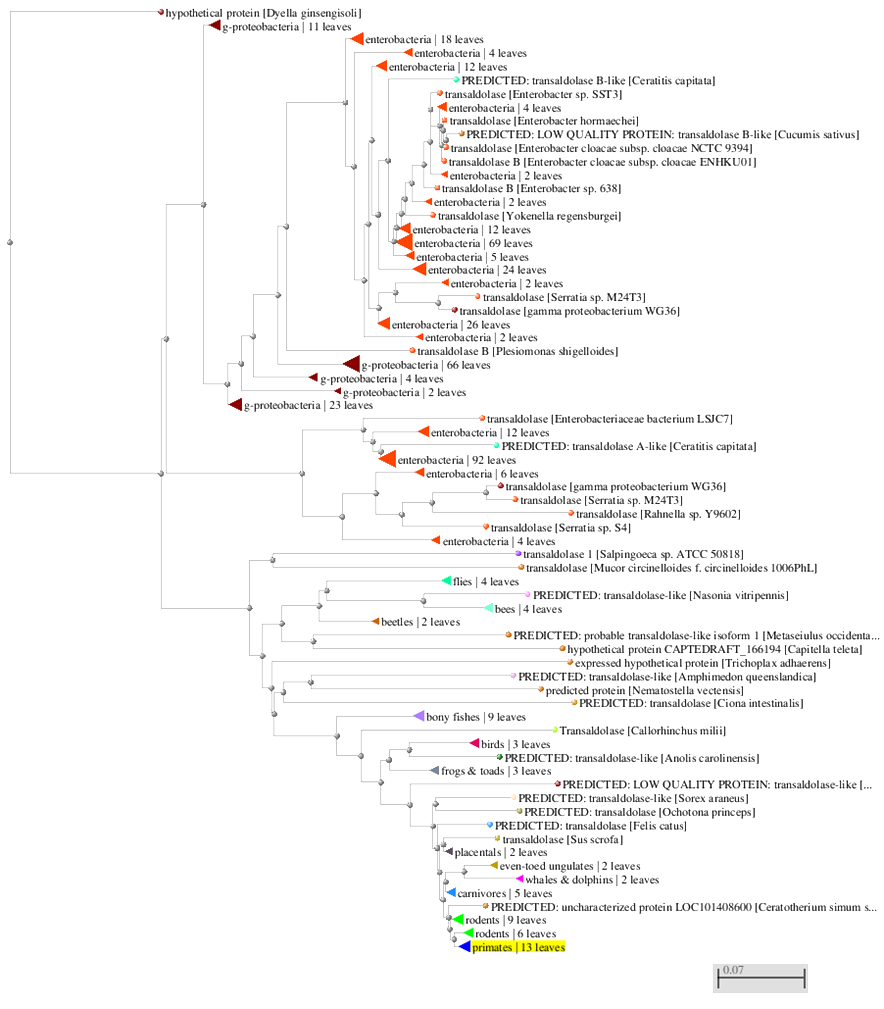
From blastp of NP_006746.1 against all non-redundant protein sequences.
Mutations
Germinal
Homozygous deletion of Serine 171 due to the loss of 3bp in the TALDO1 sequence results in liver cirrhosis and subsequent carcinogenesis.
Implicated in
Entity name
Hepatocellular carcinoma
Cytogenetics
Deletion of nucleotides 512-514 in TALDO1 resulted in the loss of serine 171 in the TAL protein and subsequent TAL deficiency (Verhoeven et al., 2001; Valayannopoulos et al., 2006). TAL deficiency results in the accumulation of sedoheptulose-7-phosphate and polyols. Further studies into TAL deficiency determined that the deletion of S171 resulted in a complete loss of enzymatic activity and rapid degradation in the proteasome (Grossman et al., 2004). Missense mutations at arginine 192, in which the arginine is mutated to either a histidine or cysteine, also results in loss of TAL activity and liver damage in patients (Verhoeven et al., 2005; Wamelink at al., 2008). In addition to liver damage, renal and cardiac complications are also present in these patients (Verhoeven et al., 2001; Valayannopoulos et al., 2006; Verhoeven et al., 2005; Wamelink et al., 2008).
In a mouse model of TAL deficiency, sperm dysmotility and subsequent male infertility are present (Perl et al., 2006). Furthermore, TAL deficiency results in the development of hepatosteatosis, cirrhosis, and hepatocellular carcinoma in both homozygous TAL knockouts and heterozygous mice relative to C57Bl/6 wild type mice (Hanczko et al., 2009). The pathogenic mechanism of liver damage in TAL deficiency is linked to depletion of NADPH, oxidative stress, and mitochondrial dysfunction (Perl et al., 2011). In TAL deficiency, it has been proposed that oxidative stress is exacerbated by increased aldose reductase activity which generates polyols and depletes NADPH (Perl et al., 2011). Low NADPH diminishes the cells ability to regulate cellular redox and polyols can induce proliferation through JNK/c-Jun (Perl et al., 2011). Thus, TAL deficiency and insufficiency predispose to oxidative stress which promotes liver damage, increased proliferation, and hepatocellular carcinoma.
In a mouse model of TAL deficiency, sperm dysmotility and subsequent male infertility are present (Perl et al., 2006). Furthermore, TAL deficiency results in the development of hepatosteatosis, cirrhosis, and hepatocellular carcinoma in both homozygous TAL knockouts and heterozygous mice relative to C57Bl/6 wild type mice (Hanczko et al., 2009). The pathogenic mechanism of liver damage in TAL deficiency is linked to depletion of NADPH, oxidative stress, and mitochondrial dysfunction (Perl et al., 2011). In TAL deficiency, it has been proposed that oxidative stress is exacerbated by increased aldose reductase activity which generates polyols and depletes NADPH (Perl et al., 2011). Low NADPH diminishes the cells ability to regulate cellular redox and polyols can induce proliferation through JNK/c-Jun (Perl et al., 2011). Thus, TAL deficiency and insufficiency predispose to oxidative stress which promotes liver damage, increased proliferation, and hepatocellular carcinoma.
Entity name
Squamous cell carcinoma of the head and neck
Cytogenetics
3 SNPs in the TALDO1 gene have been associated with different squamous cell carcinoma of the head and neck risk. The conversion of cytosine to either guanine or thymine at 490bp upstream of the origin of replication (rs10794338) was protective against tumorigenesis (Basta et al., 2008). In contrast, the mutation of thymine to adenine at position 1874 (rs3901233) and adenine to cytosine at position 2187 (rs4963163) increase the risk of squamous cell cancer of the head and neck (Basta et al., 2008).
Article Bibliography
| Pubmed ID | Last Year | Title | Authors |
|---|---|---|---|
| 8300619 | 1994 | Cloning and expression of the human gene for transaldolase. A novel highly repetitive element constitutes an integral part of the coding sequence. | Banki K et al |
| 8955144 | 1996 | Glutathione levels and sensitivity to apoptosis are regulated by changes in transaldolase expression. | Banki K et al |
| 18805652 | 2008 | Genetic variation in Transaldolase 1 and risk of squamous cell carcinoma of the head and neck. | Basta PV et al |
| 19608861 | 2009 | Lysine acetylation targets protein complexes and co-regulates major cellular functions. | Choudhary C et al |
| 9077532 | 1997 | Comparative analysis of antibody and cell-mediated autoimmunity to transaldolase and myelin basic protein in patients with multiple sclerosis. | Colombo E et al |
| 15115436 | 2004 | Deletion of Ser-171 causes inactivation, proteasome-mediated degradation and complete deficiency of human transaldolase. | Grossman CE et al |
| 19436114 | 2009 | Prevention of hepatocarcinogenesis and increased susceptibility to acetaminophen-induced liver failure in transaldolase-deficient mice by N-acetylcysteine. | Hanczko R et al |
| 10080 | 1976 | Behavior of transaldolase (EC 2.2.1.2) and transketolase (EC 2.2.1.1) Activities in normal, neoplastic, differentiating, and regenerating liver. | Heinrich PC et al |
| 11390181 | 2001 | Relationship between posttranslational modification of transaldolase and catalase deficiency in UV-sensitive repair-deficient xeroderma pigmentosum fibroblasts and SV40-transformed human cells. | Lachaise F et al |
| 21376665 | 2011 | Oxidative stress, inflammation and carcinogenesis are controlled through the pentose phosphate pathway by transaldolase. | Perl A et al |
| 17003133 | 2006 | Transaldolase is essential for maintenance of the mitochondrial transmembrane potential and fertility of spermatozoa. | Perl A et al |
| 17613166 | 2007 | The pathogenesis of transaldolase deficiency. | Perl A et al |
| 10869557 | 2000 | The three-dimensional structure of human transaldolase. | Thorell S et al |
| 17095351 | 2006 | Transaldolase deficiency: a new cause of hydrops fetalis and neonatal multi-organ disease. | Valayannopoulos V et al |
| 15877206 | 2005 | A newborn with severe liver failure, cardiomyopathy and transaldolase deficiency. | Verhoeven NM et al |
| 18331807 | 2008 | Transaldolase deficiency in a two-year-old boy with cirrhosis. | Wamelink MM et al |
Other Information
Locus ID:
NCBI: 6888
MIM: 602063
HGNC: 11559
Ensembl: ENSG00000177156
Variants:
dbSNP: 6888
ClinVar: 6888
TCGA: ENSG00000177156
COSMIC: TALDO1
RNA/Proteins
Expression (GTEx)
Pathways
References
| Pubmed ID | Year | Title | Citations |
|---|---|---|---|
| 34677006 | 2022 | Liver Disease and Risk of Hepatocellular Carcinoma in Children With Mutations in TALDO1. | 6 |
| 34677006 | 2022 | Liver Disease and Risk of Hepatocellular Carcinoma in Children With Mutations in TALDO1. | 6 |
| 34282517 | 2021 | SLC1A5 co-expression with TALDO1 associates with endocrine therapy failure in estrogen receptor-positive breast cancer. | 7 |
| 34282517 | 2021 | SLC1A5 co-expression with TALDO1 associates with endocrine therapy failure in estrogen receptor-positive breast cancer. | 7 |
| 32828637 | 2020 | Untargeted metabolomics as an unbiased approach to the diagnosis of inborn errors of metabolism of the non-oxidative branch of the pentose phosphate pathway. | 6 |
| 32828637 | 2020 | Untargeted metabolomics as an unbiased approach to the diagnosis of inborn errors of metabolism of the non-oxidative branch of the pentose phosphate pathway. | 6 |
| 30323337 | 2018 | Synthetic lethality between HER2 and transaldolase in intrinsically resistant HER2-positive breast cancers. | 17 |
| 30323337 | 2018 | Synthetic lethality between HER2 and transaldolase in intrinsically resistant HER2-positive breast cancers. | 17 |
| 27703206 | 2016 | Two isoforms of TALDO1 generated by alternative translational initiation show differential nucleocytoplasmic distribution to regulate the global metabolic network. | 11 |
| 27703206 | 2016 | Two isoforms of TALDO1 generated by alternative translational initiation show differential nucleocytoplasmic distribution to regulate the global metabolic network. | 11 |
| 25388407 | 2015 | Transaldolase deficiency caused by the homozygous p.R192C mutation of the TALDO1 gene in four Emirati patients with considerable phenotypic variability. | 12 |
| 25388407 | 2015 | Transaldolase deficiency caused by the homozygous p.R192C mutation of the TALDO1 gene in four Emirati patients with considerable phenotypic variability. | 12 |
| 23315216 | 2013 | Transaldolase deficiency: report of 12 new cases and further delineation of the phenotype. | 20 |
| 23736541 | 2013 | Effects of transaldolase exchange on estimates of gluconeogenesis in type 2 diabetes. | 5 |
| 23315216 | 2013 | Transaldolase deficiency: report of 12 new cases and further delineation of the phenotype. | 20 |
Citation
Zachary Oaks ; Andras Perl
TALDO1 (transaldolase 1)
Atlas Genet Cytogenet Oncol Haematol. 2013-07-01
Online version: http://atlasgeneticsoncology.org/gene/50613/taldo1-(transaldolase-1)
