USP32 (ubiquitin specific peptidase 32)
2013-07-01 Aysegul Sapmaz , Ayse Elif Erson-Bensan AffiliationDepartment of Biological Sciences, Middle East Technical University, Ankara, Turkey (AS, AEEB)
Identity
HGNC
LOCATION
17q23.1
IMAGE

LEGEND
Figure 1. Genes flanking USP32 gene on 17q23.3. → stands for positive strand , ← stands for negative strand.
LOCUSID
ALIAS
NY-REN-60,USP10
FUSION GENES
DNA/RNA

Figure 2. 34 exons of USP32.
Description
USP32 gene is located on a prominent gene amplification region, 17q23, in breast cancers (Bärlund et al., 1997; Erson et al., 2001) and has 34 exons (figure 2).
Transcription
USP32 mRNA is 7026 bp long. Coding sequence of USP32 starts at the 287th bp and ends at the 5101st bp of the mRNA. Total length of USP32 coding sequence is 4815 bp.
Pseudogene
No pseudogene has been reported for USP32.
Proteins
Note
Three independent studies reported USP32 to be phosphorylated at the 1173rd tyrosine and 1372nd serine residues (Dephoure et al., 2008; Rigbolt et al., 2011; Mayya et al., 2009).
Description
USP32 (ubiquitin specific protease 32 - accession number: NT_010783 and mRNA accession number: NM_032582) encodes for a protein consisting of 1604 amino acids and the resulting proteins predicted molecular weight is approximately 182 kDa. The N-terminal region contains calcium binding domain with EF-hand and DUSP domains.
The EF-hand calcium binding domains, consisting of a helix (E), a loop and a second helix (F) motif, are generally found in calcium binding proteins.
DUSP domain is common among ubiquitin specific proteases. The function of this domain in USP32 remains unclear but is predicted be functional in protein-protein interactions. In addition, USP32 harbors Cys, His and Asp triad which is common in USP subfamily of DUBs (figure 3). Recently, active deubiquitination function of USP32 has been established (Akhavantabasi et al., 2010).
The EF-hand calcium binding domains, consisting of a helix (E), a loop and a second helix (F) motif, are generally found in calcium binding proteins.
DUSP domain is common among ubiquitin specific proteases. The function of this domain in USP32 remains unclear but is predicted be functional in protein-protein interactions. In addition, USP32 harbors Cys, His and Asp triad which is common in USP subfamily of DUBs (figure 3). Recently, active deubiquitination function of USP32 has been established (Akhavantabasi et al., 2010).
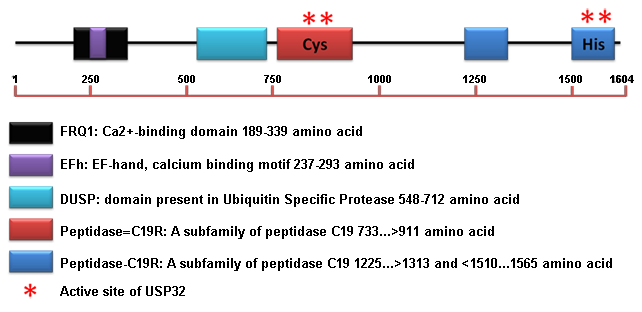
Figure 3. Domains of USP32.
Expression
Overexpressed transcript was detected in malignant breast ephitelium (Grigoriadis et al., 2006). Another study showed overexpression of USP32 in 50% (9 of 18) of breast cancer cell lines and 22% (9 of 41) of primary breast tumors compared to mammary epithelial cells (Akhavantabasi et al., 2010).
Localisation
Golgi (Akhavantabasi et al., 2010).
Function
USP32 is an active deubiquitinating enzyme (Akhavantabasi et al., 2010).
Homology
C-terminal of USP32 shows 97% nucleotide homology with USP6 (ubiquitin specific protease 6 (Tre-2 oncogene)) (Paulding et al., 2003) (figure 4).
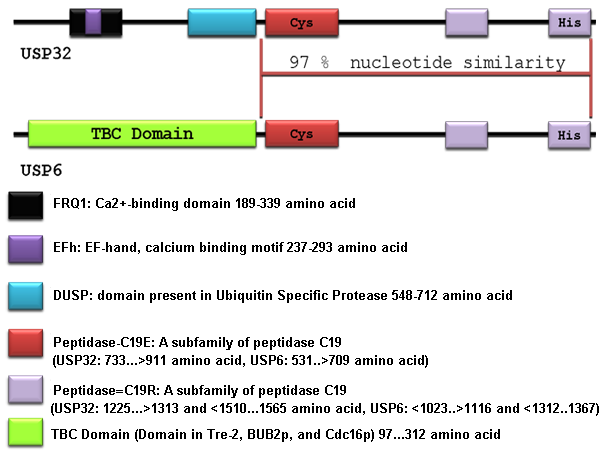
Figure 4. Sequence homology between USP32 and USP6.
Mutations
Note
In the Parkinson disease, CNVs in USP32 gene were suggested. However, these variations in USP32 were not confirmed with Multiplex ligation-dependent probe amplification (MLPA) and real time PCR (Pankratz et al., 2011).
Implicated in
Entity name
Breast cancer
Note
USP32 is located on 17q23 chromosomal region which is amplified in breast cancer (Sinclair et al., 2003; Haverty et al., 2008). Real-time PCR analysis in breast cancer cell lines determined that USP32 transcript is amplified more than two-fold in 50% of breast cancer cell lines and in 22% of (9 of 41) primary breast tumors compared to normal breast tissue samples. Moreover, silencing of USP32 leads to a decrease in the proliferation and migration properties of HeLa and MCF7 cells (Akhavantabasi et al., 2010).
In estrogen receptor (ER) positive tumors, USP32 may have a higher copy number than ER negative tumors (Zhang et al., 2009). Scafoglio et al. (2006) suggest USP32 to be an estrogen responsive gene.
In estrogen receptor (ER) positive tumors, USP32 may have a higher copy number than ER negative tumors (Zhang et al., 2009). Scafoglio et al. (2006) suggest USP32 to be an estrogen responsive gene.
Hybrid gene
RT-PCR and transcriptome sequencing analysis determined USP32 to be one of the twelve expressed fusion genes in breast cancer cell line ZR-75-30. USP32 is found to be expressed with CCDC49 as a fusion transcript (Schulte et al., 2012).
Article Bibliography
| Pubmed ID | Last Year | Title | Authors |
|---|---|---|---|
| 20549504 | 2010 | USP32 is an active, membrane-bound ubiquitin protease overexpressed in breast cancers. | Akhavantabasi S et al |
| 9408753 | 1997 | Increased copy number at 17q22-q24 by CGH in breast cancer is due to high-level amplification of two separate regions. | Bärlund M et al |
| 18669648 | 2008 | A quantitative atlas of mitotic phosphorylation. | Dephoure N et al |
| 11774034 | 2001 | Overexpressed genes/ESTs and characterization of distinct amplicons on 17q23 in breast cancer cells. | Erson AE et al |
| 17014703 | 2006 | Establishment of the epithelial-specific transcriptome of normal and malignant human breast cells based on MPSS and array expression data. | Grigoriadis A et al |
| 18335499 | 2008 | High-resolution genomic and expression analyses of copy number alterations in breast tumors. | Haverty PM et al |
| 19690332 | 2009 | Quantitative phosphoproteomic analysis of T cell receptor signaling reveals system-wide modulation of protein-protein interactions. | Mayya V et al |
| 21829596 | 2011 | Copy number variation in familial Parkinson disease. | Pankratz N et al |
| 12604796 | 2003 | The Tre2 (USP6) oncogene is a hominoid-specific gene. | Paulding CA et al |
| 21406692 | 2011 | System-wide temporal characterization of the proteome and phosphoproteome of human embryonic stem cell differentiation. | Rigbolt KT et al |
| 16514628 | 2006 | Comparative gene expression profiling reveals partially overlapping but distinct genomic actions of different antiestrogens in human breast cancer cells. | Scafoglio C et al |
| 23260012 | 2012 | Structural analysis of the genome of breast cancer cell line ZR-75-30 identifies twelve expressed fusion genes. | Schulte I et al |
| 12755490 | 2003 | The 17q23 amplicon and breast cancer. | Sinclair CS et al |
| 19336569 | 2009 | Copy number alterations that predict metastatic capability of human breast cancer. | Zhang Y et al |
Other Information
Locus ID:
NCBI: 84669
MIM: 607740
HGNC: 19143
Ensembl: ENSG00000170832
Variants:
dbSNP: 84669
ClinVar: 84669
TCGA: ENSG00000170832
COSMIC: USP32
RNA/Proteins
Expression (GTEx)
Protein levels (Protein atlas)
References
| Pubmed ID | Year | Title | Citations |
|---|---|---|---|
| 36725886 | 2023 | Deubiquitylation of Rab35 by USP32 promotes the transmission of imatinib resistance by enhancing exosome secretion in gastrointestinal stromal tumours. | 6 |
| 36951484 | 2023 | Roles of the hsa_circ_0013880/USP32/Rap1b axis in the proliferation and apoptosis of acute myeloid leukemia cells. | 3 |
| 37957631 | 2023 | High USP32 expression contributes to cancer progression and is correlated with immune infiltrates in hepatocellular carcinoma. | 1 |
| 36725886 | 2023 | Deubiquitylation of Rab35 by USP32 promotes the transmission of imatinib resistance by enhancing exosome secretion in gastrointestinal stromal tumours. | 6 |
| 36951484 | 2023 | Roles of the hsa_circ_0013880/USP32/Rap1b axis in the proliferation and apoptosis of acute myeloid leukemia cells. | 3 |
| 37957631 | 2023 | High USP32 expression contributes to cancer progression and is correlated with immune infiltrates in hepatocellular carcinoma. | 1 |
| 35440702 | 2022 | Identification of ubiquitin-specific protease 32 as an oncogene in glioblastoma and the underlying mechanisms. | 7 |
| 35440702 | 2022 | Identification of ubiquitin-specific protease 32 as an oncogene in glioblastoma and the underlying mechanisms. | 7 |
| 33744759 | 2021 | Ubiquitin specific peptidase 32 acts as an oncogene in epithelial ovarian cancer by deubiquitylating farnesyl-diphosphate farnesyltransferase 1. | 12 |
| 34815782 | 2021 | USP32 confers cancer cell resistance to YM155 via promoting ER-associated degradation of solute carrier protein SLC35F2. | 10 |
| 33744759 | 2021 | Ubiquitin specific peptidase 32 acts as an oncogene in epithelial ovarian cancer by deubiquitylating farnesyl-diphosphate farnesyltransferase 1. | 12 |
| 34815782 | 2021 | USP32 confers cancer cell resistance to YM155 via promoting ER-associated degradation of solute carrier protein SLC35F2. | 10 |
| 32226309 | 2020 | USP32 promotes tumorigenesis and chemoresistance in gastric carcinoma via upregulation of SMAD2. | 17 |
| 32226309 | 2020 | USP32 promotes tumorigenesis and chemoresistance in gastric carcinoma via upregulation of SMAD2. | 17 |
| 30926795 | 2019 | USP32 regulates late endosomal transport and recycling through deubiquitylation of Rab7. | 44 |
Citation
Aysegul Sapmaz ; Ayse Elif Erson-Bensan
USP32 (ubiquitin specific peptidase 32)
Atlas Genet Cytogenet Oncol Haematol. 2013-07-01
Online version: http://atlasgeneticsoncology.org/gene/52046/usp32-(ubiquitin-specific-peptidase-32)
