E2F6 (E2F transcription factor 6)
2004-03-01 Matthew Oberley AffiliationMcArdle Laboratory for Cancer Research, University of Wisconsin - Madison, 1400 University Ave. Madison, WI 53706, USA
DNA/RNA
Description
In humans, E2F6 has 8 exons that span 20881 bp of genomic sequence. It has an ORF of 843 nt.
Transcription
There have been 5 mRNA splice variants identified in humans.
Transcript variant 1 is the predominant transcript, and it encodes the longest mRNA isoform (a), which is 2342 bp.
Transcript variant 2 contains an additional segment (2413 bp mRNA), compared to variant 1, that causes a frameshift leading to an early stop codon. This transcript may function in a regulatory role with no protein translated. The predicted protein (isoform b) is much shorter than isoform a. Transcript variants 2 and 4 encode isoform b.
Transcript variant 3 lacks a segment (2287 bp mRNA), compared to variant 1, that causes a frameshift leading to an early stop codon. This transcript may function in a regulatory role with no protein translated. The predicted protein (isoform c) is much shorter than isoform a.
Transcript variant 4 contains two additional segments (2546 bp mRNA), compared to variant 1, that cause a frameshift leading to an early stop codon. This transcript may function in a regulatory role with no protein translated. The predicted protein (isoform b) is much shorter than isoform a.
Transcript variant 5 contains an additional segment (2475 bp mRNA), compared to variant 1, that causes a frameshift leading to an early stop codon. This transcript may function in a regulatory role with no protein translated. The predicted protein (isoform d) is much shorter than isoform a.
Pseudogene
There is an E2F6 pseudogene located on chromosome 22q11.2 (LOC376818) containing 2144 bp of the E2F6 gene with no introns.
Proteins
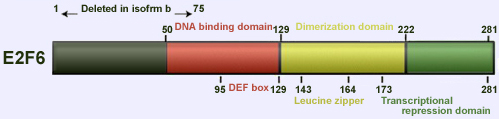
Diagram created by M. Oberley.
Description
The predominately expressed isoform is 282 amino acids, and is . The DNA binding domain is thought to be between aa 50 and 129. It has a DEF box between aa 95 to 195. The dimerization domain is thought to reside between aa 130 and 222. There is a leucine zipper domain between aa 143 and 164. The transcriptional repression domain is located on the C terminus from aa 173 to 281. The N-terminal 1-75 aa are missing in isoform B which is predicted to be 206 AA.
Expression
Ubiquitous, though more highly expressed in the placenta, skeletal muscle, heart, ovary, kidney, small intestine and spleen.
Localisation
Nuclear
Function
Heterodimerization with DP1 or 2 creates a sequence specific transcriptional repressor. Overexpression of E2F6 can delay the exit of cells from S-phase, indicating a role for E2F6 in cell-cycle control. E2F6 has been shown via yeast two hybrid and co-IPs to interact with members of the polycomb repressive complex 1, such as Bmi1, RYBP, RING1, MEL-18, and Mph1. The functional outcome of these interactions are as of yet unclear. E2F6 has been biochemically purified in a complex containing polycomb group members h-1(3) mbt like protein, RING1, RING2, hMBLR, as well as YAF and HP1g; this complex also contained a novel euchromatic histone methyltransferase (Eu-HMTase1). This finding led to speculation that E2F6 controlled cellular entry into quiescence, but E2F6 nullizygous MEFs had no kinetic changes or defects in their ability to enter quiescence, or to re-enter into the cell-cycle. However, these animals had homeotic transformations of the axial skeleton, a phenotype that resembled Bmi1 nullizygous mice. This implicated E2F6 in regulation of normal development.
Homology
E2F6 has homology with E2Fs1-5 in the DNA-binding domain, the dimerization domain, and the marked box domain located between aa 231 and 239.
Mutations
Note
A synthetic mutation in aa 68; L->E: reduced E2F6 transcriptional repressor activity by abrogating DNA binding, but had little effect on S-phase entry.
Implicated in
Entity name
Development
Note
E2F6 is required for normal homeotic development in murine models as mice nullizygous for E2F6 display transformations in the axial skeleton.
Disease
None known.
Article Bibliography
| Pubmed ID | Last Year | Title | Authors |
|---|---|---|---|
| 12771133 | 2003 | Dynamic recruitment of NF-Y and histone acetyltransferases on cell-cycle promoters. | Caretti G et al |
| 9704927 | 1998 | E2F-6: a novel member of the E2F family is an inhibitor of E2F-dependent transcription. | Cartwright P et al |
| 12383262 | 2002 | Two different E2F6 proteins generated by alternative splicing and internal translation initiation. | Dahme T et al |
| 9689056 | 1998 | Unusual proliferation arrest and transcriptional control properties of a newly discovered E2F family member, E2F-6. | Gaubatz S et al |
| 11594747 | 2001 | Molecular cloning and characterization of the mouse E2F6 gene. | Kherrouche Z et al |
| 9403682 | 1997 | An E2F-like repressor of transcription. | Morkel M et al |
| 12909625 | 2003 | E2F6 negatively regulates BRCA1 in human cancer cells without methylation of histone H3 on lysine 9. | Oberley MJ et al |
| 12004135 | 2002 | A complex with chromatin modifiers that occupies E2F- and Myc-responsive genes in G0 cells. | Ogawa H et al |
| 12101104 | 2002 | Homeotic transformations of the axial skeleton that accompany a targeted deletion of E2f6. | Storre J et al |
| 11823794 | 2002 | Sibling rivalry in the E2F family. | Trimarchi JM et al |
Other Information
Locus ID:
NCBI: 1876
MIM: 602944
HGNC: 3120
Ensembl: ENSG00000169016
Variants:
dbSNP: 1876
ClinVar: 1876
TCGA: ENSG00000169016
COSMIC: E2F6
RNA/Proteins
Expression (GTEx)
References
| Pubmed ID | Year | Title | Citations |
|---|---|---|---|
| 38153509 | 2024 | The osteoporosis susceptibility SNP rs188303909 at 2q14.2 regulates EN1 expression by modulating DNA methylation and E2F6 binding. | 0 |
| 38166853 | 2024 | A hsa_circ_001726 axis regulated by E2F6 contributes to metastasis of hepatocellular carcinoma. | 2 |
| 38153509 | 2024 | The osteoporosis susceptibility SNP rs188303909 at 2q14.2 regulates EN1 expression by modulating DNA methylation and E2F6 binding. | 0 |
| 38166853 | 2024 | A hsa_circ_001726 axis regulated by E2F6 contributes to metastasis of hepatocellular carcinoma. | 2 |
| 36464274 | 2023 | The E2F6 Transcription Factor is Associated with the Mammalian SUZ12-Containing Polycomb Complex. | 1 |
| 36525235 | 2023 | lncRNA ENST00000585827 Contributes to the Progression of Endometrial Carcinoma via Regulating miR-424/E2F6/E2F7 Axis. | 1 |
| 36464274 | 2023 | The E2F6 Transcription Factor is Associated with the Mammalian SUZ12-Containing Polycomb Complex. | 1 |
| 36525235 | 2023 | lncRNA ENST00000585827 Contributes to the Progression of Endometrial Carcinoma via Regulating miR-424/E2F6/E2F7 Axis. | 1 |
| 34588094 | 2022 | Long Noncoding RNA LAMTOR5-AS1 Interference Affects MicroRNA-506-3p/E2F6-Mediated Behavior of Non-Small Cell Lung Cancer Cells. | 2 |
| 35844791 | 2022 | A positive feedback loop of CENPU/E2F6/E2F1 facilitates proliferation and metastasis via ubiquitination of E2F6 in hepatocellular carcinoma. | 9 |
| 34588094 | 2022 | Long Noncoding RNA LAMTOR5-AS1 Interference Affects MicroRNA-506-3p/E2F6-Mediated Behavior of Non-Small Cell Lung Cancer Cells. | 2 |
| 35844791 | 2022 | A positive feedback loop of CENPU/E2F6/E2F1 facilitates proliferation and metastasis via ubiquitination of E2F6 in hepatocellular carcinoma. | 9 |
| 33734009 | 2021 | Circular RNA ZNF609 functions as a competing endogenous RNA in regulating E2F transcription factor 6 through competitively binding to microRNA-197-3p to promote the progression of cervical cancer progression. | 19 |
| 34165171 | 2021 | Long noncoding RNA SLC9A3‑AS1 increases E2F6 expression by sponging microRNA‑486‑5p and thus facilitates the oncogenesis of nasopharyngeal carcinoma. | 5 |
| 34339800 | 2021 | Deubiquitination of the repressor E2F6 by USP22 facilitates AKT activation and tumor growth in hepatocellular carcinoma. | 7 |
Citation
Matthew Oberley
E2F6 (E2F transcription factor 6)
Atlas Genet Cytogenet Oncol Haematol. 2004-03-01
Online version: http://atlasgeneticsoncology.org/gene/521/e2f6
