t(1;7)(p36;q34)
1999-11-01 Antonio Cuneo Affiliation1.Hematology Section, Dept. Of Biomedical Sciences, University of Ferrara, 44100 Ferrara Italy
Clinics and Pathology
Disease
acute myeloid leukemia (AML), presenting as a de novo condition or after preceeding myelodysplastic syndrome or exposure to myelotoxic agents
Phenotype stem cell origin
M2/M4 by FAB criteria, frequently with trilineage myelodysplasia: positivity for myeloid markers (i.e. CD13, CD33) as well as for CD117, CD34 and TdT; lymphoid-associated markers tested negative in the reported cases
Epidemiology
the frequency of this anomaly in AML is < 1%
Prognosis
the cells may be susceptible to chemotherapy since all reported cases achieved complete remission, despite the presence of other unfavourable prognostic factors
Cytogenetics
Cytogenetics morphological
the translocation is easy to visualize in G-banded preparations because the dark 7q35 band moves on top of the derivative 1p
Additional anomalies
associated / additional anomalies may include +8 and the classical t(6;9)(p23;q34)
Genes Involved and Proteins
Note
the involved genes are unknown
Article Bibliography
| Pubmed ID | Last Year | Title | Authors |
|---|---|---|---|
| 8573309 | 1995 | The role of chromosome translocations in T cell acute leukemia. | Hwang LY et al |
| 10233385 | 1999 | A novel translocation t(1;7)(p36;q34) in three patients with acute myeloid leukaemia. | Specchia G et al |
| 8055471 | 1994 | t(1;7)(p36;q32): a new recurring abnormality in primary myelodysplastic syndrome. | Stefănescu DT et al |
Summary
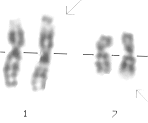
partial karyotype (G-banding) showing the t(1;7)(p36;q34)
Citation
Antonio Cuneo
t(1;7)(p36;q34)
Atlas Genet Cytogenet Oncol Haematol. 1999-11-01
Online version: http://atlasgeneticsoncology.org/haematological/1157/t(1
