i(X)(q10) in male patients
2017-02-01 Tatiana Gindina Affiliation1.R.M. Gorbacheva Research Institute of Pediatric Oncology Hematology and Transplantation at First Saint-Petersburg State Medical University named I.P.Pavlov, Saint-Petersburg, Russia / [email protected]
Abstract
Review on i(X)(q10) in male patients.
Clinics and Pathology
Disease
Extremely rare i(X)(q10) occurs in male patients, only five cases have been reported in lymphoid malignancies, including acute lymphoblastic leukemia (ALL) (Bacher et al, 2009), diffuse large B-cell lymphoma (Itoyama et al, 2002, Gindina T., table 1, case #3) and follicular lymphoma (Dave t al, 1999; Donti et al., 1988).
Epidemiology
Table 1. Reported cases with i(X)(q10).
ALL: acute lymphoblastic leukemia; DLBCL: diffuse large B-cell lymphoma; FL: follicular lymphoma
| Pts | Age, gender | Disease | Karyotype | Author |
| 1 | 51, M | B-cell precursor ALL (relapse after CT) | 46,Y,i(X)(q10),der(1)dup(1)(q32q21)t(1;17)(q42;q23),ins(7;8)(p21;p21;23),der(17)t(1;17)(q42 ;q23)[6]/46,XY[17] | Bacher et al, 2009 |
| 2 | ?, M | DLBCL | 47-48,i(X)(q10),-Y,inv(1)(p32q21),del(2)(q13),hsr(3)(q27),add(4)(q35),del(4)(q31),-6,+7,der(11)t(5;11)(q13;q23),+13, t(14;18)(q32;q21),-15,-16,-17,+mar | Itoyama et al, 2002 |
| 3 | 60, M | DLBCL | 67<3n>,Y,add(X)(p22),i(X)(q10),-2,del(2)(p21),-4,+7,+7,dic(7;7)(p22;p22),der(8)del(8)(p12)t(8;11)(q24;q13),+9,i(9)(p10), +12,der(12)t(3;12)(q13;p13),add(12)(p13),-13,+14,i(14)(q10),-15,-15,i(15)(q10),-16,add(17)(p11),add(18)(q23),-19, add(20)(q13),+21,i(21)(q10),-22,+mar [20] (Fig 1 and 2.) | Gindina T, own case |
| 4 | 75, M | FL | 47,XY,+i(X)(q10),t(1;11)(p36;q21),del(4)(q32),del(9)(q21),t(14;18)(q32;q21)[8]/46,XY[2] | Dave et al, 1999 |
| 5 | ?, M | FL | 48,XY,+i(X)(q10),+i(X)(p10),add(1)(q?),+12,add(14)(q?)/48,Y,i(X)(q10),+i(X)(p10),add(1),t(2;8)(p12;q24),+12,add(14) | Donti et al, 1988 |
ALL: acute lymphoblastic leukemia; DLBCL: diffuse large B-cell lymphoma; FL: follicular lymphoma
Cytogenetics
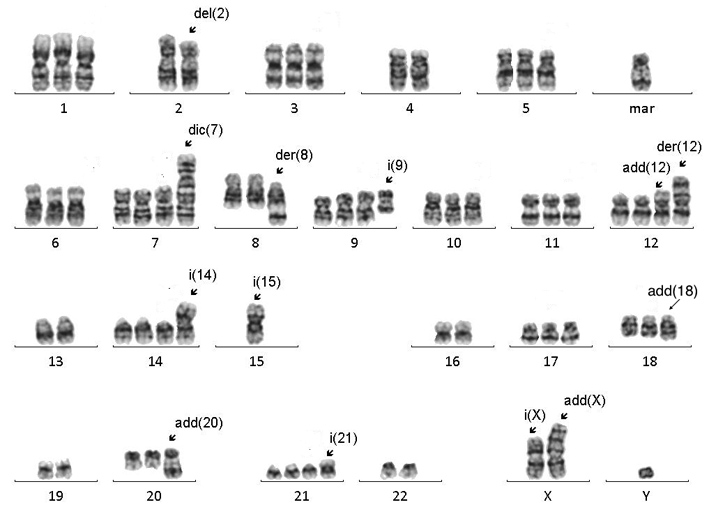
Complex karyotype with extra i(X)(q10) in a patient with DLBCL (table 1, #3).
Additional anomalies
Additional chromosome anomalies were observed in all five patients. Extra i(X)(q10) was present in 3 patients (Donti et al., 1988; Dave et al, 1999; Gindina et al, case #3). Associated in combination with other isochromosomes in 2 patients (Donti et al, 1988; Gindina, case #3). In all cases, i(X)(q10) is part of a complex karyotype. t(14;18)(q32;q21) was found in 2 cases: 1 FL case and 1 DLBCL (Dave et al, 1999; Itoyama et al, 2002).
Genes Involved and Proteins
Result of the Chromosomal Anomaly
Oncogenesis
The major consequence of this abnormality is loss of several genes on Xp and gain of several genes on Xq, that leads to genetic imbalance.
Article Bibliography
| Pubmed ID | Last Year | Title | Authors |
|---|---|---|---|
| 19100515 | 2009 | Inverted duplication dup(1)(q32q21) as sole aberration in lymphoid and myeloid malignancies. | Bacher U et al |
| 10389925 | 1999 | Rearrangements of chromosome band 1p36 in non-Hodgkin's lymphoma. | Dave BJ et al |
| 3339903 | 1988 | Immunological and molecular studies in a case of follicular lymphoma with an extra chromosome 12 and t(2;8) translocation. | Donti E et al |
| 12378526 | 2002 | Molecular cytogenetic analysis of genomic instability at the 1q12-22 chromosomal site in B-cell non-Hodgkin lymphoma. | Itoyama T et al |
Summary
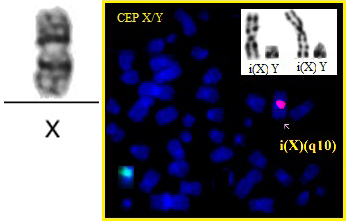
i(X)(q10) Partial karyotypes (G-banding) with i(X)(q10). Hybridization with CEP X SpectrumOrange probe specific for the alpha satellite (centromeric) chromosome X region, (Abbott Molecular, US) showing the signal on normal X and on i(X)(q10) chromosomes- Courtesy Adriana Zamecnikova.
Citation
Tatiana Gindina
i(X)(q10) in male patients
Atlas Genet Cytogenet Oncol Haematol. 2017-02-01
Online version: http://atlasgeneticsoncology.org/haematological/1492/i(x)(q10)-in-male-patients
