t(9;15)(p13;q24) PAX5/PML
2014-01-01 Jean-Loup Huret Affiliation1.Genetics, Dept Medical Information, University of Poitiers, CHU Poitiers Hospital, F-86021 Poitiers, France
Clinics and Pathology
Disease
B-cell acute lymphoblastic leukemia (B-ALL)
Epidemiology
Two cases to date, a 9-month old girl and a 1.5-year old boy, both with a CD10+ ALL (Nebral et al., 2007; Nebral et al., 2009).
Prognosis
A patient remains in complete remission 84 months from diagnosis, while the other one had a testicular relapse 2 years after diagnosis and died.
Genes Involved and Proteins
Gene name
PAX5 (paired box gene 5)
Location
9p13.2
Protein description
391 amino acids; from N-term to C-term, PAX5 contains: a paired domain (aa: 16-142); an octapeptide (aa: 179-186); a partial homeodomain (aa: 228-254); a transactivation domain (aa: 304-359); and an inhibitory domain (aa: 359-391). Lineage-specific transcription factor; recognizes the concensus recognition sequence GNCCANTGAAGCGTGAC, where N is any nucleotide. Involved in B-cell differentiation. Entry of common lymphoid progenitors into the B cell lineage depends on E2A, EBF1, and PAX5; activates B-cell specific genes and repress genes involved in other lineage commitments. Activates the surface cell receptor CD19 and repress FLT3. Pax5 physically interacts with the RAG1/RAG2 complex, and removes the inhibitory signal of the lysine-9-methylated histone H3, and induces V-to-DJ rearrangements. Genes repressed by PAX5 expression in early B cells are restored in their function in mature B cells and plasma cells, and PAX5 repressed (Fuxa et al., 2004; Johnson et al., 2004; Zhang et al., 2006; Cobaleda et al., 2007; Medvedovic et al., 2011).
Gene name
PML (promyelocytic leukemia)
Location
15q24.1
Protein description
882 amino-acids (aa) and shorter isoforms with distinct C terminus sequences; from N-term to C-term, PML contains: a proline rich domain (aa 3-46); a zinc finger (RING finger type) (aa 57-92); two zinc fingers (B-box types) (aa 124-166 and aa 183-236); a coiled coil made of hydrophobic aa heptad repeats (aa 228-253); an interaction domain with PER2 (aa 448-555); a nuclear localization signal (aa 476-490); a proline rich domain (aa 504-583); a serine rich domain (aa 506-540); and a sumo interaction motif (aa 556-562). The RING finger, B-boxes, and coiled-coil region form a tripartite motif known as the TRIM or the RBCC motif, and is associated with E3 ubiquitin ligase activity. PML is the organizer of nuclear domains called nuclear bodies, which recruit a wide variety of proteins, most often sumoylated. PML is involved in DNA damage response, cell division control, chromosome instability, and is a clock regulator via regulation of PER2 expression. PML has pro-apoptotic functions, induces senescence, inhibits angiogenesis and cell migration (Grignani et al., 1996; Chen et al., 2012; de Thé et al., 2012).
Result of the Chromosomal Anomaly
Description
Fusion of PAX5 exon 6 to PML exon 2.
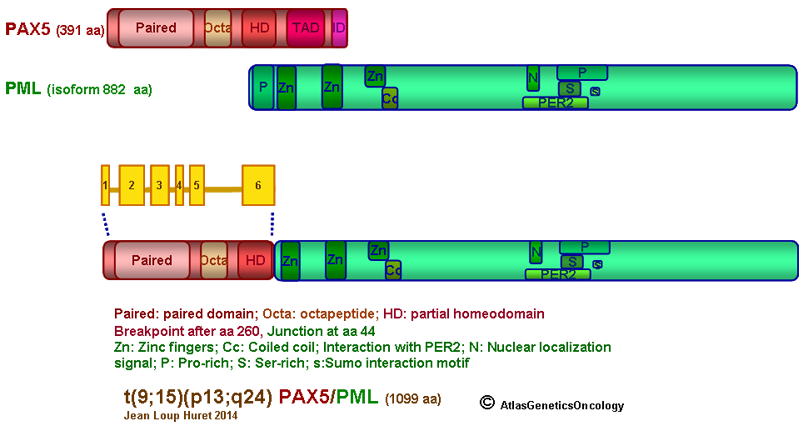
PAX5/PML fusion protein.
Description
1099 amino acids. The predicted fusion protein contains the DNA binding paired domain of PAX5 (260 aa from PAX5) and most of PML (839 aa).
Highly cited references
| Pubmed ID | Year | Title | Citations |
|---|---|---|---|
| 26703467 | 2016 | B Cell Linker Protein (BLNK) Is a Selective Target of Repression by PAX5-PML Protein in the Differentiation Block That Leads to the Development of Acute Lymphoblastic Leukemia. | 34 |
| 21217775 | 2011 | PAX5-PML acts as a dual dominant-negative form of both PAX5 and PML. | 0 |
| 20972455 | 2011 | The reduced and altered activities of PAX5 are linked to the protein-protein interaction motif (coiled-coil domain) of the PAX5-PML fusion protein in t(9;15)-associated acute lymphocytic leukemia. | 0 |
| 17897302 | 2007 | Identification of PML as novel PAX5 fusion partner in childhood acute lymphoblastic leukaemia. | 0 |
Article Bibliography
| Pubmed ID | Last Year | Title | Authors |
|---|---|---|---|
| 22935031 | 2012 | The role of PML ubiquitination in human malignancies. | Chen RH et al |
| 17440452 | 2007 | Pax5: the guardian of B cell identity and function. | Cobaleda C et al |
| 15004008 | 2004 | Pax5 induces V-to-DJ rearrangements and locus contraction of the immunoglobulin heavy-chain gene. | Fuxa M et al |
| 8890168 | 1996 | Effects on differentiation by the promyelocytic leukemia PML/RARalpha protein depend on the fusion of the PML protein dimerization and RARalpha DNA binding domains. | Grignani F et al |
| 15258579 | 2004 | B cell-specific loss of histone 3 lysine 9 methylation in the V(H) locus depends on Pax5. | Johnson K et al |
| 21970955 | 2011 | Pax5: a master regulator of B cell development and leukemogenesis. | Medvedovic J et al |
| 19020546 | 2009 | Incidence and diversity of PAX5 fusion genes in childhood acute lymphoblastic leukemia. | Nebral K et al |
| 17897302 | 2007 | Identification of PML as novel PAX5 fusion partner in childhood acute lymphoblastic leukaemia. | Nebral K et al |
| 16680144 | 2006 | Transcription factor Pax5 (BSAP) transactivates the RAG-mediated V(H)-to-DJ(H) rearrangement of immunoglobulin genes. | Zhang Z et al |
| 22778276 | 2012 | The cell biology of disease: Acute promyelocytic leukemia, arsenic, and PML bodies. | de Thé H et al |
Summary
Fusion gene
PAX5/PML PAX5 (9p13.2) PML (15q24.1) M t(9;15)(p13;q22)|PAX5/PML PAX5 (9p13.2) PML (15q24.1) TIC
Note
The translocation is noted with various breakpoints on chromosome 15, ranging from q22 to q25 (this is reminiscent of the t(15;17) PML/RARA).
Citation
Jean-Loup Huret
t(9;15)(p13;q24) PAX5/PML
Atlas Genet Cytogenet Oncol Haematol. 2014-01-01
Online version: http://atlasgeneticsoncology.org/haematological/1561/t(9
