t(6;7)(p25.3;q32.3) DUSP22/FRA7H
2013-05-01 George Vasmatzis , Andrew L Feldman , Sarah H Johnson Affiliation1.Center for Individualized Medicine - Biomarker Discovery, Mayo Clinic, 200 First Street SW, Rochester, MN 55905 USA (SHJ; GV); Department of Laboratory Medicine, Pathology, College of Medicine, Mayo Clinic, 200 First Street SW, Rochester, MN 55905 USA (ALF)
Clinics and Pathology
Disease
Phenotype stem cell origin
Mature (peripheral) T cell (most cases); occasional cases are of uncertain lineage (so-called "null cell" type).
Etiology
No etiologic factors are known.
Epidemiology
All reported cases have occurred in adults. Estimated frequency of t(6;7)(p25.3;q32.3) in ALK-negative ALCL (systemic or cutaneous) is 10% (13 of 125 ALK-negative ALCLs tested) (Feldman et al., 2011). Additional cases with rearrangements of 6p25.3 not involving 7q32.3 also have been reported.
Clinics
Presentation has not been shown to differ significantly from other ALCLs; i.e. systemic ALK-negative ALCLs typically present with lymphadenopathy and/or extranodal tissue involvement, whereas primary cutaneous ALCLs typically present with localized skin lesions and may develop locoregional lymph node involvement.
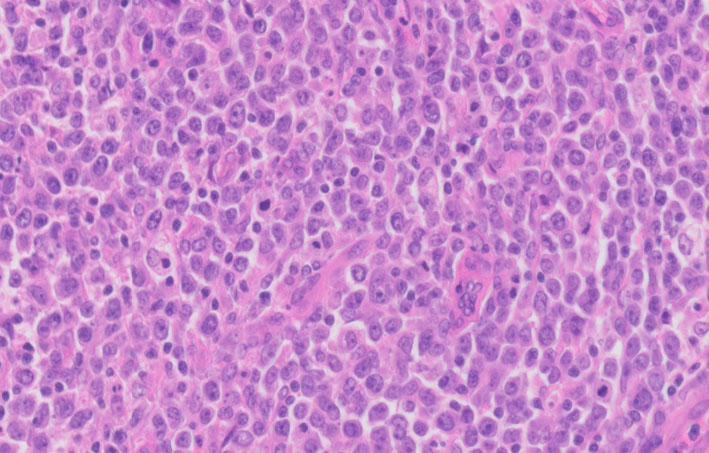
Systemic ALCL with t(6;7)(p25.3;q32.3). H&E stain s shows a lymph node filled with large blastic tumor cells that lack typical hall-mark cells - Courtesy Konnie Hebeda and Marian Stevens-Kroef
Pathology
Pathologic findings are similar to those seen in systemic or primary cutaneous ALK-negative ALCL. Detection of t(6;7)(p25.3;q32.3) in ALK-positive ALCL has not been reported.
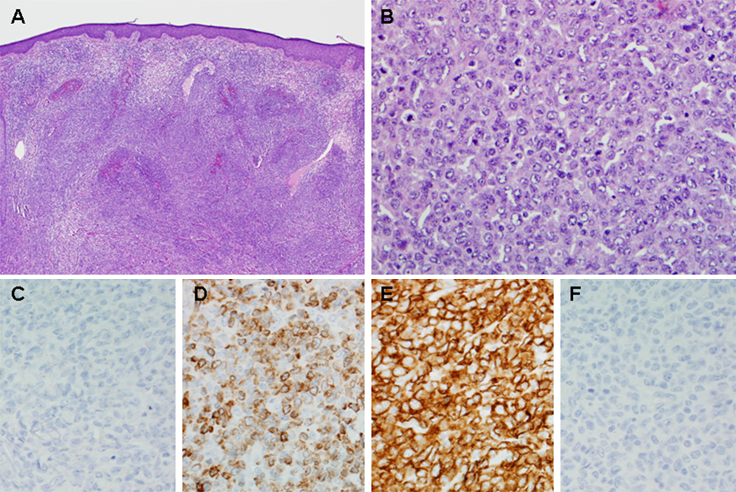
Primary cutaneous ALCL with t(6;7)(p25.3;q32.3). H&E stains at low (A) and high (B) magnification show a tumor-forming cellular infiltrate in the dermis of the skin. The tumor cells are medium-sized to large atypical lymphoid cells with a sheet-like growth pattern. By immunohistochemical stains, they are negative for CD20 (C), weakly positive for CD3 (D), strongly positive for CD30 (E), and negative for ALK (F).
Treatment
Unknown.
Evolution
Unknown.
Prognosis
Unknown.
Cytogenetics
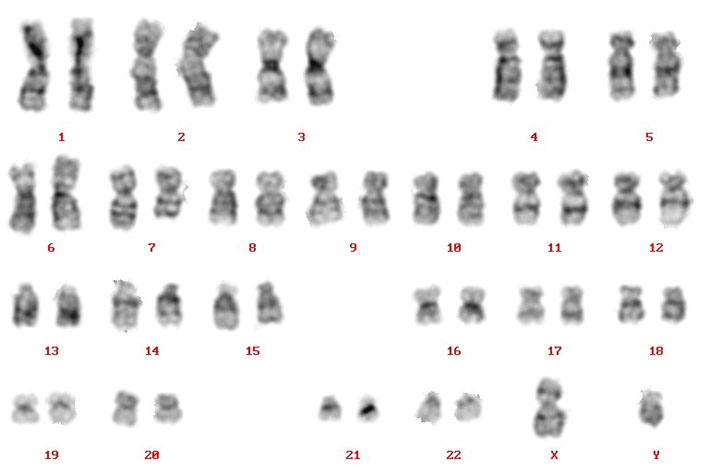
Karyogram showing 46,XY,t(6;7)(p25;q32) u2013 Marian Stevens-Kroef, Radboud UMC, Nijmegen, The Netherlands.
Cytogenetics morphological
Karyotypic findings have not been reported.
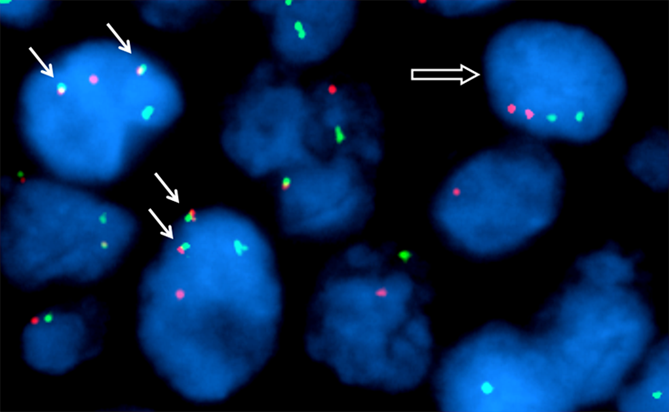
Dual-fusion FISH demonstrating t(6;7)(p25.3;q32.3) in ALCL. Two tumor cells at left show fusions of the DUSP22-IRF4 locus on 6p25.3 (red) to 7q32.3 (green) (solid arrows). The folded or reniform configuration typical of ALCL nuclei ("hallmark" cells) can be seen. The open arrow at upper right points to a normal cell with round nuclear contours and lacking fusion signals.
Additional anomalies
Unknown.
Variants
Rearrangements of 6p25.3 with other partner loci have been reported.
Genes Involved and Proteins
Gene name
DUSP22 (dual specificity phosphatase 22)
Location
6p25.3
Dna rna description
In the single reported sequenced case, the translocation disrupted the DUSP22 gene within intron 1. FISH studies using probes covering different regions of the DUSP22-IRF4 locus on 6p25.3 showed that in other cases the breakpoint was centromeric to DUSP22 and closer to IRF4 (Feldman et al., 2011). Regardless of breakpoint location, gene expression studies showed up to a 50-fold reduction in expression of DUSP22 in the translocated cases compared to untranslocated cases. IRF4 expression was similar between translocated and untranslocated cases.
Protein description
DUSP22 encodes a dual-specificity phosphatase that inhibits T-cell antigen-receptor signaling in T cells by inactivating the MAP kinase, ERK2. Its function in ALCL has not been confirmed.
Gene name
FRA7H (fragile site, aphidicolin type, common, fra(7)(q32.3))
Location
7q32.3
Dna rna description
The 7q32.3 breakpoint lies in the non-coding transcript region FLJ43663, immediately telomeric to the fragile site, FRA7H, and the microRNAs, MIR29A and MIR29B1.
Result of the Chromosomal Anomaly
Note
None known.None known.
Article Bibliography
| Pubmed ID | Last Year | Title | Authors |
|---|---|---|---|
| 21030553 | 2011 | Discovery of recurrent t(6;7)(p25.3;q32.3) translocations in ALK-negative anaplastic large cell lymphomas by massively parallel genomic sequencing. | Feldman AL et al |
Citation
George Vasmatzis ; Andrew L Feldman ; Sarah H Johnson
t(6;7)(p25.3;q32.3) DUSP22/FRA7H
Atlas Genet Cytogenet Oncol Haematol. 2013-05-01
Online version: http://atlasgeneticsoncology.org/haematological/1579/new-content/pdf
