1.Kuwait Cancer control Center, Department of Hematology, Kuwait; [email protected]
Abstract
Acute promyelocytic leukemia (APL) is characterized by arrest of leukocyte differentiation at the promyelocyte stage. In classic APL, the central leukemia-initiating event is the chromosome translocation t(15;17)(q22;q21) resulting in the fusion of the retinoic acid receptor-alpha (RARA) gene on 17q21.1 with the promyelocytic leukemia (PML) gene at 15q24.1. In rare cases, RARA is fused with genes other than PML that gives rise to APL variants such as in der(2)t(2;17)(q32;q21) with the underlying NABP1/RARA fusion gene.
Only 1 case to date, a 59-years old male patient (Won et al., 2013).
Clinics
The patient presented with anemia, thrombocytopenia, and high white blood cell count with 61% blasts and abnormal promyelocytes. BM aspirate revealed 69.2% microgranular abnormal promyelocytes. Immunophenotype analysis was positive for CD13, CD33, CD45, CD65, and MPO with negative CD34, HLA-DR, and B-cell and T-cell markers (data from Won et al., 2013).
Treatment
Therapy with all-trans retinoic acid (ATRA) was initiated but it was discontinued after 2 days due to the negative PML/RARA molecular result. Induction therapy with idarubicin and cytarabine was started but ATRA was restarted 7 days later when RARA rearrangement was identified by fluorescence in situ hybridization (FISH). The patient achieved complete remission on day 28, and underwent allogenic stem-cell transplantation after 2 cycles of consolidation chemotherapy. He remains alive and in complete remission one year after transplantation.
Prognosis
The leukemic cells from the patient showed neutrophilic differentiation in the in vitro all-trans retinoic acid assay and the patient achieved complete remission with ATRA therapy, therefore NABP1/RARA fusion appear to be an ATRA-sensitive variant in APL.
The nucleic acid binding protein 1 (NABP1, previously known as OBFC2A; oligonucleotide/oligosaccharide-binding fold containing 2A) gene encodes human single-stranded DNA binding protein 2; essential for a variety of DNA metabolic processes including genomic stability, replication, recombination; plays a role in DNA damage response and in detection and repair of damage (Richard et al., 2008).
Retinoic acid receptor-alpha is a nuclear retinoic acid receptor, implicated in regulation of development, differentiation, apoptosis, granulopoeisis and transcription; the encoded protein function as heterodimers with retinoid X receptors; regulates expression of target genes in a ligand-dependent manner by binding to retinoic acid response elements and, when bound by ligands, recruit a protein complex to activate transcription.
Result of the Chromosomal Anomaly
Description
5 NABP1 - 3 RARA
Transcript
RARA portion of the transcript started in exon 3 and was fused in-frame to exon 5 of OBFC2A; breakpoint in RARA gene in the same breakpoint as in previously described fusions of RARA.
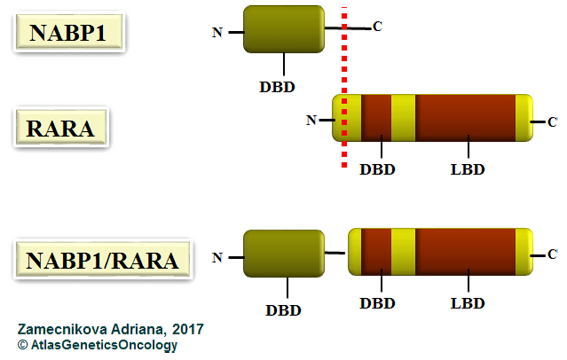
Schematic diagram of NABP1, RARA and NABP1/RARA fusion protein. DBD, DNA?binding domain; LBD, ligand?binding domain.
Description
NABP1-RARA predicted to encode a 551-amino acid protein; NABP1 5-region encoding the DNA-binding domain (DBD) is fused to the 3-region of RARA including the DBD and ligand-binding domain (Figure 1. adopted from Won et al., 2013).
Oncogenesis
Patient with NABP1-RARA fusion shows a similar breakpoint within the RARA gene sharing a common portion as in other APL cases; therefore the chimeric protein is expected to behave as an altered retinoic acid receptor. The retention of the N-terminal oligonucleotide/oligosaccharide-binding fold in NABP1 protein that binds to single-stranded DNA substrate may provide the possibility of dimerization and produce oncogenic signaling leading to accumulation of undifferentiated promyelocytes.
Please, confirm that you want to generate a PDF file of this page. This
may take some seconds once process has started. Then it will be opened automatically.