t(6;20)(q15;q11.2) BACH2/BCL2L1
2012-10-01 Thomas Burmeister Affiliation1.Charite, Med. Klinik fur Hamatologie, Onkologie und Tumorimmunologie, Hindenburgdamm 30, 12200 Berlin, Germany
Clinics and Pathology
Disease
High-grade B-cell lymphoma
Note
The chromosomal translocation t(6;20)(q15;q11.2) was detected in the cell line BLUE-1. This cell line was established from a bone marrow sample obtained from a patient with relapsed high-grade B-cell lymphoma, initially histologically classified as Burkitt lymphoma (Burmeister et al., 2006). The cell line also carries the Burkitt-typical t(8;14)(q24;q32) with MYC-IGHJ fusion. Further characterization of the t(6;20)(q15;q11.2) led to the identification of a chimeric BACH2-BCL2L1 fusion transcript, showing a fusion of the first non-coding BACH2 exon to the coding part of BCL2L1. The translocation thus effectively leads to an overexpression of BCL2L1.
Phenotype stem cell origin
The BLUE-1 cell line has the following immunophenotype: CD2-, cyCD3-, CD5-, CD7-, CD10+, CD19+, CD20-, cyCD22+, CD23-, cyIgM-, CD56-, CD33-, MPO-7-, CD34-, HLA-DR+, TdT-, CD52+.
Epidemiology
The cell line BLUE-1 is the only known case.
Clinics
The patient from whom the cell line was derived showed a very aggressive form of lymphoma. Despite intensive immunochemotherapy he relapsed, developed meningeal involvement and died 3 months after the cell line was established.
Cytology
Cytomorphology and immunostaining of the BLUE-1 cells was compatible with the diagnosis of Burkitt lymphoma (Burmeister et al., 2006).
Cytogenetics
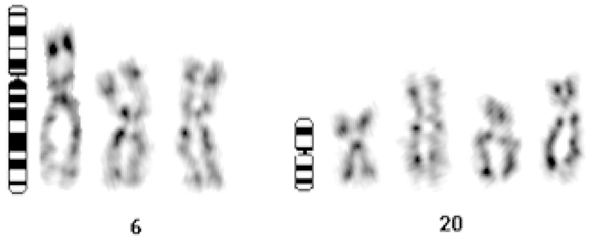
The evolved BLUE-1 karyotype shows one der(6)t(6;20)(q13;q11.2), one +6 and three der(20)t(6;20)(q15;q11.2) (one long der(20) and two short der(20)) in addition to the normal chromosome 20 (Burmeister et al., 2011).
Cytogenetics morphological
The inital karyotype of BLUE-1 was the following: 46,XY,t(6;20)(q13;q11.2),t(8;14)(q24;q32).
After one year in continuous culture the karyotype had evolved: 53,XY,+6,t(6;20)(q15;q11.2),der(6)t(6;20)(q15;q11.2),t(8;14)(q24;q32),+13,+16,+20,+20,der(20)del(20)(p12.2p13.2)t(6;20)(q15;q11.2)t(6;11)(q16;p13),+der(20),+21 (Burmeister et al., 2006). The second +20 was later classified as third der(20).
After one year in continuous culture the karyotype had evolved: 53,XY,+6,t(6;20)(q15;q11.2),der(6)t(6;20)(q15;q11.2),t(8;14)(q24;q32),+13,+16,+20,+20,der(20)del(20)(p12.2p13.2)t(6;20)(q15;q11.2)t(6;11)(q16;p13),+der(20),+21 (Burmeister et al., 2006). The second +20 was later classified as third der(20).
Cytogenetics molecular
Molecular cytogenetics showed a MYC-IGH juxtaposition. The following BAC clones were used: WI2-1694H13 (8q24), RP11-815O20 and RP11-965B13 (IGH-Eμ). The t(6;20)(q15;q11.2) was characterized using the BAC clones RP11-21G12, RP1-154G14, RP1-45N11, RP1-104D1 (on chr 6) and RP3-324O17, RP5-857M17, RP11-243J16 and RP1-310O13 (on chr 20).
Genes Involved and Proteins
Gene name
BACH2 (BTB and CNC homology 1, basic leucine zipper transcription factor 2)
Location
6q15
Dna rna description
Two different transcripts have been described, one 7-exon 9109 bp transcript and one 9-exon 9215 bp transcript. The coding last 4 exons are shared by both transcripts. Both transcripts encode an 841 aa protein.
Gene name
BCL2L1 (BCL2-like 1)
Location
20q11.21
Dna rna description
Two major BCL2L1 transcripts have been described: one long 2559 bp transcript BCL-XL resulting in the translation of a 233 aa protein and one short 2370 bp transcript BCL-XS, resulting in the translation of a 170 aa protein. The shorter transcript is generated by alternative splicing at the 3 end of BCL2L1 exon 2.
Result of the Chromosomal Anomaly
Note
The translocation t(6;20)(q15;q11.2) was characterized using a sequential BAC clone mapping strategy. The BAC clones RP11-243J16 (on chr 20) and RP1-104D1 (on chr 6) covered the chromosomal breakpoint region. The chromosomal breakpoint was not identified but is likely located 5 of the first BCL2L1 exon and 3 of the first BACH2 exon.
Transcript
RT-PCR showed a chimeric BACH2-BCL2 fusion transcript. The first non-coding BACH2 exon was fused to the second (partially coding) BCL2L1 exon. This led to an overexpression of BCL2L1 (BCL-XL).
Note
Translation of the BACH2-BCL2L1 transcript resulted in a strong overexpression of BCL2L1 as detected by immunoblotting.
Highly cited references
| Pubmed ID | Year | Title | Citations |
|---|---|---|---|
| 21412927 | 2011 | A BACH2-BCL2L1 fusion gene resulting from a t(6;20)(q15;q11.2) chromosomal translocation in the lymphoma cell line BLUE-1. | 0 |
Article Bibliography
| Pubmed ID | Last Year | Title | Authors |
|---|---|---|---|
| 16697040 | 2006 | A novel sporadic Burkitt lymphoma cell line (BLUE-1) with a unique t(6;20)(q15;q11.2) rearrangement. | Burmeister T et al |
| 21412927 | 2011 | A BACH2-BCL2L1 fusion gene resulting from a t(6;20)(q15;q11.2) chromosomal translocation in the lymphoma cell line BLUE-1. | Türkmen S et al |
Summary
Fusion gene
BACH2/BCL2L1 BACH2 (6q15) BCL2L1 (20q11.21) M|BACH2/BCL2L1 BACH2 (6q15) BCL2L1 (20q11.21) M t(6;20)(q15;q11)|BACH2/BCL2L1 BACH2 (6q15) BCL2L1 (20q11.21) TIC
Citation
Thomas Burmeister
t(6;20)(q15;q11.2) BACH2/BCL2L1
Atlas Genet Cytogenet Oncol Haematol. 2012-10-01
Online version: http://atlasgeneticsoncology.org/haematological/1614/t(6
