t(3;11)(p11;p15) NUP98/POU1F1
2017-11-01 Yiming Zhong , Megan Piazza , Shashi Shetty Affiliation1.Center for Human Genetics Laboratory, Department of Pathology, Case Western Reserve University/University Hospitals Cleveland Medical Center, Cleveland, OH. [email protected]; [email protected]; [email protected]
Abstract
Review on t(3;11)(p11;p15), with data on clinics, and the genes involved.
Clinics and Pathology
Disease
Acute myeloid leukemia (AML)
Epidemiology
Two cases to date. In the first case, a 57-year-old female was initially diagnosed with a breast adenocarcinoma and she developed therapy-related AML-M4 fourteen years later (Lisboa et al., 2013). In the second case, a 19-year-old white male was diagnosed with de novo AML-M4 (Walker et al., 2013).
Prognosis
The first patient was treated with chemotherapy (cytarabine, daunorubicin, and cyclosporin) and a complete response was achieved. The patient showed evidence of relapse ten months later and died within five months after relapse (Lisboa et al., 2013). The second patient had complete remission (CR) after induction treatment with cytarabine and daunorubicin. The post-CR therapy included high-dose cytarabine, cytoxan, and etoposide. The patient had a disease-free survival of 92+ months and an overall survival of 92.9+ months (Walker et al., 2013).
Genes Involved and Proteins
Gene name
NUP98 (nucleoporin 98)
Location
11p15
Protein description
A 98 kDa nucleoporin. It is a component of the nuclear pore complexes (NPCs) and participates in many cellular processes, including nuclear import, nuclear export, mitotic progression, and regulation of gene expression (Gough et al., 2011). NUP98 protein contains N-terminal Gly-Leu-Phe-Gly (GLGF) repeat domains and a C-terminal RNA binding domain. Translocations between this gene and many other partner genes have been observed in leukemias. Rearrangements typically result in fusion proteins with the N-terminal GLGF domain of this gene to the C-terminus of the partner gene and they seem to be associated with poor prognosis (Struski et al., 2017; Kearney, L 2002).
Gene name
POU1F1 (POU class 1 homeobox 1)
Location
3p11
Protein description
POU1F1, also known as PIT1, is a member of the POU family of transcription factors. It regulates expression of several genes involved in pituitary development and hormone expression (Ingraham et al., 1998) and also plays a role in cell proliferation and differentiation (Costoya et al., 1998; Pellegrini et al., 2006). Deregulation of POU1F1 is implicated in pituitary adenoma, combined pituitary hormone deficiency, breast carcinoma, and acute myeloid leukemia (Franc et al., 2014; Gao et al., 2016). POU1F1 protein contains an N-terminal transactivation domain and a C-terminal DNA binding domain including a homeodomain (Franc et al., 2014).
Result of the Chromosomal Anomaly
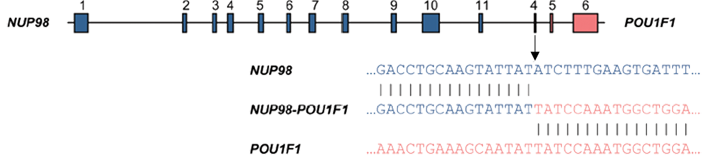
Figure A: Schematic representation of the genomic DNA breakpoint (arrow) of NUP98/POU1F1 and nucleotide sequence of the genomic breakpoint (Modified from Lisboa et el., 2013).
Description
Description: 5 NUP98 - 3 POU1F1 was produced in the case reported by Lisboa et al. in 2013. The breakpoints were 7490 bp downstream of NUP98 exon 11 and 129 bp downstream of the start of POU1F1 exon 4 (Figure A). The POU1F1 exon 4 was not included in the mature NUP98/POU1F1 message RNA (Lisboa et al., 2013).

Figure B: Schematic representation of the NUP98-POU1F1 fusion protein (Modified from Lisboa et el., 2013).
Description
The NUP98/POU1F1 fusion protein contains the GLFG repeats of NUP98 and the homeodomian of POU1F1 (Figure B).
Oncogenesis
It is expected that the expression of NUP98/POU1F1 fusion gene is under the control of NUP98 promoter, leading to POU1F1 overexpressioin which results in increased proliferation of leukemia cells. It is hypothesized that the FLT3-ITD mutation collaborates with NUP98/POU1F1 in malignant transformation (Lisboa et el., 2013).
Highly cited references
| Pubmed ID | Year | Title | Citations |
|---|---|---|---|
| 23332017 | 2013 | POU1F1 is a novel fusion partner of NUP98 in acute myeloid leukemia with t(3;11)(p11;p15). | 16 |
Article Bibliography
| Pubmed ID | Last Year | Title | Authors |
|---|---|---|---|
| 9828108 | 1998 | Correlation of Pit-1 gene expression and Pit-1 content with proliferation and differentiation in human myeloid leukemic cells. | Costoya JA et al |
| 27798557 | 2016 | Over-Expression of POU Class 1 Homeobox 1 Transcription Factor (Pit-1) Predicts Poor Prognosis for Breast Cancer Patients. | Gao Z et al |
| 21948299 | 2011 | NUP98 gene fusions and hematopoietic malignancies: common themes and new biologic insights. | Gough SM et al |
| 2902928 | 1988 | A tissue-specific transcription factor containing a homeodomain specifies a pituitary phenotype. | Ingraham HA et al |
| 23332017 | 2013 | POU1F1 is a novel fusion partner of NUP98 in acute myeloid leukemia with t(3;11)(p11;p15). | Lisboa S et al |
| 16901973 | 2006 | Involvement of the pituitary-specific transcription factor pit-1 in somatolactotrope cell growth and death: an approach using dominant-negative pit-1 mutants. | Pellegrini I et al |
| 27694926 | 2017 | NUP98 is rearranged in 3.8% of pediatric AML forming a clinical and molecular homogenous group with a poor prognosis. | Struski S et al |
| 23225546 | 2013 | New recurrent balanced translocations in acute myeloid leukemia and myelodysplastic syndromes: cancer and leukemia group B 8461. | Walker A et al |
Summary
Fusion gene
NUP98/POU1F1
Citation
Yiming Zhong ; Megan Piazza ; Shashi Shetty
t(3;11)(p11;p15) NUP98/POU1F1
Atlas Genet Cytogenet Oncol Haematol. 2017-11-01
Online version: http://atlasgeneticsoncology.org/haematological/1632/gene-fusions-explorer/new-content/meetings/cancer-prone-explorer/
