der(X)t(X;8)(q28;q11.2)
2016-09-01 Tatiana Gindina Affiliation1.R.M. Gorbacheva Research Institute of Pediatric Oncology Hematology and Transplantation at First Saint-Petersburg State Medical University named I.P.Pavlov, Saint-Petersburg, Russia / [email protected]
Abstract
Review on der(X)t(X;8)(q28;q11.2), with data on clinics
Clinics and Pathology
Disease
Acute lymphoblastic leukemia
Phenotype stem cell origin
Leukemic cells were positive for CD34, CD10, CD19, CD20, CD38.
| Patient | Leukemia | Age/Sex | WBC 109/L | Karyotype | Outcome | References |
| 1 | B-precursor ALL | 4/M | 20 | 46,Y,der(X)t(X;8)(q28;q11.2),t(9;22)(q34;q11),t(8;14)(q11.2;q32),add(17)(p13) | CR; Relapsed after 23,5 mths | Kaleem et al., 2000 |
| 2 | Common B ALL | 19/M | 17 | 46,Y,der(X)t(X;8)(q28;q11.2) | CR; Complex medullar and CNS extramedullary relapses after 10 mths and 13 mths; CR after BMT; Isolated post-transplant CNS relapse; died after 29 mths after diagnosis | Present case, 2016 |
Epidemiology
Extremely rare karyotypic event in ALL; both ALL patients were males (aged 4 and 19 years).
Clinics
Among the characteristic laboratory features were a low WBC at presentation. One of the two ALL patients had a few reddish skin nodules 5-7 mm in diameter, moderate hepatosplenomegaly. No patient had a mediastinal mass or central nervous system involvement at diagnosis, but one patient had CNS extramedullary relapses, including post-transplant.
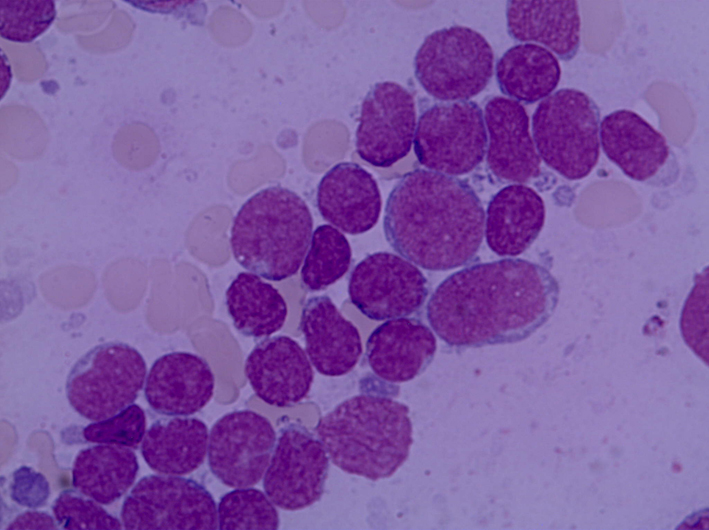
Micro- and macrogenerations of lymphoblasts. Blasts had rounded nucleus and finely dispersed chromatin with well-contoured nucleoli. Iconography courtesy Valentina Kravtsova.
Cytology
Bone marrow are hypercellular with 54.4% lymphoblasts of L1 or L2 morphology. They were negative for myeloperoxidase, whereas most of them positive for PAS stain. Erythropoiesis and myelopoiesis were decreased. Erythropoiesis had signs of megaloblastosis. Megakaryocytopoiesis: hypolobular and polyploid megakaryocytes.
Pathology
Histopathology of the skin nodules was remarkable for interstitially located groups of small- and middle-sized lymphoid blast-like cells, which were positive for TdT, PAX-5, CD20, CD10, negative for T-cell and myeloid markers and had a very high proliferation rate (Ki-67 index above 90 %). myc oncogene product was additionally assessed with immunohistochemistry (clone Y69). Over 90% of blast cells in the skin appeared to be positive for myc, although staining pattern was markedly heterogeneous. The brain tissue (at post-transplant relapse) contained a dense cellular infiltrate composed of middle-sized PAS-positive blasts with oval or round nuclei, containing 2-3 small nucleoli. Tumor cells were uniformly positive for TdT, CD19, PAX-5, and CD79a and had a very high Ki-67 proliferation index. myc oncogene product was demonstrated in over 85% of cells with heterogeneous staining pattern, compatible with indirect myc up-regulation.
Treatment
Complete therapeutic data are available for one of the two ALL cases: treatment was started according to ALL-2009 protocol, containing Daunorubicin, Vincristine, and L-asparaginase. CNS prophylaxis therapy consisted of triple intrathecal treatments, whereas cranial irradiation was not used. The patient received allogeneic HSCT; conditioning regimen consisted of Melphalan and Fludarabine.
Prognosis
The risk associated with der(X)t(X;8)(q28;q11.2) is not well determined due to low number of cases.
Cytogenetics
Cytogenetics morphological
Isolated derivative chromosome X was demonstrated in one ALL case (present case, 2016); in second one, the derivative chromosome X was combined with other recurrent chromosomal abnormalities (Kaleem et al, 2000).
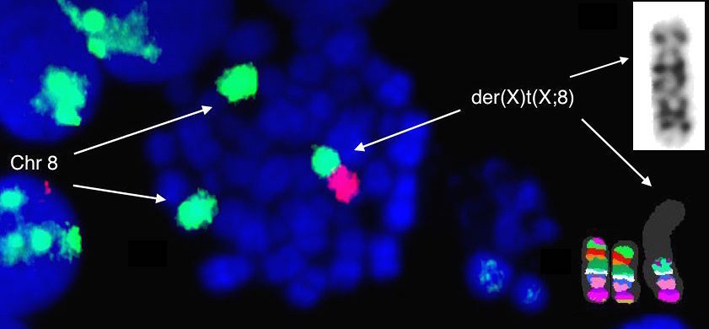
GTG-banding showing the derivative X chromosome; FISH with whole painting probes showing two normal chromosomes 8 (green color) and the derivative der(X)t(X;8) (red and green colors). Multicolor banding of two normal chromosomes 8 and the derivative X chromosome.
Probes
Whole chromosome painting (WCP X, WCP8), mBAND 8 (Metasystems, Germany).
Additional anomalies
Found in association with t(9;22)(q34;q11), t(8;14)(q11.2;q32) and add(17)(p13) in one ALL case (Kaleem et al,2000).
Genes Involved and Proteins
Note
The unbalanced translocation der(X)t(X;8)(q28;q11.2) results in a partial 8q trisomy.
Result of the Chromosomal Anomaly
Note
No specific gene or protein are described.
Oncogenesis
The presence of partial 8q trisomy leads to gain of genetic material and consequently to amplification of genes possibly involved in the neoplastic process. MYC is one of the genes located on 8q which may be implicated in disease biology. Immunohistochemical staining for MYC protein showed positivity of >85% of leukemic cells, although with markedly heterogeneous staining pattern, compatible with indirect MYC up-regulation. The latter, in turn, could increase proliferative potential of leukemic cells as well as their resistance to chemotherapy. In several studies, trisomy 8 in ALL patients is considered to be indicative of poor prognosis (Garipidou et al).
Article Bibliography
| Pubmed ID | Last Year | Title | Authors |
|---|---|---|---|
| 2214875 | 1990 | Trisomy 8 in acute lymphoblastic leukemia (ALL): a case report and update of the literature. | Garipidou V et al |
| 10673739 | 2000 | Acute lymphoblastic leukemia with an unusual t(8;14)(q11.2;q32): a Pediatric Oncology Group Study. | Kaleem Z et al |
Summary
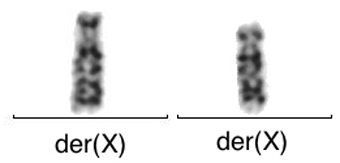
Partial GTG-banding karyotype of the der(X)t(X;8)(q28;q11.2).
Citation
Tatiana Gindina
der(X)t(X;8)(q28;q11.2)
Atlas Genet Cytogenet Oncol Haematol. 2016-09-01
Online version: http://atlasgeneticsoncology.org/haematological/1641/der(x)t(x
