Anaplastic large cell lymphoma, ALK-negative
2016-05-01 Andrew L Feldman , Rebecca L Boddicker Affiliation1.Department of Laboratory Medicine and Pathology, Mayo Clinic, Rochester, MN, USA. [email protected] (RLB); [email protected] (ALF)
Abstract
Abstract: Review on Anaplastic large cell lymphoma, ALK-negative, with data on clinics, and the genes involved.
Clinics and Pathology
Disease
Anaplastic large cell lymphoma (ALCL), ALK-negative is a CD30-positive T-cell non-Hodgkin lymphoma that by definition resembles ALCL, ALK-positive but lacks ALK expression (Mason, Harris et al. 2008). ALCL, ALK-negative was classified as a provisional entity distinct from ALCL, ALK-positive in the 2008 WHO classification, and is anticipated to be upgraded to a definite entity in the 2016 WHO update (Swerdlow, Campo et al. 2016).
Etiology
The etiology of ALCL, ALK negative is unknown.
Epidemiology
ALCL, ALK-negative makes up between 2.6% and 9.4% of T-/NK-cell non-Hodgkin lymphomas, with the lowest proportion occurring in Asia and the highest in Europe (Vose, Armitage et al. 2008). ALCL, ALK-negative generally occurs in older patients, with a median age of diagnosis of 55-60 years, compared to 25-35 years for ALK-positive ALCL (Ferreri, Govi et al. 2013). Males are affected more commonly than females (M:F, ~1.5:1).
Clinics
Patients with ALCL, ALK-negative typically present with lymphadenopathy, often with stage III/IV disease, and B symptoms (ten Berge, de Bruin et al. 2003). Extranodal sites also may be involved, including skin, bone, and soft tissues. Secondary cutaneous involvement by ALCL, ALK-negative must be distinguished from primary cutaneous ALCL, which is a distinct entity (Bekkenk, Geelen et al. 2000).
Pathology
By definition, the morphologic appearance is similar to that seen in ALCL, ALK-positive (Mason, Harris et al. 2008). Specifically, most cases resemble the so-called "common" pattern of ALK, ALK-positive and show sheet-like growth of tumor cells, sometimes sparing residual lymphoid follicles (Delsol, Falini et al. 2008). Sinusoidal involvement is common, and cohesive clusters of intrasinusoidal tumor cells may mimic metastatic carcinoma. The tumor cells typically are large and may show significant pleomorphism. So-called "hallmark" cells, with horseshoe-shaped or reniform nuclei, always can be identified (Benharroch, Meguerian-Bedoyan et al. 1998). Immunophenotyping studies are essential to the diagnosis of ALCL, ALK-negative. All cases express CD30 by definition. Aberrant loss of pan-T-cell antigen expression is common, and about two-thirds of cases express cytotoxic proteins (TIA1, granzyme B, or perforin) (Savage, Harris et al. 2008). ALK protein is absent.
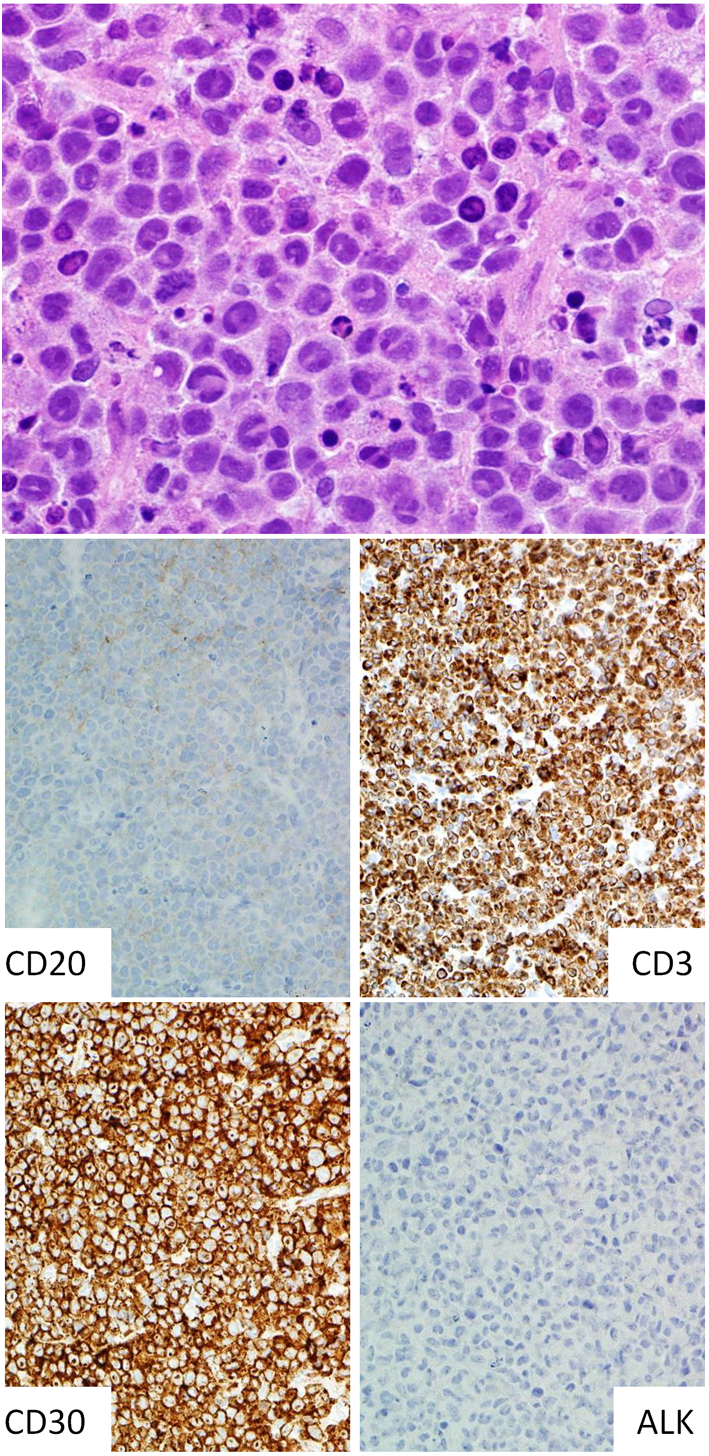
ALCL, ALK-negative. The tumor is composed of sheets of large pleomorphic cells, some with horseshoe-shaped nuclei ("hallmark" cells; H&E, top). By immunohistochemical stains the tumor cells are negative for the B-cell marker, CD20; positive for the T-cell marker, CD3; positive for CD30; and negative for ALK.
Treatment
ALCL, ALK-negative is typically treated with CHOP (cyclophosphamide, doxorubicin, vincristine, and prednisone) or CHOP-like chemotherapy, often followed by autologous stem cell transplantation (Bennani-Baiti, Ansell et al. 2016). New targeted agents such as brentuximab vedotin and histone deacetylase inhibitors have demonstrated efficacy in relapsed and refractory disease.
Prognosis
The prognosis for ALCL, ALK-negative is poorer than for ALCL, ALK-positive, with a 5-year overall survival (OS) rate of 49% compared to 70% for the latter (Savage, Harris et al. 2008). However, prognosis is better than for most other types of T-cell non-Hodgkin lymphomas, including peripheral T-cell lymphoma, not otherwise specified (PTCL, NOS). Recent data have shown that ALCL, ALK-negative is a genetically heterogeneous disease, and that outcomes vary widely based on genetic subtype (Parrilla Castellar, Jaffe et al. 2014). Specifically, 5-year OS was very good (90%) in patients carrying DUSP22 rearrangements, poor (17%) in TP63/ -rearranged cases, and intermediate (42%) in patients lacking ALK/, DUSP22, and TP63 rearrangements.
Genes Involved and Proteins
Article Bibliography
| Pubmed ID | Last Year | Title | Authors |
|---|---|---|---|
| 10845893 | 2000 | Primary and secondary cutaneous CD30(+) lymphoproliferative disorders: a report from the Dutch Cutaneous Lymphoma Group on the long-term follow-up data of 219 patients and guidelines for diagnosis and treatment. | Bekkenk MW et al |
| 9490693 | 1998 | ALK-positive lymphoma: a single disease with a broad spectrum of morphology. | Benharroch D et al |
| 26581318 | 2016 | Adult systemic anaplastic large-cell lymphoma: recommendations for diagnosis and management. | Bennani-Baiti N et al |
| 24004669 | 2013 | PRDM1/BLIMP1 is commonly inactivated in anaplastic large T-cell lymphoma. | Boi M et al |
| 25873174 | 2015 | Convergent mutations and kinase fusions lead to oncogenic STAT3 activation in anaplastic large cell lymphoma. | Crescenzo R et al |
| 18626005 | 2008 | International peripheral T-cell and natural killer/T-cell lymphoma study: pathology findings and clinical outcomes. | Vose J et al |
| 18987657 | 2009 | Recurrent translocations involving the IRF4 oncogene locus in peripheral T-cell lymphomas. | Feldman AL et al |
| 26379151 | 2016 | Morphologic Features of ALK-negative Anaplastic Large Cell Lymphomas With DUSP22 Rearrangements. | King RL et al |
| 24894770 | 2014 | ALK-negative anaplastic large cell lymphoma is a genetically heterogeneous disease with widely disparate clinical outcomes. | Parrilla Castellar ER et al |
| 18385450 | 2008 | ALK- anaplastic large-cell lymphoma is clinically and immunophenotypically different from both ALK+ ALCL and peripheral T-cell lymphoma, not otherwise specified: report from the International Peripheral T-Cell Lymphoma Project. | Savage KJ et al |
| 26980727 | 2016 | The 2016 revision of the World Health Organization classification of lymphoid neoplasms. | Swerdlow SH et al |
| 22855598 | 2012 | Genome-wide analysis reveals recurrent structural abnormalities of TP63 and other p53-related genes in peripheral T-cell lymphomas. | Vasmatzis G et al |
| 14636272 | 2003 | ALK-negative anaplastic large-cell lymphoma demonstrates similar poor prognosis to peripheral T-cell lymphoma, unspecified. | ten Berge RL et al |
Citation
Andrew L Feldman ; Rebecca L Boddicker
Anaplastic large cell lymphoma, ALK-negative
Atlas Genet Cytogenet Oncol Haematol. 2016-05-01
Online version: http://atlasgeneticsoncology.org/haematological/1705/anaplastic-large-cell-lymphoma-alk-negative
