Mu heavy chain disease
2016-06-01 Kenneth C. Anderson , Giada Bianchi Affiliation1.LeBow Institute for Myeloma Therapeutics and Jerome Lipper Multiple Myeloma Center, Department of Medical Oncology, Dana Farber Cancer Institute, Harvard Medical School, Boston, MA, 02115. [email protected]; [email protected]
Abstract
Mu heavy chain disease (HCD) is the most rare variant of HCD, a family of syndromes associated with or representing a B cell malignancy variant. The hallmark characteristic and the pathogenic mechanism of HCD is the synthesis of a mutant, misfolded immunoglobulin heavy chain (IgH) which cannot form a quaternary conformation with the immunoglobulin light chain (IgL) and/or be degraded by the proteasome. The isotype of mutated IgH (α,γ or μ) determines the nomenclature of HCD subtypes. Less than 50 cases of mu HCD have been reported. The first two cases of mu HCD were described in the 1970s. The disease was diagnosed in men in their late fifties complaining of unremitting joint pain/stiffness. Mu HCD affects predominantly Caucasian men in their 5th-6th decades. Similar to the other HCD, the etiopathogenesis of mu HCD is unknown, but most patients have a concurrent lymphoproliferative disorder resembling chronic lymphocytic leukemia/small lymphocytic lymphoma (CLL/SLL). There are single case reports of mu HCD in association with myelodysplastic syndrome (MDS), systemic amyloidosis, and diffuse large B cell lymphoma (DLBCL).(Witzens et al., 1998; Kinoshita et al., 2004) Association of mu HCD with recurrent pulmonary infections, portal hypertension, systemic lupus erythematosus, and pancytopenia has also been described.(Wahner-Roedler and Kyle, 2005) Presenting symptoms/signs of mu HCD are secondary to the associated lymphoproliferative disorder: the majority of patients have splenomegaly: 75% patients present with hepatomegaly; and 40% patients have superficial lymphadenopathy. In the first case reports of mu HCD and in 20% cases overall, patients presented with lytic bone lesions associated with lymphocytic infiltration of the bone marrow space.
Clinics and Pathology
Disease
Note
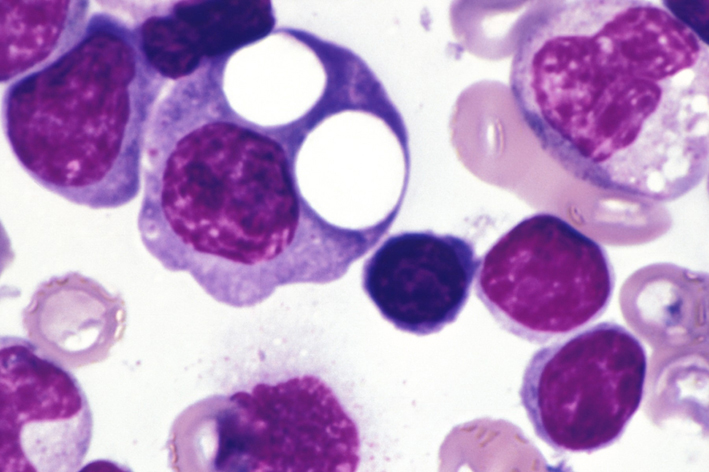
A hypoproliferative anemia is the most common laboratory finding, followed by thrombocytopenia. Lymphocytosis can be present. While serum protein electrophoresis (SPEP) is typically normal, immunofixation (IF) detects monoclonal mu IgH in polymers of different sizes without an associated light chain.(Tamura et al., 2003; Maisnar et al., 2008) Biclonal gammopathy with the presence of a second intact IgM has been reported.(Wahner-Roedler and Kyle, 1992) Cytologic examination of bone marrow aspirate smears typically shows plasma cells with prominent cytoplasmic vacuoles, and small, round lymphocytes. Upon immunophenotypic analysis, pathologic cells are typically positive for CD19, CD20, CD38 and cytoplasmic IgM, but lack light chain expression. However, dim expression of CD5 and kappa light chain has been rarely reported.(Bianchi et al., 2014)
Phenotype stem cell origin
Etiology
Epidemiology
Clinics
Pathology
Treatment
Evolution
Prognosis
Genes Involved and Proteins
Article Bibliography
| Pubmed ID | Last Year | Title | Authors |
|---|---|---|---|
| 5438427 | 1970 | A new variant of heavy-chain disease (mu-chain disease). | Ballard HS et al |
| 24683718 | 2014 | The heavy chain diseases: clinical and pathologic features. | Bianchi G et al |
| 10626151 | 1999 | Heavy-chain diseases. | Fermand JP et al |
| 4193528 | 1970 | Heavy chain disease of the gamma (gamma M) type: report of the first case. | Forte FA et al |
| 9482908 | 1998 | Frequent occurrence of deletions and duplications during somatic hypermutation: implications for oncogene translocations and heavy chain disease. | Goossens T et al |
| 9401282 | 1997 | A case of mu-heavy chain disease: combined features of mu-chain disease and macroglobulinemia. | Iwasaki T et al |
| 15203869 | 2004 | Mu-heavy chain disease associated with systemic amyloidosis. | Kinoshita K et al |
| 17050207 | 2006 | Multiple extranodal tumors in mu-heavy chain disease. | Maeda A et al |
| 18036562 | 2008 | Capillary immunotyping electrophoresis and high resolution two-dimensional electrophoresis for the detection of mu-heavy chain disease. | Maisnar V et al |
| 18434654 | 2008 | Case records of the Massachusetts General Hospital. Case 13-2008. A 46-year-old man with rheumatoid arthritis and lymphadenopathy. | Munshi NC et al |
| 14560651 | 2003 | [Immunochemical properties of free mu-chain protein in a patient with mu-heavy chain disease]. | Tamura A et al |
| 16026747 | 2005 | Heavy chain diseases. | Wahner-Roedler DL et al |
| 9858149 | 1998 | A case of mu heavy-chain disease associated with hyperglobulinemia, anemia, and a positive Coombs test. | Witzens M et al |
| 12057070 | 2002 | Heavy chain disease. | Witzig TE et al |
| 15005347 | 2004 | Successful treatment of mu-heavy chain disease with fludarabine monophosphate: a case report. | Yanai M et al |
Summary
Note
Citation
Kenneth C. Anderson ; Giada Bianchi
Mu heavy chain disease
Atlas Genet Cytogenet Oncol Haematol. 2016-06-01
Online version: http://atlasgeneticsoncology.org/haematological/1740/new-content/gene-explorer/
