der(20)t(1;20)(q12-21;p13) in hematological malignances
2018-01-01 Lubomir Mitev, MD , Lilya Grahlyova , Aselina Asenova Affiliation1.Military Medical Academy, Department of Cytogenetics and Molecular Biology, Sofia, Bulgaria, [email protected]
Abstract
Review on der(20)t(1;20)(q12-21;p13), with data on clinics, and the genes involved.
Clinics and Pathology
Disease
Multiple myeloma (MM)
Epidemiology
Der(20)t(1;20)(q12-21;p13) is found in 7 cases (0.4% of all MM cases with an abnormal karyotype) (Yoshida et al., 2013; Keung et al., 1998; Sawyer et al., 2014;Taniwaki et al., 1994; Fiedler et al., 1992; Mohamed et al., 2007; Sawyer et al., 1998). The sex ratio is M:F=1.3:1 and the anomaly has been observed only in older patients (5 cases documented: average age 64.4 years; range 40-80).
Cytogenetics
All cases are with complex karyotypes. In 5 cases der(20)t(1;20)(q12-21;p13) is present in hyperdiploid and in 2 in hypodiploid karyotype. Myeloma associated anomalies are observed in all patients: chromosome 1 abnormalities (4 cases: 3 with deletions of 1p and 1 with deletions of 1q), -13 (3 cases), 13q- (1 case) and t(14;16)(q32q23) (1 case). In one case two copies of der(20)t(1;20) are found and in one der(20)t(1;20) is accompanied with the 1q21 rearrangement der(19)t(1;19)(q21;p13). In 3 cases the sex chromosomes are involved in numerical aberration: two with -X and one with -Y
Disease
Other lymphoproliferative disorders
Epidemiology
Two cases are reported: one with diffuse large B-cell lymphoma (48 year-old female) (Levine et al., 1985) and one with acute lymphoblastic leukemia/lymphoblastic lymphoma (ALL/LL) (50 year-old male) (Wan et al., 2004).
Cytogenetics
Both cases showed complex karyotypes with multiple unbalanced anomalies. In the case of ALL the anomaly is associated with t(9;22) and other 1q12-21 translocations including der(11)t(1;11)(q12;q25), der(15)t(1;15)(q12;p13) and der(19)t(1;19)(q12;p13).
Disease
Myeloproliferative disorders
Epidemiology
Three cases are reported: one with chronic myeloproliferative disorder, NOS (CMD) (41 year-old female) (LAbbate et al., 2015), one with acute megakaryoblastic leukemia (FAB type M7) (1 year-old female) (Yoshida et al., 2013) and one with long standing (survival of the patient - 11 years) myelodysplastic syndrome (MDS) (58 year-old male) (Mitev et al., 2017).
Cytogenetics
Der(20)t(1;20) is found in complex karyotypes in the cases with CMD and AML and as a sole anomaly in the case with MDS. The case with AML-M7 is associated with Down syndrome and constitutional +21. In the case of MDS the breakpoint in the derivative 20p is located in the telomere region.
Note
The mechanisms underlying the formation of the unbalanced 1q translocations including der(20)t(1;20)(q12-21;p13) are not fully clarified. It has been postulated that the 1q gains in some solid tumors and oncohematological disorders are linked to the hypomethylation of the pericentromeric 1q12 region. (Wong et al.,2001 ; Ehrlich et al., 2003 ; Quac et al., 1999 ; Sawyer et al.,2015). Sawyer et al. 1998 demonstrated that the pericentromeric 1qh decondensation induced by hypomethylation initiates the creation of a triradial chromosomes in myeloma cells composed of 1p and two copies of 1q (one of them is an extra copy) joined by 1q12 region and proposed that a partial endoreduplication of 1q as result of the 1qh decondensation possibly generated the extra copies of 1q in MM cases with jumping translocations. On the other hand, based on the lack of uniparental disomy of chromosome 1 in cases with der(19)t(1;19)(q23;p13) and ALL, Paulsson et al. 2005 excluded the possibility that the unbalanced translocation may originate from balanced t(1;19) through loss of the derivative chromosome 1 followed by duplication of the normal homologue. The authors assumed that der(19) may arise from an initial trisomy 1 followed by t(1;19) and loss of the derivative chromosome 1. It is interesting to note that in the described case of MDS with isolated der(20)t(1;20)(q21;p13) and telomere involvement of 20p (Mitev et al., 2017) were found two cells without derivative chromosome 20 but with polysomy of chromosome 1 (one with trisomy and one with tetrasomy) (Fig 2A). The additional FISH examinations of the patients bone marrow (BM) (unpublished data) with DNA specific probes for 1q21 and 1p36 revealed that in the patients BM exists low frequent clone (18/200) with polysomy of chromosome 1 (12 cells with trisomy and 6 with tetrasomy of chromosome 1) (Fig. 2B). FISH experiments with DNA specific probes for 20q11 and 20q12 detected only 3 cells with trisomy of chromosome 20 (200 cells analysed) which suggested that most of the cells with polysomy of chromosome 1 are not polyploid (3n or 4n). The assumption of Paulsson et al. 2005 as well as the presented findings showed that the extra copy of 1q in the unbalanced 1q translocations may originate not only as a result of a partial endoreduplication of 1q but also as a result of 1q rearrangement of an initial polysomy of chromosome 1.
Cytogenetics
Cytogenetics morphological
The anomaly is unbalanced and resulted in a gain of the segment 1q12-21->qter and a loss of the segment 20p13->pter (partial deletion of 20p).Therefore, an increased dosage of gene or genes at 1q12-21->qter and/or loss of tumor suppressor gene at 20p13->pter may be is important for the pathogenesis of the disorders with der(20)t(1;20)(q12-21;p13). In the case in which the breakpoint in 20p is located in the telomere region the translocation did not result in losses of coding DNA and their molecular pathogenesis is possibly linked only to the gain of 1q12-21->qter.

Figure 2: Fig2 A Metaphase fluorescence in situ hybridization with arm specific probes for 20p (red) and 1q (green) (Kreatech Diagnostic, Leica) showing tetrasomy of chromosome 1. Fig.2B Interphase fluorescence in situ hybridization with locus specific probes for 1q21 and 1p36 (Kreatech Diagnostic, Leica) demonstrating the presence of a cell with 3 copies of chromosome 1 (3 red and 3 green signals) and another cell carrying der(20)t(1;20)(2 red and 3 green signals)(Lubomir Mitev, Lilya Grachlyova, Aselina Asenova).
Genes Involved and Proteins
Article Bibliography
| Pubmed ID | Last Year | Title | Authors |
|---|---|---|---|
| 12606126 | 2003 | Satellite DNA hypomethylation in karyotyped Wilms tumors. | Ehrlich M et al |
| 1520625 | 1992 | Comparison of chromosome analysis and BCL-1 rearrangement in a series of patients with multiple myeloma. | Fiedler W et al |
| 9797778 | 1998 | Unusual presentation of multiple myeloma with "jumping translocation" involving 1q21. A case report and review of the literature. | Keung YK et al |
| 26671595 | 2015 | t(15;21) translocations leading to the concurrent downregulation of RUNX1 and its transcription factor partner genes SIN3A and TCF12 in myeloid disorders. | L'Abbate A et al |
| 4063528 | 1985 | There are differences in cytogenetic abnormalities among histologic subtypes of the non-Hodgkin's lymphomas. | Levine EG et al |
| 17654686 | 2007 | Chromosome aberrations in a series of 120 multiple myeloma cases with abnormal karyotypes. | Mohamed AN et al |
| 15543624 | 2005 | Formation of der(19)t(1;19)(q23;p13) in acute lymphoblastic leukemia. | Paulsson K et al |
| 9973957 | 1999 | Frequent hypomethylation in Wilms tumors of pericentromeric DNA in chromosomes 1 and 16. | Qu GZ et al |
| 25943786 | 2015 | Evidence of an epigenetic origin for high-risk 1q21 copy number aberrations in multiple myeloma. | Sawyer JR et al |
| 7919347 | 1994 | Nonrandom chromosomal rearrangements of 14q32.3 and 19p13.3 and preferential deletion of 1p in 21 patients with multiple myeloma and plasma cell leukemia. | Taniwaki M et al |
| 11734326 | 2001 | Cytogenetic biclonality in polycythemia vera: unusual and unrelated clones. | Wan TS et al |
| 11485905 | 2001 | Hypomethylation of chromosome 1 heterochromatin DNA correlates with q-arm copy gain in human hepatocellular carcinoma. | Wong N et al |
| 24056718 | 2013 | The landscape of somatic mutations in Down syndrome-related myeloid disorders. | Yoshida K et al |
Summary
Note
der(20)t(1;20)(q12-21;p13) is an extremely rare structural anomaly found only in 11 cases with oncohematological disorder: 8 cases with lymphoid and 3 cases with myeloid malignancies. The anomaly belongs to the group of unbalanced 1q12-21 translocations described mostly as second rearrangements in a variety of oncohematological desorders (Zamecnicova A and Al, Bachae S, 2013). As a result of der(20)t(1;20) a derivative chromosome is formed composed of chromosome 20 and an additional segment of the long arm of chromosome 1 - 1qter->1q12-21::20p13->20qter (Fig 1A and 1B).
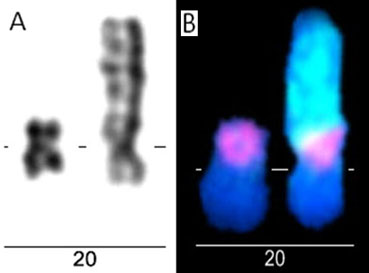
Figure 1: 1A Partial G-banded karyotype demonstrating the derivative chromosome 20. Fig.1B Fluorescence in situ hybridization with arm specific probes for 20p and 1q (Kreatech Diagnostic, Leica) demonstrating the normal and derivative chromosome 20 (Lubomir Mitev, Lilya Grachlyova, Aselina Asenova).
Citation
Lubomir Mitev, MD ; Lilya Grahlyova ; Aselina Asenova
der(20)t(1;20)(q12-21;p13) in hematological malignances
Atlas Genet Cytogenet Oncol Haematol. 2018-01-01
Online version: http://atlasgeneticsoncology.org/haematological/1789/teaching-explorer/submit-meetings/gene-fusions-explorer/
