t(2;11)(p23;q12.3) EEF1G/ALK
2019-03-01 Luigi Cristiano, MSc Affiliation1.Aesthetic and medical biotechnologies research unit, Prestige, Terranuova Bracciolini, Italy; [email protected]; [email protected]
Abstract
Review on the translocation t(2;11)(p23;q12.3) EEF1G/ALK involving EEF1G (alias, eukaryotic translation elongation factor 1 gamma) gene and ALK (alias, anaplastic lymphoma kinase) gene. The novel fusion gene and correspondent chimeric protein were observed in pediatric anaplastic large cell lymphoma (ALCL) patients. EEF1G/ALK translocation carries an unfavorable prognosis.
Clinics and Pathology
Note
Anaplastic lymphoma kinase (ALK)-positive anaplastic large cell lymphoma, alias ALK+ ALCL, is a T-cell peripheral lymphoma characterized by many genomic aberrations and chromosomal rearrangements that make the cellular karyotype much complicated. It consists of a proliferation of usually large, pleomorphic, T-lymphocytes with strong expression of the cytokine receptor CD30 (CD30+), with abundant cytoplasm and the presence of some translocation and rearrangements involving the ALK gene with 2p23/ALK aberrations well know, such as the classic t(2;5)(p23;q35) NPM1/ALK rearrangement, and others less know. These multiple partner fusion genes are transcribed and also translated in several fusion protein variants (Palacios et al., 2017; van der Krogt et al., 2017; van Krieken, 2017; Stein et al., 2000; http://codes.iarc.fr).
Epidemiology
ALK+ ALCL predominantly affects young male patients and in one study 28 pediatric patients were tested for the presence of the chimeric EEF1G/ALK fusion gene and is emerged that only four of them (4/28, i.e. 14,29%) shown a different variant by common NPM1/ALK rearrangement (that represent instead 85,71% of samples) and only two of whom (2/28, i.e. 7,14%) shown the chimeric EEF1G/ALK fusion (Palacios et al., 2017; Stein et al., 2000).
Prognosis
The prognosis is very poor. In fact, patients expressing EEF1G/ALK fusion gene have shown an unfavorable clinical course with fatal outcome.
Cytogenetics
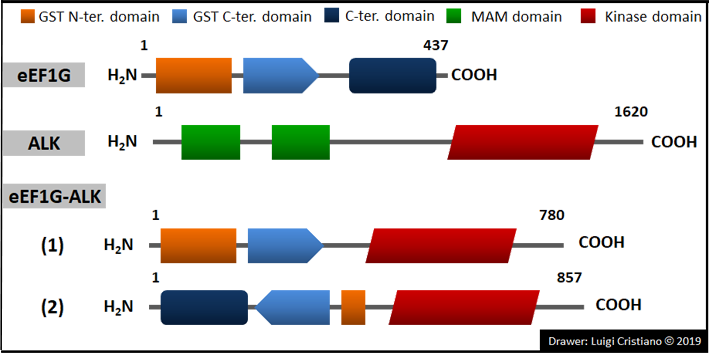
Figure.1 Schematic representation of the eEF1G, ALK and eEF1G/ALK proteins. In the picture are shown the subcellular localization of the three proteins and their main role. The native ALK protein is a transmembrane receptor ligand-dependent while the fusion of its kinase domain with a portion of eEF1G protein brings the kinase domain to be cytoplasmic, ligand-independent and constitutively active (for more details see the text).
Genes Involved and Proteins
Gene name
Location
11q12.3
Note
Alias: Eukaryotic translation elongation factor 1 gamma, EF1G, GIG35, PRO1608, EEF1γ, EEF1Bγ, EEF-1B Gamma, EF-1-Gamma, Elongation Factor 1-Gamma, Translation Elongation Factor EEF-1 Gamma Chain, Pancreatic Tumor-Related Protein
Eukaryotic translation elongation factor 1 gamma, alias eEF1G, is a protein that play a main function in the elongation step of translation process but also cover numerous moonlighting roles. It is expressed ubiquitously in human tissues and often it is found over-expressed in human cancer samples and cancer cell lines.
Eukaryotic translation elongation factor 1 gamma, alias eEF1G, is a protein that play a main function in the elongation step of translation process but also cover numerous moonlighting roles. It is expressed ubiquitously in human tissues and often it is found over-expressed in human cancer samples and cancer cell lines.
Dna rna description
EEF1G (Eukaryotic Translation Elongation Factor 1 Gamma) is a protein coding gene with 10 exons and a length of 14388 bp (RefSeq NC_000011.10). Its transcript is 1446 bp long (RefSeq NM_001404.5) but was observed five splice variants and nine pseudogenes probably originated by retrotransposition.
Protein description
eEF1G is formed by 437 amino acids (RefSeq NP_001395.1), it has a molecular weight of 50.12 kDa and it is a multi-domain protein which consist of three main domains: from the amino to carboxyl half terminal there are a glutathione S-transferase (GST)-like N-terminus domain (NT-eEF1G), a glutathione S-transferase (GST)-like C-terminus domain (CT-eEF1G) and a conserved C-terminal domain (CD-eEF1G)(Achilonu et al.,2014).
eEF1G is a subunit of the eukaryotic elongation factor-1 complex named eEF1H that result by the aggregation of different proteins that play a central role in peptide elongation during eukaryotic protein biosynthesis. The physiological role of eEF1G is still not well defined, however eEF1G seems to be necessary for guarantee the stability to entire eEF1H complex and to stimulate the activity of the eEF1B2 subunit during the elongation step of translation (Mansilla et al., 2002). However, are known that it has multiple non-canonical roles (moonlighting roles) inside the cell such as the interaction with cytoskeleton and binding with various mRNA and several proteins, comprise membrane-bound receptors (Coumans et al., 2014; Corbi et al., 2010; Cho et al., 2003).
eEF1G is a subunit of the eukaryotic elongation factor-1 complex named eEF1H that result by the aggregation of different proteins that play a central role in peptide elongation during eukaryotic protein biosynthesis. The physiological role of eEF1G is still not well defined, however eEF1G seems to be necessary for guarantee the stability to entire eEF1H complex and to stimulate the activity of the eEF1B2 subunit during the elongation step of translation (Mansilla et al., 2002). However, are known that it has multiple non-canonical roles (moonlighting roles) inside the cell such as the interaction with cytoskeleton and binding with various mRNA and several proteins, comprise membrane-bound receptors (Coumans et al., 2014; Corbi et al., 2010; Cho et al., 2003).
Gene name
Location
2p23.2
Note
Alias: anaplastic lymphoma receptor tyrosine kinase, anaplastic lymphoma kinase (Ki-1), CD246, NBLST3
Dna rna description
ALK (anaplastic lymphoma kinase) gene is composed by 29 exons (RefSeq NC_000002) and its transcript is 6240 nt long (RefSeq NM_004304).
Protein description
ALK is formed by 1620 amino acids (RefSeq NP_004295) and it has a molecular weight of 177 kDa. It is a transmembrane receptor tyrosine kinase of the insulin receptor superfamily and it is composed of several domains, i.e. an extracellular region (with meprin, A-5 protein, and receptor protein-tyrosine phosphatase mu domains, alias MAM domains), a transmembrane domain and an intracellular region with a tyrosine kinase domain (Allouche M, 2010).
Protein description
The native ALK protein is found to be expressed during the development and at a weaker level in adult central and peripheral nervous system, but it cannot be detected in hematopoietic cells (Iwahara et al., 1997). The function of ALK receptor is poorly understood but it is supposed that it may has a role in the development and maintenance of central and peripheral nervous system (Allouche M, 2010; Allouche M, 2007).
Result of the Chromosomal Anomaly
Description
It was observed in some ALK+ ALCL pediatric patients the presence of an in-frame fusion transcript between an intronic region among exons 8 and 9 of EEF1G with the middle part of exon 20 of ALK. The resulting novel fusion chimeric gene 5EEF1G/3ALK was revealed to be a coding-gene (van der Krogt et al., 2017). On the contrary, other authors found EEF1G/ALK transcripts in a tumor sample originated by the genomic fusion of the exon 6 of EEF1G with the exon 20 of ALK. The presence of the chimera EEF1G/ALK was not observed in vitro in the corresponding cancer SupM2 (NPM1/ALK positive ALCL) cell line (Palacios et al., 2017).
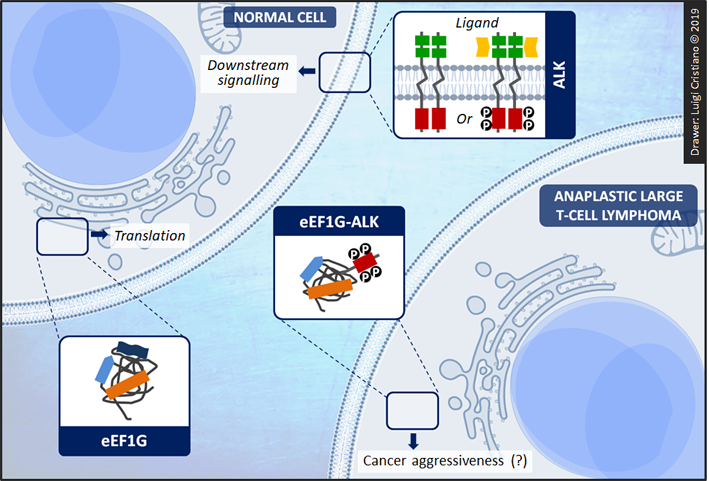
Figure.2 Schematic representation of the eEF1G, ALK and eEF1G/ALK protein structures. In the upper side of the image there are the structures with also the main structural domains both eEF1G protein and ALK protein. In the bottom side of the image are reported two proposed structures by different authors: (1) eEF1G/ALK fusion protein with complete GST C-terminal domain and GST N-terminal domain of eEF1G fused with the kinase domain of ALK (Palacios et al., 2017) and (2) eEF1G/ALK fusion protein with complete C-terminal domain, GST C-terminal domain and with a partial GST N-terminal domain of eEF1G fused with the kinase domain of ALK (van der Krogt et al., 2017) (reworked by Palacios et al., 2017; van der Krogt et al., 2017).
Description
The EEF1G/ALK fusion gene encodes a chimeric protein of 780 amino acids with a molecular mass of 87 kDa. Its amino acidic structure include the N-terminal GST-like domain of EEF1G (residues 1-225) and the intracellular tail containing the protein tyrosine kinase (PTK) domain of ALK (resides 226-780) (Palacios et al., 2017). In another study by other authors the chimeric eEF1G/ALK protein was described with some structural differences and it was reported that it is 857 amino acids long (van der Krogt et al., 2017).
Description
The chimeric protein eEF1G/ALK is a constitutively active protein as demonstrated by analysis and this is due to its own probable homodimerization followed by the kinase activation (Palacios et al., 2017; van der Krogt et al., 2017; van Krieken, 2017; Allouche M, 2007). Furthermore, was revealed that expression of EEF1G/ALK can give a cytokine-independent growth to the cancer cells. However, its biological activities, its oncogenic potential and its roles in proliferation and cancer aggressiveness are still poor understood although it is supposed that eEF1G-ALK fusion protein has a cell-transforming activity due to the activation of ALK kinase by the GST domain of EEF1G (Palacios et al., 2017).
Expression localisation
EEF1G/ALK was found only in the cytoplasm (Palacios et al., 2017).
Highly cited references
| Pubmed ID | Year | Title | Citations |
|---|---|---|---|
| 32064735 | 2020 | Gene rearrangements in consecutive series of pediatric inflammatory myofibroblastic tumors. | 0 |
Article Bibliography
| Pubmed ID | Last Year | Title | Authors |
|---|---|---|---|
| 24732582 | 2014 | Purification and characterisation of recombinant human eukaryotic elongation factor 1 gamma. | Achilonu I et al |
| 17611412 | 2007 | ALK is a novel dependence receptor: potential implications in development and cancer. | Allouche M et al |
| 9121481 | 1997 | Role of the nucleophosmin (NPM) portion of the non-Hodgkin's lymphoma-associated NPM-anaplastic lymphoma kinase fusion protein in oncogenesis. | Bischof D et al |
| 14519448 | 2003 | Direct and biochemical interaction between dopamine D3 receptor and elongation factor-1Bbetagamma. | Cho DI et al |
| 21217813 | 2010 | The eEF1γ subunit contacts RNA polymerase II and binds vimentin promoter region. | Corbi N et al |
| 23899627 | 2014 | Green fluorescent protein expression triggers proteome changes in breast cancer cells. | Coumans JV et al |
| 24060861 | 2013 | Mechanistic insight into ALK receptor tyrosine kinase in human cancer biology. | Hallberg B et al |
| 9053841 | 1997 | Molecular characterization of ALK, a receptor tyrosine kinase expressed specifically in the nervous system. | Iwahara T et al |
| 11985494 | 2002 | Mapping the human translation elongation factor eEF1H complex using the yeast two-hybrid system. | Mansilla F et al |
| 7824924 | 1995 | Fusion of a kinase gene, ALK, to a nucleolar protein gene, NPM, in non-Hodgkin's lymphoma. | Morris SW et al |
| 27840423 | 2017 | Novel ALK fusion in anaplastic large cell lymphoma involving EEF1G, a subunit of the eukaryotic elongation factor-1 complex. | Palacios G et al |
| 11090048 | 2000 | CD30(+) anaplastic large cell lymphoma: a review of its histopathologic, genetic, and clinical features. | Stein H et al |
| 29057015 | 2017 | New developments in the pathology of malignant lymphoma: a review of the literature published from May to August 2017. | van Krieken JH et al |
| 28659337 | 2017 | Anaplastic lymphoma kinase-positive anaplastic large cell lymphoma with the variant RNF213-, ATIC- and TPM3-ALK fusions is characterized by copy number gain of the rearranged ALK gene. | van der Krogt JA et al |
Summary
Fusion gene
EEF1G/ALK
Citation
Luigi Cristiano, MSc
t(2;11)(p23;q12.3) EEF1G/ALK
Atlas Genet Cytogenet Oncol Haematol. 2019-03-01
Online version: http://atlasgeneticsoncology.org/haematological/1841/t(2
