t(4;14)(p16;q32) IGH/FGFR3 and WHSC1
2005-05-01 Franck Viguié Affiliation1.Laboratoire de Cytogenetique - Service dHematologie Biologique, Hopital Hotel-Dieu - 75181 Paris Cedex 04, France
2.Unité INSERM 393, Hopital Necker-Enfants Malades, 149 rue de Sèvres 75743, Paris Cedex 15, France (JB)
3.Unité INSERM 393, Hopital Necker-Enfants Malades, 149 rue de Sèvres 75743, Paris Cedex 15, France (JB)
Clinics and Pathology
Disease
Found in plasma cell leukaemia, multiple myeloma, plasmacytoma and monoclonal gammopathy of unknown significance (MGUS)
Phenotype stem cell origin
Malignant plasma cells have the phenotype of mature terminally differenciated B-cells; there origin may be a pluripotent stem cell.
Epidemiology
Poorly described before FISH, quite karyotypically undetectable: found initially in cell lines, it represents the second more frequent IgH associated rearrangement, after t(11;14); detected by interphase FISH or RT-PCR in 25% MM cell lines, 15-20% primary MM and 0-10% MGUS lines; might be frequent but karyotypically undetected.
Clinics
Found in MM cases with unfavorable prognosis, even in patients treated with high dose chemotherapy.
Cytogenetics
Cytogenetics morphological
May be undetectable (telomere-telomere translocation).
Cytogenetics molecular
Therefore molecular probes are indicated, and FISH is relevant.
Additional anomalies
Hypodiploid karyotype and -13 / 13q- in major part of cases.
Genes Involved and Proteins
Gene name
FGFR3 (Fibroblast Growth Factor Receptor 3)
Location
4p16.3
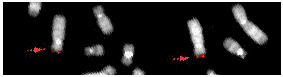
c-FGFR3 (4p16.3) in normal cells: PAC 884J17 - Courtesy Mariano Rocchi, Resources for Molecular Cytogenetics.
Protein description
Member of the tyrosine-kinase FGF receptor family, contains an extracellular domain with Ig-like loops, a transmembrane domain, and intracellular tyrosine kinase domains; localisation: plasma membrane; tyrosine kinase receptor; role in signal transduction, activates multiple signaling pathways regulating cell proliferation and differentiation; constitutional point mutations resulting in ligand-independent activation, are responsible of familial dominant achondroplasia / thanatophoric dwarfism.
Gene name
IGH (Immunoglobulin Heavy)
Location
14q32.33
Gene name
Location
4p16.3
Dna rna description
90 kb, 25 exons, 5 - 3 centromeric orientation - complex alternative splicing.
Protein description
136 KDa, 4 domains: PWWP domain (proline-tryptophan-tryptophan-prolin motif), HMG box (high mobility group), PHD-type (plant-homeodomain) zinc finger domain and SET (suppressor of variegation enhancer of zeste and Trithorax) domain. One full length 1365 aa isoenzyme and 4 possible truncated variants. Transcription factor, ubiquitously expressed but preferentially in growing embryonic tissues. Chromatin remodelling agent, regulates histones methylation.
Protein description
Constitutional deletion of one copy is responsible for Wolf-Hirschhorn syndrom by haplo-insufficiency.
Result of the Chromosomal Anomaly
Description
4p16.3 breakpoint in a 110 kb region between MMSET (centromeric) within the 5 introns, and FGFR3 (telomeric).
14q32 breakpoint in the IgH switch region involving JH + constant region.
Two fusions generated, FGFR3 brought under the influence of the Ig gene enhancer Ea on der(14); MMSET under the influence of enhancer Eµ on der(4). Both FGFR3 and MMSET genes are deregulated by the translocation and a IgH-MMSET fusion transcript, detectable by RT-PCR, is generated.No IgH-FGFR3 fusion protein, but promoter exchange between both partner genes; however, somatic mutations similar to what has been found in thanatophoric dwarfism have been identified in some cases; they may also contribute to abnormal FGFR3 activation.
According to the variable breakpoint inside MMSET gene, the translocation may generate either a full length MMSET protein or a NH2-terminal truncated one.
14q32 breakpoint in the IgH switch region involving JH + constant region.
Two fusions generated, FGFR3 brought under the influence of the Ig gene enhancer Ea on der(14); MMSET under the influence of enhancer Eµ on der(4). Both FGFR3 and MMSET genes are deregulated by the translocation and a IgH-MMSET fusion transcript, detectable by RT-PCR, is generated.No IgH-FGFR3 fusion protein, but promoter exchange between both partner genes; however, somatic mutations similar to what has been found in thanatophoric dwarfism have been identified in some cases; they may also contribute to abnormal FGFR3 activation.
According to the variable breakpoint inside MMSET gene, the translocation may generate either a full length MMSET protein or a NH2-terminal truncated one.
Oncogenesis
Overexpression and activation of FGFR3 provides an oncogenic signal enhancing cell proliferation and survival. The functional consequences of MMSET deregulation are not completely investigated. All t(4;14) positive cases express MMSET whereas 30% lack FGFR3 expression, sometimes correlated with loss of der(14), which tends to demonstrate that MMSET dysregulation should be the crucial oncogenic event.
Highly cited references
| Pubmed ID | Year | Title | Citations |
|---|---|---|---|
| 37048102 | 2023 | The TT Genotype of the KIAA1524 rs2278911 Polymorphism Is Associated with Poor Prognosis in Multiple Myeloma. | 77 |
| 36882509 | 2023 | Imaging flow cytometry-based multiplex FISH for three IGH translocations in multiple myeloma. | 42 |
| 23627452 | 2013 | Plasma cell enrichment enhances detection of high-risk cytogenomic abnormalities by fluorescence in situ hybridization and improves risk stratification of patients with plasma cell neoplasms. | 33 |
| 36362752 | 2022 | Dual Negativity of CD56 and CD117 Links to Unfavorable Cytogenetic Abnormalities and Predicts Poor Prognosis in Multiple Myeloma. | 28 |
| 21120205 | 2010 | Clinical utility of FISH analysis in addition to G-banded karyotype in hematologic malignancies and proposal of a practical approach. | 27 |
| 27532015 | 2016 | Target fluorescence in-situ hybridization (Target FISH) for plasma cell enrichment in myeloma. | 23 |
| 39134488 | 2024 | [Cytoplasmic light-chain immunofluorescence combined with FISH in bone marrow smears to detect cytogenetic abnormalities in multiple myeloma]. | 19 |
| 36699422 | 2023 | Clinical Features and Outcomes of Patients with Double-Hit/Triple-Hit Multiple Myeloma Detected at Relapse. | 15 |
| 32760648 | 2020 | Near tetrapoloid karyotype with translocation t(11;14) in a Moroccan patient with amyloid light-chain amyloidosis and multiple myeloma. | 15 |
| 31240468 | 2019 | Multiple myeloma with IGH-FGFR3 rearrangement progressing as testicular plasmacytoma during carfilzomib treatment. | 0 |
| 17498561 | 2007 | Simultaneous translocations of FGFR3/MMSET and CCND1 into two different IGH alleles in multiple myeloma: lack of concurrent activation of both proto-oncogenes. | 0 |
| 19837276 | 2009 | FGFR3 amplification in the absence of IGH@-FGFR3 fusion t(4;14) in myeloma. | 0 |
| 37658775 | 2024 | Superior detection rate of plasma cell FISH using FACS-FISH. | 0 |
| 36113967 | 2023 | IGH cytogenetic abnormalities can be detected in multiple myeloma by imaging flow cytometry. | 0 |
| 35657404 | 2022 | Plasmablastic myeloma in Taiwan frequently presents with extramedullary and extranodal mass mimicking plasmablastic lymphoma. | 0 |
| 35248783 | 2022 | Clinical characteristics and survival outcomes of newly diagnosed multiple myeloma patients presenting with extramedullary disease: A retrospective study. | 0 |
| 32447782 | 2020 | High-risk cytogenetics in multiple myeloma: Further scrutiny of deletions within the IGH gene region enhances risk stratification. | 0 |
| 38160484 | 2024 | Clinicopathological and genetic landscape of plasmablastic lymphoma in Taiwan. | 0 |
| 35422411 | 2022 | Presentation and Impact of Double and Triple hit Cytogenetics in Patients With Multiple Myeloma in the Real World. | 0 |
| 38206369 | 2024 | 1q21+ is associated with poor prognosis in newly diagnosed multiple myeloma patients with extramedullary disease: a retrospective study. | 0 |
| 36657019 | 2023 | Identification of long noncoding RNA NEAT1 as a key gene involved in the extramedullary disease of multiple myeloma by bioinformatics analysis. | 0 |
| 22489023 | 2012 | Differential positioning and close spatial proximity of translocation-prone genes in nonmalignant B-cells from multiple myeloma patients. | 0 |
| 17704743 | 2007 | Molecular cytogenetic aberrations in patients with multiple myeloma studied by interphase fluorescence in situ hybridization. | 0 |
| 9865713 | 1998 | High incidence of translocations t(11;14)(q13;q32) and t(4;14)(p16;q32) in patients with plasma cell malignancies. | 0 |
| 21611837 | 2012 | Fluorescence in situ hybridization analysis of chromosome aberrations in 60 Chinese patients with multiple myeloma. | 0 |
| 24496825 | 2014 | Impact of C-Myc gene-related aberrations in newly diagnosed myeloma with bortezomib/dexamethasone therapy. | 0 |
| 28641640 | 2017 | [Application of CD138 Immunomagnetic Sorting Myeloma Cells Combined with Fluorescence in Situ Hybridization for Detecting Cytogenetic Abnormalities of Multiple Myeloma]. | 0 |
| 30295256 | 2018 | [Detection of the Cytogenetic Aberrations in Multiple Myeloma by Using Microrray Comparative Genomic Hybridization]. | 0 |
| 21156229 | 2010 | Correlation of cytomorphology, immunophenotyping, and interphase fluorescence in situ hybridization in 381 patients with monoclonal gammopathy of undetermined significance and 301 patients with plasma cell myeloma. | 0 |
| 18284415 | 2009 | Molecular cytogenetic aberrations in 21 Chinese patients with plasma cell leukemia. | 0 |
| 29332870 | 2017 | [Autologous peripheral blood stem cell transplantation for double-refractory myeloma with K-RAS and N-RAS mutations]. | 0 |
| 20805703 | 2010 | [A case of central nervous system myelomatosis with complex chromosome aberrations]. | 0 |
| 26524036 | 2015 | [Detection of Molecular Cytogenetic Aberrations by Fluorescence in Situ Hybridization in Different Bone Marrow Samples of Multiple Myeloma]. | 0 |
| 21176360 | 2010 | [Comparative study of genetic aberrations in human multiple myeloma cell lines and newly diagnosed MM by fluorescence in situ hybridization]. | 0 |
Article Bibliography
| Pubmed ID | Last Year | Title | Authors |
|---|---|---|---|
| 8943038 | 1996 | Promiscuous translocations into immunoglobulin heavy chain switch regions in multiple myeloma. | Bergsagel PL et al |
| 9787135 | 1998 | The t(4;14) translocation in myeloma dysregulates both FGFR3 and a novel gene, MMSET, resulting in IgH/MMSET hybrid transcripts. | Chesi M et al |
| 15355895 | 2004 | A global expression-based analysis of the consequences of the t(4;14) translocation in myeloma. | Dring AM et al |
| 15543617 | 2005 | Characterization of oncogene dysregulation in multiple myeloma by combined FISH and DNA microarray analyses. | Fabris S et al |
| 10397739 | 1999 | Detection of t(4;14)(p16.3;q32) chromosomal translocation in multiple myeloma by double-color fluorescent in situ hybridization. | Finelli P et al |
| 10945609 | 2000 | Detection of t(4;14)(p16.3;q32) chromosomal translocation in multiple myeloma by reverse transcription-polymerase chain reaction analysis of IGH-MMSET fusion transcripts. | Malgeri U et al |
| 9354676 | 1997 | A novel chromosomal translocation t(4; 14)(p16.3; q32) in multiple myeloma involves the fibroblast growth-factor receptor 3 gene. | Richelda R et al |
| 12433679 | 2003 | A subset of multiple myeloma harboring the t(4;14)(p16;q32) translocation lacks FGFR3 expression but maintains an IGH/MMSET fusion transcript. | Santra M et al |
Summary
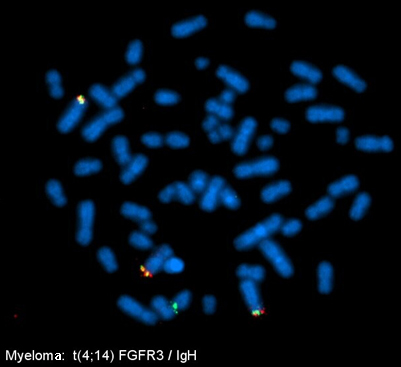
t(4;14)(p16;q32) FISH - Courtesy Hossein Mossafa.
Citation
Franck Viguié
t(4;14)(p16;q32) IGH/FGFR3 and WHSC1
Atlas Genet Cytogenet Oncol Haematol. 2005-05-01
Online version: http://atlasgeneticsoncology.org/haematological/2059/t(4
Historical Card
1998-03-01 t(4;14)(p16;q32) IGH/FGFR3 and WHSC1 by Jean-Loup Huret,Jacky Bonaventure Affiliation
Unité INSERM 393, Hopital Necker-Enfants Malades, 149 rue de Sèvres 75743, Paris Cedex 15, France (JB)
