Bone: Adamantinoma
2003-01-01 Hans Marten Hazelbag , Pancras C.W. Hogendoorn Affiliation1.Dept. of Pathology, Leiden University Medical Center, L1-Q, Leiden, the Netherlands
Summary
Note
Adamantinoma of long bones is a low-grade, malignant biphasic tumor, characterized by a variety of morphological patterns, most commonly epithelial cells, surrounded by a relatively bland spindle-cell osteo-fibrous component.
Clinics and Pathology
Etiology
Cumulating evidence indicates that classic adamantinomas derive from their osteofibrous dysplasia (OFD)-like counterparts.OFD and adamantinoma show common cytogenetic abnormalities (see below), and by immunohistochemistry, it has been shown that the epithelial component of adamantinoma is directly derived from the fibrous tissue. However, clinical aggressiveness among OFD, OFD-like adamantinoma and classic adamantinoma varies considerably, and many OFD-like lesions may never progress to classic adamantinoma.
Epidemiology
Adamantinomas are rare, they comprise 0.1-0.5% of primary bone tumors. The peak incidence is in the second and third decade. The youngest age group (up to 15 years) mainly includes patients with osteofibrous dysplasia (OFD)-like adamantinoma, whereas in older patients classic adamantinomas are predominant.
Clinics
At conventional radiography, typically a well-circumscribed, central or eccentric, (multi-)lobulated osteolytic lesion is seen. Multifocality in the tibia as well as ipsilateral fibula is regularly observed. MRI is essential for pre-operative staging of the tumor and planning surgical margins. The treatment for most cases wide en-bloc resection.
Adamantinomas may display a protracted clinical behavior. Some tumors have radiologically proven to be present 30 years prior to histological diagnosis, whereas metastases may occur decades after local treatment. Recurrence rate after irradical surgery may be as high as 90%, whereas up to 25% of these patients may develop metastases.
Adamantinomas may display a protracted clinical behavior. Some tumors have radiologically proven to be present 30 years prior to histological diagnosis, whereas metastases may occur decades after local treatment. Recurrence rate after irradical surgery may be as high as 90%, whereas up to 25% of these patients may develop metastases.
Pathology
Two main subtypes of adamantinoma are recognized: OFD-like adamantinomas lack a clear histological epithelial component, and mainly consist of osteofibrous tissue, in which woven bone trabeculae are rimmed by osteoblasts. Keratin immunohistochemistry highlights individual or small aggregates of positive cells. Classic adamantinomas have abundant epithelium, which may be arranged in basaloid, tubular, squamoid, spindle-cell, of mixed differentiation. Recently, sarcomatous dedifferentiation of the epithelial component has been described.
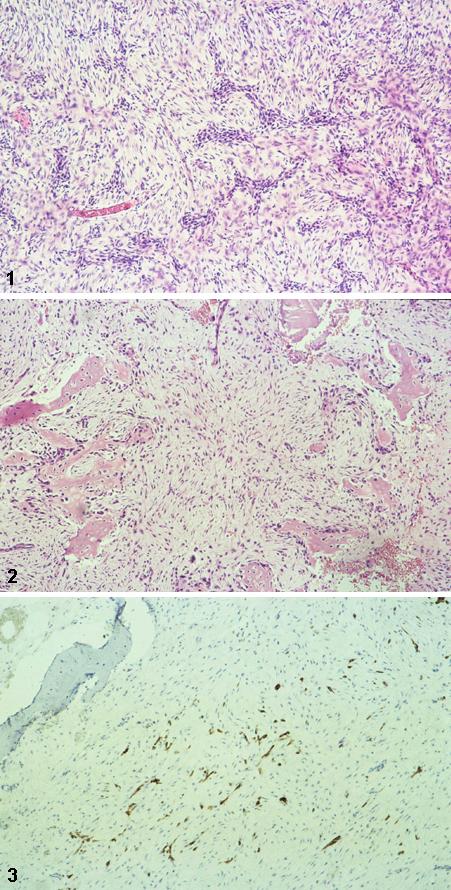
Figure 1: Classic adamantinoma, hematoxylin and eosin, x 100. Strings of epithelial cells embedded in fibrous tissue.
Figure 2: OFD-like adamantinoma, HE x 100. No epithelial cells are distinguishable in osteofibrous tissue.
Figure 3: OFD-like adamantinoma, immunohistochemistry for pankeratin, x 100. Individual keratin-positive cells (same case as figure 2).
Cytogenetics
Cytogenetics morphological
Article Bibliography
| Pubmed ID | Last Year | Title | Authors |
|---|---|---|---|
| 2017924 | 1991 | Fibrous dysplasia vs adamantinoma of the tibia: differentiation based on discriminant analysis of clinical and plain film findings. | Bloem JL et al |
| 9582523 | 1998 | Expression of growth factors and their receptors in adamantinoma of long bones and the implication for its histogenesis. | Bovée JV et al |
| 8156503 | 1994 | Clonal chromosomal abnormalities in osteofibrous dysplasia. Implications for histopathogenesis and its relationship with adamantinoma. | Bridge JA et al |
| 9989842 | 1999 | Adamantinoma-like Ewing's sarcoma: genomic confirmation, phenotypic drift. | Bridge JA et al |
| 10079250 | 1999 | Trisomies 8 and 20 characterize a subgroup of benign fibrous lesions arising in both soft tissue and bone. | Bridge JA et al |
| 2804923 | 1989 | Morphologic diversity of long bone adamantinoma. The concept of differentiated (regressing) adamantinoma and its relationship to osteofibrous dysplasia. | Czerniak B et al |
| 11592101 | 2001 | Adamantinoma-like Ewing's sarcoma and Ewing's-like adamantinoma. The t(11; 22), t(21; 22) status. | Hauben E et al |
| 11910937 | 2001 | [Adamantinoma of the long bones: an anatomo-clinical review and its relationship with osteofibrous dysplasia]. | Hazelbag HM et al |
| 7567680 | 1995 | Adamantinoma of long bones. A histopathological and immunohistochemical study of 23 cases. | Jundt G et al |
| 11227067 | 2001 | Extra copies of chromosomes 7, 8, 12, 19, and 21 are recurrent in adamantinoma. | Kanamori M et al |
| 9712421 | 1998 | Osteofibrous dysplasia-like adamantinoma of bone: a report of five cases with immunohistochemical and ultrastructural studies. | Kuruvilla G et al |
| 11107052 | 2000 | Expression of cytokeratin 1, 5, 14, 19 and transforming growth factors-beta1, beta2, beta3 in osteofibrous dysplasia and adamantinoma: A possible association of transforming growth factor-beta with basal cell phenotype promotion. | Maki M et al |
| 3514033 | 1986 | Adamantinoma of the appendicular skeleton--updated. | Moon NF et al |
| 1599019 | 1992 | Cortical osteofibrous dysplasia of long bone and its relationship to adamantinoma. A clinicopathologic study of 30 cases. | Sweet DE et al |
| 852865 | 1977 | Adamantinoma of long bone. An analysis of nine new cases with emphasis on metastasizing lesions and fibrous dysplasia-like changes. | Weiss SW et al |
Citation
Hans Marten Hazelbag ; Pancras C.W. Hogendoorn
Bone: Adamantinoma
Atlas Genet Cytogenet Oncol Haematol. 2003-01-01
Online version: http://atlasgeneticsoncology.org/solid-tumor/5154/bone-adamantinoma
